Didactic Games for Children: What They Are, Main Types, and How to Choose by Age
Short answer: a didactic game is a play activity with a clear learning purpose. It gives a child an understandable action, a brief rule, and a visible result: find a pair, name an object, sort pictures, restore a sequence, or explain a choice. A useful game is selected not only by the age printed on the box, but also by what the child can already do independently and which next step is manageable.
Didactic games are sometimes imagined as table lessons in which an adult asks questions and a child supplies correct answers. The format can be much richer. Children may move, touch pieces, negotiate with a partner, create a story, and check their own decisions. A learning purpose does not remove the playfulness when the child understands the idea, has some influence over the process, and is free to make another attempt.
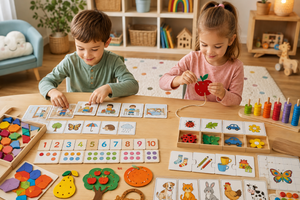
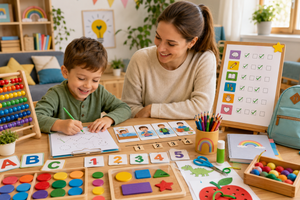
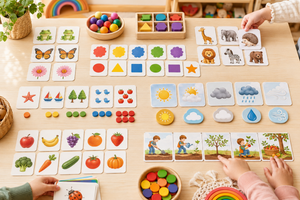
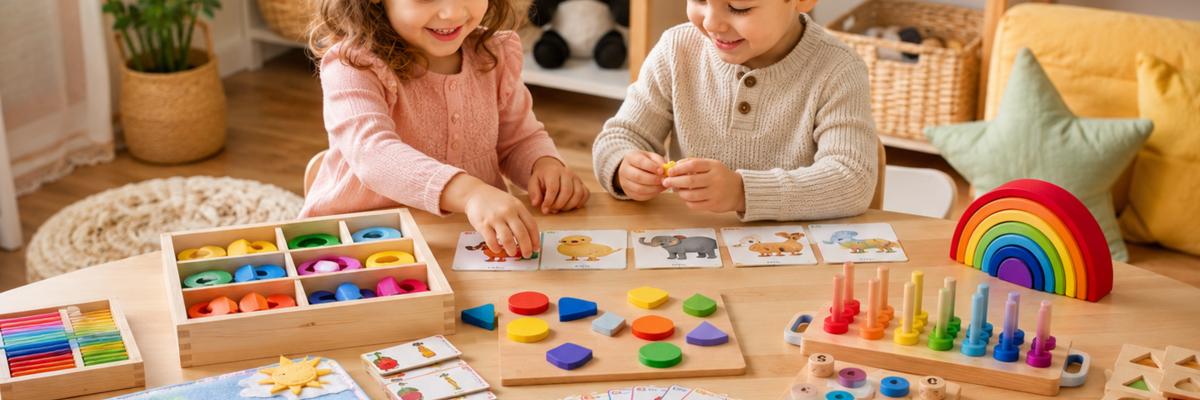
One set can support matching, sorting, memory, and storytelling. Judge a material by the meaningful actions it allows, not simply by its number of pieces.
What makes a game didactic
A didactic game brings together four elements. First is a specific learning purpose: distinguish colors, hear an initial sound, count objects, arrange events, or practise taking turns. Second is the action the child performs: searching, attaching, comparing, moving, asking, or explaining. Third is a short rule that gives the activity its boundaries. Fourth is an understandable finish, so everyone knows when a round is complete.
“Learn about animals” is too broad to guide one activity. “Find an animal that lives in water among these five pictures and tell me what helped you decide” has an action, a criterion, and a result. For a younger child, reduce the field to two contrasting pictures. An older child can find several valid answers and justify each one.
The activity does not need to be competitive. A shared mission or correcting the adult’s funny mistake often engages children better than counting points, especially while a skill is new.
The main types of didactic games
Language games help children name objects and actions, notice attributes, build sentences, retell events, and listen to a partner.
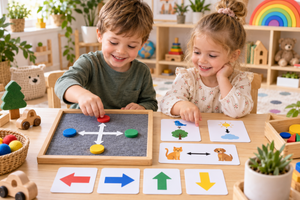
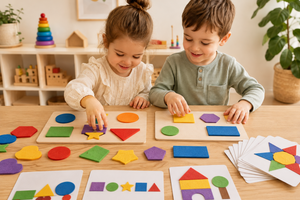
Sensory and logic games involve comparisons of color, shape, size, texture, and position. Children match an object to its shadow, sort pieces, copy a pattern, find an odd item, or continue a sequence.
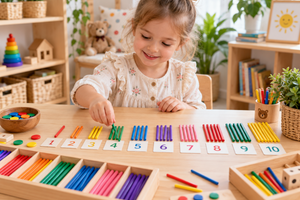
Early mathematics games connect a numeral with a real quantity and introduce more, fewer, equal, order, and simple changes in number. Preschoolers benefit from handling countable objects before being asked to work only with symbols.
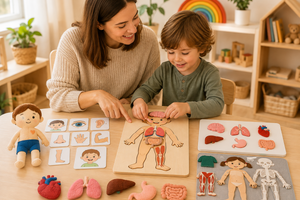
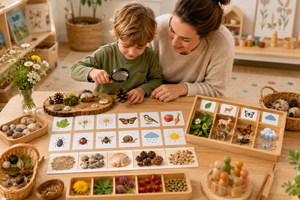
Knowledge games explore nature, transport, jobs, the body, and everyday life through classifying, questioning, and making connections.
Social and practical-life games practise taking turns, asking for help, recognizing emotions, planning routines, and choosing safe everyday actions.
How to choose by age and current readiness
Age ranges are starting points, not tests. Begin with the smallest version in which one example makes the rule visible.
|
Approximate age |
Manageable main action |
Starting amount |
One useful increase |
|
2–3 years |
Point, attach, find an identical item, or sort into two contrasting groups |
2–5 large pieces |
Add one piece or invite the child to name one feature |
|
3–4 years |
Match pairs, sort by one feature, or finish a short sentence |
5–8 pieces |
Add a third group, closer alternatives, or a brief reason |
|
4–5 years |
Restore a sequence, remember a position, or explain a choice |
8–12 pieces |
Reduce a prompt or introduce a second step |
|
5–6 years |
Follow two conditions, plan, and build a connected story |
10–16 pieces |
Offer several valid solutions and self-checking |
|
6–7 years |
Read a short rule, justify, and create an original task |
Based on complexity, not the maximum |
Give the child the role of leader or rule designer |
Didactic games for children aged 2–3 need one obvious action and many chances to repeat it without turning the round into a quiz. Older preschoolers increasingly benefit from strategy, explanation, and checking. Didactic games for children aged 6–7 should not merely add more cards; a new condition, delayed recall, a written direction, or cooperation usually creates a more meaningful challenge.
A five-minute preparation routine
State one purpose with a verb: compare, name actions, count to five, or arrange a sequence. Select only the pieces needed for that round. Spreading the complete set over the table can create unnecessary visual load and makes restoring the material harder.
Demonstrate one turn, then pass the action to the child. “Find two things we use in the kitchen” is clearer than explaining every category that might appear. After the first move, ask, “What are we doing in this game?” A short answer or a correct continuation shows whether the rule has been understood.
Prepare a finish: fill two spaces, find four pairs, or take two turns each. Use a timer only when the skill is secure and speed adds enjoyment rather than pressure.
Eight practical activities with cards and objects
1. Find and point
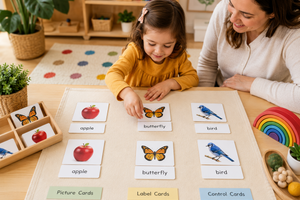
Place three or four pictures on the table and name one. After several turns, exchange roles: the child names and the adult searches. An older player can describe the item without saying its name: “Find something with wheels that carries people.”
2. Make a pair by a rule
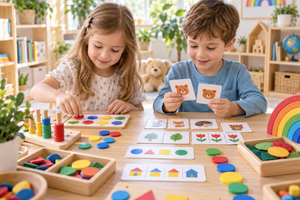
A pair may be identical pictures, an object and its shadow, an animal and its habitat, or a job and its tool. Show one completed pair and name the connection. When several answers make sense, accept a choice supported by a logical explanation.
3. Two homes
Mark two areas, such as edible and not edible, or travels on land and travels on water. The child sorts a small selection. In the harder version, the child creates the categories while the adult tries to discover the rule.
4. What changed?
Look together at four objects. Ask the child to close their eyes, then swap two positions or remove one item. Do not demand the word immediately. The child can first point to the place, describe a feature, and then retrieve the name.
5. Event chain
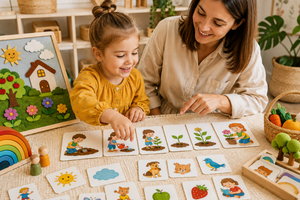
Choose three scenes: seed, sprout, plant; empty cup, pouring, drinking; putting on outdoor clothes, walking, returning home. The child arranges them and uses first, next, and finally to explain the sequence.
6. The adult’s mistake
Place a spoon with the vehicles or put the final scene first. Instead of asking “Is this right?”, ask “Which part does not fit our rule?” The child becomes the expert and practises checking without being anxious about a personal mistake.
7. Spoken mission
Start with one step: “Take the yellow circle.” Then offer two: “Take the yellow circle and put it under the blue square.” Increase instruction length only after the words, colors, and spatial concepts are familiar.
8. The child leads
Invite the child to create a task for an adult or a toy. Together clarify what the player must do, how many turns the round has, and how the result can be checked. Designing a workable game often reveals understanding better than repeating ten familiar answers.
The guide How to Use Learning Cards: 25 Games for Children Ages 2–6 offers more ways to vary one set. When children of different ages share a material, see How to Adapt One Learning Game for Ages 2, 3, and 4 for a step-by-step difficulty framework.
Supporting speech without creating an interview
Didactic games for speech development begin with shared attention, not a demand to repeat every word. The adult names what the child is looking at, adds one useful feature, and pauses. Instead of “What is it? What color is it? Where does it live?” try a short exchange: “This is a beaver. It is gnawing wood. Why might it do that?”
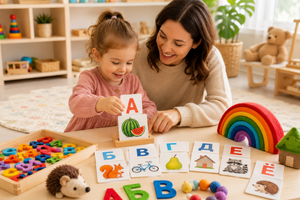
Picture-based speech development games work best when the images create a genuine reason to communicate. Ask the child to find a character, describe an action, predict what may happen next, or give a partner a clue. A younger learner may respond with a gesture, sound, or single word; the adult expands naturally: “Yes, the cat is sleeping on the chair.” There is no need to require an exact repetition of the adult’s sentence.
For a gradual path from naming to early reading, combine general educational cards for children with resources in Language and Reading. Choose clear images and words the child can encounter in daily routines, stories, and play.
How play supports school readiness
Didactic games for school readiness are useful because they practise far more than letters and numbers. A child listens to a short direction, begins and completes a task, waits for a turn, asks for clarification, checks a result, and repairs an error. These habits make group learning more manageable without turning the home into a classroom.
For ages five to seven, add tasks with a choice of method. Offer ten cards and ask the child to divide them so that every card belongs somewhere, but do not name the categories. Invite an explanation of the chosen system. Another version is to create instructions for a partner who cannot see the finished pattern. Language, planning, and spatial concepts work together.
Do not judge readiness mainly by speed. A slow, reasoned decision shows more understanding than an immediate guess. Shorten a multi-step instruction when needed; add self-checking when the action is easy.
Matching material to the action
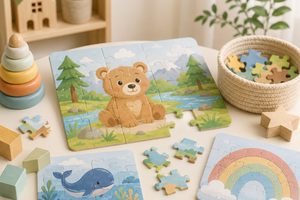
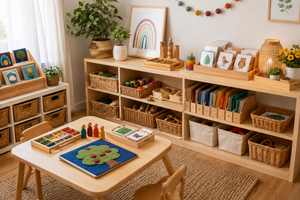
A material should make the desired action easier to see, not display the greatest possible number of topics. First sorting requires obvious contrasts; language play needs clear objects or scenes; memory practice needs a manageable number of pairs; fine-motor work requires pieces that are comfortable to grasp and safe to attach.
|
Learning purpose |
Helpful format |
First activity |
Relevant section |
|
Vocabulary and connected speech |
Object and scene cards |
Name an action and extend a sentence |
|
|
Comparison and classification |
Pairs, sequences, and feature cards |
Sort by one visible criterion |
|
|
Fine motor control and ordered action |
Felt pieces placed on a base |
Attach according to a model and check |
|
|
Mixed home activities |
A small themed card set |
Name, match, and invent one clue |
When browsing educational toys and learning materials, identify the action a child will practise before choosing the theme. Then check the age guidance, piece size, complete contents, and supervision requirements. A larger set is not automatically better: four well-chosen pictures can support a richer conversation than forty images presented at once.
How to help without taking over
Allow time after a question. If the child stops, restate the rule, point out one feature, reduce the choice to two, or demonstrate only the first movement. Stop helping as soon as the child can continue. Describe the process—“You checked the edges and moved the piece”—rather than judging the child. Gradually transfer preparation, rule-setting, checking, and restoring to the learner.
When the activity is too easy or too hard
Increase difficulty when the child remembers the rule, completes several turns without continuous prompts, checks decisions, and wants to continue. Add two cards, choose closer alternatives, hide the model, or ask for one reason. If the child guesses, repeatedly loses the rule, or needs answers on every turn, restore a smaller field or visible model. Finish while interest remains; repeating a brief favorite activity often teaches more than one long session.
Common adult mistakes
Avoid laying out the entire set, combining new vocabulary with a second rule and a timer, or turning conversation into a quiz. Do not move pieces with the child’s hands or praise only speed. Notice strategy, another attempt, explanation, and self-checking; stop when the child clearly wants to finish.
Safety and realistic expectations
Always follow the manufacturer’s age label. Simplifying a rule does not make small pieces safe for a younger child. Before play, inspect edges, lamination, fasteners, and completeness; count small pieces when the activity ends. Materials that might be mouthed require the format and supervision specified by the manufacturer.
A game supports development but is not a diagnostic test. Discuss significant concerns about speech, hearing, vision, movement, behavior, or understanding with an appropriately qualified professional.
Frequently asked questions
At what age can children begin didactic games?
Simple actions with large, safe objects can begin when a child can grasp them, examine them, and copy a brief demonstration. Around age two, this may include matching identical items, attaching a piece, and choosing between two groups. The age restrictions of the particular product always remain binding.
How long should one activity last?
Follow engagement rather than a fixed timer. A complete game may last five minutes for a younger child and fifteen or twenty for an older one. Ending after a short successful round is better than keeping a tired child at the table.
Is a separate game needed for every skill?
No. One themed set can support naming, matching, sorting, memory, description, and storytelling. Change one action or rule instead of buying new material for every goal. Continue to follow the set’s age and safety requirements.
What if a child deliberately changes the rule?
Finish one short round under the agreed rule, then invite the child to design the next version. Clarify the new rule and how players will check it. If the idea is consistent and safe, this initiative is valuable planning rather than misbehavior.
Must every incorrect answer be corrected?
No. If an error does not block the main purpose, model the correct word naturally in your response. When the criterion matters, return to the rule or model and let the child move the piece independently. Avoid shame and repeated testing.
Conclusion: a good game has a clear action
The quality of didactic games is not defined by the number of cards, packaging brightness, or length of the claimed skills list. Children need one understandable purpose, a manageable field, a short rule, the opportunity to act, and a way to see the result. The adult demonstrates the beginning, observes, and changes difficulty according to real behavior.
Start with a familiar topic and four or five pieces. Choose one action, complete a short round, and notice what kind of help was needed. Next time, change only one condition. This keeps play alive while learning grows through curiosity, repetition, communication, and increasing independence.