Outdoor Games for Children: 25 Ideas for Different Ages
Short answer: a good outing does not require a bag full of equipment. Chalk, a soft ball, a few picture cards, or objects already visible in nature can support dozens of games. Choose an idea according to the child's age, the size and condition of the space, the weather, and the number of players. One rule and a five-to-ten-minute round are enough for a preschooler. Older children can add roles, a route, a score, or shared planning.
Outdoor games for children give space for large movements, judging distance and surfaces, noticing wind and sound, and negotiating with other players. The adult provides a clear beginning and safe limits rather than directing every step.
The collection mixes active games for children with observation, paired tasks, and cooperative missions. Most work in a courtyard, park, or near home and can be simplified without eliminating less experienced players.
Check the place, weather, and child before starting
Check for glass, slippery paving, holes, open water, traffic, construction, or unfamiliar animals. Agree on one visible boundary. Do not handle unknown berries, mushrooms, or plants, and wash hands after soil contact.
Weather changes what is reasonable. In heat, use shade, water, and a slower pace. After rain, remove sharp turns and running on leaves. In winter, check that clothing does not restrict sight or movement. Go indoors when thunder is heard.
|
Conditions |
Good starting choices |
What to change or postpone |
Safety limit |
|
Age 2–3, small courtyard |
copying movements, finding a colour, carrying a large light object |
use one rule; no elimination or chase |
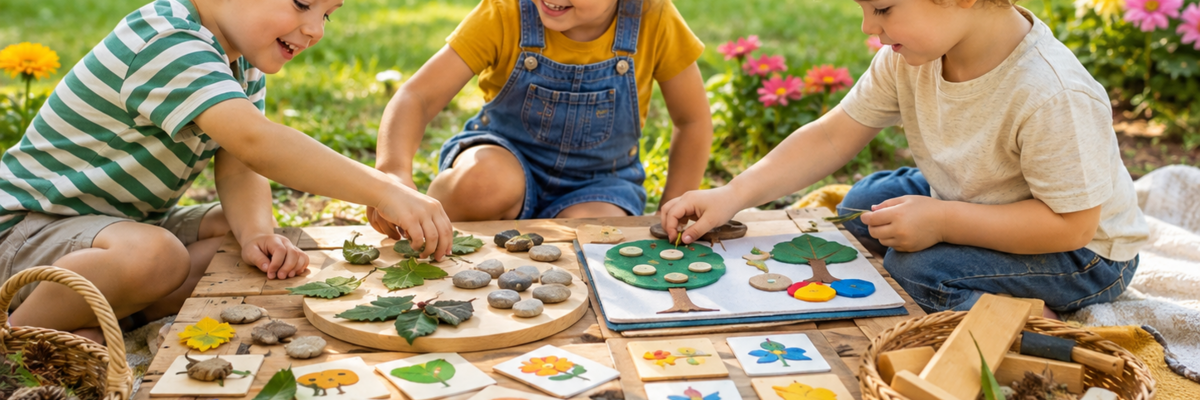
adult stays close; only large age-safe pieces |
|
Age 4–6, park or playground |
simple relays, chalk routes, sorting observations |
short rounds, visible boundaries, water breaks |
no running near traffic, swings, stairs, or water |
|
Age 7+, a group |
team missions, landmarks, strategy variations |
assign roles and scoring only after a practice round |
adult approves the route; nobody hides outside the zone |
|
Hot or very sunny |
shadow shapes, slow scavenger hunt, observation |
shorten activity and increase water and rest |
shade, suitable clothing, and no signs of overheating |
|
Cool or windy |
short movement rounds, ribbon signals, a route |
avoid long periods of standing; remove loose, flying props |
dry clothing; stop if the child is cold or tired |
|
Wet or slippery |
detail hunt, sound map, drawing in soil |
remove jumps, races, and sudden changes of direction |
grippy footwear and a level inspected area |
Pause for unusual breathlessness, pallor, flushing, pain, dizziness, nausea, cold, or repeated tripping. Move to a calm place and assess the child. Seek medical help if symptoms are severe or do not settle with rest; a planned game never has to be completed.
Give the rule in one sentence
Demonstrate one turn, state the rule briefly, and practise without points: “Stay on the chalk line; if you step off, return to the closest mark.” Then let the child suggest a story change.
With a group, establish a stop signal: a word, two claps, or a raised hand. Avoid compulsory physical tagging; players can reach a marked zone, name someone, or touch a ribbon.
Ideas 1–5: warm-up and large movements
1. Traffic lights
Show green, yellow, or red. Players walk, slow down, or freeze. Later add blue for side steps. Younger children need two colours; older ones can lead.
2. Animal trail
On level ground, walk like a bear, take “mouse” steps, then stretch like a giraffe. Avoid painful positions or unsafe wrist pressure. Let the child invent a movement.
3. Chalk islands
Draw large circles one child-sized step apart. Travel forwards, sideways, or with a pause. Add jumps only on a dry surface. An older child can design and test the route.
4. Mirror
Two players face one another beyond arm's length. One moves slowly while the other mirrors the action; swap after a minute. It suits narrow spaces where running is unsafe.
5. Deliver the parcel
Carry a large, light object to a marked “home,” alone or with a partner. Aim for control, not speed. Avoid sharp, heavy, or view-blocking objects.
Ideas 6–10: attention, signals, and self-control
6. Hear it, change direction
One clap means forward, two mean back, and a bell means stop. Begin with two signals. In noise, use gestures, but never mask traffic or another real warning.
7. Follow the leader's shadow
Follow a leader through wide steps, turns, and safe landmarks. No climbing or leaving the area. Transfer the role often so everyone shapes the route.
8. Find the colour
Name a colour and point to an example without picking plants or touching property. Next, find two shades. These children's outdoor games combine movement with close looking.
9. Freeze as a character
Players walk inside the boundary and freeze like a tree, aeroplane, or pictured character. Poses must be stable, never on kerbs. Later, children choose the prompts.
10. Silent guide
The guide silently shows a short sequence; others copy. Never use blindfolds outside. Two actions suit preschoolers; older players can plan three or four.
Ideas 11–15: a ball, aiming, and control
11. Question ball
Roll a soft ball while naming a category. The receiver answers once and returns it. Younger children roll rather than throw. Stay away from roads, windows, and bystanders.
12. Aim for the large circle
Toss beanbags into a broad chalk target or hoop. After three attempts, change distance or target size. Practise force and direction without ranking children.
13. Roll through the gate
Make a gate from two cones and roll the ball through it. Change width and distance gradually. For groups, use several lanes to avoid queues and crossed paths.
14. Ball route
Guide a ball around two or three landmarks. Keep a preschool route wide and untimed; older children can draw it first. Place corners away from steps, kerbs, and swings.
15. Ten team passes
Complete ten controlled passes. If the ball falls, begin another series and improve the team's own result. Cooperative fun outdoor games support learners instead of eliminating them.
Ideas 16–20: observing nature and using cards outside
16. Observation bingo
Prepare six to nine safe clues: something round, a bird sound, a yellow leaf, moving water, or rough bark. Players notice, photograph, or mark each item rather than collecting it. Do not include unknown berries, mushrooms, nests, or anything that requires entering an unsafe or protected area.
17. Shape hunters
Look for circles, triangles, and rectangles in signs, benches, windows, and markings. Ask what features made the child choose a shape. If an object is only approximately circular, compare it instead of declaring the answer wrong. Later, the walk can be extended with cards or felt shapes at home.
18. Sound map
Sit in a safe place for two minutes. Mark a dot for “us” on a page, then add simple symbols around it: a bird to the right, a distant vehicle, leaves behind. Identifying the exact bird is unnecessary. This quiet task practises direction and distance and offers recovery after running.
19. Sort without harming nature
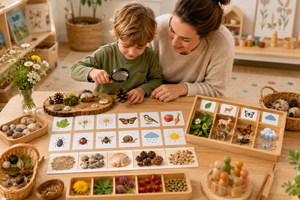
Where local rules allow, use a few leaves, cones, or stones already on the ground. Sort by colour, size, texture, or shape, then return them. In protected places, collect nothing; sort photographs instead. The Plants & Nature learning-card category offers another way to compare after the walk.
20. Find evidence of weather
Choose one sign: wind direction, cloud shape, puddles after rain, or shadow length. Observe it, make a prediction, and check again ten minutes later. The guide to weather observation calendars and themed games gives a longer route from noticing to recording and comparing.
Ideas 21–25: pairs, teams, and child-made rules
21. Partner route
Two players follow a short path while keeping a soft ball or small cushion between their palms. They do not run or trap it against the body. If it falls, return calmly to the previous marker. Completing the route together matters more than finishing quickly.
22. Two captains
Each captain contributes one movement to a sequence: three steps, a turn, and a clap, for example. The group performs both parts and then adds another. Change captains after one round so the same confident child does not always decide while others only follow.
23. Pass the mission
The first player receives a short mission: “Walk to the tree, point to something rough, and come back slowly.” After completing it, that player creates the next mission. An adult checks the boundary and removes unsafe, hidden, or distant targets. Older children may write instructions on cards.
24. Shared chalk town
Each participant draws one part of a town: road, park, river, or houses. Toy figures then travel through the areas and follow local rules. Use chalk only where permitted and away from busy walking routes. Rinse dense markings afterwards if the surface and local rules allow.
25. Invent a game from three ingredients
Choose a place, an object, and a movement—perhaps a circle, a ball, and a sideways step. Children write or explain a rule, run a practice round, and revise anything unclear. This advanced format turns active outdoor games into planning: players must communicate, test fairness, and protect everyone's safety.
Adapt one idea for age and group size
Active games for preschoolers need a short cycle: demonstrate, try two to four times, and change roles. For a two- or three-year-old, reduce choices and avoid elimination. At ages four to six, combine two steps, but do not demand speed and precision at the same time. School-age children often prefer designing the route, setting a team target, or improving the fairness of a rule.
With two players, alternate leader and follower. For six to ten children, use several stations rather than one long queue. A child who does not want to run can hold a signal, map the route, count passes, or photograph observations. Participation does not have to look identical for everyone.
A small outdoor kit
Most outdoor play ideas need only chalk, a soft ball, two ribbons, water, wipes, and a few pictures. Summer Activities three-part cards can provide movement prompts. Forest Safety Rules learning cards can start a discussion before a park or woodland visit.
When choosing educational toys for active discovery, take outside only materials that are easy to count, clean, and put away quickly if rain begins. Store cards in a water-resistant folder. Do not offer small loose pieces to children who may put them in their mouths.
|
Outing format |
Opening activity |
Main game |
Calm finish |
|
20 minutes near home |
Traffic Lights — 3 min |
Chalk Islands — 8 min |
find three colours nearby |
|
40 minutes in a park |
Animal Trail — 5 min |
Observation Bingo — 15 min |
two-minute Sound Map |
|
Two different ages |
Mirror — 4 min |
Partner Route at two levels |
each creates one mission |
|
Preschool group |
practise the stop signal — 2 min |
three stations: ball, shapes, route |
group circle and favourite choice |
|
Hot day |
slow search for shade |
short bingo without running |
water, rest, cloud observation |
For a deeper nature strand, see Nature Science for Preschoolers Through Play. It shows how an observation can lead to comparison and classification without replacing direct, respectful experience outside.
Frequently asked questions
What can a three-year-old play outside?
For simple games to play outside with a three-year-old, choose one movement and one visible rule: find a colour, copy a slow pose, walk between large chalk circles, or roll a ball. A three-to-five-minute round is enough. Avoid elimination, small loose parts, blindfold routes, and areas close to traffic or water.
Is special equipment necessary for outdoor play?
No. Many outdoor games for kids use only chalk, a ball, a ribbon, or a page with simple symbols. Natural objects are often better observed or photographed than collected. Any prop should be large, lightweight, visible, washable, and appropriate for the child's age.
How can children's outdoor games include mixed ages?
Keep one shared story but offer different roles. A younger child finds a colour or completes a short section; an older one plans the route, reads a mission, or checks boundaries. Compare each player's own task and cooperation rather than speed.
How long should active outdoor games last?
One active round usually lasts five to twelve minutes, depending on age, weather, and intensity. Alternate it with water, free play, or observation. Stop earlier if a child becomes too hot or cold, trips repeatedly, feels unwell, or loses interest.
Which fresh air games for children avoid competition?
Try ten shared passes, a chalk town, observation bingo, a sound map, or a partner route. These fresh air games for children give the group one common goal. A mistake becomes information for the next attempt rather than a reason to remove a player.
Conclusion
Good outdoor play begins with an inspected space, a short rule, and permission to stop. Alternate running with precise movement and observation, rotate roles, and let children improve the rules. The result supports coordination, attention, language, and cooperation while the outing remains genuine free time rather than a lesson disguised as play.