Putting socks in a basket, finding the sleeve of a coat, wiping a small spill, and carrying a cup look like tiny actions to an adult. For a child, each one contains several decisions and coordinated movements. A broad instruction such as “Get ready” or “Clean up” leaves those hidden steps unexplained. Play can isolate a movement, reveal the sequence, and make repetition manageable.
The goal is not a miniature household worker who performs at adult speed. Meaningful participation is small, safe, and genuinely connected to family life. A child may complete one part of a shared task, see what that contribution changed, and know where the activity begins and ends. Independence grows through understandable responsibility, not through the withdrawal of adult support.
This guide focuses on three everyday areas: order, clothing, and routine care of the home. It shows how to prepare the environment, demonstrate a task, use games without turning every responsibility into entertainment, and transfer practice into real situations. Safety boundaries remain adult decisions throughout.
Key takeaways
- Break an everyday task into visible steps and transfer one manageable part at a time.
- Use play to practise a movement or sequence, then connect it to the real situation.
- Make the object’s home, the necessary tool, and the sign of completion easy to recognize.
- Avoid shame, races, and a prize for every ordinary contribution; the shared result has meaning.
- Heat, blades, electricity, medication, cleaning chemicals, and heavy objects remain under adult control.
Treat the task as a skill, not a compliance test
A life skill combines orientation, planning, movement, checking, and restoration. Hanging a coat means finding the hook, turning the garment correctly, controlling its weight, placing the loop, and noticing whether it stays. A refusal or mistake does not automatically mean unwillingness. One step may be uncomfortable, invisible, or beyond the current setup.
Watch where the action stops. If a child carries toys but cannot decide which container belongs to them, the categories need to be clearer. If a hat goes on easily but a zipper does not connect, practise joining the two zipper parts on a loose garment that does not also have to be worn and held in place.
Offer an authentic division of work: “You place the napkins; I carry the hot dish.” This respects both the child’s contribution and the safety boundary. A task that an adult immediately and secretly redoes loses its purpose. It is better to reduce the field beforehand until the child’s result can truly remain.
Plan participation by experience and situation
|
Starting point |
Order |
Clothing |
Everyday task |
|
About 2–3 years |
Return large items to one visible basket |
Choose between two items, remove a hat, find a sleeve |
Carry a napkin or wipe a tiny spill together |
|
About 3–4 years |
Sort two groups and check a picture label |
Lay out clothes in order and pull on simple garments |
Place unbreakable dishes or water one plant with a measure |
|
About 4–5 years |
Restore one shelf from a simple reference |
Select for conditions and practise fasteners |
Prepare a cold snack with tools approved by an adult |
|
About 5–6 years |
Use a short checklist and report missing pieces |
Prepare clothes for tomorrow and fold simple items |
Complete several connected steps with appropriate supervision |
These are possibilities, not required milestones. Hand size, furniture height, familiarity, energy, and the actual materials all affect participation. When a child needs reminders for every move, shorten the sequence or change the environment before concluding that more motivation is needed.
Prepare the environment for a successful action
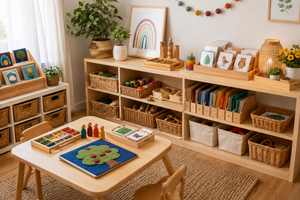
Give each recurring task a location, a tool, and a visible finish. A cloth waits where a child can reach it after a spill. The laundry basket has an obvious opening. A coat hook is at a usable height. A small watering container holds only an amount the child can control. The environment can prompt the next move more reliably than a voice from another room.
Reduce scale, not reality. Offer three unbreakable plates rather than the entire cupboard, one plant rather than all the pots, and one shelf rather than a whole room. Set objects on stable surfaces and clear the route. The child needs to recognize the result: an open walkway, an empty task basket, a complete place setting, or a restored activity.
Lock away medication, cleaning products, matches, sharp blades, and dangerous tools. A picture prompt or playful story does not make a hazardous action safe. The adult judges the actual room, product, child, and level of direct supervision instead of relying on a broad age suggestion.
Present a new household action step by step
1. Invite at a calm time
Do not teach a new fastening method when everyone is already late. State the modest aim: “I will show you how this cloth gathers water.” A child can decline a practice presentation when there is no immediate safety need.
2. Move slowly in a consistent direction
Collect the tool, complete the central action, inspect the result, and restore everything. Say only what the hands do not show: the safety boundary, the measured amount, or the feature that signals completion.
3. Transfer one complete part
The child may begin by carrying dry items or placing one spoon. Add another part when that contribution is familiar. Avoid inserting extra rules halfway through the first attempt.
4. Leave room for repair
A small spill can be part of the task when the setting is safe and a cloth is available. “What still needs to be finished?” preserves the child’s role better than silently taking the tool away.
5. Include restoration
Putting the cloth in the laundry, returning the brush, or emptying crumbs in the agreed place completes the cycle. Otherwise, the next attempt starts with a search for missing equipment.
Games that prepare children to restore order
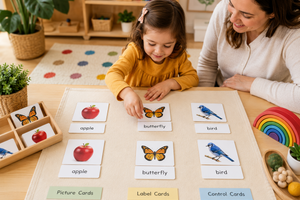
- An object’s address. A picture labels each container. Deliver three objects, then check whether all the “residents” share the category’s feature.
- The finished-shelf reference. Use a private photo of one small shelf without the child in frame. Compare complete sets and open space rather than decorative perfection.
- Find the visitor. Place one item in the wrong location. The child finds it and explains which category reveals its real home.
- Five returns. Select only five items and complete the cycle. A small field has a clear ending, unlike the instruction to clean everything.
- Ready for next time. Before a puzzle, card set, or game returns, compare its pieces with a reference. Move an incomplete set to an adult checking place.
Not every cleanup needs a character voice or a song. Play introduces the logic. Once the locations and sequence are familiar, an ordinary short agreement may be all that is needed.
Playful practice for dressing and choosing clothes
A floor sequence. Arrange two or three garments in dressing order and find the first step. Later the child prepares the line for the next morning. Opening detective. On a large garment, locate the neck, sleeves, and lower opening, then trace the hand’s route. Fastener workshop. Practise a button, hook-and-loop strip, or zipper on a loose item before managing it on the body.
Clothing for conditions. Offer a situation: a windy walk, a rainy errand, quiet indoor play, or active time in snow. The child selects items and explains each function. Do not reduce the answer to a season’s name. Temperature, wind, precipitation, duration, and activity can make two winter days require different choices.
Choice has real boundaries. When conditions require them, the adult provides two safe and suitable alternatives. If a garment is difficult, support the exact stopping point rather than completing the whole process. One finished independent step is more useful than rushing through every step for the child.
Turn daily tasks into short shared projects
Setting a place. Draw a simple one-person layout and place unbreakable items. The adult carries anything hot or heavy. Caring for one plant. Measure water into a small container, water, and wipe drops. The adult decides whether watering is actually needed.
Cold food preparation. Washing a soft fruit, tearing lettuce, mixing already safe ingredients, or arranging pieces can be meaningful after an adult has considered allergens, choking hazards, hygiene, and tools. Laundry. Pair socks, group light and dark items by an agreed rule, or carry a light stack without gaining access to detergent or machinery.
Preparing to leave. A short visual list can ask the child to check water, a tissue, a hat, or another agreed item. The adult retains keys, documents, medication, and the final safety check. Stable roles make participation understandable rather than a guessing game about what help is wanted today.
A seven-day cycle without a public chore chart
Choose one micro-skill for the week, such as returning shoes. On the first day, show the complete cycle. Over the next two days, transfer the final step. Then add carrying and placement. At the end of the week, observe whether the child can begin with a shorter prompt. If not, change the height, label, amount, or timing rather than simply repeating the command.
Avoid public rankings and sibling comparisons. A brief private adult note can record the conditions: there was enough time, the item was accessible, and the child knew the move. This separates an unclear system from ordinary fatigue, distraction, or a refusal in that moment.
Use language that guides attention without taking over
Replace “Be careful” with an observable cue: “Check whether the towel still touches the floor,” or “See whether any blocks remain in the basket.” One precise sentence directs observation without dictating every movement. Once the sequence is known, a brief “What comes next?” can be enough.
Describe the effect rather than assigning a character label. “The walkway is clear, so no one will trip on the truck” explains why the action matters. If work remains, refer to the task: “Two objects do not have a home yet.” The problem stays repairable instead of becoming a judgment about the child.
During planning, use sequence words: first, next, after that, and finally. Ask the child to repeat only the next two steps or represent them with pictures. A long spoken list can disappear even when every individual action is familiar.
Learn&Dream materials for talking about home routines
The live Ukrainian Home and Everyday Life category confirms the sets below, but substantive English versions of the exact product pages could not be verified. The names are therefore unlinked. Check the current shop description for language, contents, age marking, and care guidance before choosing a material.
|
Material |
First card activity |
Real-life transfer |
Prompt |
|
Living Room — three-part cards |
Name and group familiar room objects |
Locate the real home of two items |
Which objects are used together? |
|
Children’s Room — three-part cards |
Match pictures with a familiar space |
Return one complete activity to its place |
How do we know the shelf is ready? |
|
Kitchen — three-part cards |
Compare objects by function |
Select safe items for setting a place |
Which objects are for adult use? |
|
My Home — three-part cards |
Group objects by room |
Build a short route for a household task |
Where does the task begin and end? |
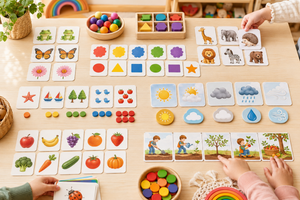
A card cannot replace the real action, but it can reduce the language load. First arrange the pictured steps, then complete one actual move and return to the visual sequence to check what remains.
Common adult mistakes
- A command without steps. “Tidy up” does not define categories, boundaries, or completion.
- Teaching under time pressure. Demonstrate a new fastener in the evening, not one minute before leaving.
- An unusable standard. Offer a small field whose result will not need to be entirely redone.
- Making everything a performance. Once the system is understood, an everyday task may remain ordinary.
- Helping before observation. Find the stopping point and support only the movement that is needed.
- Independence above safety. The adult sets risk boundaries even when that interrupts the planned scenario.
Frequently asked questions
At what age can children participate in household tasks?
From an early age, offer one safe, simple step such as carrying a napkin, placing an item in a basket, or choosing a garment. Scale and supervision matter more than an exact age.
What if the game is appealing but the real task is refused?
Check whether the real action has the same clear beginning, manageable tool, and short ending. Invite the child to complete one part with you without pressure to finish the entire cycle.
Should every cleanup earn money or a sticker?
A constant reward is not necessary for ordinary participation in home life. Name the specific contribution and visible result, while keeping any separate reward agreement for genuinely additional work.
How should adults respond to spills or slow dressing?
Stay calm when there is no danger. Show the repair process or help at the stopping point, then reduce the amount of water or allow more time for the next attempt.
Which household tasks should remain off limits to preschoolers?
Children should not independently handle medication, cleaning chemicals, flames, hot surfaces, electrical appliances, sharp tools, or heavy objects. The adult defines the specific boundary.
Conclusion: a small real contribution matters more than a perfect result
Life skills grow through readable cycles: notice a need, find the tool, perform a manageable action, check, and restore the space. Play makes an isolated movement or sequence visible. The real household situation gives that practice a reason.
Choose one task, prepare the setting, and demonstrate without rushing. Transfer responsibility in parts, accept a realistic result, and keep adult control wherever risk is present. Order, clothing, and daily care can then become shared ways of caring for the home and oneself instead of a stream of commands.