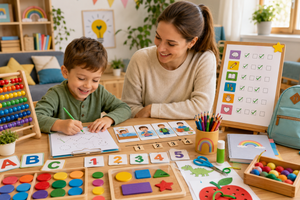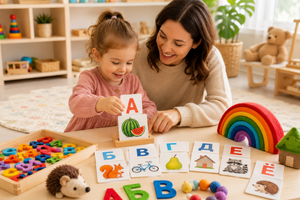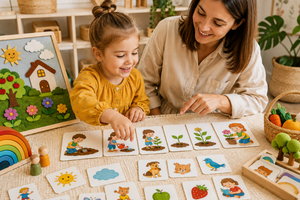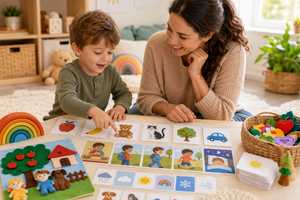
Educational Games for Children Aged 5–6: Logic, Language, Maths and Fine Motor Skills
Short answer: At ages 5–6, the most useful activities are not school exercises in disguise. They are games in which a child compares, plans, explains, counts real objects and uses their hands with precision. A 15–25-minute home session is enough: choose one logic or maths challenge, one language game and one short fine-motor activity. Increase the difficulty only when the child understands the rule, remains interested and can explain their choice.
A search for “games for 5-year-olds” often produces unrelated activities. Parents and carers need a practical answer: what to offer today, how to begin without pressure, when to add difficulty and whether a material suits their child.
The ideas cover logic, language, maths and fine-motor preparation for writing. This is not a school-readiness test. Each game can be repeated with new themes and adapted to the preschooler.
How Play Changes at Ages 5–6
Many five-year-olds can remember a short rule, compare features and finish a small task. Closer to six, children may enjoy inventing rules, testing another strategy or explaining an answer. Development still varies widely at the same age.
Look at the actions a game invites, not the number of tasks printed on its box. A strong activity encourages a child to:
- examine the problem before acting;
- compare at least two features;
- make a prediction and test it;
- describe or justify a choice;
- notice a mismatch and try again;
- handle pieces accurately without excessive tension.
When a rule is new, demonstrate once and pass the turn to the child. If the task becomes automatic, add one challenge: an extra piece, second condition, memory interval or explanation.
How to Choose a Game for Today’s Need
Start with the thinking action, not the picture theme. Space, transport, animals and food can all support sorting, counting or storytelling. Use your observation to choose the first step.
|
What you notice |
Start with |
Make it easier |
Make it harder |
|
The child acts at random without studying the task |
Copy a design made from 3–4 pieces |
Leave out only the pieces needed and show the first step |
Add spare pieces or hide the model after 10 seconds |
|
The child gives one-word answers despite knowing the scene |
Describe an object by feature, place, action and reason |
Offer a sentence starter or two possible answers |
Connect three pictures in a cause-and-effect story |
|
The child names numerals but miscounts objects |
Count while moving each object once |
Work within 5 and arrange objects in a row |
Rearrange them, compare sets or compose the same total in two ways |
|
Drawing causes quick fatigue |
Use large paths, tongs, pegs and simple patterns |
Shorten the movement and work on a vertical surface |
Use a smaller format, a rhythm or a more complex route |
|
Sorting by one feature is easy |
Sort by two conditions |
Say both conditions aloud and use 4–6 objects |
Find an exception or invent a new sorting system |
You need not cover all four areas daily. Weekly variety matters more than completing similar cards in one sitting.
Logic Games: Explain the Rule, Not Just the Answer
Copy a Model
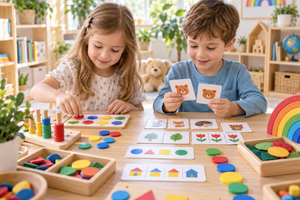
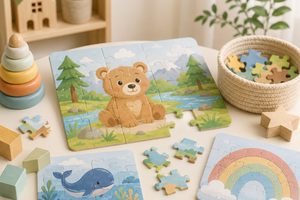
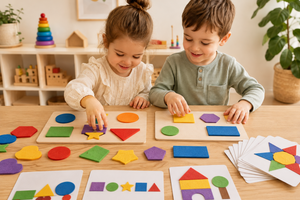
Build a simple arrangement with shapes, felt pieces, blocks or sticks. The child studies and copies it, then answers the questions “Where will you start?” and “How will you check?” This develops planning and visual memory.
Keep the model visible, then show and cover it briefly. Finally, the child makes a design and tells the adult where each piece belongs, adding spatial language to the challenge.
Find the Odd One Out—and Defend the Choice
A bus, boat, plane and apple have one obvious odd item. A boat, plane, bus and bicycle allow several valid answers: the bicycle is human-powered, while the boat travels on water. Accept any consistent reason; explaining matters more than guessing the adult’s choice.
Change the Sorting Rule
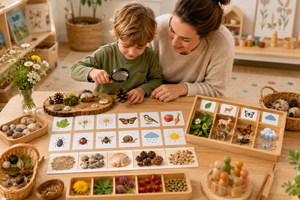
Sort the same objects by colour, then shape, material, purpose or number of parts. Next, the child invents a rule for the adult to discover. Changing rules develops flexible thinking.
Try Simple Strategy
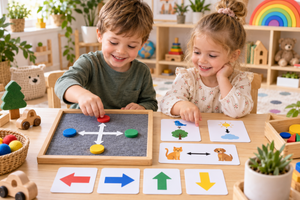
Tic-tac-toe, obstacle paths and one-move-ahead games suit many children this age. Ask, “What could the other player do next?” If planning is difficult, play openly and discuss both sides.
Language Games: From Naming to Connected Ideas
At 5–6, pictures can prompt comparison, prediction, reasoning and storytelling—not only naming. Vocabulary and coherent speech are different skills.
Description Detective
Describe a room object without naming it, using material, shape, function and location. The child guesses, then gives clues. Require three features, including an action or purpose.
A Story with a Twist
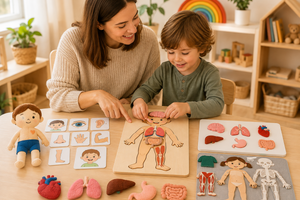
Choose three scene pictures and decide on a character, place and goal. Add a surprise after two sentences: rain, a missing object or a letter. The child links it to what happened before.
If needed, ask: Who? Where? What did they want? What got in the way? What did they do? How did it end? Sentence starters should still leave room for the child’s idea.
Verbal Sorting and Sound Substitution
Name things that fly, foods, wooden objects or winter words, and ask for their category. Then mix categories and clap only for the chosen feature. For sound awareness, replace a familiar word’s first sound and decide if the result is real. Reading is unnecessary; listening is the goal.
Maths Games: Quantity Before the Symbol
Even if a child names numerals, check quantity through action: request six buttons, split seven counters two ways or compare sets before counting to verify.
A Shop with an Exact Order
Order three blue pieces and two yellow ones from a selection of small, safe objects. The child fills the order, counts and explains the check. Later, add ten tokens and prices from 1 to 5.
Compose a Number
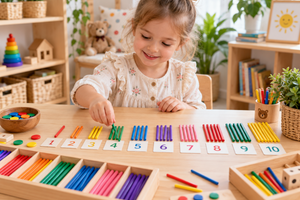
Split five counters between two bowls: 1 and 4, 2 and 3, 5 and 0. Before writing equations, let the child see that the total stays the same. For a fuller progression, see how to explain numbers and quantities from 1 to 10 through play.
Continue a Pattern
Make a red–blue–blue repeating sequence. The child continues and states the rule. Then vary shape or movement, such as clap–step–step. Finally, find and repair an error.
Even Means “Everyone Has a Partner”
Introduce evenness by pairing objects. If every button has a partner, the number is even; if one remains, it is odd. This is optional for most five-year-olds and follows secure counting and numeral–quantity matching.
Preparing the Hand: Accuracy Without Forced Worksheets
Writing readiness is not pages of repeated marks. It requires a stable shoulder, mobile wrist, eye–hand coordination, pressure awareness and directional control.
Alternate surfaces and materials: draw large loops on a vertical board, move pompoms with tongs, make patterns with buttons or felt pieces, trace a wide route, add short strokes in different directions, cut along broad lines with child-safe scissors under adult supervision and build small symmetrical designs.
Stop before pain or a tight pencil grip. If fingers whiten, the shoulder rises or the child shakes out their hand, pause and use a larger format later. Aim for control, not a perfect page.
A Weekly Rhythm Without “School at Home”
Treat this as a menu, not a required schedule. Choose three or four days and repeat favourite formats with different materials.
|
Day and focus |
3–5-minute warm-up |
10–15-minute main game |
Short finish |
Materials |
|
Monday: logic |
Find one difference between two designs |
Copy a model, then make one for the adult |
Name the checking strategy |
8–12 pieces and 2 model cards |
|
Tuesday: language |
Describe an object using three features |
Build a three-picture story with a surprise event |
Give the story a title |
Scene cards or family photos |
|
Wednesday: maths |
Give the adult an exact quantity |
Play shop and compare completed orders |
Split 6 counters between two bowls |
10 counters, 2 bowls, cards 1–10 |
|
Thursday: fine motor and spatial skills |
Draw large loops in the air with both hands |
Make a pattern, use tongs and copy a route |
Relax hands and fingers |
Tongs, pompoms, paper, thick pencil |
|
Friday: combined play |
Choose a theme from the week |
Build a scene, count its characters and explain their route |
Child sets one task for the adult |
Any familiar set and paper |
For educational games for 4–5-year-olds at home, keep one condition, 3–5 pieces and more demonstration. For a six-year-old who finds that easy, add an explanation, two conditions or self-checking rather than simply adding more cards.
Learn&Dream Materials That Support These Games
A clear, adaptable material can support maths, language, memory and precise hand movements in different rounds.
- Hearts with Numbers is marked 5+. Use the hearts to connect numerals and quantities, compare values or arrange a short number sequence.
- Felt Board Even / Odd is marked 5+. It makes pairing and the difference between even and odd quantities visible for a child who already counts confidently.
- Tic-Tac-Toe is marked 4+. It supports turn-taking and simple planning; ask the child to consider both their own move and the opponent’s possible reply.
- Number and Quantity 1–10 is marked 4+. Match each numeral to a set, compare two sets and compose a chosen quantity in more than one way.
When choosing educational toys for children aged 5–6, check the product’s age marking, contents and piece size against the individual child’s abilities. The manufacturer’s age label indicates a recommended minimum, not a promise that every task level will suit every child.
Interest Matters More Than Gender
Search phrases such as “toys for a 5-year-old girl,” “toys for a 5-year-old boy” or “games for 5-year-old girls” reflect how adults search; they do not identify a learning need. A transport-themed logic game is not inherently for boys, and story cards or pattern work are not inherently for girls.
A better filter is the child’s interest and the action to practise. Do they enjoy building, inventing stories, counting, exploring nature, copying models or following rules? Any engaging theme can support logic, language, maths or fine-motor control.
Do not automatically move a six-year-old to “first-grade” difficulty. One child may need a simple rule with a deeper explanation; another may be ready for a complex spatial problem. Choose the next step from what the child actually does, not from gender or age alone.
How to Lead Play Without Taking Over
Show one move, state the rule in a short sentence and hand over the material. After a mistake, wait: the child may notice the mismatch independently. Instead of saying “wrong,” ask, “What could you compare with the model?” or “Does every object have a partner?”
Do not question every action. A few minutes of focused silence are part of learning. Step in when a strategy would help: work from left to right, count each object once, find corners first or repeat the instruction in your own words.
Keep 4–6 varied materials available rather than displaying everything at once. More ways to reuse one set appear in 25 games with educational cards for children aged 2–6. For a broader view of the next learning stage, use the separate school-readiness-through-play checklist for children aged 4–6.
Frequently asked questions
How long should educational games last for a child aged 5–6?
Usually 15–25 minutes is enough, but the child’s state matters more than a timer. Two 7–10-minute games with a movement break may work better. Finish while some interest remains, especially when the rule is new or the task is physically demanding.
Which games for 5-year-olds develop logic most effectively?
Choose model copying, sorting by two features, pattern finding, an odd-one-out task that requires a reason and simple strategy games. Logic comes from comparing options, anticipating a result and explaining a rule—not from the decorative theme of the set.
What if a child knows numerals but counts objects incorrectly?
Return to “one object, one number word.” Move each item once while counting and arrange objects in a row. Work with small quantities and ask the child to prepare an exact order before matching the completed set to a printed numeral again.
Are handwriting worksheets necessary for preparing the hand at ages 5–6?
They can be one activity, but they are neither the only nor always the best starting point. Large lines, vertical drawing, tongs, cutting, small-piece patterns and short paths develop basic control. Persistent pain, marked tension or ongoing difficulty should be discussed with an appropriate qualified professional.
How can I tell when it is time to make a game harder?
Increase the challenge when the child follows the rule correctly several times without prompts, can explain what they did and wants to continue. Change only one thing: add pieces, introduce a second feature, hide the model briefly or let the child design the task. If random guessing begins, step back one level.
Conclusion
Good toys for 5-year-olds and toys for 6-year-olds do not try to teach everything at once. They offer a clear action, a way to check the result and a next level that genuinely changes the thinking required. Begin with an interest the child already has, then add one demand: explain, remember, count, plan or copy more precisely. Home play can then support logic, coherent speech, early maths and writing readiness without pressure, gender stereotypes or duplicating school.