What to Give a Five-Year-Old: Educational Gifts by Interest
A fifth birthday often arrives at an interesting point in childhood. The child may already invent rules, enjoy small challenges, tell elaborate stories, count familiar objects, and ask to do things “by myself.” At the same time, attention, hand control, emotional regulation, and confidence can still vary greatly from one activity to another. That is why the best answer to what to give a five-year-old is rarely “the most advanced toy.” A better gift matches the child’s current interests, offers an achievable first step, and leaves room for new ways to play.
An educational present need not resemble a lesson. It can invite the child to plan, compare quantities, reproduce a pattern, negotiate a rule, or explain an idea. These actions support practice, not guaranteed outcomes; their value lies in willing repetition rather than a package label.
This guide compares four reusable formats through a practical decision process. It helps an adult choose one thoughtful gift for a five-year-old that suits the child and family.
Start with the child, not the age label
“Age five” is useful as a broad filter, but children of the same age can want very different experiences. One child may spend twenty minutes arranging cars into precise rows; another may prefer quick games with a parent; a third may turn every picture into a story. None of these preferences is more educational than the others. They simply point toward different entrances into learning.
Before choosing, ask the adult who knows the child well three short questions:
- What does the child return to without being prompted: numbers, drawing, vehicles, pretend worlds, puzzles, or family games?
- Does the child currently enjoy following a model, or would an open-ended invitation feel easier?
- Will the gift usually be used alone, with an adult, with siblings, or with friends?
The answers are more informative than a long list of “skills for five-year-olds.” They also reduce the risk of buying something that is impressive to adults but frustrating or irrelevant to the recipient.
Searches such as what to give a five-year-old boy or “gift for a five-year-old girl” are common, but gender is a poor shortcut for interest. A child who loves parking layouts may also adore space stories; a child fascinated by numbers may also enjoy a lively strategy game. Choose from observed interests, sensory preferences, and readiness. This produces a more personal gift and avoids narrowing the child’s choices before play even begins.
Four questions that make the decision easier
1. What kind of action does the child enjoy?
Look past the theme and notice the action. Does the child like matching, building, counting, planning, competing, narrating, or correcting a result? The action determines whether the material will be used after the first burst of excitement. A beautiful space theme will not compensate for a task the child dislikes, while a simple familiar theme can become absorbing when the play action feels satisfying.
2. How much structure feels comfortable?
Some children enjoy a clear model and a visible finish. Others need permission to experiment before they are willing to copy anything. A good educational gift for age five can accommodate both approaches: first free exploration, then one suggested challenge, and later independent invention. Avoid treating the printed task as the only correct way to use the material.
3. What session length is realistic?
A gift that works in a ten-minute family routine may be used more often than one that requires elaborate preparation. Think about storage, setup, and cleanup as part of the choice. Small pieces can be valuable for precise work, but only when the family has a suitable place to keep and supervise them. The adult should also follow the product’s stated age guidance and inspect components before play.
4. Can the challenge grow without becoming a test?
Longevity comes from variation, not simply from more difficulty. A child can reproduce a two-element pattern, describe it, change one part, design a new version, or ask an adult to copy it. In a number activity, the child can match one quantity today and compare two quantities later. Growth should feel like another game, not an examination.
Match the gift to an interest
The following comparison starts with what the child likes doing. The “next variation” column shows how the same material can remain useful without rushing the child.
|
Child’s current interest |
A fitting format |
What the child can practise |
A gentle next variation |
|
Quick shared games and simple strategy |
Taking turns, noticing lines, planning one move ahead |
Ask the child to explain a move or swap who begins |
|
|
Space stories, visual models, and arranging pieces |
Comparing a model with a result, spatial language, visual attention |
Rebuild from memory after a short look, or invent a new scene |
|
|
Vehicles, routes, and orderly layouts |
Position, direction, sequencing, and checking against a model |
Give verbal directions instead of showing the whole model |
|
|
Numbers and collections of objects |
Connecting a numeral with a quantity and comparing small sets |
Find two ways to make a total or order selected quantities |
This table is a starting point, not a diagnosis. If two rows seem suitable, choose the format that fits the family’s likely play situation. A child who loves numbers but rarely sits alone may enjoy a shared counting challenge more than solitary practice. A child who dislikes competition can explore tic-tac-toe pieces as patterns before playing by standard rules.
How each gift can work beyond the first day
A strategy game for connection and flexible thinking
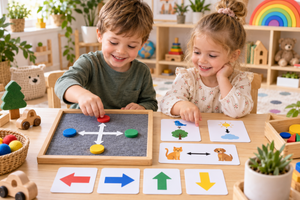
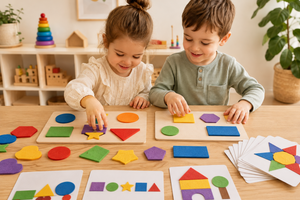
Tic-tac-toe is familiar enough that many adults can begin without reading a long manual. Its educational value comes from the conversation around the moves: “What could happen next?”, “Where do you see two in a row?”, or “Would you like to start again with a different plan?” Keep early rounds light. If the adult plays only to win, the game quickly becomes a test of whether the child can tolerate losing.
If competition feels uncomfortable, begin by making lines or patterns with the pieces, then play collaboratively before introducing ordinary rules.
Pattern work for a child who loves scenes
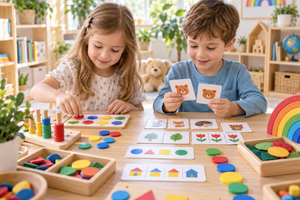
The space and parking sets share a useful action—placing pieces according to a model—but the themes invite different language. With the space set, the child might describe above, below, near, far, before, and after while inventing a journey. With the parking set, the adult can use left, right, between, first, last, facing, and next to in a concrete layout.
Do not begin by correcting every mismatch. Invite the child to compare the model and construction: “What is the same?” and “What would you like to change?” This approach keeps ownership with the child and encourages self-checking. If copying a complete model is difficult, reveal only part of it or place the first piece together.
For more ways to change challenge without replacing a material, see how to adapt one educational game for ages two, three, and four. The same principle works at five: adjust the rule, information, or adult support first.
Number play without turning the birthday into homework
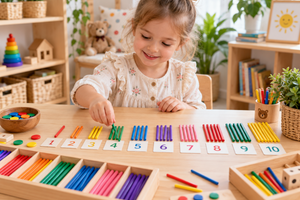
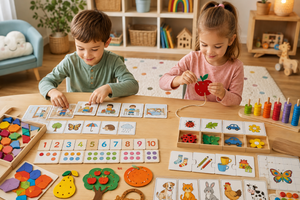
A number-and-quantity set can suit a child who spontaneously counts steps, snacks, cars, or blocks. The key is to preserve meaning. Instead of asking for a rapid sequence of correct answers, offer one small problem: “Can you find the quantity that belongs with this number?” Then let the child handle the pieces, check, and explain.
Vary one element at a time: match a numeral and quantity, compare two sets, arrange a short sequence, or create a playful shop where quantities become “orders.” Stop while the child still wants another turn.
Use a simple gift filter before buying
When several options still look appealing, score them informally against the realities of the child’s home. There is no need to calculate points. A strong “yes” in three or four rows usually matters more than an impressive promise on a product page.
|
Decision check |
A useful “yes” sounds like |
Pause and reconsider when |
|
Interest |
“The child already chooses this theme or action” |
The theme reflects only the adult’s preference |
|
Entry level |
“There is an easy first game the child can complete” |
Every task requires constant correction |
|
Shared use |
“A familiar adult or sibling can join naturally” |
The family lacks time or space for the expected setup |
|
Reusability |
“We can change the rule, model, role, or story” |
There is only one narrow correct response |
|
Practical fit |
“Storage, component size, and supervision suit the home” |
Pieces are likely to be lost or used without suitable supervision |
This filter also helps when browsing a wider selection of educational toys for five-year-olds. Instead of comparing everything at once, remove options that do not fit the child’s preferred action, the family routine, or an achievable first challenge.
Present the gift so the child wants to explore it
Open the gift calmly and give the child time to look and touch. Name the invitation in one sentence—“These pieces can make a space picture”—without demonstrating every possibility.
Use this three-step introduction:
- Explore. Let the child examine and arrange the material freely.
- Offer one small game. Choose the easiest meaningful action and complete it together.
- Leave a future invitation. Store the set where an adult can bring it back without a long search.
If the child changes the rules, ask what they are trying to do. An invented version may contain real planning or storytelling; standard rules can come later.
For families building a steady rhythm around materials, the guide to organising an educational environment at home explains storage, rotation, and presentation. The most useful birthday gift is often not the one left permanently on a crowded shelf, but the one that reappears at the right moment.
Adjust support without taking over
At five, a child may understand a task but still need help with planning, language, or frustration. Useful support makes the next action visible without taking control.
Try one adjustment at a time:
- reduce the number of pieces on the work surface;
- complete the first move together;
- describe position or quantity without pointing to the answer;
- offer a choice between two possible next steps;
- pause the game and return later if tension rises.
After a prompt, watch what happens. If the child continues independently, the support is probably useful; if every move still needs instruction, simplify further.
An educational gift for age five should not become a measure of school readiness. It can, however, create pleasant opportunities to practise listening, explaining, comparing, taking turns, and completing a self-chosen challenge. For a broader view of these abilities, use the play-based school-preparation checklist and activity programme for ages four to six as a flexible reference rather than a pass-or-fail test.
Common gift-selection mistakes
Do not choose only for future usefulness: a material intended for “later” may sit untouched if the child cannot enter the play now. Also avoid equating value with visible difficulty. Long instructions and many pieces do not automatically create richer learning.
A third mistake is buying for a category of child rather than for this child. The phrase what to give a five-year-old boy should lead to questions about his interests, not assumptions about vehicles, competition, or colour. The same applies to gifts described for girls. Themes can be offered widely, and the child’s response can guide the final choice.
Notice process rather than rewarding only correct answers: “You checked the model,” or “You changed your plan.” This supports persistence without promising that one game will transform a skill.
Frequently asked questions
What is a useful educational gift for a five-year-old?
A useful gift matches an existing interest, has an easy first activity, and can be varied over time. Strategy games, pattern-building sets, and meaningful number activities can all work. The best option is the one the child is likely to choose and the family can realistically revisit.
Should a fifth-birthday gift prepare the child for school?
It can support playful practice of abilities used in everyday learning, such as listening, comparing, explaining, hand control, or taking turns. It should not turn the birthday into an assessment. Choose enjoyment and an achievable challenge first; school-related practice can emerge naturally from repeated play.
What should I give a five-year-old boy who already has many toys?
Ignore gender-based lists and ask what action he currently enjoys: planning moves, building scenes, counting, storytelling, or playing with others. A reusable format that adds a new kind of play is often more valuable than another item with a familiar theme.
Is one focused game better than a large multi-activity set?
Often, yes, especially when the focused game fits the child well. A clear invitation can be easier to begin and repeat. A larger set is useful only if its options remain organised and the child can understand how to start without the adult managing every step.
How can I tell whether the gift is too difficult?
Watch the first few attempts. If the child understands the goal after a brief demonstration and can complete part of it with light support, the challenge may be appropriate. If every move requires correction or frustration keeps rising, reduce the task, use fewer pieces, play collaboratively, or set the material aside temporarily.
A thoughtful choice is more important than a perfect choice
There is no single perfect answer to what to give a five-year-old. A strong choice comes from a small set of observations: what the child already loves, how they prefer to play, who will join them, and what first challenge is likely to feel successful. Theme attracts attention, but the action keeps the gift in use.
Choose one format, introduce it without pressure, and allow the rules to grow with the child. A birthday present becomes genuinely educational not because adults call it so, but because it invites the child to return, notice, decide, explain, and create.