How to Teach a Child to Read by Syllables: A Step-by-Step Plan and Card Games
Short answer: if you are wondering how to teach a child to read by syllables, begin with speech sounds, not a string of letter names. Help the child blend known sounds into one spoken and printed chunk, join chunks into a familiar word, and then read that word in a short sentence. In English, syllable work should build on phonics the child has already learned: spelling is not a perfectly transparent code, so do not invent a fixed “one vowel, one sound” rule. Use regular examples from the child’s current phonics sequence, reveal pictures after decoding as a meaning check, and stop a short session before accuracy and interest fade.
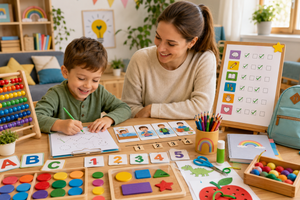
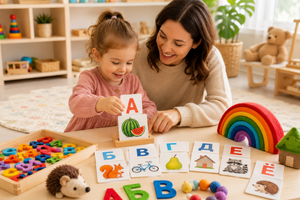
Syllable reading for children supports, but does not replace, sound–letter knowledge, blending, vocabulary, and comprehension. Cards, movable letters, a paper window, and familiar objects are enough. When considering educational toys, choose material that can show one relationship at a time.
The route: sound → syllable → word → sentence
A speech sound is heard; a letter or letter group is its visible spelling. Letter names have a purpose, but a child blends sounds. Map begins with /m/, not the whole name “em.” Use clean sounds, without adding “uh,” and gradually close the gaps.
|
Stage |
What the child does |
A practical example |
A sign to move on |
|
Sound |
Hears a known sound and connects it with its spelling |
Finds /m/ at the start of map and matches it to m |
Distinguishes the target among two or three spoken choices without relying on position |
|
Syllable |
Blends sounds into a spoken and printed beat or chunk |
Blends /s/ /u/ /n/ as sun; identifies two beats in sun-set |
Reads several taught chunks after their order is changed |
|
Word |
Joins syllables and checks that they make a meaningful word |
sun-set, pic-nic, or another regular word from the taught code |
Says the whole word and explains or shows its meaning without guessing from a picture |
|
Sentence |
Reads short words in sequence and carries meaning across them |
Reads a brief sentence containing familiar words |
Answers one simple question about what was read |
This is not an age schedule. A child may name letters yet need oral blending, or blend speech while still learning spellings. Returning one step identifies the action that needs support.
Signs that a child is ready for printed syllables
The child does not need to know the entire alphabet. A more useful starting point is being able to hear a first sound in a familiar word, recognise several spellings already taught, follow two or three sounds in order, and show curiosity about print. The child should also know the vocabulary in the activity. Agree on each picture name before sorting; an image called couch by one person and sofa by another creates a false sound mismatch.
The child should also manage one short rule and repeat an action a few times without distress. If oral blending is difficult, remove print: say /s/…/ʌ/…/n/ with narrowing gaps and ask the child to choose sun from two pictures.
The guide to letters and sounds through play covers this foundation. Begin with known sound–spelling links; a complete alphabet only adds choices.
Preparing syllables for children without teaching a false rule
Make equal-sized cards with clear print, movable graphemes, and separate meaning pictures. Choose examples from patterns already taught. A syllable may be open, as in me, or closed, as in cat; vowel teams, final e, and other patterns need accurate teaching.
Do not present ma, me, mi, mo, mu as if each vowel always keeps one sound. Instead use regular chunks and words, such as sun-set, only when their spellings are known. Select examples by the taught code, not visual neatness.
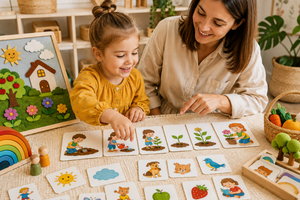
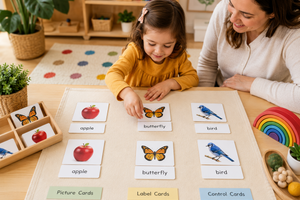
Keep pictures separate. Show print first and reveal the image after blending; otherwise picture naming can look like reading. Use small temporary arcs under syllables rather than huge gaps between them.
Step 1. Blend sounds instead of reciting letter names
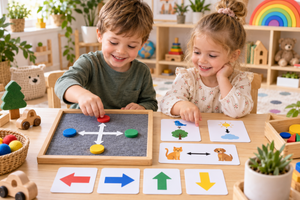
Place a known initial spelling on the left and the rest of a short chunk on the right. Move a finger smoothly beneath the print while producing the sounds with a decreasing gap. Continuous sounds such as /m/, /s/, and /f/ can be stretched briefly. Stop sounds such as /t/, /p/, and /k/ should remain short; do not turn /t/ into “tuh.” Finish by saying the whole chunk naturally.
If the child says “em–a,” clarify: “This letter is called M. Here it represents /m/.” Use a only in a known pattern. Model once, complete one attempt together, then return to an easy example.
Change one feature at a time: first compare shared beginnings, then shared endings. Mix the cards so position cannot supply the answer.
Step 2. Make the syllable a manageable chunk
Say a familiar two-syllable word and clap or tap its spoken beats. Then show the printed word with a light arc beneath each syllable. The child reads the first chunk, keeps it in mind, reads the second, and blends both into the natural word. Remove the arcs after the route becomes familiar so the child also meets ordinary print.
English dictionary syllable boundaries do not always provide the easiest decoding division. Choose a split that respects the taught spelling and leads back to the correct word; replace ambiguous examples.
Mix three or four cards each round. Alternate “Find the chunk I say” with “Read the chunk you chose”; listening recognition and independent decoding are different actions.
Step 3. Join syllables into a meaningful word
Start with familiar two-syllable words made from known patterns. The child reads one part, reads the next, and then says the whole word without an exaggerated pause. Ask a meaning question: “What is a picnic?” or “Can you point to the sunset?” Decoding and understanding should meet at every word.
If the first part is forgotten, say it quietly together and place one token under each chunk. Slide both into one frame when joined. Avoid restarting after every hesitation.
Add one new word among secure examples. If using an invented word to practise the code, label it clearly as pretend; keep most practice meaningful.
Step 4. Move from words to short sentences
Build one sentence mainly from words the child has already decoded. Use normal spaces, large uncluttered print, and a reading window if the next line distracts attention. Model a brief pause after a word, but do not break every familiar word back into letter names. When necessary, mark one longer word into chunks and then read it again as a whole.
Afterwards, ask who acted, what happened, or which object was mentioned. If every word was sounded out but the child cannot answer, reread the sentence together in a natural voice and discuss it. Comprehension is part of reading, not a bonus test after pronunciation.
Begin with one sentence, then two connected sentences. Speech and language through play offers next steps for retelling.
Eight reading games with cards
1. The blending road
A toy travels beneath graphemes as the child blends. Shorten the gaps and finish with the natural chunk.
2. Syllable post boxes
Label two boxes with known chunks. The child delivers and reads word cards, then checks one adult mistake.
3. Find the spoken chunk
Lay out four mixed cards. Say one chunk; the child finds and reads it, then becomes caller.
4. Change one sound
Swap one grapheme in a regular word and blend again. Compare print and sound using known patterns.
5. Word builder
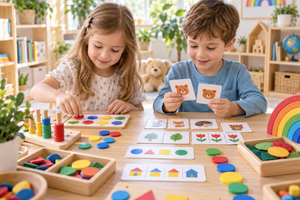
The child orders two familiar chunks, reads the word, and reveals its picture afterwards.
6. Syllable detective
Search familiar words for a spoken chunk. Accept it when heard, not merely when the same letter appears.
7. Reading window
Slide a paper window left to right, revealing one chunk or word, then reread the full line.
8. Sentence switch
Build and read a sentence from word cards, change one card, and explain the new meaning. See 25 learning-card games for more formats.
A flexible two-week practice plan
This plan controls adult pacing; it promises no fourteen-day outcome. A session may last 8–15 minutes and end sooner when accuracy fades. Repeat a stage while prompts remain necessary.
|
Days |
Main purpose |
Sample material |
Quick check |
|
1–3 |
Blend two or three known sounds orally and in print |
Movable graphemes and a finger track |
The child uses sounds rather than full letter names |
|
4–6 |
Read three to five taught chunks in changing order |
Plain chunk cards from the current phonics sequence |
Reading survives a new position and order |
|
7–8 |
Hear syllables in familiar spoken words |
Claps, tokens, and two-syllable picture names |
The child keeps the whole spoken word after segmenting it |
|
9–11 |
Join two printed chunks into a familiar word |
Two-part words with known spelling patterns |
The child says the whole word and checks its meaning |
|
12–14 |
Read a known word in one short sentence |
One uncluttered sentence and a meaning picture |
The child answers one question about the sentence |
Use the full cycle for a small word set if needed. Changed order and games reveal more than continuously adding cards.
What to do when blending stalls
When a child recites names, return to clean sounds and a moving finger. When the first sound is forgotten, shorten the gap and reduce the word to a familiar part. When the picture invites guessing, cover it. When similar letters are confused, leave one target beside a visibly different choice. Change the single source of difficulty rather than repeating the same unsuccessful task five times.
After an error, model one correct example, complete one together, and finish with a secure item. Begin the next session one step easier. Persistent difficulty hearing sound differences, understanding spoken language, producing speech, or managing print deserves individual discussion with an appropriate qualified professional; a home guide cannot identify a cause.
Common teaching mistakes
- Blending complete letter names instead of the sounds represented in the word.
- Adding an extra vowel to consonants, such as turning /m/ into “muh.”
- Treating English as a perfectly regular one-letter, one-sound system.
- Displaying a huge syllable chart before one blending action is understood.
- Keeping cards in a memorised order instead of mixing them.
- Showing the answer picture before the child attempts the print.
- Introducing vowel teams, final e, digraphs, and several new rules together.
- Measuring speed while ignoring accuracy and meaning.
- Turning every shared story into a decoding test instead of also modelling fluent reading.
Choosing and using materials
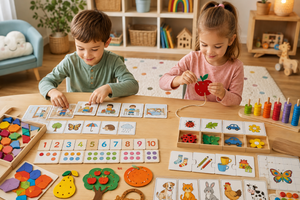
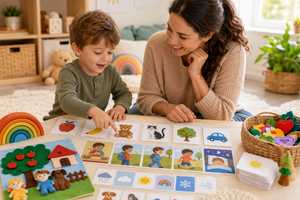
In the Language and Reading cards section, check the language, exact words, print style, and intended task of any set. A visually appealing word is not automatically suitable for first blending. The wider collection of educational cards for kids can provide pictures and sorting formats, but the adult still names today’s single purpose: hear a sound, read a chunk, build a word, or understand a sentence.
Homemade material is also enough: print a few known chunks, cut movable graphemes, and choose three familiar pictures. Keep mastered cards separate from new ones so familiar examples remain the majority. Clear sequencing and accurate modelling matter more than the number of sets.
Frequently asked questions
At what age should syllable reading begin?
Look at readiness, not one birthday: interest in print, several secure spellings, awareness of sounds in familiar words, and the ability to keep two or three sounds in order.
Must a child know the whole alphabet first?
No. A small set of secure sound–spelling links is enough. Add graphemes gradually; the full alphabet can remain a reference.
What if the child says letter names instead of blending?
Clarify: “This letter is called M; here it represents /m/.” Blend with a narrowing gap and smooth finger movement, then return to an easy example.
How many syllables should appear in one session?
Begin with three or four mixed familiar chunks. Add one when they are read without positional or constant adult prompts.
When is a child ready for sentences?
Move on when known chunks become meaningful words without picture guessing. Offer one mostly familiar sentence and ask one meaning question.
Conclusion
The route runs from sound to syllable, word, and sentence. In English it must follow accurate phonics, not a memorised chart. Pictures check meaning after an attempt; they do not decode.
Keep practice brief, vary one condition, and preserve fluent adult read-alouds. When print leads to meaning, syllables become a bridge rather than an isolated drill.