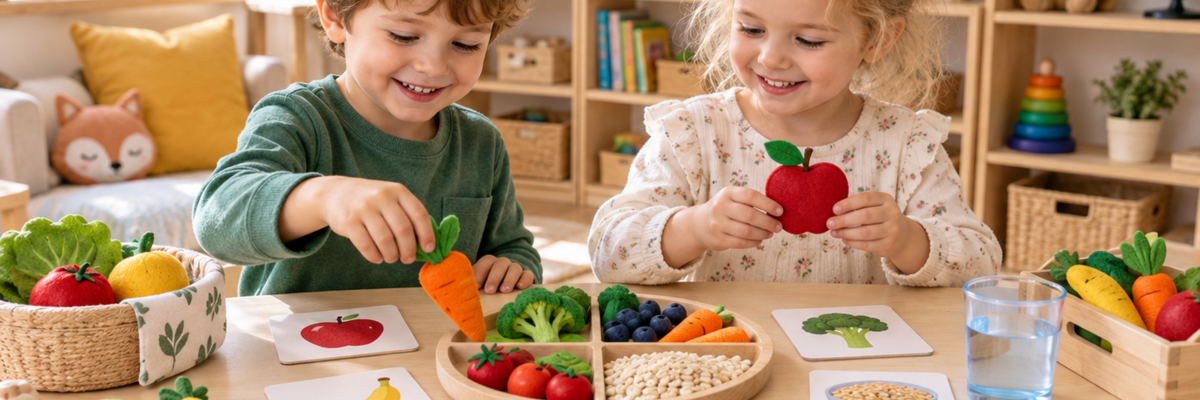
Healthy and unhealthy food for children: how to discuss balanced eating through play
“Is this food healthy or unhealthy?” sounds like a simple question, yet a rigid answer rarely helps a preschooler understand eating. An apple does not make someone “good”, and a slice of birthday cake does not make them “bad”. What matters is the wider pattern: the variety offered over time, regular access to water, how often foods high in added sugar or salt appear, and whether meals feel safe rather than judgemental.
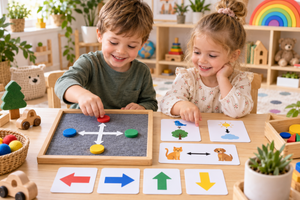
It is more useful to introduce healthy and unhealthy food for children through exploration, not bans. Which groups can we find? What forms the basis of meals? What might we choose less often? Cards, sorting and a pretend shop let children compare without judging bodies or appetites. Among Learn&Dream’s educational toys and materials for shared activities, adults can choose formats for classifying, storytelling and changing the rule.
Why “completely good” and “completely bad” foods are unhelpful
Black-and-white labels are memorable, but they distort a much bigger picture. One item does not define an entire diet, and one sweet does not erase the vegetables, grains, beans, eggs, fish or other foods eaten during the day. Foods that contain a great deal of added sugar, salt or saturated fat do not need frightening names. An adult can simply explain that the family chooses them less often and usually in smaller amounts.
Calling a food “bad” may also make a forbidden item more appealing or create guilt when a child eats it at a celebration. A conversation about wellbeing then becomes a test of obedience. Neutral wording leaves room for nourishment, flavour, family traditions and the pleasure of eating together.
Describe a food’s place in the overall pattern rather than its moral value. Vegetables, fruit, whole grains, pulses, eggs, fish, meat, dairy foods or suitable alternatives can contribute to varied everyday meals. Sweet drinks, highly salted snacks and confectionery are not “poison”, but they should not displace water and nourishing foods that are offered regularly.
Words that guide without creating shame
A preschooler understands a concrete action more easily than a lecture about nutrients. Try: “Water is a good drink when we are thirsty”, “Let’s add a vegetable to lunch”, or “This is a party treat and we can enjoy it.” There is no need to threaten illness, promise extraordinary strength after broccoli or connect a food choice to appearance.
|
Instead of saying |
A neutral alternative |
The message a child receives |
|
“That is bad food” |
“We choose this less often and usually eat a variety of nourishing foods” |
Context matters; there is no guilt |
|
“Eat vegetables so you will be healthy” |
“Vegetables differ; which one would you like to explore?” |
Choice replaces a magical promise |
|
“You are not allowed sweets” |
“Sweets can be treats, while water is our usual drink for thirst” |
The boundary is clear but not dramatic |
|
“One more bite for me” |
“Check your tummy: are you still hungry or beginning to feel full?” |
Internal signals deserve attention |
|
“You never eat anything healthy” |
“You have rice and egg. Which fruit or vegetable shall we add?” |
The adult notices and offers a step |
|
“That will make you fat” |
“We can talk about taste, variety and how often we choose it” |
A body is not something to grade |
The same approach belongs in play. If a card lands in an unexpected group, do not say that the child “does not know healthy food”. Ask: “What rule did you choose?”, “Could it fit somewhere else too?” or “When do we usually eat it?” A yoghurt card can belong to dairy foods, breakfast or a snack. More than one answer may be sensible.
The food groups behind a varied pattern
Healthy eating for preschoolers is easier to represent with broad groups than with a long list of approved dishes. A varied pattern can include vegetables and fruit, grain foods, protein sources, dairy foods or appropriate alternatives, with water as the usual drink. The combination depends on culture, access, season and individual needs.
Vegetables and fruit differ in colour, flavour and texture. A child need not like every kind; calm, repeated encounters are more useful than pressure. Grains include oats, rice, buckwheat, pasta and familiar staples. Protein sources include pulses, eggs, fish, meat, nuts and seeds in age-safe forms. Milk, plain yoghurt, cheese or suitable alternatives make another group.
A plate model can be a visual prompt, not a ruler applied to every meal. Part of an imaginary plate can hold vegetables and fruit, another part grain foods, and another protein foods. Soup, stew, casserole and mixed dishes will not always show neat sections, although they can still combine several groups.
Healthy foods for children do not have to be expensive, exotic or arranged for a photograph. A seasonal apple, carrot, oats, beans, an egg or plain yoghurt can be ordinary building blocks. No “superfood” replaces variety, and no single ingredient guarantees health.
Frequency is clearer than a forbidden list
Two baskets labelled “allowed” and “not allowed” are too rigid for real life. Try three time frames: “often in different combinations”, “sometimes” and “particular occasions”. These are not marks awarded to foods or a universal calendar; they simply reveal an overall pattern.
Water, vegetables, fruit, grains and varied protein sources might appear in the first group. Birthday cake, a sweet drink at a celebration or a highly salted snack may belong in a less-frequent group. Do not argue over one official placement: recipes and family customs differ.
If “special occasions” turns sweets into a prize, rename the field “choose less often”. Avoid paying for vegetables with dessert. That trade teaches that vegetables are an unpleasant duty and sweet food is the valuable reward. Treats can be served in a predictable context without bargaining.
An educational food game that grows with the child
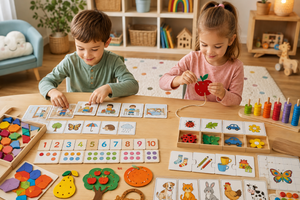
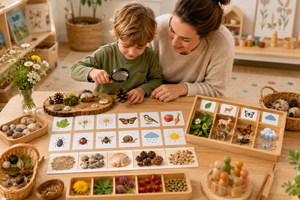
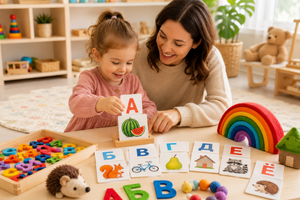
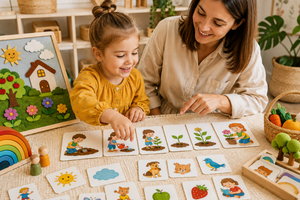
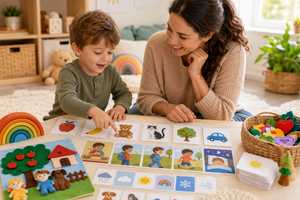
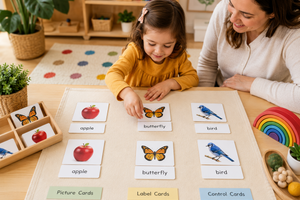
The first activity should test whether the rule is clear, not whether the child already knows nutrition. Present four to six pictures, name the foods and allow time to look. The Food and Drinks demonstration cards can support this first meeting; display a small selection rather than the whole set.
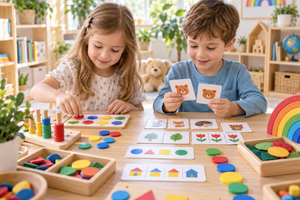
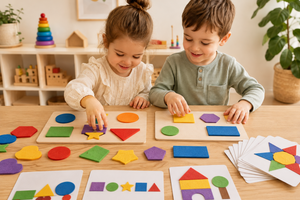
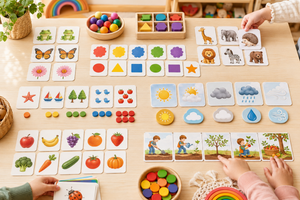
Next choose one visible or familiar distinction: food and drink, fruit and vegetables, ingredients for breakfast and lunch, or foods from plants and animals. The Food and Drinks sorting set can be used with new storylines, although a vocabulary-sorting activity should never be presented as medical guidance.
Once sorting feels easy, invite an explanation. “I put the banana with breakfast because we eat it with porridge” reveals more thinking than a guessed label of “healthy”. It connects the picture to real experience and builds language at the same time.
Seven playful activities without a nutrition test
|
Activity |
How to play |
What to discuss |
A small next step |
|
A colourful plate |
Choose produce in three colours |
Colour, flavour and familiarity |
Build another plate without repeats |
|
The family shop |
“Buy” ingredients for one meal |
Which group each item fits |
Plan a menu with five counters |
|
Build a breakfast |
Add a grain, protein food, produce and drink |
Why water suits thirst |
Make two different versions |
|
Often or less often |
Place cards on two fields without using “forbidden” |
Frequency depends on the whole pattern |
Add a party or travel situation |
|
What changed? |
Remove one card from an imaginary plate |
Which group now has less representation |
Suggest two possible replacements |
|
Teddy’s café |
Prepare an order for a toy |
Preferences and the right to decline |
Let the child become the waiter |
|
Food detective |
Describe a card without naming it |
Origin, shape, colour, preparation |
Search with two clues |
For Food Detective, the Fruit and Vegetables demonstration cards support a progression from naming the picture to describing it without saying its name. A step-by-step guide to sorting by different features helps change the rule again: the child classifies a visible property rather than judging “healthiness”.
A fifteen-minute session with a clear shape
Choose one goal before beginning. If the child is learning names, do not simultaneously introduce food groups, frequency and a plate model. Lay out five to seven cards, name them and ask the child to find two familiar items. An easy opening creates a chance to understand the material before a new rule appears.
Spend the next five minutes on one activity. Demonstrate one move and give the turn to the child. If a card seems misplaced, ask for the rule before correcting it. If the rule disappears, reduce the field or restore an open example.
Finish by carrying one observation into daily life: “Which fruit do we have at home?”, “What shall we take to drink on our walk?” or “Which ingredients can you see in the soup?” Stop after a few successful turns. An educational food game should not become a test of what the child agrees to eat at dinner.
In a small group, Food and Drinks Bingo adds listening and turn-taking. The caller shows or names an item and players find it on their boards. After a match, ask one neutral question: “Is it a drink or a food?”, “What colour is it?” or “Which dish might contain it?” Never ask children to disclose publicly who eats “properly” at home.
Exploring real food without turning it into a trial
Everyday participation gives words meaning. A child can wash a cucumber, tear lettuce, stir safe ingredients, choose between two fruits or set out napkins. Preparation offers contact with smell and texture without requiring a taste.
Do not require three more bites in exchange for praise or dessert. The adult organises suitable meals, offers variety and manages safety; the child can notice hunger, fullness and preference. A refusal today does not mean the food must disappear forever or be hidden in another dish. It can be offered calmly another time alongside something familiar.
Real foods must be prepared in age-appropriate sizes and textures. Whole nuts, uncut grapes, hard pieces and other potential choking hazards require suitable modification and close adult supervision. Sorting cards and counters also need to match the age guidance of the set, particularly where small pieces are involved.
Supporting a selective eater
Wariness of unfamiliar foods is common during the preschool years. At first, a child may only tolerate a new item on the table, then perhaps touch, smell or lick it. These are possible stages of exploration, not a ladder that must be completed during one meal.
Predictability helps: a familiar food beside a new one, a small amount for exploration, a calm tone and no running commentary on how much has been eaten. In play, look for similarity rather than the “healthiest” choice: two crunchy foods, two red foods or two round foods. The unfamiliar item then becomes an object to investigate rather than a character test.
A persistently narrow food range, repeated coughing, choking or gagging during meals, pain, clear difficulty chewing or swallowing, concerns about growth, or intense fear of food needs more than a game. A paediatrician can assess the situation and refer to other professionals when appropriate. A child’s diet should not be changed for known allergies, medical restrictions or special dietary needs on the basis of cards or general online guidance.
When a helpful idea turns into pressure
Do not use play as a hidden contract: correctly sorting a vegetable does not create an obligation to eat it. Avoid praise for a “clean plate” and comments about weight, body shape or another person’s portions. Children absorb adults’ diet talk too. Eating patterns matter, but no food group guarantees an outcome or replaces healthcare.
Finally, do not overload the session. Twenty cards, three rules and a lecture will quickly feel like an exam. Begin with one small field and one question. The Home and Everyday Life category offers more story-based materials, but one set and several well-understood turns are enough for a useful meeting.
Frequently asked questions
Should adults use the words “healthy” and “unhealthy” at all?
They can be simplified everyday terms, but not permanent moral labels. Discuss varied nourishing foods offered regularly and foods high in added sugar, salt or saturated fat chosen less often. Eating never makes a child good or bad.
How can I explain why sweets are not an everyday food?
Sweets can be enjoyable treats, while children need different foods and water each day. Do not threaten illness or make dessert payment for the main course. A predictable boundary is easier than a sudden ban.
When can children begin sorting foods into groups?
At about two to three years, many children can try two obvious groups with four to six large pictures, such as food and drinks or fruit and vegetables. Older preschoolers can explore grains, protein sources, meal ingredients and frequency. Follow the child’s understanding of the rule rather than relying on age alone.
Will a game persuade a child to eat vegetables?
Play can make vegetable names, shapes and properties more familiar, but it cannot guarantee immediate tasting. Do not make eating a condition of the activity. Calm repeated opportunities, involvement in preparation and an absence of force support familiarity; significant feeding difficulties belong in a conversation with a paediatrician.
How can a preschool group explore food without judging families?
Use an imaginary plate, shop or character’s menu. Ask about features and possible combinations rather than what an individual child ate at home. Accept more than one reasoned answer, avoid ranking the “healthiest” lunchboxes, and follow the setting’s allergy and food-safety procedures.
A practical ending: change one phrase and play one game
Begin with language. For one week, replace “bad”, “forbidden” and “earn your dessert” with specific words about groups, frequency, taste and context. Leave bodies out of the judgement, and do not ask a child to prove obedience through the amount eaten.
For the first game, choose six cards and two fields: “choose often in different combinations” and “choose less often”. Place one example, listen to the child’s reasoning and allow the rule to change. Next time, use the same pictures to build breakfast or run a pretend shop. Food then becomes a subject for thinking and everyday decision-making, not a reason for shame.