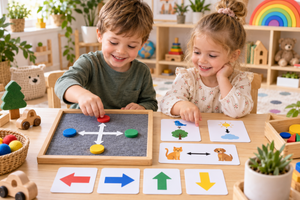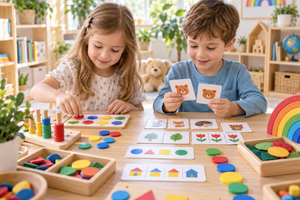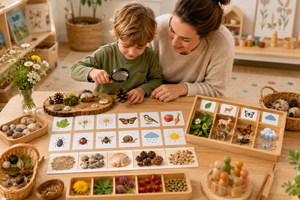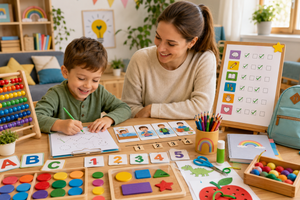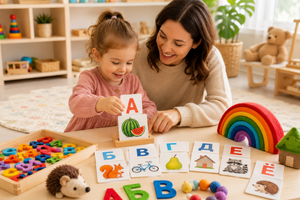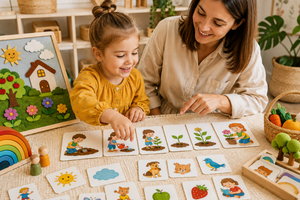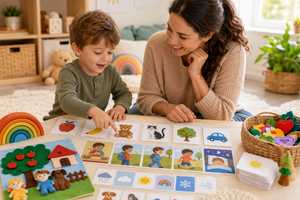
Finding two identical pictures looks simple, but it requires several mental steps. The child studies an image, identifies important features, compares options, remembers the rule, and checks the choice. When cards are face down, the task also involves remembering their locations and waiting for a turn.
Matching games are not limited to the classic memory game. A child can pair an object with its silhouette, join two parts of one whole, match an animal to its home, or connect an ingredient with a finished food. Changing the kind of relationship—not only adding more cards—gradually develops attention, visual memory, language, and logical thinking. The practical sequence below will help you choose an achievable level and make the activity harder without overwhelming the child.
Key takeaways
- Start with all cards face up and two or three very clear pairs.
- Offer identical pictures first, followed by object-to-silhouette, part-to-whole, logical, and associative matches.
- Change only one variable at a time: the number of pairs, picture similarity, card position, or the rule.
- Invite the child to name a feature or explain a connection, but do not turn every move into a quiz.
- Use the child’s current skills as your guide; age ranges are helpful starting points, not strict standards.
What skills do matching games develop?
In every matching activity, a child has to understand why two elements belong together. With identical cards, accurately comparing details is enough. In an “object and silhouette” task, the child recognizes a shape without color or texture. A logical pair requires knowledge about the world: a key opens a lock, an umbrella is used in the rain, and a bird lives in a nest.
Regular, short matching activities support several skills at the same time:
- visual perception as the child notices outlines, colors, direction, small details, and differences;
- focused attention by keeping the rule in mind and attending to the relevant feature;
- working and visual memory by remembering a card and where it was placed;
- logical thinking through finding a relationship, testing a guess, and rejecting options that do not fit;
- language by naming objects, describing similarities, and explaining why two items belong together;
- self-regulation through taking turns, following the rule, and calmly turning cards back over when they do not match;
- fine motor control by picking up, flipping, rotating, and accurately placing cards or felt pieces.
A matching game is not a diagnostic test, however. A child may quickly pair identical face-up pictures but struggle when the same cards are turned over. This does not mean the child “cannot match.” The activity now includes another demand: remembering locations. Look at each component separately and change the conditions in small steps.
Which matching games are appropriate at each age?
Age can suggest a starting level, but experience and readiness matter more. For an introductory game, a toddler only needs to look at two pictures, copy a short demonstration, and choose between two options. If the rule keeps getting lost, reduce the number of pieces or turn the cards face up.
|
Approximate age |
Good starting point |
Activity format |
Next step |
|
18–24 months |
Two or three face-up pairs with large, clear pictures |
Find two identical pictures or place a real object on its picture |
Add one pair or switch to another familiar theme |
|
2–3 years |
Three to five face-up pairs; a simple object and silhouette |
Match identical items, colors, shapes, characters, and shadows |
Turn over some cards or introduce a part-to-whole pair |
|
3–4 years |
Four to eight pairs in a memory game and clear logical relationships |
Remember locations, assemble wholes, and explain a simple connection |
Add similar images and ask the child to justify a choice |
|
4–6 years |
Eight to twelve pairs, associations, and links based on function or habitat |
Take turns, consider more than one possible match, and invent a rule |
Set a limit for one turn or let the child create a set |
Children do not need to move through every level at the same pace. A child who knows a great deal about animals may easily match each animal with its home but still need a smaller memory board. A familiar topic reduces the language demand, so introduce a new rule with objects the child already understands.
How to introduce a matching game
Prepare a small, easy-to-read set
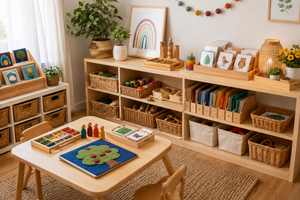
Choose two to four pairs without distracting decorative details. The pictures should be clearly different from one another: an apple, a car, a cat, and a cup are easier than four similar flowers. For toddlers, use large pieces that are comfortable to grasp and meet age-appropriate safety requirements.
Demonstrate one complete match
Place one sample and two possible choices in front of the child. Pick up the matching card and say briefly, “Here is a cat, and here is a cat. They match.” Return the pieces and invite the child to find the next pair. One clear demonstration is usually enough; a long explanation adds an unnecessary memory load.
Keep every picture face up at first
The classic face-down memory game is not the first level. When all cards are visible, the child learns the underlying idea of matching. After several confident games, turn over two or three pairs. This way, you can tell whether a new difficulty comes from memory rather than from not understanding what a pair is.
Allow time for an independent decision
Pause after asking a question. If the child hesitates, narrow the choices or direct attention to a feature: “Look at the ears,” “What shape is this piece?” or “What goes with the lock?” Do not move the card for the child. Finding and correcting a choice independently is an important part of learning.
Practical activities with different types of pairs
1. Identical pairs: same goes with same
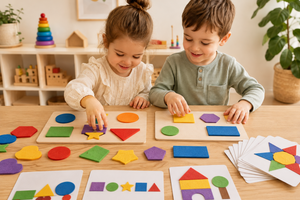
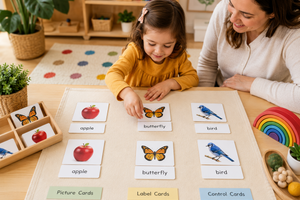
This is the simplest and clearest type of match. Arrange one picture from every pair in a row and shuffle the duplicate cards. The child places each copy beside its sample. To support language, name the object and one feature: “yellow bus,” “large apple,” or “cat with white paws.”
When the face-up version becomes easy, turn the set into a memory game. Start with two pairs: turn four cards face down, flip two cards on each turn, and keep a pair that matches. If the pictures differ, return them to the same places. A child needs to see that an incorrect match is not punished; it provides useful information for the next turn.
2. Object and silhouette
A silhouette removes color and many internal details, so the child relies on outline, proportion, and distinctive features. Begin with objects that have very different shapes, such as a tree, mushroom, car, and bird. Place the color pictures on one side and the shadows on the other, and allow the child to lay a piece over its silhouette.
To make the task harder, add similar outlines, rotate an object, or ask the child to choose the correct shadow without laying it on top. Invite an explanation: “This is the teapot’s shadow because I can see the spout and handle.” A visual task can then support descriptive language at the same time.
3. Part and whole
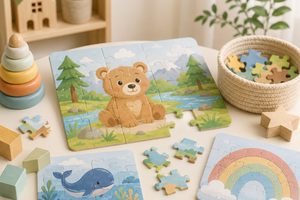
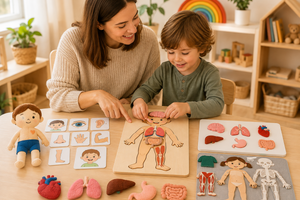
Cut simple pictures into two unequal parts, or use ready-made pieces that form a complete image. Show the whole picture as a model at first. The child can follow a continuing line, color, symbol, or the shape of an edge. Fruit, animals, vehicles, geometric designs, and decorative hearts all work well.
At the next level, remove the model and mix the halves from two or three pictures. A harder variation asks the child to identify the whole from a fragment: show a wheel and decide which vehicle it belongs to. These activities build the ability to form a complete mental image from partial information, a skill used later in puzzles, diagrams, and spatial tasks.
4. Logical and associative pairs
Items in a logical pair do not look alike, but they are meaningfully connected. Start with obvious functional relationships: toothbrush and teeth, key and lock, cup and saucer, shoe and foot. Then try animal and baby, animal and home, ingredient and food, occupation and tool, or weather and clothing.
An explanation is especially important here. Ask, “Why do these go together?” or “Could you make a different pair?” Both an umbrella and rain boots could match rain. If a child can justify the connection, do not reject an original answer only because the set’s answer key suggests another option. Flexible thinking is more valuable than mechanically reproducing one expected match.
How to make matching games harder without overwhelming a child
Change only one variable at a time. If you add many cards, make the pictures more similar, and turn them face down at once, you will not know what caused the difficulty. A practical progression looks like this:
- Face-up identical pairs. Use two or three pairs, clear pictures, and a choice between two options.
- More face-up pairs. Add one pair at a time without changing the rule.
- A new kind of match. Introduce a silhouette or part-to-whole relationship, but reduce the number of pieces again.
- Face-down memory. Turn over two pairs first, then four, six, and more.
- Similar pictures. Add items that differ only in color, direction, or one small detail.
- A logical connection. Ask the child to find a pair and explain the reason.
- More than one possible answer. Invite the child to choose the best match or offer an alternative.
- A child-created set. Let the child draw or collect pairs and state the rule for an adult.
Readiness for the next level is not about record speed; it is about steady understanding. The child completes most matches without constant hints, notices at least some mistakes, and remains interested. If successful attempts are rare, step back once: turn the cards face up, remove extra choices, or replace an unfamiliar topic.
Which Learn&Dream materials work for matching activities?
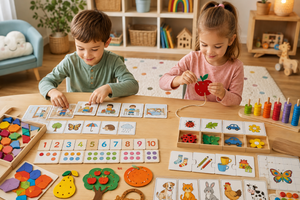
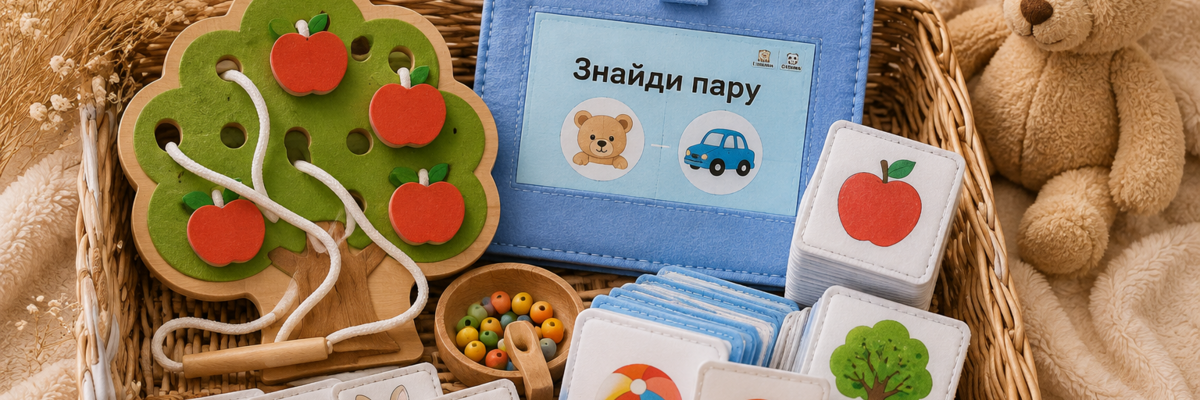
Matching materials are most useful when they have a clear learning action and can be played in several ways. The collection of educational cards for sensory development and logic includes activities for memory, visual matching, classification, and associations. Choose a level based on the relationship a child needs to identify, not simply the number of pieces in the package.
|
Material |
Type of pair |
Main skills |
How to adjust difficulty |
|
Identical pictures |
Visual memory, attention, and English vocabulary about toys |
Match cards face up first, then play with two to four face-down pairs and add new ones gradually |
|
|
Object and silhouette |
Outline recognition, visual analysis, and hand-eye coordination |
Let the child lay a piece on its shadow, then match without testing and describe the identifying features |
|
|
Part and whole |
Shape and symbol recognition, spatial thinking, and fine motor control |
Begin with two hearts and a visible model, then mix more halves and remove the prompt |
To vary the activity, combine cards with movement, real household objects, or a short storytelling prompt. If handling and aligning pieces is difficult, reduce the visual demands, use larger elements, and allow the child to practice the hand movement separately before returning to a more complex matching rule.
How to use matching games at home and in preschool
At home: short, regular, and in different settings
Five to ten minutes is enough when the child is rested. You do not need the entire set every time: match three face-up pairs today, find silhouettes tomorrow, and pair socks after laundry over the weekend. Repeating the rule with different materials helps the skill transfer.
In a shared memory game, follow the same rules as the child: turn over two cards, return an unmatched pair, and avoid prompting every move. Model calm losing and celebrate another player’s match. If abilities differ greatly, let the child take the first turn.
In preschool: stations, partner work, and shared explanations
For a large group, set up stations for four to six children. Children find identical pictures at the first, silhouettes at the second, and logical pairs at the third, then rotate. Everyone gets more opportunities to act and spends less time waiting.
When children work in pairs, one chooses a card and the other finds its match; then they switch roles. At the end, the teacher can show two or three pairs and invite explanations. Hearing several ways to describe a similarity or logical relationship is more useful than requiring one fixed sentence.
Common adult mistakes during matching games
- Starting with a face-down memory game. First make sure the child understands pairs when every picture is visible.
- Using the complete set immediately. A large number of cards creates a heavy visual load; extra pairs can wait.
- Changing several conditions at once. Introduce a new type of relationship with a few familiar pictures.
- Focusing only on speed. A slow choice with a clear reason can be more useful than a fast guess.
- Correcting with the adult’s hands. Direct attention to a detail or narrow the choices, but let the child move the piece.
- Rejecting an original logical match. If the connection is possible and the child can explain it, discuss it instead of automatically saying it is wrong.
- Playing until the child is tired. Stop after a successful turn or one complete round while the child still wants to play again.
Safety also matters. Card and piece size, strength, and construction should be appropriate for the child’s age. Remove damaged elements and supervise any activity that contains small parts.
Frequently asked questions
At what age can a child start playing matching games?
At about 18–24 months, many children can try two or three face-up pairs with large, clear pictures. A classic face-down memory game usually comes later, after the child can confidently match identical items and briefly remember where a card was placed.
How many pairs should I use for a child’s first memory game?
Start with two pairs, or four cards. Add one more pair after several confident games. If the child flips cards randomly without using information from previous turns, return to face-up matching or reduce the playing area.
What should I do if my child finds matches only by chance?
Turn every picture face up and practice the matching rule again. Ask the child to study one card, name a noticeable feature, and then look for its pair. In a face-down game, keep cards in fixed positions so their locations can actually be remembered.
How are logical pairs different from a regular memory game?
A regular memory pair contains two identical pictures. Logical pairs are linked by meaning, such as animal and home, occupation and tool, or ingredient and finished food. They rely more heavily on world knowledge, associative thinking, and the ability to explain a relationship.
How do I know when to make a matching game harder?
A child is ready when the rule is understood, most matches are completed without constant help, some mistakes are corrected after a neutral question, and interest remains. Add only one challenge: another pair, a similar picture, or a new kind of relationship.
From identical pictures to independent logical connections
An effective matching game progresses from simple to complex: a few face-up identical pictures, an object and silhouette, part and whole, face-down memory, and finally logical or associative connections. Add each new level when the previous one is understood, not simply because the child is older.
Leave room for a pause, an independent check, and an explanation. Matching then becomes practice in observing, remembering, comparing, reasoning, and noticing relationships in everyday life.