Safety Rules for Children: At Home, Outside, and with Strangers
A rule helps only when a child can turn it into a short action. “Be careful” is too broad. The steps are to stop, move away, call an adult, and tell what happened; a child can rehearse each one. Adults remain responsible for the environment, supervision, transport, and real assistance. No conversation makes a preschooler responsible for preventing every risk.
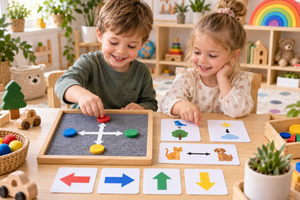
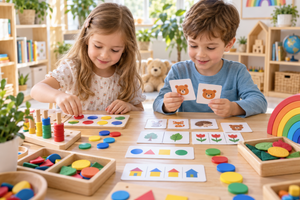
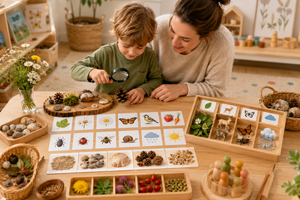
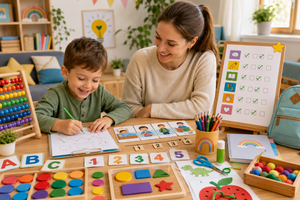
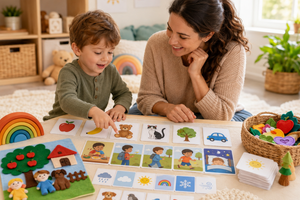
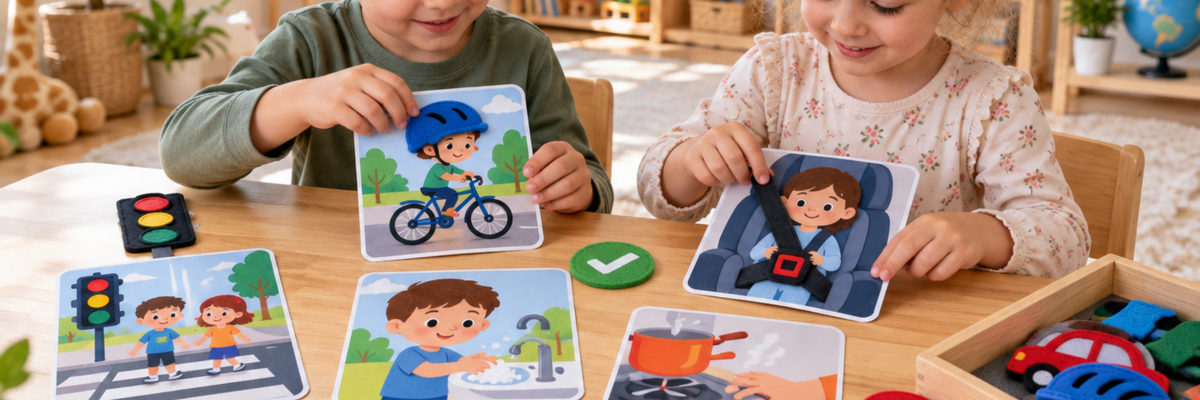
This guide covers situations at home, near roads, on public transport, when a child becomes separated, and during contact with other people. Practise them openly and calmly, without frightening stories or secret tests. A doll, a picture, or other educational toys for calm safety practice let a family pause a scene, consider a choice, and repeat the action without exposing a child to danger.
Four actions are more useful than dozens of prohibitions
Begin with one sequence that transfers across settings. Stop: do not touch, continue, or agree automatically. Move away: increase the distance from traffic, smoke, an unknown object, or a person whose behaviour feels wrong. Get help: find the child’s own adult, a police officer, or a previously identified security guard, cashier, driver, or other worker. Tell: report what happened even if the child accepted a gift, followed for a moment, became frightened, or forgot the practised rule.
The last action matters. Freezing, confusion, or compliance with an insistent adult can be automatic responses, not misconduct. “You can always tell me, and I will help first” is safer than threatening punishment.
Familiarity does not guarantee safe behaviour, while an unfamiliar cashier may help. Teach actions, not labels: leaving without caregiver confirmation, demanding secrecy, touching without consent, blocking a route, or ignoring “no.”
A practical family map
|
Situation |
Child’s action |
Adult preparation |
Short practice phrase |
|
Smoke, flames, or a burning smell at home |
Does not hide; leaves by the practised route and calls an adult |
Removes hazards, shows exits and the meeting point, practises requesting help |
“Get out, call, do not go back” |
|
Medication, chemicals, a sharp or hot object |
Does not touch and tells an adult immediately |
Locks or places hazards out of reach instead of relying on memory |
“Do not take it; get an adult” |
|
Kerb, driveway, or car-park exit |
Stops before the edge and crosses at an agreed place with the adult |
Chooses a safe route and models checking traffic every time |
“Stop at the edge; look together” |
|
Child notices they are lost |
Stays in a visible safe place, calls their adult, and approaches an identified worker |
Teaches names and a phone number, chooses a meeting point, keeps a current photo |
“Stay here and ask a worker to help” |
|
Family members are separated in transit |
Follows the route-specific family plan and asks transport staff for help |
Makes one concrete plan for the familiar journey before travelling |
“Do not chase; ask the worker” |
|
Someone asks the child to leave, enter a car, or hide a secret |
Says no, moves toward people, calls loudly for help, and tells their adult |
Makes clear that politeness never outranks safety and identifies places to run to |
“No. I am not going. Help!” |
Child safety at home starts with the environment
Child safety at home cannot depend on memory. Medication, chemicals, matches, lighters, sharp tools, and hazardous batteries need to be locked away or inaccessible. Adults secure hot liquids, cords, windows, and unstable furniture. A spoken rule adds information; it does not replace prevention.
Use one boundary for unknown substances, loose wires, and broken material: do not pick them up; show an adult. Similar-looking liquids may have different contents, so the action depends on adult permission rather than guessing.
Transfer independence in safe portions. A child may wipe water while an adult removes glass, or place an unbreakable cup but not carry boiling water. The guide to everyday life skills through play gives further examples without transferring adult-level risk.
If there is smoke or fire
The central child action is to leave the dangerous place and never hide. Toys and belongings stay behind; the child does not return or attempt to fight a fire. Once outside, everyone goes to the agreed meeting point and informs an adult. A child who is already in a safe place and has no adult nearby can request emergency help using a practised call sequence.
In Ukraine, 112 connects callers with emergency assistance. The established numbers also operate: 101 for fire and rescue, 102 for police, 103 for emergency medical help, and 104 for the emergency gas service. A child needs one primary number, their name, an address or landmark, and a short answer to “What happened?” Practise on a toy phone, never a real line. Elsewhere, teach the current local numbers and instructions.
Walk the route in ordinary conditions rather than surprising a child with theatrical smoke or alarms. Identify usable exits and an outdoor meeting point. Adapt the plan to the actual building and local instructions.
Electricity, gas, and unknown substances
A child does not repair a socket, pull at a jammed plug, or approach a fallen wire. They move away and get an adult. If gas is suspected, no one should operate a light switch, create a flame, or search for the leak. The adult leads everyone out and contacts the appropriate service from a safe place.
Do not call medicine “sweets.” Only an authorised adult gives it in the intended amount. A child immediately reports a substance entering the mouth or eyes or spilling on skin. Unless a medical or emergency professional instructs otherwise, do not induce vomiting or give a “neutralising” drink; obtain appropriate help instead.
When an older child is left at home in a lawful, age-appropriate situation, they do not open the door to an unplanned visitor or announce that no adult is present. Adults assess the child’s age and maturity, the home, communication, and access to help. This rule does not make leaving a young child alone safe.
Outside: roads, play areas, and getting lost
Young children remain beside an adult near traffic and hold hands where needed. Everyone stops before entering the road, checks traffic, and uses an appropriate crossing without emerging from behind a parked vehicle. A green signal permits movement but does not prove every driver has stopped.
Set a clear boundary between play space and vehicle routes. Garage exits, car-park lanes, and gaps between parked cars are not hiding places. If a ball reaches the road, the child stops and gets an adult. Reflective items improve visibility after dark but do not replace a safe route or supervision.
When a child notices they are lost, stopping is safer than running randomly. In a shop, they can approach a cashier, guard, or identified worker. Elsewhere, they can seek a police officer, uniformed worker, or an adult with children while remaining visible. They give their name and caregiver’s phone number but do not leave with an unknown person to search.
Unknown packages, ammunition, or fragments may also be found outside in Ukraine. Do not touch, move, or approach them to take a photograph. Retrace the safe route, alert an adult, and report the object through 101, 102, or 112 from a safe distance. Adults must not send a child back to point out the object more closely.
Public and private transport
Wait back from the road or platform edge. Let passengers exit before boarding, then enter without pushing. Inside, a child sits or holds a rail, stays away from doors, and keeps hands and head inside. In a car, the adult uses the legally required seat belt and child restraint suitable for the child and current rules on every journey.
No separation instruction fits every transport system. The action depends on who remained behind, available staff, station design, and age. For a familiar route, agree on one plan: never chase a moving vehicle, approach designated staff, provide the caregiver’s number, and wait at the agreed point.
A child crosses tracks only at an authorised place, does not climb on a rail vehicle, and stays away from electrical equipment. They report another person’s dangerous behaviour to staff or a trusted adult instead of intervening.
Children and strangers: teach boundaries, not universal fear
“Never speak to strangers” is too broad because a lost child may need to request help. Define safer roles and unsafe requests instead. A child can answer the cashier they deliberately approached in a busy shop, but does not leave, enter a vehicle or room, or change the route without confirmation from their own adult.
“Your parent sent me,” a request to find a pet, a gift, or a promised game does not change the rule. A password is only an extra check: a caregiver still confirms every unexpected collection or route change through the family’s agreed method.
Children may refuse to answer, step away, shout “No! I don’t know you!”, call for help, and move toward a staffed or busy place. Courtesy never outranks safety. Do not ask a child to judge another person’s intention perfectly. Their job is to exit and tell; adults assess what occurred and provide protection.
Discuss familiar people too. No one may demand secrecy about touch, threats, or serious discomfort. A surprise has an expected reveal; an unsafe secret creates fear and silence. Whether a child complied or disclosed later, they deserve belief and help. Materials in the Social World category can prompt discussion of roles after an adult checks the item’s current description.
Practise without fear or traps
Announce role-play and let the child pause it. Never stage a secret test. After each attempt, identify one effective action and add only one missing step.
|
Rehearsal scene |
Adult or puppet line |
Child’s action |
One next challenge |
|
Unknown bottle on a table |
“It looks like water. What should we do?” |
Does not touch; calls an adult |
Transfer the rule to a tablet or battery |
|
Ball rolls beyond the play boundary |
“Let’s grab it quickly” |
Stops and asks an adult |
Add a parked car blocking the view |
|
Lost in a shop |
“Who can help here?” |
Stays by the checkout and asks a worker |
Say the caregiver’s name and phone number |
|
Unknown person calls the child to a car |
“Your parent is waiting; come with me” |
Says no, moves away, and calls loudly for help |
Add an offer of a gift or secret |
|
Pretend smoke appears in a room |
“What is our first move?” |
Goes to the exit, does not hide, reaches the meeting point |
State the location and event in a pretend call |
|
Separated at a familiar station |
“The doors closed. What does our plan say?” |
Does not chase; finds the designated worker |
Repeat the adult’s phone number and waiting point |
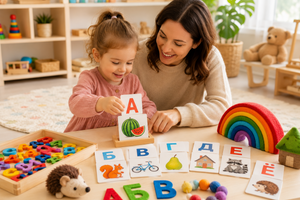
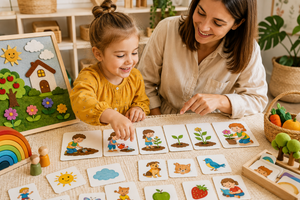
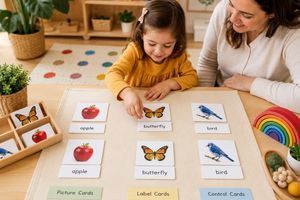
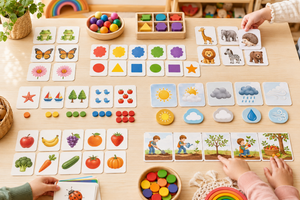
Three to five pictures are enough. General educational cards for children become a safety resource when the adult defines a concrete action. The guide to 25 games with learning cards shows ways to demonstrate, choose, and exchange roles. Cards never replace an evacuation route, child restraint, or supervision.
Explain safe and unsafe through conditions
The pair safe and unsafe needs context. An adult may use a knife for food preparation, while a preschooler does not take it without permission. A crossing still requires stopping, looking, and going with the adult. Children learn the boundary, role, and help needed rather than fearing ordinary life.
Ask for a decision instead of a label: “How can we create more distance?” or “Who can help?” Add an action to every prohibition: do not touch—show an adult; do not leave—return to the cashier. One scenario is enough for a younger preschooler. An older child can compare conditions or name a backup adult. Revisit rules before a new route, trip, home, or increase in independence.
Common adult mistakes
Graphic warnings teach fear rather than action. “Trust no one” obstructs help-seeking, secret tests damage trust, and long lists disappear under stress. Adults must not shift responsibility onto a child by leaving chemicals accessible, choosing an unsafe route, travelling without an appropriate restraint, or failing to set a meeting point. After an incident, establish safety, listen without interrogation, and obtain appropriate help. Ask “What do you need now?” rather than blaming the child.
Frequently asked questions
At what age should safety rules begin?
As soon as a child moves independently and follows a simple request, an adult can name one concrete boundary while securing the environment. Short role-play becomes useful in the preschool years. Each rule should match the freedom the child actually has.
How many rules should one session include?
Choose one situation and one or two actions: do not touch the unknown object; call an adult. After several calm repetitions, transfer the sequence to a new object. One dependable response is more useful than reciting a long list.
What if a child freezes and cannot say no?
Do not blame them. Freezing is an automatic response. Rehearse an easier first movement—step back, raise a hand, move to the checkout—and one loud phrase. Emphasise that a child may disclose later and will still receive help.
Is a family password enough?
No. It may be a supporting check, but it can be forgotten or disclosed. The central plan is that the caregiver confirms an unexpected change through the agreed channel. Without confirmation, the child does not leave.
How can a child practise making an emergency call?
Use a toy phone to rehearse the number, name, address or landmark, brief description, and answers to an operator. Explain the difference between practice and a real call. During real danger, move to a safer place first when possible, then call.
Conclusion
Safety rules for children should lead to action, not constant anxiety. Adults secure the environment, choose routes, identify helpers, and prepare meeting plans. Children receive one transferable sequence: stop, move away, get help, and tell. Practise leaving the home, stopping near traffic, following the family transport plan, and refusing to leave with another person.
Keep every rehearsal open, permit mistakes, and never blame a child for an automatic response during danger. The topic of children and strangers then becomes one part of broader boundary and help-seeking skills rather than a lesson that everyone should be feared.