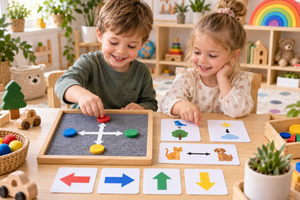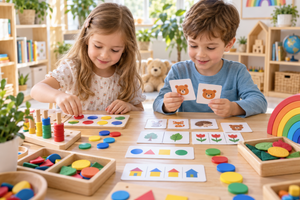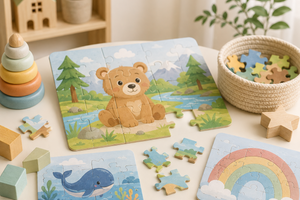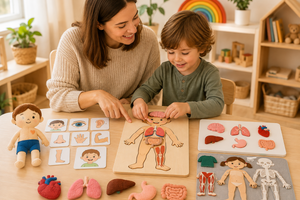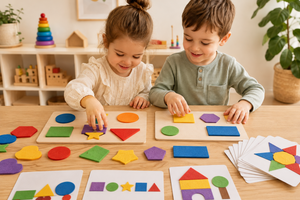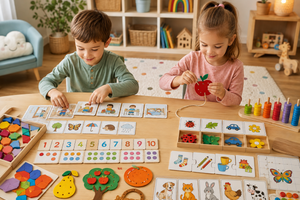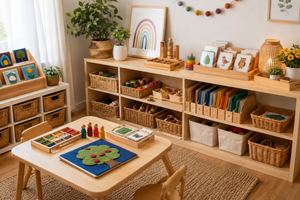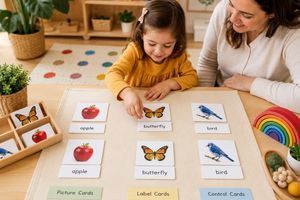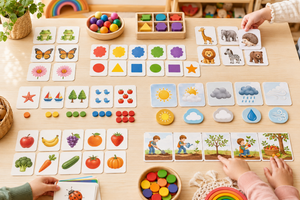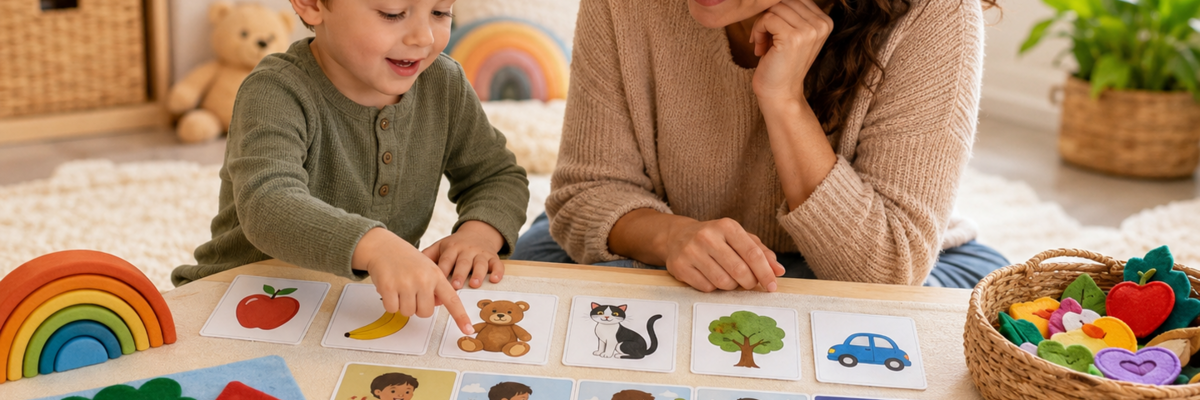
Children do not learn to communicate only by naming flashcards or repeating after an adult. Language becomes useful when a child needs to request a missing piece, assign a role, explain a plan, protest a surprising turn, or tell someone what happened to a toy character. Play supplies a genuine reason to send and receive a message.
The adult's most valuable role is not to run a quiz. It is to notice what already holds the child's attention, join the action, offer clear language, and wait. A gesture can become a word, one word can become a short combination, and two connected events can become the beginning of a story. Progress is built from many responsive exchanges rather than one perfect lesson.
This is an educational play guide, not a diagnostic checklist or a speech-language treatment plan. The stages below help adults choose a manageable activity; they are not deadlines. If you have continuing concerns about hearing, understanding language, loss of previously used skills, or a child's ability to communicate needs, discuss those observations with a pediatrician or qualified speech-language professional.
Key takeaways
- Give language a real job: choosing, requesting, explaining, negotiating, predicting, or repairing a mix-up.
- Expand a child's message by one meaningful element instead of demanding a long exact repetition.
- Practice naming, describing, conversation, and storytelling; they place different demands on a speaker.
- Pause after a prompt so the child has time to plan an answer, gesture, or action.
- Follow engagement and successful communication rather than counting correct words in a session.
- Cards and toys can make ideas visible, but responsive interaction is what turns them into language tools.
What language-rich play actually supports
Vocabulary is one part of the picture. A new word becomes flexible when a child hears it in several meaningful situations, connects it with an object or action, and uses it for a purpose. The word “tall,” for example, gains substance while two towers are compared, rebuilt, and made too tall for a bridge. It is more than a label seen once.
Shared attention and turns
Conversation begins before elaborate sentences. Two people notice the same event, read each other's response, and take turns adding an action or message. While rolling a car, an adult might wait for the child's glance and say, “Into the garage.” The short synchronized exchange matters more than a stream of commentary the child cannot enter.
Names, actions, and useful detail
Nouns identify the players and objects; verbs move the scene; descriptive and location words make the message precise. Instead of drilling “cup, spoon, plate,” open a pretend cafe. A bear orders warm tea, the spoon falls under the table, and the blue cup stays empty. Each word now belongs to a connected event.
Sentences and patterns
Adults can model a fuller form without interrupting every attempt. If a child says, “cat chair,” the response might be, “Yes, the cat sat on the chair.” The meaning is acknowledged while a usable pattern is supplied. The child does not have to repeat it on command to benefit from hearing it again in context.
Conversation and narrative
A conversation requires attending and responding to a partner. A narrative requires keeping a topic and event order available for someone who was not there. Pretend shop play may feature short exchanges; afterwards, the players can recall who arrived, what was needed, what went wrong, and how the problem was solved.
Choosing a format for the child's current communication
|
Current communication |
Existing strengths |
A useful play format |
One manageable next step |
|
Gestures and first words |
Looking, pointing, copying an action, familiar single words |
Real objects, a choice of two, an action song with a pause |
Add an action word or a short two-word model |
|
Short word combinations |
People and object names, simple requests, “more,” “gone,” or “help” |
Feeding a toy, building, searching, sorting with a reason |
Add a quality, location, or person doing the action |
|
Simple sentences |
Comments, answers to concrete questions, brief exchanges |
Pretend shop, toy clinic, picture description, a character route |
Link two events with “and,” “then,” or “because” |
|
Short connected accounts |
Several related sentences and a simple cause or result |
Picture sequences, recounting an event, collaborative stories |
Include an opening, a change, a response, and an ending |
A child may recount a familiar outing in detail yet use gestures with an unfamiliar adult. Another may name many pictures but still be learning how to take turns in conversation. Select support for the immediate situation instead of assigning the child a permanent level.
How adults can make room for a child's voice
Start by describing what the child has chosen to do: “You put the large block on top.” A comment offers accurate language without requiring a performance. Pause next. When the child replies with a look, gesture, word, or sentence, treat it as meaningful and add no more than one useful idea.
A helpful balance is fewer back-to-back questions and more genuine contributions. “What is it? What color? How many?” quickly feels like a test. Try, “I can see three red train cars, and my train will not fit through the tunnel.” The child can disagree, offer a solution, or change the construction.
Questions still have different jobs. “Where is the rabbit hiding?” focuses a location word. “Is the rabbit worried or surprised?” offers a supported choice. “What could we try next?” invites planning. Begin with a prompt the child can enter successfully, and move toward open explanation when the exchange is flowing.
Ten practical games from a word to a story
1. A choice with a consequence
Offer two materials that would genuinely change the build or scene. Ask whether the roof should be a blue rectangle or a red triangle. Accept a gesture, word, or sentence, model a complete phrase, and use the selected piece. The result shows that communication affects another person's action.
2. Action commentator
Take turns moving a figure while the partner describes it: “jumps,” “walks slowly,” or “hides behind the box.” Offer a younger child two possible verbs. Invite an older child to say who moves, where, how, and for what purpose.
3. Mystery bag
Hide a familiar object in a cloth bag. The child feels it, describes clues, and makes a guess. If the word is unavailable, give a clue about its use, such as, “We use it to eat soup,” rather than immediately supplying the first sound. Reveal the item and compare it with the evidence.
4. Who belongs where?
Create a few simple locations: a home, park, bakery, or workshop. The child places characters and explains a connection. More than one answer can work if the reasoning makes sense. A photographer might be at the park for a portrait, while a builder may be repairing a bench.
5. The mixed-up order
In a pretend cafe or store, deliberately swap one safe, silly detail. The bear asked for an apple but received a sock. The child notices the problem, explains it, and makes a clearer request. Humor creates several natural turns without making an error feel threatening.
6. A sentence that grows
Begin with “A bird is flying.” Each player adds one relevant part: “A small bird is flying to the nest because it has a twig.” Stop before the sentence becomes hard to hold, then draw what the sentence describes. Meaning, not maximum length, is the goal.
7. Three pictures, one event
Select a character, a place, and an object. Name each picture, then connect them: “The girl went to the park and found a key.” Ask whose key it might be and what could happen next. The pictures provide anchors, while the child retains authorship of the plot.
8. What changed?
Act out a tiny scene, change one detail, and describe the contrast. “First the truck was beside the bridge; now it has driven under it.” The visible difference gives location words, time words, and verb forms a reason to appear.
9. Interview a character
The adult speaks as a toy and the child asks questions. Offer starters if needed: “Where did you…?”, “Why did you…?”, or “What do you need?” Switch roles so the child experiences both planning a question and giving an informative answer.
10. News of the day
Choose one real event and shape three parts: how it began, what mattered most, and how it ended. The adult can draw three quick symbols. Listen to the whole account before refining a form; understanding the message comes first.
Moving from a single word to a connected story
Expand the number of meaningful relationships, not length for its own sake. When a child says “dog,” an adult can add an action: “The dog is running.” Later a place appears: “The dog is running to the gate,” then a reason: “because the family came home.” Each addition answers a real question about the scene.
Four anchors make an early narrative easier to hold: a character, a place, a change, and a result. Let the child arrange objects or pictures, act the event, and only then tell it without moving the pieces. Acting reduces the memory load and makes order visible.
If the account falls apart, do not replace it with an adult-written story. Restore one anchor: “We know who arrived. Where were they?” or “Show me the picture where everything changed.” After the child finishes, retell the account briefly and accurately while preserving the child's idea.
Learn&Dream materials as language prompts
Choose a set for the action it makes possible, not for the largest number of pieces. A calm language session might involve naming and finding, describing a visible difference, matching a word to a picture, or combining three unrelated pictures into one plausible event.
|
Material |
Language focus |
A simple start |
Story extension |
|
“Children's Room” three-part cards |
Familiar object names and location words |
Find the same object in the room and describe its place |
Invent who used it and what changed in the room |
|
“Movements” three-part cards |
Action words, manner, and direction |
Act out one movement and name it |
Combine a character, movement, destination, and purpose |
|
Pink Series three-part didactic cards, No. 1 |
Connections among an image, a word, and a control pair |
Describe the image before bringing in the printed label |
Choose three images and link them through one event |
|
Pink Series “Match Words to Pictures,” No. 1 |
A precise connection between a visual and a written word |
Make a pair and explain one visible clue |
Use the selected word in a character's line or story ending |
Check the product's current language, contents, and age guidance before choosing it. For a child not yet using printed words, keep labels aside and work with the pictures, objects, and conversation. A material should simplify the next language action rather than cover the table with unused pieces.
A ten-minute language routine
- Two minutes of shared attention. The child selects the material; the adult comments without quizzing.
- Three minutes of action. Build, sort, or stage a small problem that calls for messages.
- Two minutes for one new step. Add a useful word, connection, or kind of question.
- Two minutes switching roles. Let the child direct, question, or speak for a character.
- One-minute recap. Together state how the event began and how it ended.
This is a rhythm, not a daily test. Stay with a plot when it is producing genuine exchange; finish after a successful turn when energy fades. Regular practice means another opportunity to communicate, not an identical script and stopwatch.
Common habits that limit conversation
- Requesting repetition after every model. Show that the message was heard and supply a natural model in your reply.
- Using only test questions. Comments, surprises, and the adult's own ideas create a two-way exchange.
- Correcting form in the middle of a plot. Keep the event moving and recast the phrase accurately in context.
- Presenting too many cards. A small selection leaves more attention for description and connections.
- Demanding a story without support. Restore an object, drawing, gesture, or three markers for order.
- Comparing children. Notice how this child's participation changes in familiar settings over time.
- Treating play as a substitute for consultation. Educational games cannot identify the cause of persistent difficulty.
Frequently asked questions
Should I make my child repeat every new word?
No. Offer the word inside a meaningful action, pause, and accept a gesture or short response. Repetition can be enjoyable in songs and character voices, but a constant demand can turn communication into a test.
Are real objects or picture cards better for language?
They serve different purposes. Real objects offer action, sensory information, and practical context. Cards support comparison, classification, and talk about something that is absent. Connecting the two often creates the richest exchange.
How should I respond to an incorrect word form?
Respond to the meaning and naturally model the fuller form: “Yes, two cars went away.” Avoid interrupting the storyline for repeated correction. If the child asks about the form, explain it briefly outside the dramatic moment.
How long should a language game last?
Continue while the exchange remains mutual. Ten attentive minutes may be more useful than a long session after the child is tired. End at a clear point and leave an idea that can be revisited.
When should a family seek professional advice?
If you remain concerned about hearing, understanding, communication progress, intense frustration, or loss of skills the child previously used, share specific observations with a pediatrician or qualified speech-language professional. A home activity or online list cannot determine the reason.
Conclusion: language grows inside shared action
The route from a first word to a connected account is made of many brief exchanges. A child looks, gestures, labels, hears a slightly fuller model, clarifies, and tries again in a new moment. Play gives these attempts a purpose beyond getting an answer right.
Begin with an activity the child already enjoys, reduce the number of materials, and add one genuine communication problem. When an adult listens, waits, and protects the child's idea, words can become sentences, turns can become conversation, and a shared event can become a story worth telling.