Emotions for Children: How to Help Them Recognise and Name Feelings
A child may slam a door after losing, cry when a block tower falls, or hide behind an adult in a new room. There is a feeling beneath the behaviour, but a preschooler may lack the words to say, “I’m disappointed” or “I feel scared.” Learning begins with understanding, not a demand to calm down quickly.
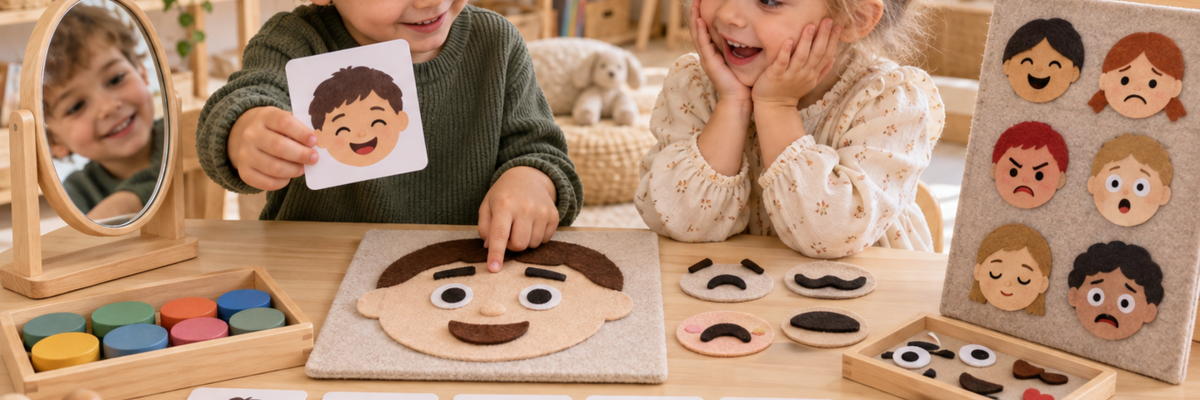
Emotions for children become clearer when an adult connects a feeling word with the event around it and a safe next action. A picture of an angry face may help a child recognise an expression, but deeper learning comes through questions: What happened? What might the person feel? What could they do next? Books, pretend play and educational toys for shared activities offer useful starting points when the format suits the child.
Feelings are not bad, while actions still have limits
Joy, sadness, fear, anger, embarrassment, jealousy and disappointment all provide information. Fear may signal danger or uncertainty. Anger may arise when something blocks a goal or crosses a boundary. Sadness can accompany loss, while joy marks an experience that matters to us. A child does not need to be persuaded to feel only pleasant emotions.
Accepting a feeling does not mean allowing every action. An adult can acknowledge what is happening and stop unsafe behaviour at the same time: “You’re very angry because your brother took the car. It’s okay to be angry, and I won’t let you hit. You can say, ‘Please give it back,’ or come with me for a moment.” The inner experience is respected, while the safety rule remains clear.
“Don’t cry” or “Don’t get angry” may be intended as comfort, but such phrases neither explain the experience nor make it disappear. A more useful response is specific: “That loud sound frightened you. I’m here.”
Begin with four clear feeling words
Joy, sadness, anger and fear make a practical first set. Their expressions are often easier to contrast, and young children can connect them with familiar events. Once those words appear in daily conversation, gradually introduce surprise, disappointment, worry, pride, loneliness, embarrassment or frustration.
Avoid testing every label in one sitting. Meet the same word on a character’s face, in a story and in real life. This shows that sadness may look like tears, quietness or a wish to stay close, while anger may appear as a loud voice or tense body. No single expression tells the whole story.
|
Feeling |
Possible situation |
What an adult may notice |
A supportive response |
|
Joy |
A friend arrives or a difficult model finally works |
Smiling, lively movement, a wish to share |
“You’re delighted to see your friend and want to show them everything” |
|
Sadness |
A treasured object is lost or a favourite activity ends |
Tears, a quieter voice, less movement |
“You’re sad because the game is over. I’ll stay with you” |
|
Anger |
Someone takes a toy or a plan fails |
Tight hands, shouting, abrupt movements |
“You’re angry because you wanted to do it yourself. I won’t let you hit; let’s use words” |
|
Fear |
A loud noise, a dark room or a new place |
Freezing, hiding, holding tightly to an adult |
“That scared you. Would you like to hold my hand and look together?” |
|
Disappointment |
An expected plan changes |
Protest, tears, withdrawal |
“You expected to go outside, and now it’s raining. That is disappointing” |
|
Pride |
The child completes something independently |
Showing the result and seeking an adult’s attention |
“You feel proud because you kept trying and managed it” |
An adult’s label is an invitation, not a verdict: “I wonder if you’re sad. Or is it more like anger?” “I don’t know” is valid too. Offer two choices, a picture, or time.
A useful sequence: event, feeling, need and next step
Instead of asking the broad question “What’s wrong with you?”, describe what you can see: “Your tower fell and you threw the block.” Then offer a tentative feeling word: “It looks as if you felt disappointed and angry.” Pause. If the child is ready, connect the feeling with what mattered: “You wanted the tower to stay up,” or “It was important to finish it by yourself.”
Only then look for an action. Ask, “Would you like to try again, take a break, or ask for help?” This sequence does not promise to remove the feeling. It shows a child that a powerful emotion can be experienced alongside a dependable adult, while responses can gradually become more intentional.
A detailed discussion is rarely helpful during an outburst. First protect everyone, reduce noise and offer a quieter place, closeness or space. Revisit the event after the intensity falls.
Emotion cards: move from a face to a story
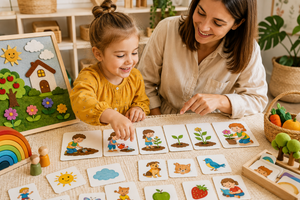
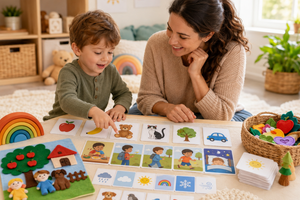
Emotion cards provide useful distance: a child can begin with a character rather than a personal experience. Lay out three or four pictures and notice the eyebrows, mouth, gaze and posture. Then ask, “What might have happened?” and “What could this person need?”
The “Emotions” demonstration cards present emotion vocabulary in English. Keep the conversation in the language the child understands best and add English only if it serves the activity. Understanding the situation matters more than memorising a translation.
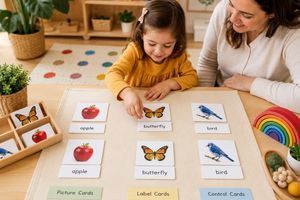
When a child can confidently match a picture with a familiar label, the three-part “Emotions” cards allow the image and written word to be handled separately. Matching is one possible task, but add an open question as well: “When might someone feel this way?” A card should open a conversation rather than carry one unquestionable answer.
Emotion games that do not feel like an interview
“Mirror” begins with imitation. The adult shows delight or surprise, the child copies it, and then roles change. Add voice and posture: How might a confident character stand? How does a tired character move? Explain that people express the same feeling in different ways. A face offers a clue, not proof.
In “Finish the Story”, a toy bear prepares for a party, but the guests are late. Ask what the bear might feel. Worry, anger, sadness and disappointment can overlap. The child then invents a helpful next step.
“Emotion Detective” works well while reading. Pause before the ending and look for three kinds of clue: what happened, what the character’s body is doing, and what the character says. Emotion games like this teach children to use context rather than deciding from a smile or tears alone.
To revisit vocabulary, simplify the “Emotions” memory game. Keep pairs face up, name each feeling and invent an event for it. Turn over only a few pairs once the rule is familiar. In “Emotions” bingo, the caller can read a situation: “A girl cannot find her glove.” Players choose a possible feeling and explain why; several answers may make sense.
Notice what feelings do in the body
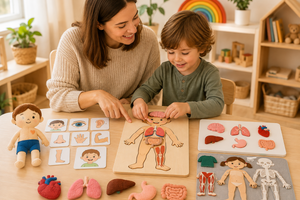
The body often signals a feeling before a child can find its name. During a calm moment, wonder together what happens when someone is frightened, angry or excited. A heart may beat faster, shoulders may tighten, hands may become damp, legs may want to jump, or the stomach may feel knotted. Do not give every child the same body map; physical experiences differ.
Draw an outline and colour where a story character might feel worry or happiness. Later say, “Your fists are tight. Is the anger getting strong?” The aim is earlier awareness, leaving more time to call an adult, move away or use words.
Questions remain optional. A child can point, gesture or answer through a character: “Where does the fox feel fear?”
When a feeling becomes very intense
During an intense moment, the adult’s first task is safety. Use a quiet voice and short statements: “I’m here,” “I won’t let you hit,” or “Let’s move away from the noise.” Do not insist on an explanation, eye contact or an immediate apology. Complex language may be unavailable while the child’s body is highly activated.
Offer a few options without forcing one: sit nearby, have a hug if the child wants it, make a slower exhale, drink water, squeeze a cushion, walk, or use a quieter space. No calming strategy works for every child or on every occasion. Familiar options practised during calm play are easier to remember than a new instruction during conflict.
Afterwards, reconstruct the sequence briefly: “You wanted the first turn, heard ‘no’ and became furious. You pushed Sam, and I stopped you. Next time say ‘I want a turn too’ or call me.” This prepares an alternative without shame.
Sometimes the best response is simply to stay nearby. A child may need time before accepting water, touch or words.
Adapt the activity to age and communication
Use age as a guide, not a test. Consider how the child understands questions, enjoys pictures and chooses between options. If the activity is tiring, reduce the cards; the adult can supply words while the child points.
|
Starting point |
A manageable format |
An adult might ask |
A sign the activity can grow |
|
Ages 2–3 or few spoken words |
Two cards, facial expression, pointing |
“Happy or sad?” |
The child reliably points to a named feeling |
|
Ages 3–4 |
Four basic feelings and brief familiar events |
“How might the character feel when Dad comes back?” |
The child links a feeling word with an event |
|
Ages 4–5 |
Stories, role play and body signals |
“What made her angry? What could she do safely?” |
The child suggests more than one cause or action |
|
Ages 5–6 and beyond |
Mixed feelings, conflict and different viewpoints |
“Can someone feel excited and worried at the same time?” |
The child notices that people may feel differently in one event |
Pointing, signs, a communication button or choosing a picture are complete responses. A child’s emotional intelligence is not measured by sentence length.
Build feeling words into ordinary life
A short planned activity once or twice a week is useful, but words gain their meaning in real events. On a walk, you may notice delight at a puddle. Before a medical visit, you can name worry. After a failed attempt, you can acknowledge frustration. There is no need to interpret every reaction; one accurate, non-judgemental observation is enough.
Try a brief evening ritual: each person names one pleasant and one difficult feeling from the day. Adults join in: “I felt nervous before a conversation, then relieved.” This shows that everyone has feelings.
In a group, do not require personal disclosure. Use a fictional character and allow a child to show a card privately. Respecting “I don’t want to talk” is part of emotional literacy.
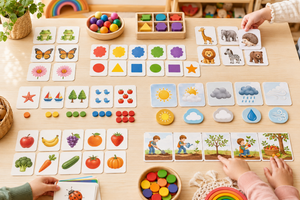
The wider collection of educational cards can inspire stories about social situations and routines. The value lies in the conversation, not the number of cards completed.
Look for progress without a test
Progress is not limited to naming ten pictures correctly. A child may begin to ask for help sooner, clarify “I’m not angry, I’m sad,” notice a story character’s feelings, accept a pause, or explain an incident after it has passed. These developments do not mean intense reactions will disappear. Growth is uneven, and tiredness, hunger, major changes or stress can temporarily make familiar skills harder to access.
Notice whether the child has more options. Calling an adult before throwing is meaningful change even if difficult moments still occur. Avoid comparisons and scores.
If distress or behaviour persistently and substantially interferes with sleep, eating, play, preschool attendance, relationships or safety, speak with a paediatrician or a qualified child mental health professional. Cards and home activities can support communication, but they do not replace an individual assessment.
Frequently asked questions
At what age can adults start naming feelings for a child?
Adults can use simple feeling words as soon as they describe a young child’s experience: “You’re happy,” or “That startled you.” A child who speaks very little can choose between two pictures, copy a face or point. The accessible communication method matters as much as chronological age.
Should feelings be divided into positive and negative ones?
It is often more helpful to call feelings pleasant or unpleasant rather than good or bad. Every emotion may carry useful information. Limits apply to actions: anger is allowed, while hurting another person is not. This distinction accepts the child without removing safety rules.
What if a child disagrees with the feeling word I suggest?
Accept the correction. The adult is offering a hypothesis, not defining the child’s inner experience. You might say, “Okay, it isn’t sadness. Could it be disappointment, or are you not sure yet?” Being listened to helps a child learn the fine differences between feelings.
Will emotion cards stop tantrums?
Emotion cards build vocabulary, but cannot guarantee that intense reactions will end. Preschoolers still need adult help, rest and predictable limits. Aim for greater awareness and more ways to communicate, not a child who is never upset.
How often should we play emotion games?
Five to ten minutes a few times a week, plus brief conversations during ordinary events, is enough. Finish while interest remains rather than covering every card. Meeting the same word in several different stories is more useful than a long drill.
Words for feelings, support for difficult moments
Start with four familiar words, a few everyday situations and the assurance “I’m here.” Look at expressions, but do not decide from a face alone. Ask what happened, listen to the child’s view, and consider a safe next step only after the experience has been noticed.
Cards create distance, stories reveal different viewpoints, and real life gives words meaning. A child need not label every feeling perfectly or stay calm every time. What matters is bringing emotion into a trusted relationship and finding language, boundaries and a safe action together.