Doman Cards and Montessori Three-Part Cards: What Is the Difference and Which Should You Choose?
Short answer: Doman-style sessions are brief, adult-led presentations: the adult shows and names a small sequence of cards. Montessori three-part cards invite the child to match pictures, pair labels with images, classify, and eventually check the work independently. Similar-looking materials therefore support very different participation.
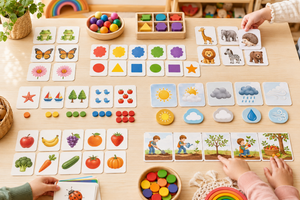
Pictures of animals, vehicles, plants, or household objects can make all learning cards seem alike. When parents compare Doman cards vs Montessori cards, the more useful questions are: Who leads? What does the child do? Is the aim a quick introduction, precise vocabulary, matching, reading, or classification?
Neither approach is a shortcut to exceptional intelligence or guaranteed early reading. Cards can enrich a routine, but cannot replace conversation, shared reading, play, movement, observation, or real objects.
Key takeaways
- In a Doman-style presentation, the adult shows and names while the child mainly looks and listens.
- With Montessori three-part cards, the child matches, sorts, labels, names, and checks against a control card.
- A fast presentation can introduce a few words or images without becoming a quiz.
- Three-part cards fit children ready to handle materials, find pairs, follow a sequence, and work more independently.
- Calendar age matters less than interest, language readiness, and the ability to follow one simple instruction.
- Both formats may appear within one topic, but they work best as separate activities with separate purposes.
What “Doman cards” actually means
Official Doman-derived programs distinguish several materials: large word cards for reading, dot cards for mathematics, and clear picture cards—often called “bits of intelligence”—for world knowledge. Retail catalogues and parenting discussions, however, use “Doman cards” much more broadly for many picture, word, or fact cards.
If your search begins with “buy Doman cards,” look beyond the product label and check both the set contents and the proposed activity. Separate cards for a quick presentation and a three-part matching material can look similar while asking the child to do very different things.
This article therefore compares the common short, fast, adult-led presentation with work using Montessori three-part cards. It does not discuss therapeutic Doman–Delacato patterning, a separate rehabilitation practice.
How Doman-style cards differ from Montessori three-part cards
Both formats may cover insects, transport, foods, rooms, flowers, or animals. Their structure and intended action are what differ.
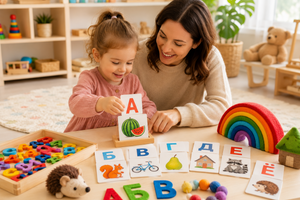
In a Doman-style presentation, the adult shows and names a small group of cards. The child need not find pairs, repeat terms, or prove recall. The session ends while the child is still engaged.
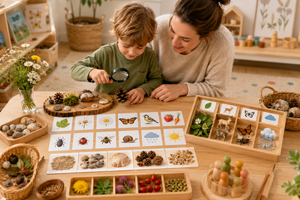
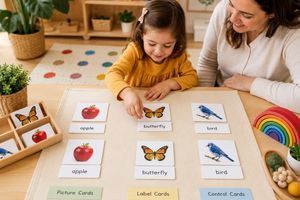
A Montessori three-part set is constructed differently. Each concept has three elements:
- a control card showing the image and its name;
- a picture-only card;
- a separate word label.
All three elements need not appear at once. The child may first match pictures to control cards; labels follow when the spoken vocabulary is familiar and print has meaning. The control card then enables checking without an adult’s verdict.
The full sequence appears in Montessori Three-Part Cards: What They Are and How to Present Them. Here, the focus is choosing between two modes of learning.
|
Feature |
Quick Doman-style presentation |
Montessori three-part cards |
|
Primary purpose |
Introduce selected images, words, or facts |
Refine vocabulary, match labels and images, and classify |
|
Material structure |
A sequence of individual cards presented by an adult |
A control card, a picture-only card, and a separate label for each concept |
|
Adult’s role |
Selects, presents, and sets the pace |
Demonstrates briefly, then steps back |
|
Child’s role |
Mainly watches and listens |
Arranges, matches, names, sorts, and checks |
|
Pace |
Fast and very brief |
Calm and led by the child’s working rhythm |
|
Self-checking |
Not part of the quick presentation |
The control card enables self-checking |
|
Readiness needed |
Brief visual interest |
Understanding a short instruction and handling cards purposefully |
|
Best use |
First contact with a topic or a few new words |
Deeper vocabulary, sorting, and linking a spoken name, image, and printed word when the child is ready |
|
Common risk |
Showing too many cards or demanding visible results |
Introducing every component before the simpler matching task is understood |
The central difference is therefore not how many facts appear on a card. One format is organised around an adult’s presentation; the other is organised around the child’s independent action.
When building a home collection of educational toys for children, look beyond the number of promised learning benefits. A useful material encourages the child to observe, name, compare, check, and return to the activity by choice.
When a quick card presentation may be useful
A Doman-style presentation can suit a young child who enjoys clear, realistic images but is not yet ready for a multi-step tabletop activity. An adult might name three to five insect cards and finish in under a minute.
This format may be appropriate when you want to:
- introduce a new topic for the first time;
- give precise names to a few familiar objects;
- add a very short language moment to the day;
- work with a child who does not yet understand more complex instructions;
- connect new words to an ongoing conversation, book, or outing.
Keep it an invitation, not a performance test. Do not show dozens of cards, continue after attention fades, or require immediate repetition. A response is not required during this kind of presentation. Looking away, turning, reaching elsewhere, or leaving are valid signs to stop.
Let the card lead back to experience. A butterfly can later be noticed outdoors, found in a book, described, or imitated in movement. Such connections give the word more substance than an isolated image can.
When Montessori three-part cards are the better choice
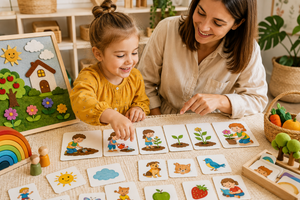
Choose the three-part format when the child wants to act: matching two pictures, arranging a short row, following a concise demonstration, and completing a small task without constant direction.
Three-part cards are particularly suitable when the aim is to help a child:
- distinguish between related concepts;
- learn accurate, specific names;
- group objects by theme or observable feature;
- connect a familiar spoken word with its printed form;
- carry out a sequence more independently;
- notice and correct a mismatch without constant adult judgement.
A child may say “car” for a bus, excavator, tractor, and fire engine. A small set supports observing, naming, matching, and later sorting them; labels follow when the images and spoken terms are secure.
Over several days, a family might read about transport, observe vehicles, build a garage, and revisit the same vocabulary in cards. Each word then belongs to a meaningful context.
Which format fits your child’s age and readiness?
There is no reliable “Doman before three, Montessori after three” rule. Calendar age is only a reference point: two children born at the same time may differ in vocabulary, experience, attention, and readiness for a structured task. It is more useful to watch for readiness signals:
- If the child enjoys looking and listening but does not yet complete card tasks, begin with a brief presentation of two to four familiar images.
- If the child can find identical pictures, offer matching without separate word labels.
- If the child sorts small groups and wants more precise names, introduce fuller work with a three-part set.
- If printed words attract the child and they want to match them, add the third component gradually without turning the activity into a reading test.
An appropriate level is visible in the child’s behaviour: they repeat the demonstrated action and later return to the material. If the pieces are mixed indiscriminately, frustration rises, or interest disappears quickly, simplify the task regardless of the age printed on the package.
A practical two-session test for your child
To find a starting point, try one familiar theme over two or three calm days.
Prepare five realistic transport images. Show and name them individually without questions, then stop while attention remains.
Another day, duplicate three images. Place one set in a row, demonstrate one match, and invite the child to continue. Keep words brief.
Observe the quality of interest rather than counting correct answers:
- If the child wants to see more but not arrange cards, a brief presentation may fit better.
- If the child takes the material and searches for matches, active work may be more engaging.
- If naming is enjoyable but several pairs are confusing, reduce the set to two or three.
- If matching is easy and the printed words attract attention, introduce one or two labels gradually.
- If neither holds interest, change the topic, try another kind of play, or return later.
Do not judge from one tired or hungry afternoon. Two or three attempts give a fairer picture because the child’s state often matters more than the card format.
How to combine both approaches without mixing their purposes
Separated in time, both formats can support one topic. One day an adult names five insects; another day the same concepts become a matching, sorting, or vocabulary activity.
Keep each activity internally consistent:
- During a quick presentation, the adult names rather than tests.
- During matching, the child works at an unhurried pace.
- Word labels appear only after the picture task and spoken names make sense.
- Books, conversation, art, outdoor observation, and pretend play give the vocabulary a wider context.
Do not flip through all three Montessori elements as unrelated flashcards; that erases their purpose. Likewise, repeated “What is this?” questions turn a quick introduction into an examination.
For more active variations, see How to Use Learning Cards: 25 Games for Children Ages 2–6.
How to choose Montessori three-part cards by theme
In the educational card materials category, begin with a theme the child already recognises rather than the largest available set. Familiar content reduces the language load, so the learner can concentrate on the new action: matching, arranging, checking, or adding labels.
|
If your child… |
Material to consider |
Possible first activities |
|
Is new to the three-part format and knows everyday room objects |
Match identical images, name familiar objects, and add two known labels later |
|
|
Is curious about nature and small creatures |
Refine insect names, compare visible features, and sort by a clear rule |
|
|
Loves vehicles and movement |
Distinguish types of transport and classify them by environment or function |
These sets are intended for matching, vocabulary, classification, and work with labels. They should not be presented as products from the Doman method simply because they contain individual pictures. Learn&Dream’s product pages describe Montessori three-part materials; this article discusses Doman-style presentation only as a comparison of teaching formats.
Common mistakes when choosing and using cards
Confusing the material with the method
A realistic image with a printed name does not automatically make a set “Doman cards” or Montessori material. First identify the intended action: does the adult present the cards quickly, or does the child match components and check the result?
Turning a quick presentation into a test
Asking “What is this?” after every card changes the purpose of the activity and adds pressure. During a brief presentation, the adult names the item; there is no need to test immediate recall.
Flipping quickly through all three Montessori components
The control card, picture-only card, and word label have different functions. When they are shown as three unrelated flashcards, the matching sequence and opportunity for self-checking disappear.
Expecting guaranteed early reading
Both formats may enrich vocabulary and draw attention to printed words, but neither guarantees early reading. Cards remain a supplement to live language, books, sound play, and a gradual introduction to letters.
Frequently asked questions
Can Montessori three-part cards be used like Doman cards?
You can show the pictures quickly, but that is not the set’s main purpose. Its value lies in matching, labelling, classifying, and self-checking. Keep presentation and active work separate.
Which type is better for a two-year-old?
If the child enjoys looking and listening, name a few clear pictures. If they can find identical images and follow a simple direction, offer control-card and picture-card matching without labels.
Do cards help children learn to read earlier?
Cards can enrich vocabulary and draw attention to print, but they do not guarantee early reading. Oral language, phonological awareness, letters and sounds, decoding, comprehension, and enjoyable books also matter.
How many cards should be used in one session?
Three to five images are enough initially. Add more when the child handles them comfortably and wants to continue; purposeful interest matters more than finishing the box.
Do we need to use cards every day?
No. Repetition helps, but a rigid schedule is unnecessary. Return while interest remains and connect the topic with books, conversation, outings, movement, art, and pretend play.
What should you choose in the end?
If your child enjoys looking and listening briefly, start with a calm Doman-style presentation. If they want to handle, match, arrange, and work independently, Montessori three-part cards are the more logical choice.
A short presentation can open a topic; three-part material can explore it more deeply. Keep the purposes distinct, reduce quantity when needed, and let the child’s response guide the next step.