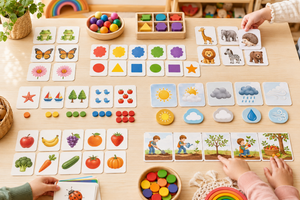
Seguin Boards: What They Are, Their Benefits, and How to Use Them with a Child
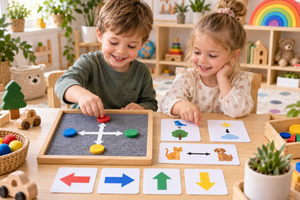
In brief: in the Ukrainian toy-market usage addressed here, Seguin boards are sets of frames and matching inset pieces. Each small frame has a recess or cutout, and the removable piece repeats its shape. A child studies the outline, chooses a possible inset, turns it, and places it into the matching space. Begin with one frame and one clearly different piece. Increase only one feature at a time: the number of choices, similarity of outlines, orientation, a continuing design, or the way the task is presented.
The activity resembles a small puzzle, but its central action is not assembling one large picture from many interlocking pieces. Each frame–inset pair is a separate problem: which part completes this empty space? The boundary provides concrete feedback. A mismatched or incorrectly oriented shape does not settle into the recess, while the corresponding one fills it.
This action may support visual discrimination, hand–eye coordination, precise movement, and a calm search for a solution. It is not an intelligence test and does not promise accelerated development. The value comes from a manageable action that the child can attempt and check. Among educational toys for matching shapes and outlines, choose a level that leaves room to compare, turn, and retry without constant adult intervention.
How a frame-and-inset task works
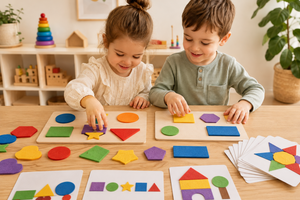
The basic unit has two parts. The frame remains on the table and contains an empty space with a defined outline. The inset repeats that outline and fits inside. A first shape may be strongly contrasting and symmetrical, such as a circle. More challenging pieces can have irregular silhouettes, a required direction, or lines that complete a design only when oriented correctly.
The child follows a short but meaningful sequence:
- notice the empty space and inspect its boundary;
- compare available pieces with that outline;
- choose and move one inset;
- rotate, or flip it if the construction allows this;
- try the fit, evaluate the result, and adjust when necessary.
The material lets a hypothesis be tested through action. If an adult immediately points out the right piece, rotates it, and pushes it with the child’s hand, most of the problem disappears. A better presentation makes the goal visible, demonstrates one complete attempt, and leaves the next one to the child.
An important naming distinction
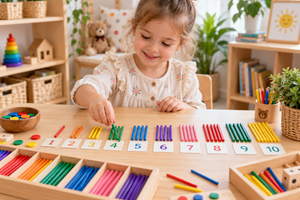
In English-language Montessori practice, Seguin Boards most often means a different mathematics material: the Teen Boards and Ten Boards. On long number boards, a child forms the numbers 11–19, the tens, and later numbers between the tens by placing unit numeral cards. That activity concerns number composition and place value, not matching shaped recesses.
In Ukrainian-market usage, the term Seguin inset boards often describes frame-and-inset sets: a cutout, its corresponding piece, and graded matching by shape, direction, or picture. A shaped inset should not be presented as a Montessori number board, and it will not teach the teen numbers merely because the names overlap. The two materials are not interchangeable.
What skills are involved?
Visual discrimination
To find a match, a child notices straight and curved edges, corners, projections, indentations, proportion, and direction. Gradually, attention shifts from color or a familiar picture to the outline itself. This is related to sorting and matching by a relevant feature.
Hand–eye coordination
The inset must be grasped, moved, turned, and lowered within the recess. Vision guides the movement: if one edge does not match, the hand adjusts the position. Other materials that invite precise hand movements can be explored in the fine motor skills collection.
Part and whole
A separate piece finds its place in a completed surface or image. The child sees how an empty shape and its inset complement one another. A themed silhouette can also prompt vocabulary and conversation, but naming the picture should not replace the matching action.
Planning and self-correction
When several options are present, a child puts aside a mismatch, turns another piece, and checks the result. This is a simple cycle of testing an idea: “Perhaps this one; I will try; the edge does not match; I will change it.” The child does not need to explain the entire process verbally.
Different sets place different demands on these skills. One large circular inset mainly practises the movement of removing and replacing. Choosing among similar asymmetrical outlines requires more visual analysis. Judge difficulty by the action the child must perform, not by a broad label on the package.
Choosing a first level and increasing difficulty gradually
The best starting point is one in which the child understands the goal after a brief demonstration and can complete much of the action independently. Do not display every frame at once. One or two manageable pairs create more useful practice than a large, confusing pile.
|
Level |
What is presented |
Main action |
One next challenge |
|
1. One match |
one frame and its inset |
remove, inspect, and replace the piece |
place the inset a little farther from the opening |
|
2. Contrasting choice |
two frames and two very different insets |
find the corresponding pair |
add a third clearly different shape |
|
3. Similar forms |
3–4 frames with related outlines |
compare edges, not only colors |
rotate the frames in different directions |
|
4. Direction and design |
asymmetrical pieces or a continuing pattern |
orient the piece and complete the image |
reduce a color clue or add one similar option |
|
5. Rule and memory |
a familiar set shown briefly |
follow a verbal direction or restore an arrangement |
let the child prepare a task for the adult |
Move on when the child repeats a useful approach rather than succeeding once by chance: looking, comparing, turning, and independently correcting some attempts. If pieces are forced, every option is tried rapidly, or each step requires a demonstration, reduce the choice.
Change one variable. Adding five similar pieces, rotating every frame, and asking for memory work at the same time makes the cause of difficulty impossible to see. Instead, keep familiar shapes and alter only their direction, or retain their position and add one similar outline.
Presenting the first activity
Place one frame in front of the child and its inset beside it. Slowly trace the recess, grasp the piece, compare one edge with the outline, and lower it without pressure. Remove it and return it to the starting place. The demonstration takes seconds and needs few words.
Invite the child to act. If the piece is laid across the frame or turned sideways, wait before helping. “Where is its place?” or “Do these edges match?” brings attention back to the material. Offer prompts from least to most direct:
- move the frame slightly closer;
- suggest tracing the outline with eyes or a finger;
- narrow the choice to two insets;
- mention one landmark, such as a pointed corner;
- finally repeat the full demonstration and offer another turn.
Do not enclose the child’s hand in yours or press a piece into place. If it does not enter easily, check the match, orientation, and condition of the material. Force can damage a frame and changes problem-solving into a struggle.
Seven ways to work with one set
Remove and replace. Use one pair. Describe the change in simple language: “Out—the space is empty. In—the space is filled.”
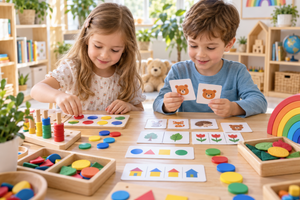
Find the home. Arrange two or three frames in a row and put the insets below. The child finds a home for each piece. Begin with outlines that are clearly different.
Compare the edges. Before trying, identify one feature: a curve, corner, or long side. Formal geometry words are optional; “round here, pointed there” is enough.
Turn it to fit. The correct inset lies in a different orientation. The child rotates it on the table until its edges align. Do not add numerous distractors at the same time.
What changed? Place several familiar pieces, but leave one beside the wrong frame. The child finds and repairs the mismatch. The guide to sorting by color, shape, and size offers related ways to direct attention to one feature at a time.
Complete the design. If the frame and inset carry lines or sections of a picture, check whether the image continues after insertion. This is harder than matching the outline alone. The article on pattern-copying activities explains how orientation and visible models can be graded.
Let the child lead. The child selects two or three frames, mixes the insets, and presents a task to the adult. Ask them to check the finished work and offer a useful clue if the adult makes an agreed mistake.
Home alternatives without confusing the materials
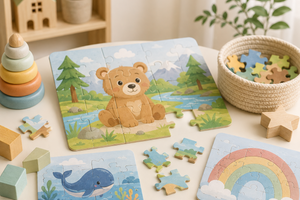
The relationship “outline—corresponding part” can be practised without buying a product with this exact name. A safe shape sorter, a one-piece inset puzzle, a large knob puzzle, or a card on which the child overlays a large flat shape on a full-size silhouette uses a related matching action. These are alternatives for practice, not identical materials.
For homemade overlay cards, use large intact pieces, a sturdy base, rounded edges, and materials suitable for children. Do not give a toddler thin fragments, sharp edges, loose magnets, buttons, or tiny handmade inserts. A flat silhouette lacks the mechanical feedback of a recessed frame, so the adult may need to ask a neutral question instead of announcing the answer.
The logic and sorting games collection includes different actions: matching, sorting, reproducing a model, and continuing a rule. Not every logic game is an inset frame, but experience with comparing one relevant feature can make transitions between materials easier.
Responding to common difficulties
|
What you observe |
A possible reason |
A change that leaves the solution to the child |
|
every piece is tried at random |
too many options are visible |
leave two contrasting pairs and separate them clearly |
|
the correct inset does not enter |
it is rotated or not lying flat |
compare one corner and turn it on the table |
|
a piece is pushed forcefully |
mechanical feedback is being ignored |
stop the pressure and inspect edges and material condition |
|
color is the only clue used |
color is stronger than the outline |
offer same-color shapes or describe one edge |
|
interest ends quickly |
the task is too easy, hard, or long |
present one achievable pair and finish after success |
Avoid turning the activity into a speed test. A more informative sign of progress is a change in search strategy: the child inspects an outline longer, makes fewer random trials, attempts a rotation, and returns to an unresolved piece. A brief note about the amount of choice that was manageable can guide the next session.
Safe use and care
Follow the age marking for the specific product. Check for cracks, splinters, sharp edges, peeling surfaces, and small parts that could detach. A child who mouths objects needs large pieces and close supervision; an unsuitable set should be stored until later.
Clean the material only as its manufacturer recommends, because bases and coatings react differently to moisture. Store frames with their matching pieces but beyond the reach of younger children. Count the parts before and after play so none remains on the floor.
Frequently asked questions
At what age can a child use Seguin inset boards?
There is no single age for every set. Follow the manufacturer’s guidance and consider piece size, outline complexity, and whether the child mouths objects. A starting task uses one large frame and one distinct inset under adult supervision.
Must a child know the names of all geometric shapes?
No. Seeing the match and controlling the movement come first. An adult can naturally say “curved edge,” “pointed corner,” or “long side” without turning each attempt into a quiz. Formal names can be added gradually.
What if the child finds a match only by trying every piece?
Reduce the choice to two very different shapes and separate the frames. Before each attempt, invite the child to find one noticeable feature. Add a third option when comparison begins before insertion.
Are these the same as Montessori Teen and Ten Boards?
No. Here, Seguin boards are shaped frame-and-inset puzzles. Montessori Teen and Ten Boards, also called Seguin Boards in English, are mathematics materials for forming 11–19, the tens, and numbers between them.
What can replace a frame-and-inset set at home?
Use a safe shape sorter, a large one-piece puzzle, or a large flat shape placed over its full-size silhouette. These activities practise related matching, but without a recess they do not provide the same mechanical self-check as a precisely fitted frame.