Board Games for Children: How to Choose by Age and Skills
Short answer: a good board game should match more than the age printed on its box. Consider how a child follows a rule, waits for a turn, handles pieces, and responds to an unpredictable result. For a first game, choose a short round with one clear action: find a pair, place a piece, continue a sequence, or make one strategic move. Demonstrate it, then increase only one aspect of the challenge.
Board games for children are often bought for their theme. Dinosaurs, vehicles, animals, or storybook characters catch attention immediately. Once the box is open, the mechanic matters more. The child must understand a turn, see how an action changes the situation, and wait for another opportunity. Too many steps can leave even an attractive game untouched.
Begin with the family’s real routine, not a ranking. Who will play? How much time is available? Does the child enjoy competition or prefer shared missions? Can the set be packed away easily? These questions help families choose educational toys for shared games that will actually be used.
What Makes It a Board Game Rather Than Any Tabletop Activity?
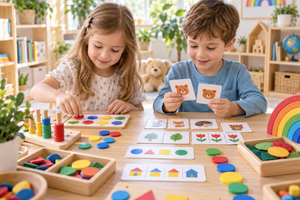
Coloring, puzzles, and sorting may all happen at a table, but they are not automatically board games. A game has an agreed rule, a sequence of actions, and a recognizable ending. Players often take turns, make decisions, or respond to a random event. The outcome is not simply a matter of completing an exercise correctly.
Depending on the format, a board game for children may be competitive, cooperative, or designed for one player. In a competitive game, each participant works toward an individual win. In a cooperative game, everyone completes a common mission. A solo puzzle presents a series of challenges, often with a way to check the answer. None of these formats is universally best; they simply create different kinds of interaction.
Choose the Mechanic Before the Theme
A mechanic is the action that players repeat throughout a game. The easiest mechanics for preschoolers use direct comparison and make the effect of a move visible.
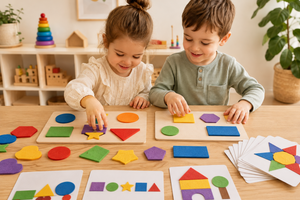
- Matching: connect identical pictures, a silhouette and object, or a logical pair.
- Picture lotto: fill a small board with corresponding pieces.
- Memory: remember where previously revealed cards are located.
- Path movement: move a token along a route according to a simple rule.
- Pattern building: reproduce a model or spatial arrangement.
- Classification: group items using one or more features.
- Simple strategy: consider a personal goal and the opponent’s possible reply.
A favorite theme can support attention, but it should not obscure the action. A child who loves the sea may enjoy cards with marine animals, yet one set may only invite naming while another requires matching, sorting, or remembering positions. Before buying, look at an example turn. It reveals more about the experience than the artwork alone.
Matching Age, Rules, and Playing Time
An age label primarily indicates the intended minimum, component safety, and expected level of complexity. It cannot describe an individual child’s experience. One three-year-old may happily match open cards but be unable to wait through three adults’ turns. Another may enjoy turn-taking yet tire quickly when the board contains too many details.
Evaluate board games for ages 3+ through four practical questions: How many new actions must the child remember? How long is the pause between turns? Are the components comfortable and safe to handle? Can the child see how to check the result? At first, one action and a round lasting five to ten minutes are enough. A stable rule creates predictability, while the theme supplies novelty.
|
Approximate stage |
A manageable start |
Sign that the child is ready for more |
A suitable next step |
|
About 2.5–3 years |
Open pairs, simple lotto, 2–4 minutes of shared action |
Understands one demonstrated turn and returns a piece to its place |
Add one or two pairs or a brief turn-taking sequence |
|
3–4 years |
One rule, a visible result, a round under 10 minutes |
Waits through one other turn and remembers the personal goal |
Hide some cards or offer a choice between two actions |
|
4–5 years |
Matching, paths, pattern building, or simple strategy |
Explains the rule in their own words and notices an error |
Add distractors, a memory element, or planning one move ahead |
|
5–6 years |
Two connected conditions, brief planning, a 15–25 minute game |
Compares options and accepts an imperfect outcome |
Add distinct roles, scoring, or a more complex board |
|
6+ years |
Several possible actions, simple combinations, independent setup |
Tracks the shared game state and justifies a decision |
Add longer-term strategy, limited resources, or a team mission |
Board Games for 3-Year-Olds: What Should Stay Simple?
At three, the main difficulty is often not recognizing pictures but understanding the structure of a shared round. The child is learning the difference between “my turn” and “your turn,” resisting the urge to collect every attractive piece at once, and completing a short sequence. In practice, board games for 3-year-olds should therefore move from explanation to action very quickly.
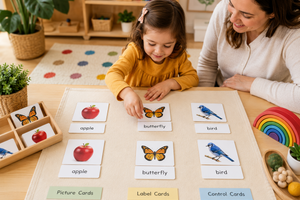
Show one turn without a long introduction. Say, “I take a card and look for the same picture,” then pass the material to the child. When a reminder is needed, state the action rather than listing prohibitions. “We turn over two cards” is easier to follow than “Do not turn over a third one, and do not take another card.”
Open matching is usually easier than memory. Lotto with a small personal board is easier than a shared map with several routes. Pieces that can be grasped comfortably are easier than thin tokens. Always check the current age guidance and component size on the specific product page, and supervise young children throughout play.
Teaching Turn-Taking Without Constant Corrections
Waiting is not a prerequisite a child must master before joining a game. It is part of the experience and develops gradually. Begin with two players so that the pause stays short. You can make the active turn visible with a small “speaker” token placed beside the person who is acting and passed on afterward.
When waiting becomes a struggle, reduce the player count or choose a cooperative task that allows discussion. The goal is not to make a child silently endure any delay. It is to keep the sequence understandable and the next opportunity close enough to anticipate.
Chance, Strategy, and an Honest Win
A die or random card can level the field: a young child may beat an adult without the adult pretending. This is useful during early play. Yet a game decided entirely by chance offers almost no agency. If the child enjoys influencing the result, choose a game with at least one decision per turn: which card to take, where to place a token, or which pair to test.
In a strategy game, an adult does not have to lose deliberately. It is better to adjust the advantage through a visible rule: use fewer pieces, explain part of the reasoning aloud, or let the child begin. A win then remains genuine, while a loss does not become a punishment.
After a round, mention one effective action rather than judging the child as a player: “You noticed that my line was nearly complete and blocked the square.” If the outcome hurts, acknowledge the disappointment and offer a choice—one short rematch, another game, or a break. A lecture about being a good loser is rarely helpful in that moment.
Cooperative or Competitive?
A cooperative format works particularly well when participants are different ages or when personal defeat still feels overwhelming. Everyone may complete a shared picture, rescue a character, or finish a mission before the deck runs out. The adult should not become the director who makes every choice. Ask for ideas, then leave the child a genuine decision.
Competition also provides valuable social experience. It asks everyone to follow the common rule even when a particular turn is unfavorable. This only works when the challenge is fair. If the oldest player has an automatic advantage, adjust the conditions or choose a different mechanic.
Adapting One Game Without Rewriting It
When a game is slightly too difficult, explaining it more loudly or playing every turn for the child will not solve the problem. Change one parameter and observe the effect.
|
Difficulty you notice |
Change for this round |
Keep unchanged |
How to restore the full challenge |
|
Too many pictures |
Use only three or four clearly different pairs |
The matching principle |
Add one pair after two confident rounds |
|
The child forgets the goal |
Keep a reminder card or model in view |
The order of turns |
Hide the prompt for one turn, then for a whole game |
|
Waiting is difficult |
Play with two people or let the child help check results |
The active player’s right to decide |
Add a third player after short rounds feel comfortable |
|
One loss ends the evening |
Play cooperatively or use a best-of-three series of tiny rounds |
Honest scoring |
Return to a single game with the option of a rematch |
|
The rule has become too easy |
Add time, memory, or an explanation of the choice |
Familiar pieces and the core action |
Keep the new condition only if it adds a decision rather than haste |
Do not change the piece count, turn order, and objective all at once; that effectively creates a different game. Describe an adaptation neutrally: “Today we are using six pairs,” not “This is still too hard for you.”
Learn&Dream Materials for Playing Together
The Logic and Sorting collection makes it possible to compare several actions. A useful home rotation contains a few different mechanics rather than many nearly identical sets.
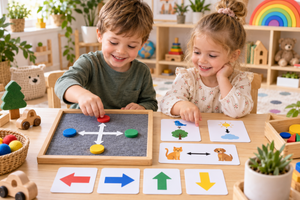
- Felt Tic-Tac-Toe offers a short rule, alternating turns, and simple planning. A beginner focuses on making a line; later, the child can notice and block the other player’s opportunity.
- Felt “Find a Pair: Sea Animals” can be used for open matching, memory, and short conversations about the animals.
- Felt “Pattern Matching: Parking” shifts attention from competition to a spatial task: observe a model, position the pieces, and check the result.
There is no need to introduce all these materials at once. One familiar game, one new mechanic, and several days for repetition provide enough variety. Before play, open the product page and check the current contents, age marking, and condition of every piece.
Keeping Family Play From Becoming a Lesson
At home, children’s board games can easily be overloaded with questions: “What color is this?”, “How many are there?”, “Why did you do that?” If every turn becomes a knowledge check, the child stops following the game. Ask when an answer helps with a decision or makes a strategy visible.
Do not correct every small mistake immediately. When the consequence is visible on the board, allow time for self-checking. If help is needed, point to where the child can check: “Compare the top row with the model” or “See whether this square is free.” That returns control to the player.
There is no need for a learning summary after every game. Pack the components together, decide who will choose next time, and stop. Regular, pleasant rounds are what make games part of family life.
Related Guides
The guide to adapting one learning game for ages 2, 3, and 4 shows how to adjust pieces, prompts, and rules. The article on matching games and increasing their difficulty moves from open pairs to memory and logical associations.
Frequently asked questions
At What Age Can a Child Start Playing Board Games?
Simple shared formats may be introduced at about 2.5–3 years, provided every component meets the manufacturer’s safety and age guidance. Start with one turn rather than a full game: match a pair, place a piece, or pass the turn. Age is a useful reference, not proof of readiness.
How Long Should a Preschooler’s First Game Last?
Five to ten minutes is often enough for a three-year-old; older preschoolers may remain engaged for 15–25 minutes. Stop while the rule is still clear and interest remains. A short, successful round is more valuable than pushing through fatigue to reach a formal ending.
Should an Adult Deliberately Lose?
There is no need to lose every time. Instead, balance the conditions openly: let the child begin, give the adult fewer pieces, or explain some planning aloud. Games with a meaningful element of chance already give a younger player a genuine opportunity to win.
What If a Child Changes the Rules Mid-Game?
First decide whether the child forgot the agreement or invented a variation. Calmly return to the shared rule for the current round. Afterward, try a short game using the child’s rule if it is clear and applies equally to everyone. Creativity can coexist with predictability.
How Can We Store Games Without Losing Pieces?
Keep each set in a separate labeled bag or box and compare the contents with a short list or photo before putting it away. Display three to five games with different mechanics and rotate the rest. A child can be responsible for one simple part of the packing routine.
Conclusion
A well-chosen game gives a child one understandable action, a manageable wait, and a genuine chance to affect the outcome. Look beyond the theme and box age to playing time, decision count, the role of chance, and component usability. Begin with a demonstrated move, protect the child’s decisions, and increase challenge gradually.
In this way, fun board games for children become a family practice: open matching today, memory next month, and a first strategy later. Development takes place naturally inside shared play.