How to Choose Puzzles for a Child by Age: Benefits, Difficulty and First Pictures
Short answer: a first puzzle should offer a clear action and a quick way for the child to check the result. A toddler may begin with one large inset piece or a picture divided into two distinct halves. A preschooler can move towards several pieces with strong visual clues, then a fuller scene, an open-ended composition or a mathematical challenge. Piece count alone does not determine difficulty. Shape, size, contrast, repeated background and the individual child’s experience matter just as much.
The label “puzzles for children” covers everything from a one-piece frame to a complex model. Age guidance is an important filter, but it cannot identify the set a particular child will use independently.
It helps to think of puzzling as a sequence of actions: recognise the intended whole, find a clue, rotate a piece, compare edges and check the outcome. That makes it easier to choose the next achievable step instead of buying a large set for the child to “grow into” while an adult completes most of it.
What Does Puzzling Actually Practise?
A puzzle connects visual analysis with precise hand movements. The child notices a colour, line, outline or part of a familiar object, forms a prediction and tests it physically. A piece that does not fit gives immediate information: it may need turning, another position or a different strategy.
Depending on the design and the way it is presented, a puzzle can support:
- understanding how a part relates to a whole;
- visual discrimination and sustained attention;
- spatial language such as edge, corner, above and left;
- planning a short sequence of actions;
- hand–eye coordination, rotation and accurate placement;
- persistence, correction and self-checking;
- descriptive language when the child explains what they are seeking.
These opportunities are reduced when the adult points to every position or inserts difficult pieces on the child’s behalf. A short demonstration, a pause and one neutral prompt leave room for the learner to notice the mismatch and own the solution.
How to Find the Starting Level Without Relying Only on Age
Observe three actions. Does the child understand that the pieces create a whole, turn a piece that does not fit, and compare the picture or outline rather than push at random?
If these actions are new, use a few large, clearly different pieces. If the child finds the place but not the orientation, choose parts with an obvious top and bottom. After a familiar picture becomes easy, briefly hide the reference, invite an explanation or try a composition with several valid results instead of simply doubling the piece count.
The ages below are guides, not developmental tests. A child who is new to the mechanism can begin with an earlier stage without any concern.
|
Approximate stage |
Useful starting format |
Clues the child can use |
One next challenge |
|
18–24 months, when ready |
One large inset or a familiar image in two parts |
Clear outline and easy-to-hold edge |
Offer two possible spaces to compare |
|
2–3 years |
Two-piece matching puzzles, 2–4 pictures or inset frames |
Distinct colour, silhouette or meaningful connection |
Mix the parts of two pairs |
|
3–4 years |
A 4–12-piece picture or short themed set |
Large objects, little background, obvious top and bottom |
Find edges first, then reduce prompts |
|
4–5 years |
12–24 pieces or a scene with several objects |
Clues across the whole picture |
Hide the model briefly or give verbal directions |
|
5–6 years and beyond |
A larger image, logic or maths puzzle, or open composition |
Frame, colour, story and pattern strategies |
Ask for a plan, assign cooperative roles or design a scene |
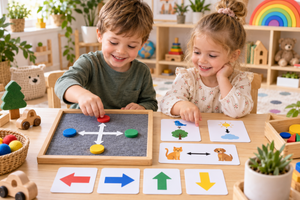
Puzzles for two-year-olds do not have to form one rectangular picture. A two-part animal, object-and-shadow match or large shape in a frame makes the principle visible. Puzzles for ages two to three can be mixed gradually: offer one pair first, then two, and eventually ask the child to find all the relationships on the table.
Matching Halves, Inset Frames and Jigsaw Pictures
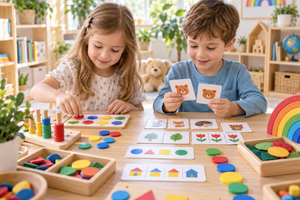
Two-piece matching puzzles let a child finish a simple image or meaningful relationship. Each part already reveals much of the answer: an animal’s head and body, two parts of a vehicle, or an object and the place where it belongs. This is a useful bridge between ordinary matching and creating one whole from many fragments.
An inset has a fixed position in a base. Its boundary immediately shows whether the shape is aligned, while the frame limits the number of possible solutions. Wooden inset puzzles are often comfortable for beginners because the parts are rigid. Material alone does not guarantee a good choice, however. Smooth edges, sound construction, non-toxic finishes, suitable piece size and sufficiently different outlines are more important than the word “wooden”.
A traditional jigsaw requires attention to both the connecting shape and the continuation of the picture. Corners and straight edges provide a strategy, but a young child may need to see that strategy once. Begin with observation rather than speed: locate the sky and ground, identify possible edges and find one object that is easy to recognise.
Wooden, Magnetic, Felt and 3D Formats
No single material is best for every child. Wooden puzzles are rigid and tactile; laminated pieces offer compact themed pictures; felt holds on a suitable surface and lets the learner rearrange a scene.
Magnetic puzzles for children can be practical on an upright board or while travelling, provided every magnet is securely enclosed and the current age guidance is followed. Damaged magnetic puzzles must be removed immediately. Swallowed magnets can cause severe internal injury and require urgent medical attention.
3D puzzles usually produce a model rather than a flat picture. The child needs to manage order, connections and more than one plane, so the activity is closer to construction. It is rarely the simplest introduction to the part–whole idea. Choose a 3D format when the child already enjoys building, can operate its particular connectors and is old enough for every component.
|
Family need or child interest |
Format or example |
What it offers |
What to check |
|
Strong first outlines and shape names |
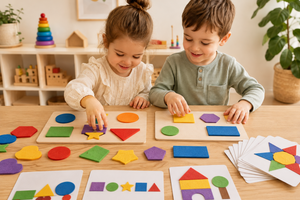
Geometric images connect logic with English vocabulary |
Marked 3+ with laminated cards; check whether its language suits your goal |
|
|
A familiar animal theme |
Animal parts provide meaningful visual clues |
Marked 3+ and in English; check completeness |
|
|
A spatial scene without one fixed ending |
Roads, buildings and transport form original scenes |
Felt, marked 3+; use a clean surface where pieces hold |
|
|
An upright or portable activity |
Magnetic format |
Pieces move less easily and support spatial talk on a board |
Secure enclosure, piece size, condition and current age marking |
|
Interest in models and construction |
3D format |
Sequencing, joining and thinking across several planes |
Small parts, connector type, fragile tabs and likely need for adult assistance |
When browsing a wider collection of educational toys for children, choose according to the action the learner can take independently. A clear first step, meaningful self-check and one available extension matter more than a long list of promised benefits.
What Makes a Good First Picture?
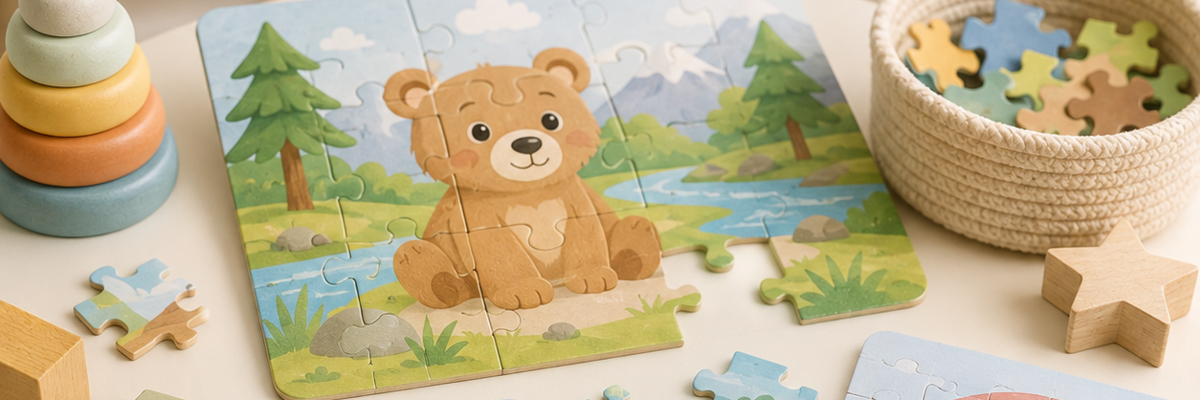
A beginner’s image benefits from one large central object, a clear silhouette and little repeated background. An animal, vehicle, house or familiar food gives the child a prediction about the intended whole. A wide plain sky, many identical flowers or a crowd of similar characters can make a puzzle unexpectedly difficult even when the piece count is low.
Interest is important, but it cannot compensate for tiny parts or a visually crowded illustration. A manageable familiar scene that the child wants to repeat is usually more useful than a spectacular image assembled mainly by the adult.
For an older preschooler, use the finished scene to predict an earlier event or describe a character’s route. Language adds a new layer without increasing the piece count.
How to Present a New Puzzle Without Taking Over
Show the completed image and state the purpose in one sentence: “These pieces make an animal.” For a jigsaw, turn every piece picture-side up. If there are many parts, find the corners, straight edges or one bright section together. Demonstrate one move and hand the process back.
When the child pauses, avoid pointing immediately to the correct place. Return attention to a usable clue:
- “Which colour are you continuing?”
- “Does that look like an outside edge?”
- “Could the piece turn?”
- “Which part of the animal can you see?”
- “What can you compare with the reference?”
If there is still no route forward, offer two pieces or cover part of the workspace. This adjusts difficulty without supplying the answer. Restore the wider choice later.
Seven Ways to Reuse One Set
1. Fragment detective. Describe a piece’s colour, line, texture and visible object. Predict its place, then test the idea.
2. Edge hunt. Collect straight sides and corners. Build the frame, or simply identify possible edges in a small set.
3. One rotation. Put the correct piece in the correct area but turn it wrongly. The child changes only its orientation, separating position from rotation.
4. Build from memory. Show the reference for 10–20 seconds, cover it and begin. Reveal it for checking before frustration rises. The guide to copying patterns for spatial thinking and visual memory offers further ways to increase this challenge gradually.
5. Verbal navigator. One player can see the target area and explains: “left of the roof”, “below the wheel” or “next to the blue edge”. The other places the piece. Swap roles so the child produces precise instructions as well as following them.
6. Cooperative puzzle game. Divide roles: search for edges, group colours and check the story. Complete the picture together and name the strategy.
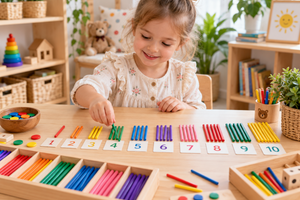
7. Number and quantity. Maths puzzles can connect a numeral, a group of objects and a simple relation. The child counts first, finds the symbol and explains how the answer was checked. If the quantity is not yet understood, prevent the activity from becoming mechanical pair matching.
Children who especially enjoy finding correspondences may also like the variations in matching games and ways to increase their difficulty by age. A spatial puzzle asks for more than recognising two identical cards: the result depends on position, orientation or a sequence of decisions.
Signs That a Puzzle Is Too Hard—and How to Adjust It
Random pushing, waiting after every move, stopping after one mismatch or an adult completing most of the image suggest that the demand is too high. Similar pieces, weak contrast, awkward joins or an unfamiliar picture may be the cause.
Change one variable: offer half the pieces, complete the frame, separate one colour zone, keep the reference beside the workspace or provide a choice of two. Restore one removed difficulty next time. If a familiar set is too easy, do not immediately replace it. Ask the child to look briefly and work from memory, explain each move or tell a story about the completed scene.
Avoid treating a timer as the main measure of progress. Repeated speed often reflects memory for a specific set. A more useful sign is strategy: the child scans, groups, rotates, compares and can say why a piece belongs.
Safety, Completeness and Storage
Check the current product age marking before play and inspect edges, coatings, magnets and connectors. Small pieces are unsuitable for children who may put them in their mouths. Remove damaged magnetic components immediately. With a model, look for fragile tabs and small joining parts.
Store each set separately with its reference picture and check completeness. A few different mechanisms in rotation are more inviting than incomplete sets mixed together.
Frequently asked questions
How many pieces should a child’s first puzzle have?
Begin with one inset or a familiar image in two large parts. The important question is whether the child understands the goal, handles and rotates a piece, and notices a match. After several independent successes, add another pair or a 3–4-piece picture.
Which puzzles suit a child aged two to three?
Large matching halves, simple inset frames and individual pictures with few, clearly different parts are useful starting points. Choose familiar objects and strong outlines. Every component must meet current age guidance, remain intact and be too large to swallow.
Are wooden or cardboard puzzles better?
The better format is the one the child can use independently. Wood gives a rigid piece and tactile edge; dense card or laminated material may offer more themes and compact storage. Judge construction, edge finish, contrast and ease of joining rather than the material name alone.
Should I help when my child cannot find a piece?
Yes, but narrow the search instead of inserting it yourself. Invite the child to compare colour, edge or object, rotate the piece, or choose between two options. Leave the final placement and the check to the child.
When is a child ready for a harder puzzle?
The child completes a familiar set without step-by-step directions, uses a strategy, corrects mismatches and remains interested. Add one new demand: more pieces, a less obvious background, a short memory interval or an open composition. Return to the earlier level if random guessing replaces purposeful checking.
Conclusion
A useful puzzle provides an understandable whole, reliable clues, independent feedback and one manageable next step.
Start with what the child actually does. Demonstrate one strategy, allow time to search and increase the challenge gradually. Puzzling can then support spatial reasoning, hand precision, language and persistence without becoming a test or race.