How to Build a Child's Attention and Concentration: 15 Short Games
In brief: attention is easier to practise through a short game with one clear rule. A child might look for a chosen feature, respond to a signal, copy a model, notice a change, or switch to a new sorting rule. Begin with three to five minutes, remove unrelated materials, and finish while the child still understands the activity. Change only one demand at a time: the number of items, the length of the round, the similarity of the choices, or the number of steps. Regular manageable attempts matter more than sitting for a long time or completing every turn without error.
Attention is not a switch that a child can keep on simply because an adult says, “Concentrate.” It is easier to direct when the goal is visible, the beginning and end are predictable, and the child can act rather than only listen. Tiredness, hunger, noise, an unfamiliar rule, and an overcrowded playing area can all change performance. One difficult round therefore says little about what the child can do in a better setting.
Attention games for kids can involve several distinct actions: selecting relevant information, holding a brief direction in mind, pausing before an automatic response, returning after a rule changes, and checking a result. You do not need a specialised “brain training” product. Cards, blocks, lids, familiar toys, household pictures, and movement are enough. When choosing educational toys, look first at what the child will actually do and whether the field can be simplified, rather than relying only on the age printed on the box.
What concentration means during play
In a short home activity, concentration does not mean sitting perfectly still. It means directing action towards the current goal. The child may listen for one sound, scan pictures in an orderly way, compare a construction with a model, or remember two movements. A lively stop-and-go game requires attention too, because the player must monitor a cue while moving.
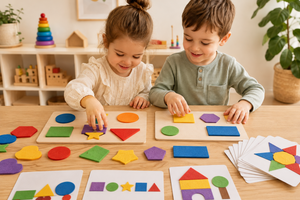
It helps to separate three demands. Selective attention is used when the child finds a red circle among unrelated pieces. Holding a rule is required when the child claps only for animal words across several turns. Switching happens when the same pieces must now be sorted by shape rather than colour. Make one of these the main challenge in any single round; combining all three at once can hide which part needs support.
Preparing a short concentration game
Choose a moment when nobody is rushing and the child is not already tired. Leave only the required materials on the table and keep spare pieces to one side. State the rule in one sentence, then demonstrate one example. “Touch only the round cards” is more useful than “Pay attention,” because it identifies both the action and the relevant feature.
|
Approximate stage |
Starting field |
Length of one attempt |
Useful adult support |
Sign that a change may be suitable |
|
First encounter |
2–3 clearly different items |
2–3 minutes |
demonstrate one action, then do the next together |
the rule is understood without another demonstration |
|
Familiar rule |
4–6 items |
3–5 minutes |
restate the goal before starting |
most short rounds are completed comfortably |
|
Wider choice |
6–10 items |
5–7 minutes |
ask which feature matters |
the child scans rather than choosing at random |
|
Rule switching |
the same small field |
5–8 minutes |
clearly mark when the old rule ends |
the new rule is followed after a brief pause |
Experience is often a better guide than age. A two-year-old may need two objects and one movement, while an older preschooler may also need the simplest version of an unfamiliar listening game. Ideas can be paired with materials designed for children aged 1–2, children aged 2–3, or children aged 4–5, but the number of choices should still follow the individual child's response.
Choose concentration exercises for kids by the action they already enjoy. Movement cues suit a child who does not want to sit, while comparison and model copying suit one who likes inspecting detail. The same cards can become observation games for children when the goal is to find one change, follow a visual clue, or explain what differs. A familiar theme may invite participation, but the rule should still fit into one sentence.
15 short attention games for kids
1. Clap for the target word
Agree that the child will clap only when they hear the name of an animal. Say five to seven words slowly: “cat, cup, fox, table.” After a comfortable round, choose a different category and announce the change before starting. If every word produces a clap, use only three words and leave a longer pause between them.
2. Freeze when the cue stops
The child moves around the room while you make steady claps and freezes when the sound stops. Begin with short, predictable sections. Later, vary their length or replace silence with a raised hand. The player has to monitor a cue during movement, showing that concentration does not require a chair or worksheet.
3. Colour hunt
Name one colour and ask the child to find three safe objects of that colour in the room. They can point instead of carrying anything. On another day, search for a shape or material. Keep to one feature at first; “small, round, and blue” turns a simple visual search into a much heavier language and memory task.
4. What changed?
Arrange three familiar objects and allow time to inspect them. Ask the child to turn away, then remove one object or swap two positions. The child identifies the change and restores the row. If that is difficult, reduce the field to two items and name their positions together instead of extending the viewing time indefinitely.
5. Build one difference
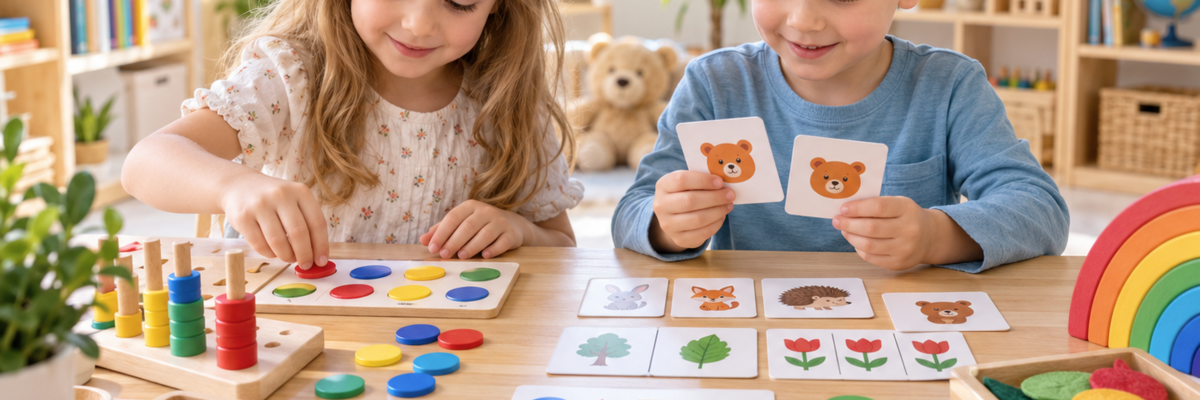
Make two nearly identical arrangements with blocks or cards, changing one detail such as colour, direction, or number. The child compares them from left to right and touches the difference. Later, let the child prepare the puzzle for you. Creating a deliberate difference requires a clearer grasp of the rule than merely guessing one.
6. Copy the model
Display a sequence of three pieces: circle, square, triangle. Provide only the pieces that are needed and invite the child to reproduce the order beside it. Compare one position at a time without moving the child's pieces. For a later challenge, show the model briefly, cover it, and allow one planned look for checking.
7. Continue the pattern
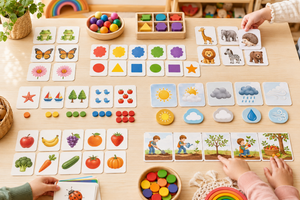
Start a repeating sequence such as red-blue-red-blue or large-small-large-small. Ask what part repeats, then let the child add two items. If the next choice is a guess based only on the final piece, draw a small gap between each repeated pair. Logic and sorting games offer many materials for keeping this action familiar while changing the pictures.
8. Sort under a new rule
First sort six pieces into two colour groups. Mix the same pieces and sort them by shape. Say clearly, “The colour rule has finished; now shape matters.” Do not measure speed. The meaningful action is noticing which property is currently relevant and leaving the previous response behind.
9. Description detective
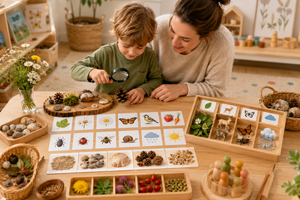
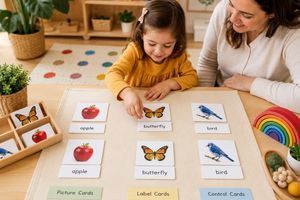
Set out four different pictures and describe one without naming it: “It is green and it can grow.” The child chooses the answer and explains which clue helped. Then exchange roles. Pictures from thematic learning sets make it easy to vary topics without changing the familiar detective format.
10. Listen and build
Provide a block, a figure, and a small box. Give one direction: “Put the figure on the box.” Later join two actions: “Take the block and place it in front of the box.” If the order is lost, repeat the same sentence or separate the steps. Add a third step only after two are manageable.
11. The forbidden movement
Slowly demonstrate simple movements and ask the child to copy all except one agreed action, such as touching the head. One forbidden gesture is enough at first. Later, replace it or require a stamp instead. Keep an even pace so that the child can insert a pause before copying rather than being defeated by speed.
12. Slow mirror
Stand face to face and move your hands continuously and slowly. The child mirrors their height, direction, and distance from the body. Exchange roles after about half a minute. A smooth pace gives the follower time to compare and adjust without a stream of corrections; making it fast changes the task into reaction rather than observation.
13. Movement chain
Show two actions in order, perhaps clap then step. The child repeats the same sequence. Add a third action only after several secure attempts, or invite the child to create a chain for you. Stop before the chain becomes an endurance test. A short accurate sequence with continued interest is a complete round.
14. Find the number or symbol
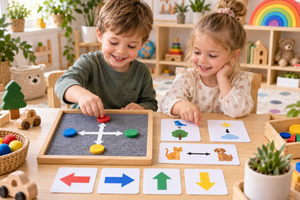
Lay out four familiar number, letter, or symbol cards. Name one, then add a positional clue: “It is between the circle and the two.” The child combines visual search with spatial language. Materials from language and mathematics activities can change the content while the search routine stays predictable.
15. Let the leader catch the error
The child creates a small model, a sorting rule, or a movement sequence. You follow it and make one friendly, obvious mistake. The leader finds the error and explains how to correct it. Leading reveals whether the rule is genuinely understood rather than copied, and an adult's playful mistake makes checking feel purposeful rather than punitive.
Helping without taking over
First allow a pause. Then repeat the short goal, reduce the field, or direct attention to one feature: “We are looking at shape now.” If that is not enough, demonstrate the first step and return control. A general reminder to focus does not tell the child what to inspect, whereas a specific cue makes another independent attempt possible.
An error can have several causes. The direction may not have been heard, the rule may have been forgotten, the images may be too similar, or the response may have been rushed. Test one possibility at a time. Avoid speaking louder, adding three examples, and rearranging the materials all at once. A simpler next round provides clearer information.
A light weekly plan
There is no reason to complete all 15 games in one sitting. Choose one familiar activity and perhaps one new one, with ordinary free movement between them. Repeat a mechanic for several days, changing only the pictures or story when the basic action remains enjoyable.
|
Day |
Short game |
Keep this stable |
One possible next challenge |
|
Monday |
No. 1, Clap for the word |
one category and five words |
add two words that do not require a response |
|
Tuesday |
No. 4, What changed? |
three objects and one change |
swap two positions instead of removing one item |
|
Wednesday |
No. 6, Copy the model |
three pieces and a visible model |
cover the model after viewing |
|
Thursday |
No. 8, New sorting rule |
six pieces |
switch from colour to shape |
|
Friday |
No. 12, Slow mirror |
a calm pace |
give the child the leading role |
A successful session is one in which the action made sense and the child could finish a short round without a struggle. Looking away, changing the subject, or deliberately breaking the rule can simply mean it is time to stop. Next time, shorten the field or return to a version that was previously comfortable.
Frequently asked questions
How long should an attention game last?
Three to five minutes is often enough for a first attempt, and some children will prefer less. Follow the clarity of the rule and willing participation rather than a timer. Ending after a successful short round is more useful than extending the activity into frustration. Increase duration gradually without also adding harder choices.
Which attention games suit a two-year-old?
Choose one action using two or three clearly different objects: find the named colour, copy one movement, match identical pictures, or notice which toy disappeared. Demonstrate once and play alongside the child. Do not use small parts unless they suit the manufacturer's age guidance and the child's current tendency to mouth objects.
What should I do if my child keeps making mistakes?
Reduce the field, shorten the instruction, and check that every picture and word is familiar. Ask the child to show the rule on one example. If the simplified version works, the original demand was too high for that moment; it does not show a lack of effort. Reintroduce one small challenge another day.
Do I need to correct every mistake immediately?
No. Allow a few seconds for self-checking, place the model beside the result, or ask about one relevant feature. Intervene quickly when safety is involved or when the child explicitly requests help. A neutral invitation to look again preserves the problem-solving part of the game better than labelling the child careless.
How can I tell when concentration exercises should become harder?
The child remembers the rule, completes most short rounds, checks the result, and remains interested. Add only one change: two more items, one similar picture, a short wait, or a second instruction step. If performance drops sharply, return to the previous version without treating the change as a failure.
Conclusion
Developing attention in children does not require long demands to sit still. Use short, understandable actions that alternate listening, searching, sorting, model copying, and movement. Preserve the option to pause, and change one variable at a time. The game then remains meaningful, while the adult can see which precise rule is becoming easier to manage.