Shape Sorter for Children: When to Start and How to Choose the Right One
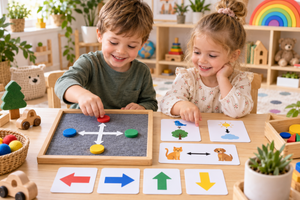
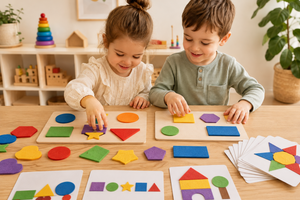
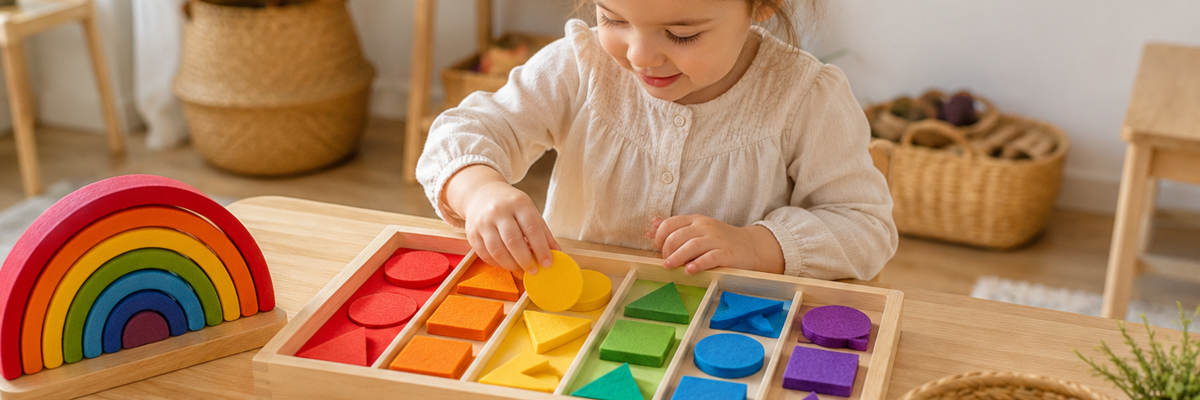
A classic shape sorter for children is a box, board or other base with openings that match separate pieces. Yet sorting is a much broader idea. A child can group objects by colour, shape, size, material, function or meaning. One format therefore suits a toddler’s first attempts at putting objects into a container, while another can challenge a preschooler who is ready to explain a rule.
There is no single correct age for introducing a sorter. Look at what the child can do: sit steadily, grasp an object deliberately, release it in a chosen place and show interest in putting things in and taking them out. One child may begin near the first birthday with two large pieces; another will be ready later. The manufacturer’s age marking sets essential safety boundaries, while the child’s current actions indicate an appropriate level of challenge.
What sorting really develops
When a child rotates a piece, compares it with an opening and tries again, vision, touch and movement work together. The child notices features, coordinates hand and eye, plans an action and changes strategy after an unsuccessful attempt. These benefits do not come magically from owning the toy. They emerge through active, repeated decisions.
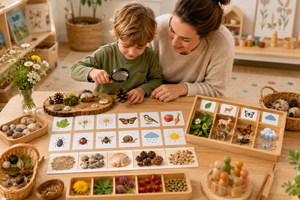
Sorting is also an early experience of classification. At first the rule is visible: a circle fits a circular opening. Later, children understand less obvious relationships. The same object can be wooden, red and round at once. This flexible attention to attributes supports later work in mathematics, language and science.
A well-designed shape sorter gives clear feedback. A piece passes through or it does not; a picture fits the agreed category or needs a new explanation. An adult does not have to grade every move. The child can observe the result and correct the action independently.
An age-by-age path from posting to classifying
The ranges below are approximate. Always follow the age and safety guidance for the exact product, and never offer small parts to a child who still mouths objects.
|
Approximate stage |
Suitable format |
Make the first game easier |
A sign the child is ready to progress |
|
10–18 months |
A container with one large opening and 2–3 safe objects |
Slowly post one piece and place the container within easy reach |
Repeatedly puts objects in and takes them out with clear intention |
|
18–24 months |
Two very different openings, such as circle and square, with large pieces |
Present only two shapes and turn the base to a convenient side |
Compares a piece with openings instead of pushing at random |
|
2–3 years |
Three to five shapes or a simple one-feature colour or size sort |
State one short rule and demonstrate one example |
Matches most pieces independently and names some features |
|
3–4 years |
Several features, matching pictures or familiar thematic groups |
Begin with two contrasting groups, then add one new group |
Explains why an item belongs in a particular group |
|
4–6 years |
Meaning-based categories, two intersecting rules and child-made systems |
Use a familiar theme and invite the child to choose a rule |
Finds more than one valid classification and justifies a choice |
If every piece is placed in seconds without comparison, change the rule or move to richer material. Conversely, constant adult assistance indicates that fewer pieces or a simpler action would be more appropriate.
Main types of sorter
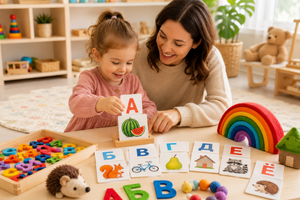
An inset sorter has a flat base with openings or recesses. All pieces remain visible and are easy to pick up, making this format accessible at the beginning. If pieces have knobs, check that every knob is securely attached.
A sorting box adds spatial orientation. The child must find an opening and rotate a three-dimensional block correctly; after insertion, the piece disappears inside and motivates retrieval and repetition. The box should open without pinching fingers, and no piece should become stuck during normal play.
A peg or post sorter asks the child to place pieces on rods, sometimes considering colour, number of holes or sequence. It needs more precise movement. The base should be stable and rods short, rounded and free of cracks.
A colour or size sorter may have no fitted openings. Bowls, large counters, rings, cards or safe objects are divided by one visible attribute. Loose household items, pompoms and tongs are inappropriate for a child who still mouths materials or cannot use them safely.
A meaning-based sorter uses concepts such as sport and music, hot and cold, edible and inedible, or natural and human-made. It suits a child who can listen to a brief rule and explain a choice. Some answers may be debatable, which is valuable: a sensible reason matters more than mechanically reproducing an adult’s arrangement.
How to choose without paying for distractions
Begin with the action the child can almost perform, not with a material, brand or list of features. The best challenge is one small step beyond current ability, not five new demands at once. A box with ten similar openings overwhelms a child who is only learning to release an object into a container. A preschooler who already knows basic shapes may be more engaged by explaining categories.
|
Criterion |
A helpful sign |
Warning sign |
Practical check |
|
Safety |
Clear age mark, large enough pieces and smooth edges |
Cracks, sharp points, loose magnets or weak fittings |
Inspect every component and read the maker’s warnings |
|
Difficulty |
First success is possible after one short demonstration |
An adult must continually guide the child’s hand |
Offer 2–3 pieces and observe the independent strategy |
|
Shape contrast |
Openings and pieces are clearly different at the first level |
Shapes look almost identical or fit several random holes |
Test every piece gently without forcing it |
|
Feedback |
The result is visible and the action can be retried |
Lights or sounds distract from comparison |
Ask whether the play still makes sense without batteries |
|
Longevity |
Pieces can be added gradually or used under new rules |
There is only one fixed route and no variation |
Imagine three different activities with the same set |
|
Care |
Surfaces can be cleaned as directed and all parts store together |
Finish rubs away, fabric stays damp or pieces are always lost |
Check care instructions and choose a storage container |
Music and lights are optional. If they react regardless of the solution, attention may shift from comparing shapes to pressing a button. A direct sequence is often richer: rotate, compare, test and reconsider.
Wood, plastic, fabric or cards
A good wooden shape sorter has a stable base and tactile surface. Wood alone is not evidence of quality: check for splinters, smooth finishing, durable coatings, accurate openings and strong joints.
A wooden sorting toy should survive repeated dropping without parts separating. If the item is painted, inspect it regularly for chips and follow the manufacturer’s cleaning instructions rather than soaking it. Swollen wood can change the fit of pieces and damage the surface.
Plastic models can be light and easy to clean, but look for adequate thickness, sound seams and a secure lid. Fabric and felt are quiet and work well for advanced thematic groups, although they require different care. Cards provide many classification rules in a compact set but suit children who no longer crumple or mouth learning materials.
The label Montessori sorter is not a guarantee that a product reflects Montessori principles. Evaluate the object itself. Does it isolate one difficulty? Is the result understandable? Can the child work independently? Are unnecessary effects absent? A simple material with a clear purpose may fit those principles better than a crowded activity cube with fashionable wording.
Safety checks before the first play session
The age label is the starting point, not decoration. A part that presents a choking hazard is unsuitable for a child under three and for any older child who still puts objects into the mouth. Pay special attention to magnets, button batteries, cords, removable knobs and decorative attachments; swallowing a magnet or button battery is a medical emergency.
Make sure openings cannot trap fingers, the lid cannot fall on a hand and the base is not likely to tip onto the child. Stay close during early play even when the task appears simple. Supervision means being near enough to intervene, not watching from across the room while doing something else.
How to demonstrate without doing the work
Place the material on a stable surface and present two contrasting pieces. Slowly take one, compare it with an opening, rotate it and let it drop through. A visible model is more helpful than a long explanation. Then return your hands to your lap and give the child time.
If the piece does not fit, avoid taking over. Try a neutral prompt: “That side stopped. How could you turn it?” or “Which opening has a similar edge?” A pause allows a new plan to form. Do not encourage force, because pushing harder teaches the child to overcome resistance rather than observe and compare.
End before frustration or fatigue. A few successful repetitions are enough for a first session. Store the base and pieces together on an accessible shelf. Short activities chosen independently usually support more learning than a compulsory long “practice time.”
Ways to extend one shape sorting toy
Once posting the shapes is easy, you may not need a new set. Hide a piece in an opaque bag and identify it by touch, name a shape before inserting it, build a colour sequence or find an object of the same shape in the room. Add only one condition at a time so that the child can understand what changed.
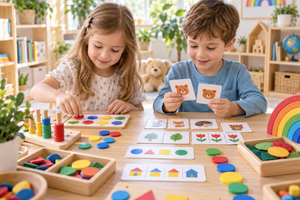
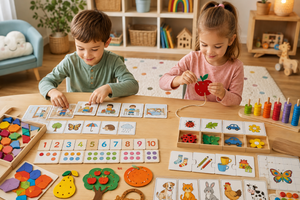
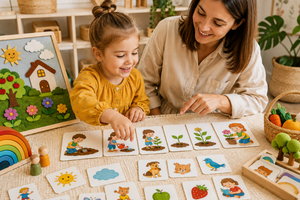
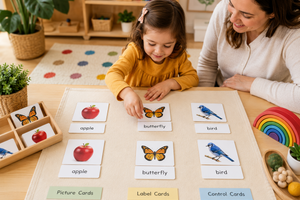
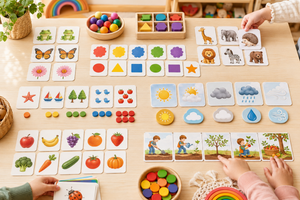
For an older preschooler, move from visible attributes to meaning. The logic and sorting collection includes felt and card-based tasks with thematic rules. In Sorting: Sport and Music, pictures are placed into two meaningful groups. Sorting: Hot and Cold can prompt discussion about temperature and safety, while What Is It Made Of? 2 encourages comparisons of materials and their origins.
Check the exact age recommendation, contents and language before ordering any set. The linked product pages are localized, but the material language should still be confirmed on the product page. Do not treat thematic sorting as a test with only a score. Ask whether an object could belong to two groups, which feature mattered most and what alternative rule the child would invent.
Common adult mistakes
The first is presenting too many pieces. A heap of twelve shapes creates visual noise when the child is just comparing a circle and a square. Start with two and keep the rest out of sight. Add one only when the existing choice looks easy.
The second is correcting every attempt with “no” or “wrong.” Describe the observable result instead: “The piece stopped,” or “This opening has straight edges and the piece is curved.” Attention returns to the useful feature rather than to adult approval.
The third is demanding speed. Sorting toys for children are most valuable in the pause when a child compares, rotates and checks. Timed races only make sense for an older child who requests that variation and already completes the underlying task accurately.
The fourth is insisting on one category when several rules are valid. An apple may belong with foods, plants, round objects or red things. Ask, “What rule did you use?” and accept a coherent explanation. Flexible reclassification is a higher-level skill, not an error.
Related ideas for the next step
The guide on sorting by colour, shape and size gives a practical sequence from two contrasting objects to rules involving two attributes. When matching familiar features becomes secure, these matching games and age-based variations add memory, visual comparison and changing rules.
When browsing educational toys, look for the nearest manageable action rather than the greatest number of pieces. A material works when the child can begin with some independence and still has a meaningful next challenge.
Frequently asked questions
At what age can a child use a shape sorter?
Simple “put it in” play may begin around 10–18 months when a child sits steadily and releases objects intentionally. Follow the manufacturer’s age label, consider the size of every part and account for mouthing. Begin with one large opening and two large, safe objects.
What if my child does not want to insert the shapes?
Do not insist. Demonstrate one brief action, keep the material accessible and try another day. A plain container with large safe objects may be a better starting point, because interest in filling and emptying often appears before precise shape matching.
Is wood better than plastic for a sorter?
Neither material guarantees quality. Wood needs smooth finishing, sound joints and durable coating; plastic needs strong seams, adequate thickness and a reliable lid. In both cases, safety, appropriate difficulty and accurate matching between pieces and openings matter most.
Does a sorter need lights and sounds?
No. Effects can be enjoyable, but they should not replace visual comparison and self-correction. Music that activates after any press may distract from the rule. A simple, visible result often supports concentration more effectively.
How can I tell that the sorter is now too easy?
If the child places every piece in seconds without looking closely and no longer returns to the activity, change the rule. Add naming, tactile recognition, a sequence or meaning-based groups. Buy a new resource only when the current set cannot support a useful next step.
The best guide is meaningful independent action
The right sorter matches the child’s present way of acting, not only a printed age range. It is safe, offers a clear first problem, provides visible feedback and allows one small extension. The adult models the beginning, supervises closely and leaves room for a genuine attempt.
Start with very few pieces, stop before fatigue and gradually move from fitting shapes to noticing multiple attributes and building meaningful categories. Sorting then becomes more than a one-time success at an opening: it supports observation, language, logic and independent thought.