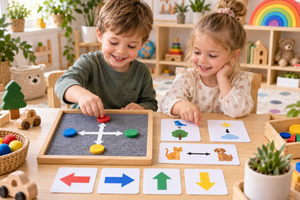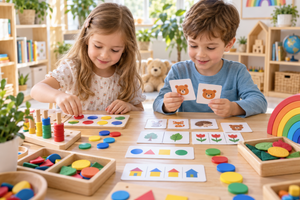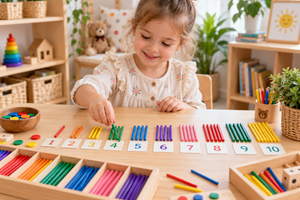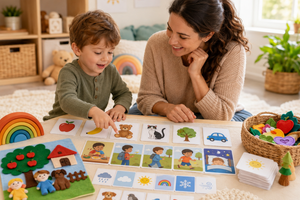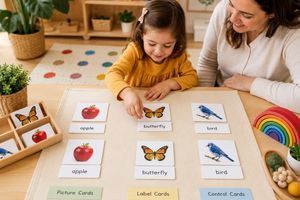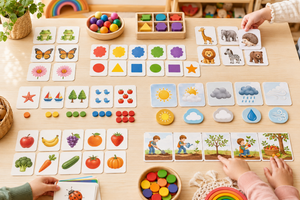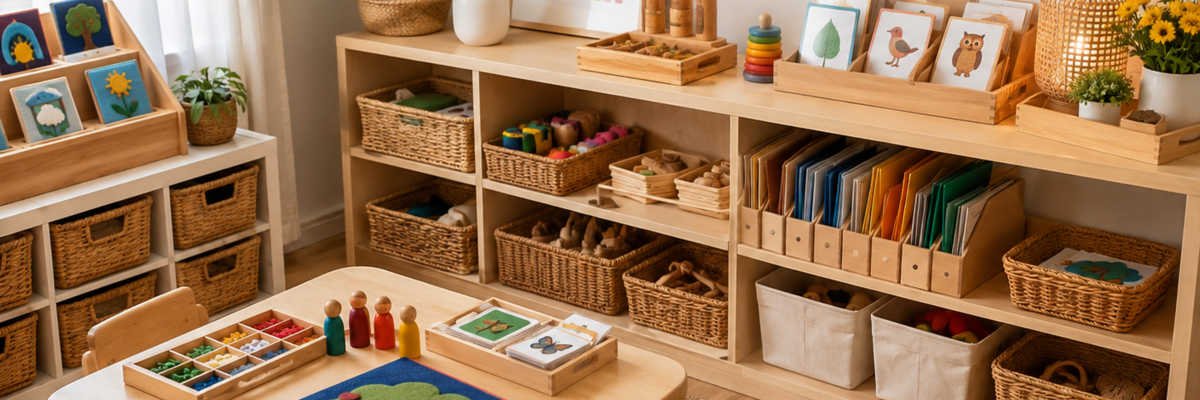
A useful home learning environment does not begin with new furniture or an enormous collection of toys. Its clearest sign is that a child can see a manageable choice, carry one complete activity to a work area, understand its main action, and return it. The space supports independence when its order can be read without repeated adult directions.
The common difficulty is not too little material but too much visible at once. A deep bin of mixed pieces hides every possibility. A crowded shelf turns choosing and restoring into harder tasks than the activity itself. A smaller selection in separate baskets, folders, or trays gives each invitation a recognizable beginning and end.
This guide offers a system for an ordinary apartment or shared family room. It covers observation, zones, safe storage, rotation, presentation, and weekly maintenance. The goal is not a picture-perfect “Montessori room.” It is a workable arrangement that reflects the real child, the adults’ capacity, and the safety needs of everyone who uses the home.
Key takeaways
- Keep only as many activities accessible as the child can distinguish and reasonably restore.
- One basket, tray, or folder should contain the complete set for one understandable action.
- Rotate from observation and changing interest, not because a calendar says the shelf must change.
- Present a material by showing how to carry it, use it, check it, and put it away.
- Furniture stability, manufacturer guidance, and supervision always take priority over open access.
Observe the child before reorganizing the shelf
For several days, notice what the child chooses without reminders, which movement is repeated, where help is requested, and which sets are abandoned immediately. Record visible events instead of interpretations: opened a box, searched for a missing pair, mixed two envelopes, returned to the same sorting task three times.
Those notes suggest different responses. The activity may be too difficult, a piece may be absent, the child may never have seen a complete demonstration, or the container may be physically hard to reach. Rotation is only one option. Reducing the number of pieces, changing the position, or presenting the action again may solve the actual problem.
Observe the household rhythm as well. Water work belongs where spills can be handled easily. Cards need a surface protected from food and traffic. Movement materials should not block a route through the room. A prepared environment succeeds by fitting the home, not by reproducing somebody else’s photograph.
Access and responsibility by stage
|
Approximate stage |
Accessible selection |
Storage |
Child’s part of the cycle |
|
About 2–3 years |
A few large, clearly different materials |
Open baskets without difficult fasteners |
Carry, complete one action, restore together |
|
About 3–4 years |
Familiar matching, language, and hand-work sets |
A separate tray or envelope for each set |
Check pieces against a simple visual reference |
|
About 4–5 years |
Activities with two possible levels |
Small inserts and consistent shelf labels |
Choose a level and report a missing piece |
|
About 5–6 years |
Project, classification, and creative materials |
Folders, trays, and boxes organized by activity |
Help prepare a tray and discuss rotation |
This is not a developmental test or a required inventory. Expand access after the existing routine is understood. Small parts, tools, and any potentially hazardous material must follow the product’s age guidance and the actual supervision available in your home.
Four functions the environment needs
A place to choose
This might be a low shelf, one section of a cabinet, or two accessible containers. Keep activities separate and face their most informative side toward the child. Empty space between sets is useful: it marks boundaries and lets a basket be removed without shifting everything else.
A place to work
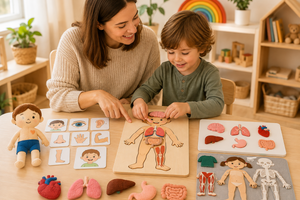
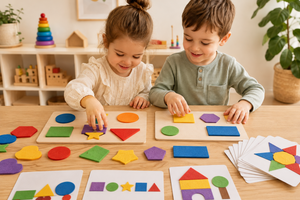
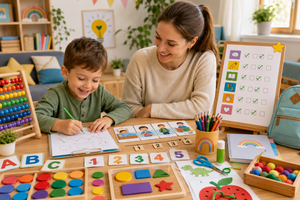
A small table, floor mat, or defined area gives the activity a frame. It is not permanent storage for unrelated objects. The child brings one set, works, completes or deliberately pauses, and clears the surface before another material arrives.
A place for materials that are waiting
The reserve does not need to be visible. Use an adult-height shelf, closed bin, or cabinet section. Group sets by topic or kind of action rather than whichever items happen to fit together. A simple inventory prevents duplicates and makes the next considered change easy to find.
A place for recovery and repair
Keep a cloth, small brush, and a container for found, damaged, or incomplete pieces in a known location. A child can place an unidentified piece there instead of pushing it into the first box. Cleaning, repairs, and the final safety decision remain adult responsibilities.
Choose storage that explains the activity
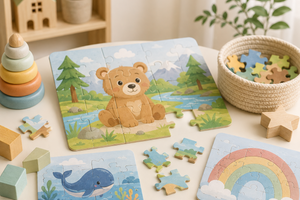
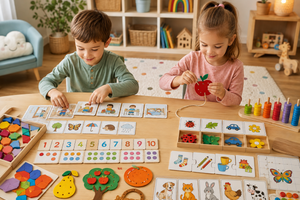
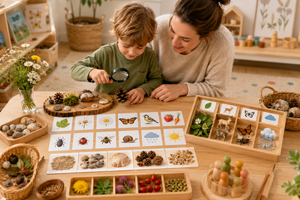
A tray keeps several objects together while they travel to a table. A shallow basket suits soft or larger components. A folder or envelope keeps one card set flat with little space. A box with a few inserts can separate kinds of pieces once the child understands how to reconstruct the system.
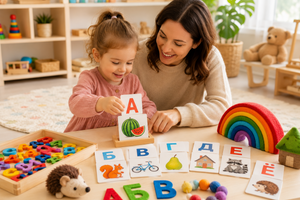
A picture label can show a younger child where a set belongs; a short word helps an emerging reader. Label stable categories rather than every individual object. If decoding the labels is harder than doing the activity, the organization depends too heavily on the adult. Check that containers open easily, remain stable, and are not too heavy when complete.
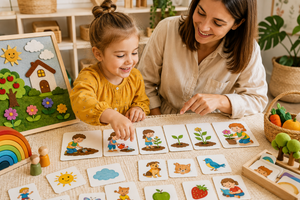
Card sets benefit from a consistent internal order. Pairs, control cards, or labels can be divided with paper bands or small inner envelopes. Use the set’s visual reference or contents information when available. Remove an incomplete set from the active shelf until it is restored, so the next session does not begin with an invisible obstacle.
Rotate without creating a demand for constant novelty
Think of three statuses: active, waiting, and temporarily unavailable because of missing pieces, excessive difficulty, or supervision needs. The active selection can include different kinds of work—construct, match, sort, name, create, care—but it does not need to represent every category at all times.
Possible signals for change include an activity that has not been noticed for many days, a task completed instantly without new variation, repeated misuse that reveals an unclear presentation, or a sustained request for another subject. Before removing a set, check whether a brief demonstration or a related new action might renew meaningful use.
Change one or two materials rather than replacing the whole shelf. Familiar sets provide stability and support repetition. Put a new activity in a visible open position, then allow the child to choose it or ignore it. Review not just frequency but the quality of work: longer attention, more orderly restoration, more precise decisions, or fewer requests for rescue.
Give a short presentation of a new material
1. Invite at a suitable moment
Do not interrupt deep play to introduce your planned activity. Name the material and offer a brief demonstration when the child is available. A refusal can simply move the presentation to another time.
2. Demonstrate the whole route
Take the tray from its place, carry it safely, establish the workspace, perform the main action, check the result, and restore everything. The first and last steps often explain how the environment functions.
3. Reduce simultaneous language
Say only what the hands cannot show: a name, an essential safety rule, or the checking method. A long explanation makes the child divide attention between speech and movement.
4. Hand over the central action
Invite the child to try without inserting a second rule halfway through. If help is needed, demonstrate only the movement where the process stopped, then return control.
5. Leave the option to return
After restoring the set, place it in its visible home. Do not require an immediate second performance. A later independent return is useful evidence that the path and purpose were understood.
A brief weekly check instead of a room makeover
Once a week, check furniture stability, clear routes, cleanliness, complete sets, and whether each material still matches its current use. Remove damaged items, reunite separated parts, and clear the work surface. This technical maintenance matters more than decorative rearranging.
Next, review a few observation notes. Keep what the child uses purposefully, simplify anything that requires constant intervention, and add one option related to a strong interest. A private photograph of the shelf can reveal visual crowding, but it cannot replace watching what happens during real work.
Learn&Dream examples for flat and loose-piece storage
Use product format to plan storage: cards stay flat and separated, while loose felt pieces need a pouch or divided tray. The examples below illustrate both approaches. Always consult the current product page for contents, care, and age guidance before use.
|
Material |
Storage idea |
What to present |
Rotation idea |
|
A flat card box or folder with inner bands |
A small selection for naming or grouping |
Return later with a different classification rule |
|
|
A flat pouch placed on a presentation tray |
Only the pieces needed for the current action |
Alternate a visible model and free arrangement |
Keep the rules separate. Complete and restore a card activity before bringing out felt pieces, or prepare each format on its own tray. The physical boundary lets the child recognize which checking method and cleanup sequence belong to each task.
Adapt the system to a small or shared room
A separate playroom is unnecessary. Use one low shelf in a shared cabinet, a stable cart with locks, or two containers that an adult brings out at predictable times. The kitchen table after meals or a roll-up mat can be the work area. Consistent procedures matter more than permanent furniture.
With siblings, personal folders can protect ongoing work while shared materials keep one common return location. If a younger child cannot safely use an older child’s pieces, divide access physically. An open environment does not mean every object must be accessible to every person at every moment.
Common home-environment mistakes
- Treating the shelf as a display. Beauty does not help if the child cannot carry and restore a set.
- Offering too many choices. Keep part of the collection in adult storage.
- Replacing everything at once. Preserve familiar anchors and change one or two items.
- Leaving mixed or incomplete sets. One absent piece can make a rule impossible to understand.
- Demonstrating only the middle. Include carrying, checking, and returning in the presentation.
- Prioritizing access over safety. Stable furniture, age guidance, and supervision come first.
Frequently asked questions
How many materials should remain on an open shelf?
There is no universal number. Keep enough space for every set to have a visible home and for the child to remove and restore it without moving many unrelated objects.
How can I tell when an activity should rotate?
First check the contents and presentation. Rotation makes sense when an activity remains unnoticed, its available variations are exhausted, or the child sustains interest in another topic.
What if the child does not put materials away?
Reduce the visible selection, show the full cycle, and make the return location obvious. Restore together at first, transferring one part of the routine at a time.
Do we need special Montessori furniture?
No. A stable low shelf, safe containers, and an ordinary defined work surface can provide access and order. Choose an arrangement that genuinely fits the household.
How should cards be stored so pieces stay together?
Keep each set in a separate folder or envelope and divide its components with small inner sleeves. Remove incomplete sets from the active shelf until they are checked.
Conclusion: let the environment explain itself
A functional home learning space is readable rather than abundant. The child sees a few distinct possibilities, knows where work happens, finds a complete set, and understands where it returns. The adult maintains the system through observation, repair, safety checks, and concise presentations.
Begin with one shelf and one week of observation. Remove excess, restore complete sets, demonstrate a full cycle, and change only what has a clear reason. The environment can then evolve with the actual child and actual home instead of chasing a static ideal.