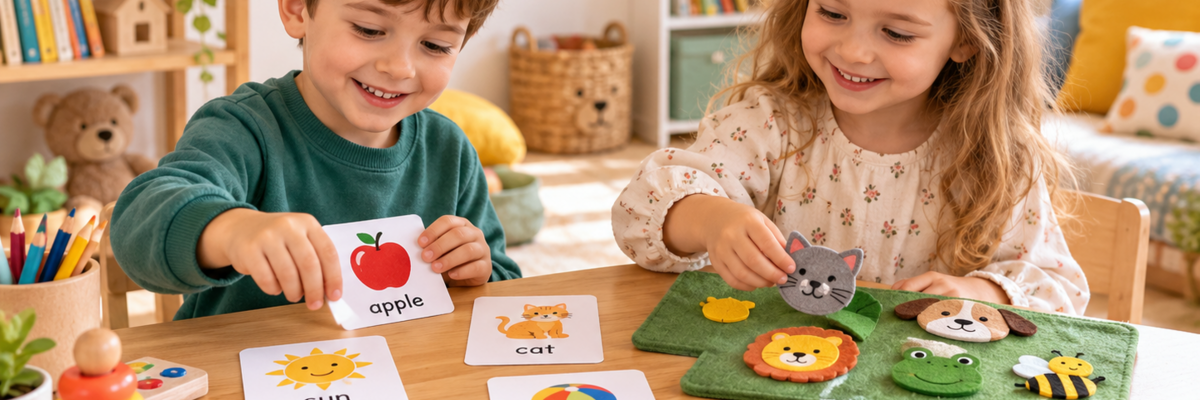
English for preschoolers through play: cards, memory, bingo and lotto
A preschooler does not need a long lesson to begin exploring another language. Short, familiar encounters work better: see a ball, hear ball, find it in a picture, cover it on a board, and recognise it again tomorrow. In this kind of English for children, the word has a purpose inside the game. It is not an answer that must be produced on demand.
The early goal is not instant fluency. Children gradually connect sound, object, image and action. One child may repeat a word immediately; another may listen for several sessions and consistently point to the right card before speaking. Both are learning. Among the shop’s educational toys and materials for shared play, families and educators can choose a format that fits a child’s interests and current attention span.
A small word set worth revisiting
Keep one theme to five to seven new words, not a whole illustrated dictionary page. That amount can be laid out clearly, named several times and used in two different activities. If the child already knows some of the set, add one unfamiliar item while keeping familiar ones as anchors. Replacing everything at once makes the rule and the language new at the same time.
Choose themes from the child’s present world: toys on the floor, clothes before going outside, food at snack time or animals in a favourite book. English words for children become memorable through meaningful encounters, not through twenty identical repetitions. A child might find hat in bingo today, hand over a real hat tomorrow and notice one in a story later in the week.
|
Theme |
A set of 5–7 words |
A useful adult prompt |
Everyday follow-up |
|
Toys |
ball, doll, car, train, blocks, kite |
“Show me the car” |
Find the item in the room or put it away |
|
Clothes |
hat, coat, dress, shoes, socks, shirt |
“Where are the shoes?” |
Choose an item before going out |
|
Food |
apple, banana, bread, milk, water, cheese |
“I see an apple” |
Notice one word naturally during snack |
|
Animals |
cat, dog, bird, fish, horse, rabbit |
“Find the rabbit” |
Look in a book or act out the animal |
|
Actions |
jump, run, sit, clap, sleep, wave |
“Clap and sit” |
Follow the action, then lead the adult |
A ten-minute session with a clear shape
A predictable routine lowers pressure. Eight to twelve minutes is a guide, not a test: if the child tires sooner, finish with something easy; if a story takes off, continue without adding vocabulary.
Open with the same greeting and revisit two or three known items. Introduce five to seven target words while the child looks, touches or moves them. Choose one main game. End with two successful turns and put the materials away together.
In a small group, offer several valid roles: say the word, find the card, place a counter or demonstrate an action. A hesitant speaker still gets a full turn.
Introducing a word without forcing repetition
Begin with one object or clear picture. Say the word naturally and connect it to an action: “Ball. Roll the ball.” The child need not echo every label; looking, selecting and following a request also show understanding.
Next offer two choices: “Ball or car?” Later, increase the field to three or four. Ask “What is it?” after recognition feels secure, giving choices or the first sound when needed. Recast errors with a useful model — “Yes, a train” — and continue.
Use the home language briefly for an unfamiliar rule, misunderstanding or feelings. Keep target words and a few repeated instructions in English; a long explanation the child cannot understand adds little.
Flashcards are a starting point
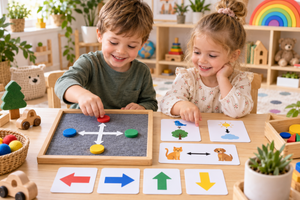
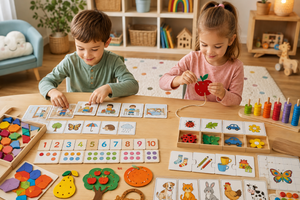
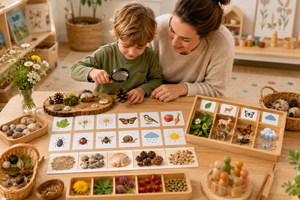
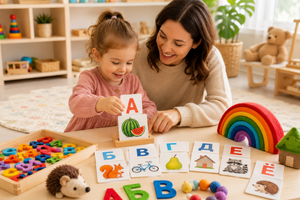
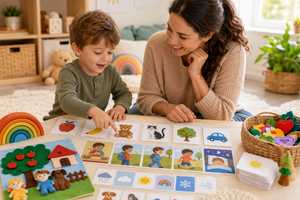
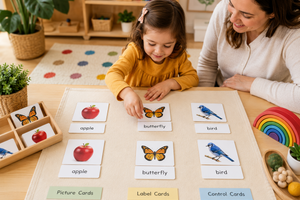
English flashcards keep the picture stable while the action changes. Lay out three face up and ask for one. Next, deliver a card to a toy, hide one, identify what disappeared or sort the pictures.
Avoid turning every card into a question. Swap roles or let the adult supply the language while the child moves the pieces. The educational card materials category shows the stated language, theme and age guidance of individual sets.
For a toys theme, the English-language “Toys” demonstration cards offer a visual introduction to toy names. Show only a small selection, match the images to real objects, and establish the words before adding a game rule. A complete pack does not need to appear on the table all at once.
Memory: match first, remember later
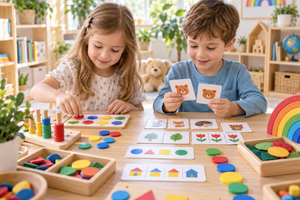
Classic memory combines positions, turns and picture recognition. Begin with pairs face up: the child matches while the adult names. Then turn over two or three pairs, adding another only when the rule is comfortable.
Name each image naturally: “A car. Another car — a pair!” Invite speech but never cancel a turn for silence or approximate pronunciation. The English-language “Toys” memory game uses matching toy pictures; its page states age 3+ and laminated cards. Adults should still judge individual readiness for the pieces and turn-taking.
Bingo: listening without a speaking test
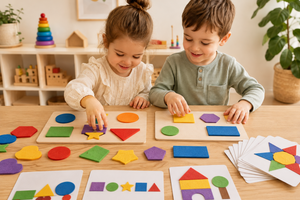
Bingo supports recognition: the caller says a word or shows a card, and players find the picture on their boards. Keep a beginner’s field manageable and the first goal cooperative rather than competitive.
Next, remove the visual cue and say the word, then use a short prompt such as “Find the coat”. A ready child can call. In the English-language “Clothes” bingo game, children listen to words or view cards and find matching clothing pictures on their boards — a bridge from labels to instructions.
Lotto: from visible matching to listening
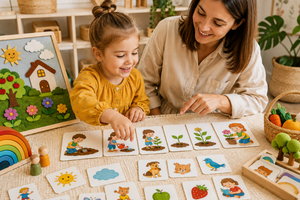
In open lotto, the call card stays visible. The child finds the same picture on a simple board and covers it while the adult supplies the word. This establishes matching and turn order.
In closed lotto, the caller says the word without showing the card; reveal it after the choice for self-checking. Begin with five to seven familiar images, then let the child call or give a clue such as “You wear it on your head”. Do not enlarge vocabulary, board and sentence difficulty together.
|
Format |
Accessible first version |
Main learning job |
One small next step |
|
Face-up cards |
Select the named item from 2–3 pictures |
Connect sound and image |
Enlarge the field or add an action |
|
Open matching |
Pair identical visible pictures |
Recognise and hear the label |
Turn over two or three pairs |
|
Memory |
Use a few well-known pairs |
Vocabulary, turns and visual memory |
Add one pair or the phrase “I found…” |
|
Bingo |
Show and name each call card |
Recognition with visual support |
Say the word without showing it |
|
Lotto |
Match a visible call card to the board |
Learn the rule and theme words |
Listen first, reveal the card to check |
|
Sorting |
Divide familiar pictures by one feature |
Notice categories and meaning |
Explain the choice with a word or short phrase |
Reusing one set across a week
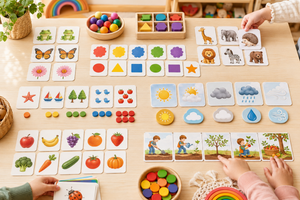
Repetition need not look identical. On the first meeting, introduce five to seven words and locate real examples. Next time, use face-up cards or simple sorting. A third encounter can be memory, a fourth bingo or lotto, and a fifth a short pretend scene with a puppet. Two meetings in a week are also a perfectly workable rhythm.
Keep most of the material familiar at the start of every session. Add a word when the child responds confidently to the earlier set, not because a schedule says it is time. The practical guide to games with educational cards offers more ways to change the action without constantly replacing the materials.
Moving from a word to a short phrase
Once a word is recognised across games, place it in one stable frame: “I see a…”, “Where is the…?”, “I can jump” or “Let’s clap”. Use one pattern with several known words before changing it.
Do not require a full sentence each turn. A child may point or say only car while the adult models “I see a car”. Spontaneous phrases often follow extended listening and cannot be promised by a particular week.
Use the phrase in a situation that makes sense. “Put on your coat” belongs near real clothes; “The rabbit can jump” works with an animal figure. Meaningful reuse helps English for preschoolers extend beyond the tabletop without turning the entire day into a lesson.
Pronunciation, mistakes and bilingual support
An unsure adult can check the five to seven target words in a reliable audio dictionary before playing. Speak clearly at a natural pace. If the child’s version is approximate, model the conventional pronunciation in the next sentence.
Mixing languages is not a reason to stop. Respond to meaning and offer an attainable model: “Yes, a blue car.” The child hears a fuller form without embarrassment.
Different children in the same group
Use one shared set with varied responses: a beginner finds the picture, another child names it, and another says “I have a…” or gives a clue.
Reduce waiting with small jobs such as holding counters or turning call cards. Avoid speed rounds until everyone knows the words and rule; speed also reflects temperament and familiarity, not just learning.
For a busy visual field, show fewer, well-spaced cards. For a child needing movement, place pictures across the room. Keep the target words unchanged across adaptations.
Noticing progress without a test
Look beyond words produced on request. Can the child find the picture, recognise the word without a gesture, transfer it to a real object or take the caller’s role? These changes reveal learning without a test.
Record the date, theme and two neutral observations, such as “recognised 5 of 6 without a shown card”. Use them to plan repetition or one new item, never as the child’s scorecard.
If interest drops, change the action: hide cards, offer bingo counters or teach a puppet. With repeated fatigue, shorten the meeting and keep three or four words. End before play becomes a struggle.
Frequently asked questions
How many new words should one session include?
Use five to seven within one theme. If all are unfamiliar and the child struggles, begin with three or four and add the rest later. Meeting the same small set through several actions matters more than viewing a large pack once.
Must a child repeat every word aloud?
No. Listening, pointing, sorting and following a brief request are meaningful early responses. Invite repetition, but do not withhold a turn when the child stays quiet. Naming usually becomes easier after recognition is secure.
How are memory and lotto different in a language session?
Memory requires players to find pairs and remember where cards lie. In lotto, they match a shown card or a spoken word to an image on their own board. Lotto can therefore focus closely on listening, while memory adds a substantial position-memory and turn-taking demand.
What if the child answers in the home language?
Accept the meaning and supply a short English model. If the child points to a hat and uses another-language word, reply, “Yes, a hat.” Requiring several immediate corrections can interrupt communication and reduce willingness to join the next turn.
When is it time to introduce another theme?
Move on when the child recognises most current words in two or three formats and the play still feels comfortable. Perfect pronunciation is not required. Retain a few known cards for spaced review and introduce the next set in a small portion.
A game worth returning to
Steady progress comes from enjoyable return visits, not from stretching one lesson. Choose a relevant theme, limit it to five to seven words, let recognition come before production, and vary the way those words reappear. Cards provide a clear reference, memory changes the retrieval task, bingo foregrounds listening, and lotto moves from visible matching to a word heard without a picture cue.
The adult is responsible for an understandable rule, a useful language model and a kind pace. The child brings curiosity, choices and an individual moment of readiness to speak. That partnership turns a short game into genuine language practice without making it a miniature examination or promising fluency on a timetable.