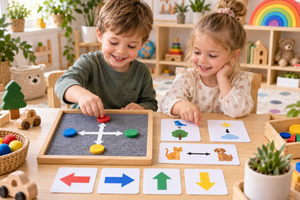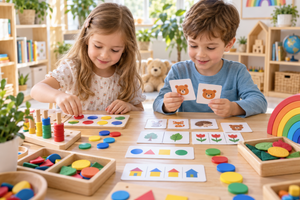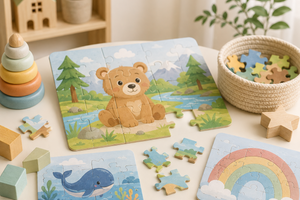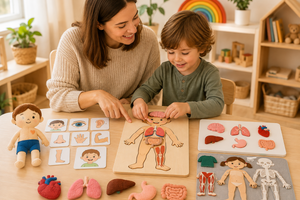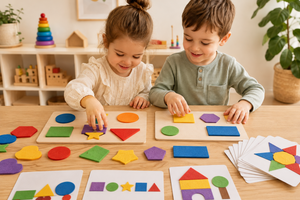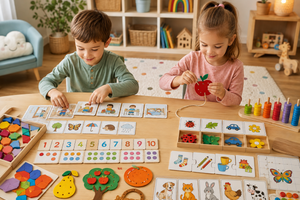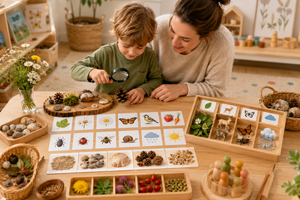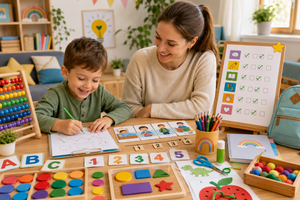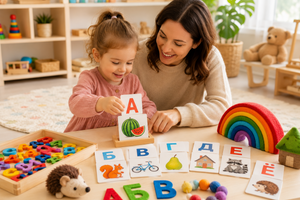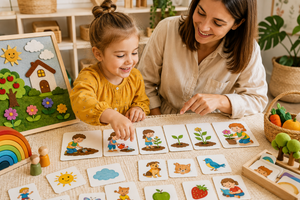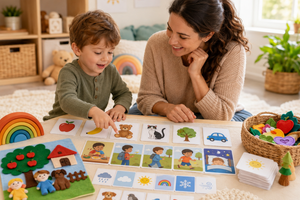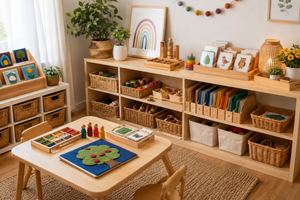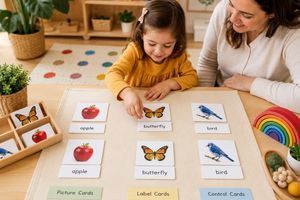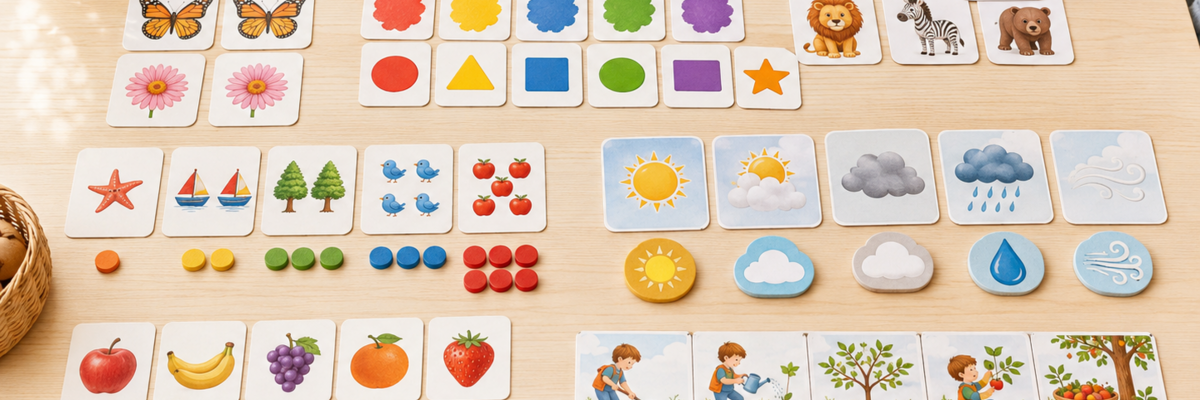
One set of learning cards can become a picture dictionary, a sorting material, a memory challenge, a movement prompt, or the starting point for an original story. Its value depends less on the number of cards than on what a child is invited to do with them. A clear goal, one short rule, and a manageable level of challenge can keep familiar pictures useful for a long time.
This guide is not a shopping catalogue and does not try to decide which set every family should buy. It explains how to use material that is already available at home, in preschool, or in an individual session. The 25 games below work with animals, transport, household objects, plants, occupations, food, and many other themes.
Key takeaways
- Begin with three to five familiar pictures instead of spreading out the entire set.
- Choose one main action for each game: name, find, compare, remember, move, or explain.
- Demonstrate one example, pass the action to the child, and allow time before offering a hint.
- Stop while interest remains; a short activity that children want to repeat is more valuable than a long test.
- Change only one source of difficulty at a time: quantity, rule, time, or level of independence.
How to choose a format by age and current skill
An age label is not an activity plan. A two-year-old often needs to look, touch, hear a precise name, and find a familiar image. An older preschooler may justify a category, hold a sequence in mind, and invent a new rule. The table offers a starting point, not a rigid schedule.
|
Approximate age |
Cards at the start |
Useful action |
Sign that the child is ready for more |
|
2–3 years |
3–5 large pictures |
Point, name, match an identical image, or copy a simple movement |
Chooses confidently between two or three options |
|
3–4 years |
5–8 cards |
Match, find a pair, sort into two groups, or describe one feature |
Can restate the rule in words or actions |
|
4–5 years |
8–12 cards |
Remember positions, explain a choice, or build a sequence |
Notices an error or suggests another method |
|
5–6 years |
10–16 cards |
Use two criteria, labels, stories, and rules with several steps |
Creates an activity for an adult or another child |
If the child becomes tired, reduce the field and bring back familiar cards. If every answer has become automatic, do not immediately add many new words. Change the thinking action instead. For example, replace “Point to the butterfly” with “Find something that flies and tell me why it belongs there.”
A two-minute preparation routine
Decide on one purpose and select only the cards needed for it. For new vocabulary, choose pictures that look clearly different. For comparison, choose related items. For sorting, prepare examples that form two understandable groups. Place every card upright, fully visible, and within comfortable reach.
State the rule in one sentence and demonstrate a single turn. There is no need to describe every possible mistake. After the model, ask, “What are we going to do?” A brief explanation or a correct first action shows whether the instruction was understood. Keep a box, tray, or two marked spaces nearby if the game involves collecting or sorting.
For children who still explore objects with their mouths, use only large, safe pieces with direct adult supervision. Check the lamination, corners, and general condition before play. Avoid timers, competition, or small counters when they add pressure or do not suit the child’s developmental stage.
Games 1–5: vocabulary and spoken language
- Point and name. Lay out three cards, say one name, and invite the child to point. Then exchange roles: the child names a picture and the adult searches. Accept a gesture or meaningful sound from a young learner; ask an older child to add a color, part, use, or location.
- Finish the sentence. Begin a phrase such as “The bus goes…,” “The bee collects…,” or “We use a cup to….” The child chooses a related card and completes the thought. If this is difficult, offer two spoken choices without requiring an exact scripted answer.
- Three clues. Describe a picture without naming it: where it is found, what it looks like, and what it does. The child finds the card. For younger preschoolers, use one obvious clue and one confirming clue. Older children can become the clue-giver.
- Grow the phrase. The child names an item and the adult adds an adjective: “apple — green apple.” The next turn adds an action or place: “A green apple grows in an orchard.” The game shows how a single word expands into a meaningful sentence.
- Mini interview. Choose a person, animal, or occupation card. Ask simple questions such as “Where do you live?”, “What do you need?”, or “Who do you help?” The child answers in character, practising dialogue and imagination without being tested on a single correct answer.
Games 6–10: attention, observation, and memory
- What disappeared? Show three or four cards, name them together, and then remove one while the child closes their eyes. The child identifies the missing picture. To extend the game, leave every card in place but exchange the positions of two.
- The photographer. Arrange a short row, allow five to ten seconds for looking, and cover it. The child rebuilds the order with duplicates or names what was seen. Begin with two elements so that success comes from remembering rather than guessing.
- Quiet replacement. Put down four cards. While the child looks away, replace one with a new card. Ask what changed and invite the child to name both images. An older preschooler can explain one similarity and one difference between them.
- Quick look. Show one card for two seconds and hide it. Ask about only one feature, such as color, a prominent part, or the direction of movement. The aim is purposeful looking, not a quiz about tiny details that were never relevant.
- Memory chain. The first player places and names a card. The next repeats that name and adds another. Continue only while the chain remains enjoyable. Let players look at the row; it provides visual support alongside listening and verbal recall.
Games 11–15: comparison, classification, and logic
- Two homes. Mark two areas, such as “lives in water” and “lives on land.” The child sorts the cards and explains at least one choice. Begin with a rule that has no confusing exceptions and save ambiguous examples for a shared discussion.
- Which one does not belong? Place three related cards and one from another group. The important part is the sentence “This one does not belong because….” With older children, look for a different rule that makes another card the odd one out.
- Pairs with a connection. Pairs do not need to be identical: a bird and a nest, a worker and a tool, a fruit and jam. Ask the child to name the relationship. This requires more reasoning than standard matching because the connection is conceptual.
- From small to large. Order pictures by size, speed, length of journey, or stages in a process. Emphasize that the sequence depends on the chosen feature. With illustrative images, say “It looks larger on this card” instead of treating the drawing as a true scale.
- Secret rule. Select several cards using one unstated feature. The child guesses the rule and tests it with another card, then builds a new group for the adult. Classification becomes a small investigation rather than a worksheet with one prompt.
Games 16–20: movement, self-control, and cooperation
- Move like it. Draw an animal, vehicle, or weather card and represent its movement for others to guess. Clear a safe area first and agree which actions are unsuitable indoors. A child who prefers not to perform may choose the next card.
- Card relay. Put cards on one side of the room and two category zones on the other. The child carries one image at a time to the correct place. The activity combines a decision with movement; accuracy matters more than racing.
- Stop and find. Players move while music or clapping continues. At the pause, name a feature: “Find something that flies.” The child stands beside a matching card. In a group, provide several correct options so children do not compete for one space.
- Pass and add. One player picks a card and gives a fact or visible feature; the next contributes something different. A genuine question also counts when information is missing. The game develops listening, shared description, and the ability to build on another person’s idea.
- Rule maker. The child selects five cards and invents a short task for the adult. After one trial turn, clarify the wording together if it has two possible meanings. Making a playable rule develops planning, precise speech, and respect for agreements.
Games 21–25: imagination, sequence, and early reading
- A three-card story. Randomly choose a character, a place, and an object. Build a story with a beginning, an event, and an ending. Support the sequence with “What happened first?” and “How did it end?” rather than taking control of the plot.
- Before and after. Offer two or three cards that can form a process: fruit, preparation, finished food; seed, sprout, plant. The child orders them and explains each transition. If the pictures allow more than one sequence, accept a logically supported version.
- First sound. Name every picture clearly, then find two words that begin with the same sound or place cards beside matching letters. Focus on the sound, not only the printed symbol, and use a small number of contrasts at first.
- Labels go home. With three-part cards, separate several labels and match them to their images. The child checks the completed work against a control card. A nonreader can notice an initial letter or word length without being asked to pretend to read.
- Create a new card. The child draws an item missing from the set, names it, and explains which group it joins. An older preschooler may add a written label or a short riddle. The finished material becomes an open project rather than a collection of fixed answers.
How one set becomes a sequence of sessions
Use the first meeting for free observation and accurate names. During the second, match identical pictures or parts of three-part cards. Next, sort by one feature and play a simple memory game. Stories, two criteria, printed labels, and multi-step rules come later. The topic stays familiar while the thinking action gradually changes.
A simple rotation works well: leave part of a set accessible, store the rest, and change one game every few days instead of presenting completely new material. This protects the useful familiarity of the pictures while restoring curiosity through a different purpose.
Matching Learn&Dream materials to the games
Check the age recommendation, language, contents, and format on each product page before selecting a set. The examples below do not rank products. They show how the structure of one compact card set can support several distinct actions instead of one repetitive question.
|
Material |
Start with |
Games from this guide |
Next step |
|
Name the fruits and match related images |
2, 7, 13, 22 |
Describe color or taste and explain the product sequence |
|
|
Any set with identical pairs |
Match openly before turning cards face down |
6, 7, 8, 10 |
Add one pair or ask for a spoken clue after a match |
|
Any thematic picture set |
Name a small selection and find one visible feature |
1, 3, 9, 11 |
Sort by a child-created rule and justify each choice |
|
Any three-part card set |
Match picture, label, and control card |
14, 15, 23, 24 |
Remove one support and let the child check at the end |
How to notice progress without grades or tests
Watch more than the final answer. Useful signs include how the child starts, whether one demonstration is enough, how they request help, whether they check a choice, and whether they can explain a rule. A note such as “matched four pairs independently; needed a question to explain the link” is more informative than a score or general praise.
Frequently asked questions
How many cards should I offer at one time?
For a first game at ages two or three, three to five cards are often enough; an older preschooler may manage eight to twelve. The child should be able to see the field, understand the rule, and make a considered choice instead of guessing because there is too much information.
How long should a learning-card activity last?
Finish before clear fatigue rather than obeying a timer. A younger child may play for three to five minutes and an older child for ten to fifteen. One short activity that invites a willing repeat is better than a long session that must be forced to its end.
What if the child does not want to name the pictures?
Change the response from speech to action: ask the child to point, carry, match, or represent a movement. The adult can name cards naturally without demanding repetition. Spoken responses often grow after enough understandable, enjoyable interaction with the same vocabulary.
Should I correct every mistake?
No. Let the child complete the turn and ask how they decided. Then offer a control card, repeat the rule, or compare two options. A direct correction is useful when independent checking is not yet possible or when an error would establish an inaccurate fact.
How do I know when to make a game harder?
Increase the challenge after the child completes the action confidently several times, remembers the rule, and can explain a choice. Add only one change: one or two cards, a new category, a shorter demonstration, or the role of leader. If interest falls, change the format rather than only increasing quantity.
Conclusion: change the action, not the material every time
Learning cards become versatile when children do more than view pictures. They find, name, compare, classify, remember, move, and tell stories. Begin with a small field and one clear rule, then add difficulty in response to what you observe.
Choose two familiar games and one new one from this collection. Repeat them while giving the child increasing control. When the learner states a rule, notices a way to check, or creates an original card, the material is supporting thought and independence rather than simple recall.