Counting Sticks: 10 Games That Help a Child Learn to Count
In brief: counting sticks make quantity something a child can see and move. A child can touch one object for each number word, separate counted pieces, compare two groups, split a number into parts, and check an answer with their hands. Begin with three to five large, age-appropriate pieces, a brief demonstration, and an unhurried game. Once the child reliably matches one stick to one number word, move on to number bonds, patterns, and simple story problems.
Reciting numbers and counting objects are not the same skill. A child may say “one, two, three, four, five” correctly but skip an object, count one twice, or be unable to answer how many there are altogether. Moving each stick from a starting area to a finished row makes the process visible and gives the child a way to notice an error without an adult immediately correcting it.
A purpose-made set is convenient, but other identical, age-appropriate objects can work. Small sticks are unsuitable for children who mouth objects. Use large pieces and follow the manufacturer’s guidance. Among educational toys for early mathematics, favor materials that can be grouped, compared, and reused.
Why meaningful counting is more than saying the number sequence
To count a group, a child coordinates several ideas. Number words must come in a stable order. Each item receives exactly one word. Finally, the last word said describes the quantity of the whole group, not merely the final object touched. That last idea is often the least obvious.
Sticks can be spaced, touched in order, or moved from left to right. After counting, ask, “How many altogether?” If the child starts again, connect the total to the last word: “You finished on five, so there are five.”
Once this foundation is secure, the same objects can model comparison, addition, and subtraction. Joining one stick makes a group larger; taking one away makes it smaller. The guide on teaching numbers and quantity from 1 to 10 explains how to connect concrete groups with written numerals without rushing to worksheets.
Preparing the material and work area
Choose a flat surface with few distractions. Put the sticks in a small bowl or on the left side, and move counted ones into a row on the right. Begin with one color so that quantity remains the important feature. Introduce colors later when a game genuinely uses sorting or a repeating pattern.
Do not pour out an entire box. To work with four, offer four pieces and perhaps one extra for a choice. A small collection keeps the rule visible.
|
Current stage |
Pieces to offer |
A useful first task |
Sign that the next step may be ready |
|
First attempts |
1–3 |
move one stick at a time while saying the number words |
counts each piece once |
|
Counting to 5 |
3–5 |
make a requested group and compare two short rows |
answers “how many altogether” without restarting |
|
Counting to 10 |
5–10 |
take a requested quantity from a larger group |
stops when the target number is reached |
|
Number bonds |
4–10 |
split one group into two parts and reunite it |
finds more than one way to compose a number |
|
First operations |
up to 10 |
act out addition or subtraction in a short story |
describes the change and checks it with objects |
These stages describe actions, not fixed age expectations. One child may count to five carefully and readily notice a pattern; another may recite to ten but still skip objects. Choose the next challenge by observing the exact action rather than the longest sequence a child can say.
10 counting-stick games
1. Move and count
Place three sticks on the left and an empty bowl on the right. The child moves them one at a time while saying “one, two, three.” When all have moved, ask how many are in the bowl. Change the quantity only after two or three comfortable attempts.
If the hand moves faster than the words, touch the rim after each piece. If a number is repeated or a stick skipped, restart more slowly. Avoid counting in chorus: the adult’s voice can hide whether one-to-one correspondence is secure.
2. Build the number
Name a number within the child’s secure range: “Please make a row of four.” The child takes sticks from a small supply and places them neatly. Count the finished row together and ask whether it stops at the requested number.
Later, the child can build four and then find numeral 4. Make your own row with one extra stick and invite a repair. Ask what changed.
3. Which has more?
Make two parallel rows, perhaps three sticks and five. Align each stick with a partner in the other row. Two sticks are left without partners, so the group of five has more. Introduce “more,” “fewer,” and “the same” in this concrete situation.
Spacing can mislead the eye: three widely separated sticks may form a longer line than five close ones. Show this deliberately, ask whether the amount changed, and return to matching pairs or counting. The child learns that quantity is not the same as the space a row occupies.
4. Make the groups equal
Put two sticks in front of one toy character and four in front of another. Ask how both can receive the same amount. The child might add two to the smaller group, remove two from the larger one, or redistribute all the pieces.
Describe the solution: “The bear had fewer. We added two, and now each has four.” This gives equality meaning before the equals sign appears. Begin with two groups.
5. Number houses
Choose 5 and lay out all five sticks. Create a gap after the first: one on the left and four on the right. Name the two parts, push them together, and say, “One and four make five.” Then explore 2 and 3, followed by 3 and 2.
Let the child move the gap and discover each arrangement. Two colors may show the parts, but should not add a sorting rule. For 6, find 1 and 5, 2 and 4, and 3 and 3. Explore before memorizing.
6. The hidden part
Show five sticks, ask the child to close their eyes, and cover two with your hand. Three remain visible. Ask, “There were five and we can see three. How many are hiding?” Reveal the pieces after the child predicts, then count to check.
A beginner may rebuild the full row with spare sticks; this is a useful strategy. Familiar number bonds gradually make the hidden part predictable. Stay with small numbers until guesses give way to reasoning.
7. Continue the pattern
Start a short sequence using colors or orientation: red, blue, red, blue. Ask what repeats and invite the child to add another two or four pieces. The next challenge could use a three-part unit or alternate vertical and horizontal sticks.
Ask for an explanation: “Blue is followed by red because the pair repeats.” The article on pattern-copying activities offers more ways to move from copying a visible model to continuing a rule independently.
8. Repair the pattern
Build a familiar sequence with one deliberate error. The child scans from left to right, finds the break, and replaces or turns the incorrect stick. Begin with one obvious error in a six-piece sequence.
Do not point to the answer. If needed, separate the row into repeating pairs or threes. Then exchange roles: the child creates an error and explains the rule. Designing the challenge reveals understanding.
9. Act out a story problem
Tell one short story: “Three logs were beside the path. A beaver brought two more. How many are there now?” The child lays out three sticks, joins two, and counts the combined row. For subtraction, physically remove pieces: “There were five, and two were taken away.”
Use one operation and small numbers. Ask the child to show the event before answering. Change the characters while retaining the numbers to see whether the action, rather than a phrase, is understood.
10. Invent a challenge
Offer six to eight sticks and let the child lead. They may request a number row, set up two groups to compare, make a pattern, or tell a simple problem. The adult follows the instruction and occasionally makes one deliberate mistake for the child to identify.
Creating a task requires holding, communicating, and checking a rule. If an open choice is difficult, offer a number puzzle or a pattern. Clarify the instruction together without taking over.
Connecting sticks with numerals and picture cards
Concrete quantity should lead to the symbol. First ask the child to make five sticks, then find numeral 5, and finally recount to verify. Reverse the direction too: show 7 and ask for seven objects. Alternating both directions prevents the numeral from becoming a picture learned without quantitative meaning.
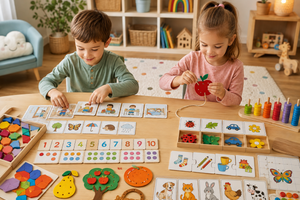
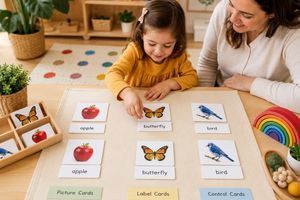
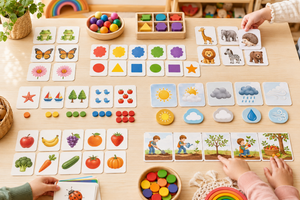
Sticks can also provide a simple check when the main material uses illustrated cards. The Autumn Counting to 10 learning set works with quantities, numerals, and introductory addition in a themed format; a separate stick row can model the counted amount. The product itself has Ukrainian-language printed material, so check the language and specifications on its page before choosing it.
The Language and Mathematics collection includes other materials for early number work. Follow each product’s stated age guidance and choose for the action a child is ready to practise, not merely for the largest advertised number range.
A gentle rhythm for regular practice
Five to ten minutes is enough when the child is rested. Start with a familiar game, introduce one new variation, and finish with an open choice. Stop when interest fades. Repeating twenty identical examples mechanically does not deepen the idea.
|
Practice period |
Familiar action |
One new step |
What to observe |
|
1 |
move and count to 5 |
build a requested number |
whether each stick receives one number word |
|
2 |
make short rows |
compare and make equal |
whether “more” and “fewer” are explained |
|
3 |
count within the secure range |
split one number into two parts |
whether another composition is found independently |
|
4 |
copy a simple pattern |
act out one operation in a story |
whether the child can show what changed |
This is a sequence, not a deadline. Repeat stages and return to easier games when needed. Progress includes arranging objects systematically, noticing an extra piece, checking, and explaining.
Common difficulties and helpful prompts
- One stick is counted twice. Space the pieces out and move each one into a completed row.
- The sequence is known, but “how many” is unclear. Repeat the final number and gesture around the entire group.
- The child guesses which row has more. Align the rows in pairs or count them.
- Number bonds are confusing. Work with one small total and physically separate and reunite its parts.
- Following an instruction causes resistance. Offer a choice of two games or let the child lead; free construction can close the session.
An error is information about which action still needs a concrete support. Fewer objects, a clearer layout, and one neutral prompt are usually more useful than repeating the answer.
Safety during play
Always check the manufacturer’s age label, the size of every piece, and the condition of the set. Small sticks are a choking hazard for children who may mouth objects; use a different large counting material and maintain close adult supervision. Never substitute matches, toothpicks, skewers, splintered wood, or other sharp and breakable objects.
Sticks belong on the work surface, not in mouths or close to faces. Do not allow running while holding them. Count all pieces together after the activity and store them in a closed container away from younger children.
Frequently asked questions
At what age can a child use counting sticks?
Follow the age guidance for the specific set and consider whether the child still mouths objects. Small pieces are not appropriate in that situation. Early counting can instead use large, safe items when the child can move one at a time and imitate a brief adult demonstration.
Should we begin by counting all the way to ten?
No. Secure work with 1–3 and then 1–5 is more valuable than reciting a longer sequence without matching words to objects. Extend the range when the child counts each piece once, stops at the requested amount, and understands the total.
Are ordinary counting sticks the same as Cuisenaire rods?
No. Ordinary sticks are often equal in length and represent individual units. Cuisenaire rods use different lengths and a consistent color system to represent values. They are a distinct material with a particular presentation, so its rules should not be assumed for any colorful stick set.
What if the child recounts the same group every time?
Recounting is normal at first. After the count, emphasize the final word: “You ended on four, so there are four.” Keep the arrangement unchanged and ask “How many altogether?” so the total gradually becomes connected with the whole group.
Can household objects replace a purpose-made set?
Yes, provided they are identical enough for the task, intact, large, and safe for the child’s age. Large blocks may work well. Do not use matches, toothpicks, skewers, or any sharp, brittle, or swallowable substitute.