A child may recite “one, two, three” all the way to ten and still be unable to place the numeral 4 beside four apples. That is not a contradiction. Memorizing a sequence of words is easier than connecting a spoken number, a written symbol, and an actual group of objects.
The clearest way to teach number and quantity is to move from action to symbol. First, the child handles and counts objects one at a time. Next comes the spoken number name. Only then do you add the written numeral. A playful task—giving a bear three berries or parking five cars—makes the relationship visible instead of asking the child to memorize another rule.
Key takeaways
- A numeral is a written symbol; a number describes quantity or order. Children need experience connecting the two.
- Start with 1–3, expand to 5, and introduce 6–10 after the smaller quantities are secure.
- Have the child touch or move each object once while saying one number word.
- Ask “How many altogether?” so the child learns that the last number said tells the size of the whole group.
- Measure progress by whether the child can make a requested quantity and match it to a numeral—not by speed.
What is the difference between a numeral, a number, and a quantity?
Adults often use these words interchangeably, but they represent different ideas. A numeral is the written mark we see, such as 5. A number is the mathematical idea we name and use to describe quantity or position. A quantity is how many items are in a particular group.
Imagine five buttons on a table. The child touches them and says “one, two, three, four, five.” The word five names the number, the symbol 5 is a numeral, and the five-button group has that quantity. A preschooler does not need a formal definition. Repeated, concrete language is enough: “There are five buttons. We ended on five. Let’s find the numeral 5.”
Numeral recognition and counting may develop at different rates. Identifying 7 does not prove that a child can give you seven blocks, while an accurate counter may still confuse the written 6 and 9. Practice and observe the two skills separately.
When should children start learning to count to 10?
Understanding quantity begins before formal activities: a toddler asks for one more cracker or notices that one tower is taller. Rather than using a fixed starting age, look for the ability to follow a brief direction, move an object intentionally, and join a shared activity for a few minutes.
|
Approximate age |
Primary goal |
Play example |
Sign that the child is ready for more |
|
18–24 months |
Experience “one,” “one more,” and the contrast between one and many |
Give a doll one cup and give each of two bears a spoon |
The child can follow a request such as “Give me one” with familiar objects |
|
2–3 years |
Count very small groups to 3, then gradually to 5 |
Put one apple on each plate and count the finished group |
The child touches each object once and states how many there are |
|
3–4 years |
Match quantities from 1 to 5 with written numerals |
Collect the correct number of pieces for a numeral card |
The child makes a group up to 5 without copying a prepared model |
|
4–5 years |
Work with 1–10 and compare small groups |
Fill ten train cars and decide which station has more passengers |
The child counts different arrangements and chooses the matching numeral |
|
5–6 years |
Compose quantities flexibly and explore neighboring numbers |
Show 7 as 5 and 2 more; find the number before and after 7 |
The child explains a choice and can notice or correct an error |
Use the table as a guide, not a test. A child may recognize every numeral to 10 yet need practice with small quantities, or count toys without caring about written symbols. Begin where success requires only a little support.
The central sequence: object, number word, numeral
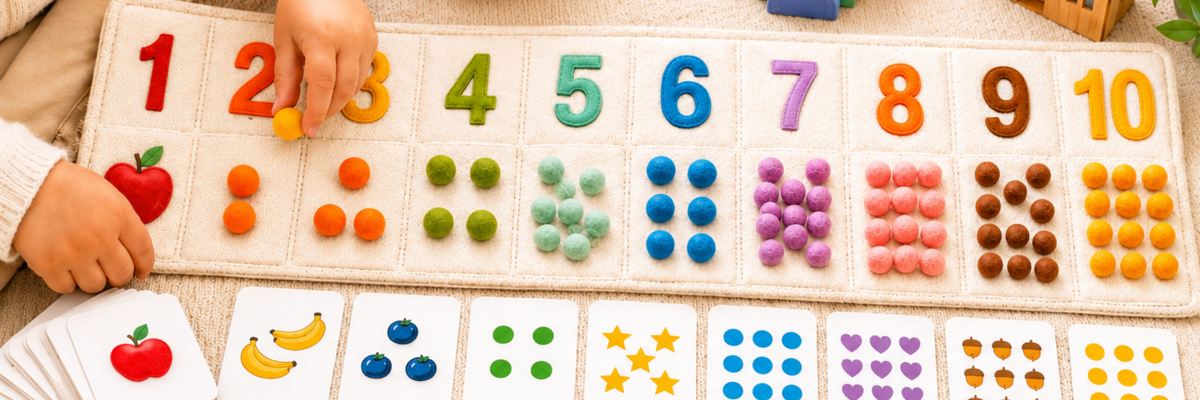
A numeral becomes meaningful through action. Place three safe pieces on the table and move them into a row while saying, “one, two, three.” Ask, “How many altogether?” After the answer, show the numeral 3. Later, use different objects with the same quantity.
This sequence uses three representations:
- Concrete quantity. The child can see, hold, and move real objects.
- Number name. The spoken word is connected to the counted group.
- Written numeral. A numeral card is matched to that quantity.
Do not replace objects with worksheets too quickly. Moving pieces helps prevent skipped or double-counted items. Once that is reliable, use pictures in a row and then scattered objects to transfer the principle to a new layout.
A step-by-step first number-and-quantity activity
Step 1. Choose a range the child partly knows
Begin with 1–3. A small range keeps attention on matching rather than recitation.
Step 2. Gather matching objects
Use six similar, age-appropriate pieces and numeral cards 1, 2, and 3. A consistent appearance keeps quantity as the important feature.
Step 3. Model one complete match
Place the numeral 2 on the table, add two objects, and say, “One, two. There are two altogether. The numeral 2 tells us how many.” Keep later directions brief.
Step 4. Ask the child to make a quantity
Show 3 and ask the child to give a bear three berries. Count together if needed, but let the child move each object to support one-to-one correspondence.
Step 5. Reverse the task
Now set out one or three objects and ask for the matching numeral. Practice both building a group from a symbol and selecting a symbol for a group.
Step 6. Ask for the total
After counting, ask “How many altogether?” If the child starts over, repeat the final number: “We ended on three, so there are three.”
Step 7. Stop after a few successful turns
Three or four thoughtful matches are enough. Repeat the familiar range in a different story the next day.
Games for understanding quantities from 1 to 5
Feed the character
Show a numeral card and ask the child to give a puppet that many pretend treats. The puppet checks the order by touching and counting each item. The story gives the counting a purpose and creates a natural reason to adjust the group when there is too much or too little.
Parking garage
Make five parking areas and mark each destination with a numeral. A card beside the garage tells how many cars may park there. Occasionally add one extra car and ask what needs to change. Invite the child to verify by counting instead of labeling the first attempt wrong.
Number stairs
Build groups of one, two, three, four, and five blocks. The child can see that each next number is the previous quantity plus one more. Remove a block from one step and work out which quantity remains.
Exact-order store
Give the child a picture or numeral “shopping list”: two apples, four carrots, one roll. The shopper collects and checks each order. Later, switch roles. Let the child prepare the list while the adult makes an occasional mistake that the young storekeeper can explain.
How to move from 1–5 to 6–10
The second group of five is harder for more than memory reasons. In a larger set, a child is more likely to skip an item, use two number words during one touch, or count an object twice. Organize the objects at first: place them in a row, move them left to right, or use a ten-frame with two rows of five spaces.
Use 5 as a familiar anchor. Six is 5 and 1 more; seven is 5 and 2 more. This is not a request for written addition. The point is to make the structure of the quantity easy to see. Two hands, a tray divided into five-and-five, or a filled group of five plus extra pieces all make larger quantities more recognizable.
Introduce 6 and 7, then 8 and 9, followed by 10, mixing them with familiar numbers. Later rearrange the same pieces in a circle or loose cluster to show that position does not change quantity.
Five counting ideas children need to understand
The simple direction “Count these” actually requires several separate skills. Identifying which one is still developing makes support more precise.
- One number word for one object. Pointing, moving, or touching synchronizes speech with each item.
- A stable number sequence. Four follows three regardless of whether the child is counting buttons or footsteps.
- The last number is the total. If the count ends at seven, the group contains seven items.
- Counting order does not change quantity. The child may begin on either side as long as every object is counted once.
- Different things can be counted. Five can describe fish, jumps, sounds, or ideas in a story.
Also count claps, steps, or drumbeats. A number can describe an event as well as visible objects.
How to explain more, less, and the same amount
Comparison gives numbers practical meaning. Set out three blue and five yellow pieces in two straight rows. Pair them by placing one blue item opposite one yellow item. If one row has unpaired pieces, that row has more. If every item has a partner, the quantities are equal.
After the visual match, count both groups and name the numbers: “Is five more or less than three? How can you tell?” The child may answer with words, a gesture, or by moving the pieces. There is no need to introduce >, <, and = yet; the relationships should make sense before the written signs do.
Learn&Dream materials for early counting
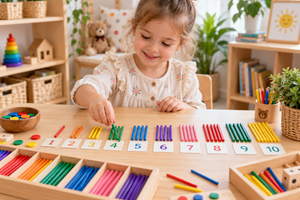
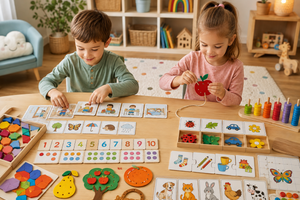
The Language and Mathematics category includes felt activities that children can handle, attach, and count. Choose the number range according to what the child understands—not according to how quickly you hope to reach ten.
|
Material |
Age listed on the product page |
Main action |
Best fit |
|
2+ |
Match a numeral with a small quantity and count the pieces |
An accessible first experience with 1–5 |
|
|
3+ |
Recognize a numeral and build or find its corresponding group |
A child who recites numbers but still confuses symbol and quantity |
|
|
3+ |
Count, match, compare, and examine groups of objects |
Transferring counting to different pictures and story contexts |
|
|
4+ |
Work across the full 1–10 range and match numbers to quantities |
After the child understands quantities through 5 |
Reuse one set at several levels: count a few pieces, choose the numeral, compare two groups, or make one more. Change only one mathematical demand at a time.
Counting practice at home and in preschool
At home: mathematics inside real routines
Ask the child to bring two napkins, set out one spoon for each of three people, place five apples in a bowl, or identify a floor number in the elevator. A routine is brief and has a real result. If the quantity is off, do not quietly correct it; invite the child to check whether each person received an item.
Show one number in several forms—blocks, steps, claps, or plates—but avoid turning the day into a quiz. One or two natural counting moments are enough.
In preschool: short activity stations
Set up several stations for a group: a café with plates, a building site with blocks, a post office with envelopes, and a place for matching numeral cards. Children work in small groups so everyone can move and count the pieces. Rotate after a few minutes rather than asking the whole class to wait for individual turns.
At the end, select one match and ask, “Why does this basket have the numeral 6?” A child may explain verbally or demonstrate by counting. Offer comparison or “make one more” to children who are secure to 10, while keeping 1–3 or 1–5 available for children building the foundation.
Common mistakes when teaching number and quantity
- Starting with numeral writing. Tracing a shape does not explain quantity. Let the child count and build groups first.
- Presenting all ten numerals at once. Secure 1–3, expand to 5, and then add the second group of five.
- Counting too quickly. Number words separate from objects. Slow the movement so one touch matches one word.
- Giving the final answer instead of checking. Invite the child to move and recount the pieces, then state the total.
- Treating a memorized count as complete understanding. Ask the child to make a requested quantity and select its numeral.
- Changing every condition at once. When adding a new number, retain familiar objects and rules. Change the story during review.
- Turning errors into judgments. “Let’s check together” supports reasoning better than pressure for a fast answer.
All loose pieces must be age-appropriate, intact, and used with adult supervision. If the child becomes tired, guesses randomly, or avoids the activity, reduce the range and return to a familiar task that can end successfully.
How to tell whether a child truly understands numbers to 10
Understanding travels beyond one lesson. The child can count unfamiliar objects, give a requested quantity without copying a model, choose the numeral, answer “how many altogether,” and compare two groups. Look for these skills on different days and with different materials.
Record specific observations such as “builds quantities 1–5” or “confuses 6 and 9.” For many preschoolers, 5–10 minutes of focused play a few times per week, plus everyday counting, is enough. Stop after a clear result rather than requiring every card.
Frequently asked questions
Why can my child count to 10 but not give me five objects?
The child may know the number sequence like a rhyme but has not yet coordinated one word with one object or understood the total. Return to 1–3 or 1–5, move each piece as you count, and ask “How many altogether?” after the last item.
Which numbers should I teach first?
Start with 1, 2, and 3 because these quantities are easy to make, compare, and check in daily routines. When the child can build each group and match its numeral, add 4 and 5. Introduce 6–10 in small steps.
Should a child learn to write numerals right away?
No. Understanding quantity, counting each object once, and recognizing numerals come first. Add writing when the child shows interest in marks and has the hand control to enjoy it. Tracing can remain a separate, brief activity.
What should I do if my child confuses 6 and 9?
Reduce the number of cards and compare only those two symbols. Give each a consistent visual cue and pair it with the correct group of objects. Check symbol recognition separately from quantity understanding, and avoid time pressure.
How can I stop my child from skipping objects while counting?
Arrange the objects in a row and have the child move each one into a new area while saying its number. Once that is reliable, move to fixed pictures and scattered arrangements, using a deliberate pointing motion to mark each counted item.
Numbers become meaningful through action
Learning 1–10 does not begin with writing every numeral or repeating the entire sequence. A child needs to see and make a quantity, name it, find the symbol, and check the match. With that experience, counting becomes more than a memorized chant.
Move through small ranges and vary the story while preserving a clear mathematical action. A few objects, a focused question, and time to correct a result independently build a stronger foundation than a long lesson designed to produce a quick answer.