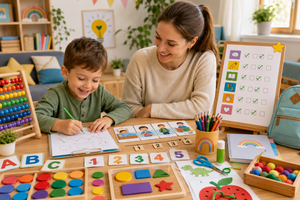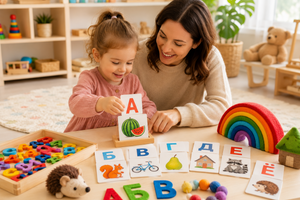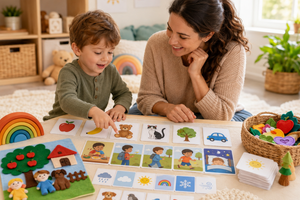
A child may look at three pictures and name everything correctly without yet creating a story. “Boy. Ball. Puddle” identifies important details, but it does not tell a listener how they belong together. A narrative lets someone understand who acted, where the event took place, what changed, and how the situation ended.
Begin with a visible structure rather than the broad instruction, “Tell me a good story.” Let the child inspect and move the scenes, point out evidence, answer different kinds of questions, and only then combine those ideas. Pictures reduce the memory load, but they do not generate a narrative automatically. Sequence needs a reason, and a storyteller needs an audience.
This guide has a deliberately narrow focus: organizing events from images. It does not replace broader language play, and the suggested stages are flexible rather than developmental deadlines. If a child consistently struggles to understand simple questions, loses communication skills previously used, or becomes very distressed while trying to communicate, share those observations with a pediatrician or qualified speech-language professional.
Key takeaways
- Inspect every picture and name visible evidence before choosing an order.
- Build around four anchors: who, where, what changed, and what resulted.
- Use beginning–middle–end as a logic for events, not three memorized opening phrases.
- Ask one question at a time and wait; several rapid prompts can replace the child's thinking.
- Accept more than one sequence when the child can defend the causal connection.
- Gradually remove pictures, transition cues, and the adult's model so the child can use the structure independently.
How a story differs from a list of pictures
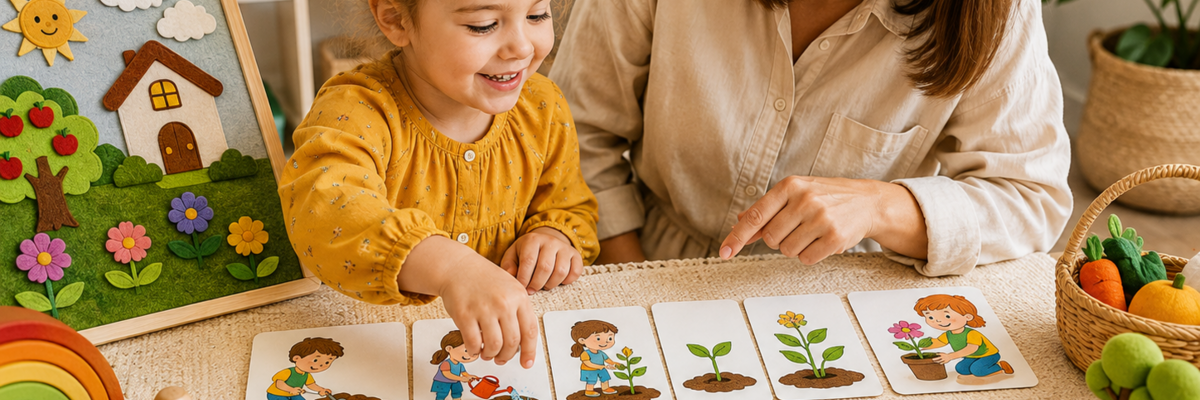
A list reports what is visible: “A girl has a watering can. There is a flower. The sun is shining.” A narrative establishes relationships: “The girl noticed that the flower was drooping, brought a watering can, and dampened the soil. Later the leaves lifted.” The second version has a need, an action, and a consequence.
Not every image set has one correct plot. When cards are not numbered and show no unambiguous physical change, another plausible order may work. Ask for evidence. Wet clothing suggests that rain has begun; a closed box may come before an open one; an empty plate usually comes after a meal.
It also helps to identify the listener. A story told to someone who cannot see the pictures requires clearer links. Hide one scene and ask the child to describe its role well enough for you to guess where it belongs. The challenge shows why connections matter more than naming cards in order.
Matching picture work to the child's current skill
|
Current skill |
Useful visual support |
The child's task |
Next small step |
|
Names familiar objects and actions |
One large scene or two contrasting pictures |
Point out the character, place, and main action |
Build one who–does what–where sentence |
|
Uses simple sentences |
Two or three pictures with an obvious change |
Decide what happened earlier and later |
Add a cause or a result |
|
Connects several events |
Three or four narrative scenes |
Identify an opening, problem, response, and ending |
Use time words without repeating every adult prompt |
|
Tells short stories |
Four to six scenes or mixed thematic cards |
Create a plot and defend the chosen sequence |
Change one event, retell without cards, or address a new listener |
More pictures do not automatically make a richer task. Two ambiguous scenes may require more reasoning than six obvious steps. Increase one demand at a time: order, length, independence, or the need to explain a cause.
Four anchors: who, where, what changed, and what resulted
Who is the main character?
A scene may contain several people or animals. Ask whose experience we follow from beginning to end and what that character wants. A goal ties scenes together: a child looks for a lost mitten, a dog tries to retrieve a ball, or a family prepares a picnic.
Where does it happen?
The place need not be repeated in every sentence, but the listener should be able to imagine it. Look for evidence: a bed and shelf suggest a room, a counter suggests a shop, and a swing suggests a playground. A change of place can become an important transition.
What is the important change?
The middle is not simply the second card. Something appears, disappears, breaks, fails, or becomes surprising. Ask, “After which picture could the character no longer continue in the same way?” This often reveals the center of the plot.
What is the result?
The ending shows what the action produced. It may be partial, funny, or open, but it should grow from earlier events. If the cat spills water, somebody may wipe the floor. If the children build a boat, they may test whether it floats.
Explaining beginning, middle, and end
At the beginning, the listener learns who is present, where they are, and what the ordinary situation looks like. In the middle, a goal, obstacle, or change appears and the character responds. At the end, we see the consequence and a new state. These parts do not need equal numbers of pictures; the middle is often longer.
Draw three spaces or place three sheets on the floor. Mark the first with a doorway or start symbol, the second with a question mark, and the third with a flag. The child places scenes and explains the purpose of each space. Once the structure is familiar, remove the icons and keep only a few transition words.
Avoid beginning every sentence with “then.” Offer a small selection: “at first,” “suddenly,” “because,” “as a result,” “after that,” and “finally.” Choose one or two that fit the current story. A well-chosen connector is more useful than reciting a long list.
A picture-story session step by step
- Survey every scene. Do not let the first card determine the whole plot immediately. Name characters, actions, places, and visible changes.
- Find the character and goal. State in one short sentence what the character wanted or noticed.
- Locate evidence for order. Compare the condition of objects, weather, positions, and whether a result is already present.
- Arrange beginning, middle, and end. Allow the child to move cards while explaining.
- Tell with support. The adult may point to scenes but should not complete every sentence.
- Retell for a new listener. Hide one cue or tell the story to a toy that “did not see any pictures.”
When the child stops, prompt for the missing kind of information rather than supplying the whole phrase: “We know who. Where did this happen?” or “What changed after the rain?” Support should rebuild the structure without taking ownership of the plot.
Eight games for flexible storytelling
1. Find the first picture
Place three scenes and ask which one begins the event. Follow with, “What in the picture gives you that clue?” If the reasoning works, check whether the remaining scenes can form a coherent sequence.
2. The missing scene
Remove a middle event. The child suggests what could happen between the opening and the result, then compares the idea with the original scene. A difference is not an error when both versions are connected and possible.
3. The adult's mixed-up order
Swap two scenes and confidently tell an absurd version. The child stops the narrator, repairs the sequence, and explains the contradiction. Becoming the expert often elicits more precise language than answering another test question.
4. What is the character thinking?
Add a paper thought bubble to one scene. The child says what the character knows, feels, or plans at that moment. Then check whether the next action is consistent with the proposed thought.
5. Two possible endings
Offer an expected ending and an unexpected one. The child selects a version and adds a sentence connecting the middle to it. Changing the ending makes the need for a causal bridge visible.
6. A story from unrelated cards
Select a character, setting, and object from different sets. Allow any sensible plot, then ask for one difficulty and one result. This changes the task from guessing a prepared sequence to deliberately creating a coherent plot.
7. Storytelling in roles
The adult narrates the opening, the child speaks as the character in the middle, and both create the ending. Switch parts in the second round. The contrast helps the child hear the difference between a narrator's voice and character dialogue.
8. An audio message
Record the finished story for a relative or for later listening. Play it once and ask, “Could someone without the pictures understand what happened?” Add only information that a real listener is missing.
Giving support without telling the story for the child
Begin with the lightest help: silently point to a scene, repeat the child's last words, or ask one concrete question. If that is not enough, offer a choice. Save a complete sentence for the final level of support and invite the child to change at least one detail.
Do not correct every grammatical form in the middle of an episode. Protect the sequence first, then naturally recast a phrase: “Yes, the boy dropped the ball, and it rolled into the puddle.” After the story is complete, choose one sentence together and make it clearer.
Remove supports gradually. Today the child tells the story while seeing every scene. Tomorrow the final card is turned over; later only three abstract markers remain. Do not remove pictures, transition words, and adult questions at the same time.
After the first version, avoid the vague request, “Tell it better.” Become a genuine listener and identify the information gap: “I understood that the boat reached the water, but I do not know who put it there.” The child now has a communicative reason to add a link instead of merely responding to a demand for a longer story.
Changing the audience is equally useful. First tell the story to an adult who sees all the scenes; next tell it to a toy behind a screen or a relative in a voice message. The contrast makes it clear that a listener without pictures needs character, setting, and transition information.
Learn&Dream materials as story anchors
Cards showing places, objects, and actions can have separate jobs inside a who–where–what happened structure. A set does not need to be a ready-made narrative sequence. The adult and child can deliberately assign one card as a character clue, another as the setting, and a third as the change.
|
Material |
Story role |
First activity |
Extension |
|
“Children's Room” three-part cards |
A setting and familiar room objects |
Describe where a selected object belongs |
Invent what went missing, who searched, and where it was found |
|
“Movements” three-part cards |
Actions that connect scenes |
Choose an action for a character and act it out |
Explain why it began and what it caused |
|
“Fruit Ice Cream” didactic set |
A link between a chosen ingredient and a result |
State what the character ordered |
Create a cafe story with a mix-up, repair, and ending |
|
“Little Town” felt puzzle |
Locations, routes, and scene changes |
Build a path between two places |
Add three errands, an obstacle, and a reason for the order |
Before choosing a set, check the current contents, language, and age guidance. Use only a few pieces for one coherent relationship. Additional cards should introduce a clear new job in the plot, not merely make the table look busier.
Common mistakes with picture stories
- Demanding a complete story immediately. Make the character, place, change, and result visible first.
- Judging only the expected order. Ask for evidence and causal reasoning.
- Finishing every sentence. Try a pause, gesture, or smaller question before supplying words.
- Correcting everything at once. Work on sequence in one round and refine one sentence later.
- Using too many pictures. Three well-connected scenes are more useful than ten disconnected labels.
- Requiring an adult-approved ending. A surprising ending works when an earlier event prepares it.
Frequently asked questions
How many pictures should we begin with?
Two or three scenes with one visible change are often enough. The child needs time to inspect each one, locate evidence for order, and state a connection. Add another picture after that process is familiar.
What if the child only lists objects?
Ask the child to select one main character and action. Then ask what happened before that action and what changed afterwards. Listing is useful observation; the next step is turning details into relationships.
Should I correct an unexpected order?
Ask for the explanation first. Accept a possible version. If the scenes contradict one another, return to visible evidence: whether an object is intact or broken, clothing is dry or wet, or a plate is full or empty.
How can I help when the child says, “I don't know”?
Reduce the task to choosing between two possible first scenes, pointing out the character, or completing one short model. After a successful response, return to an open question. Avoid delivering the entire story at once.
Is it useful to record the child's story?
Yes, when recording is not treated as assessment. A short audio message can reveal whether a listener without pictures understands the plot. Select one missing detail to clarify rather than cataloguing every language difference.
Conclusion: build the connection before removing support
Picture storytelling begins with understanding an event, not producing long sentences. Who acts, where the action occurs, what changes, and what results form a frame. Time words, causes, character thoughts, and descriptive details can be added once that frame is stable.
Let the child move scenes, challenge the order, and invent another ending, while returning to evidence and clarity for a listener. As pictures and adult prompts gradually disappear, the organizing pattern remains available for personal memories, explanations, and imagined stories.