Children's Lotto: Rules, Benefits and Ways to Play by Age
In brief: in children's lotto, each player has a board containing several pictures. A caller reveals or names one matching card at a time, and a player covers the corresponding picture on their board. Begin with the small cards face up so the child can see every option and understand the matching action. In the closed format, cards are drawn at random, adding turn-taking, uncertainty, and sustained attention. Increase only one demand at a time: the number of pictures, their similarity, the type of clue, or the need to explain a choice.
A useful picture lotto for kids has a clear structure: a visible beginning, a repeated action, and an understandable finish. Yet the activity need not remain a race to fill a board. The same material can support naming, careful description, classification, storytelling, and child-created rules. When browsing educational toys for shared play, therefore, look for an activity that can be simplified for a first attempt and extended once the basic action is secure.
What children's lotto is
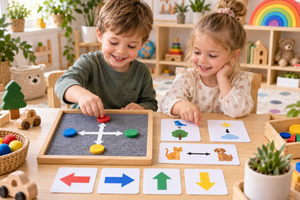
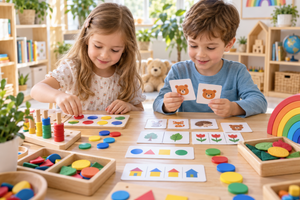
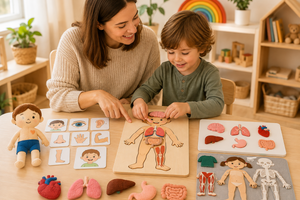
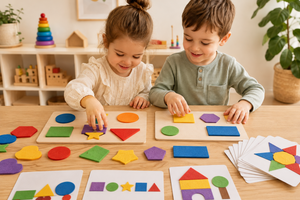
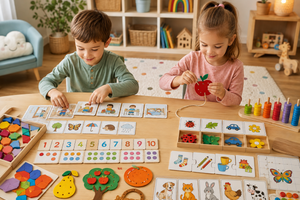
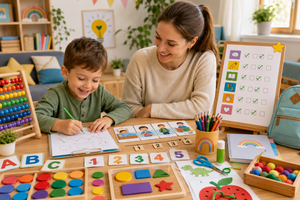
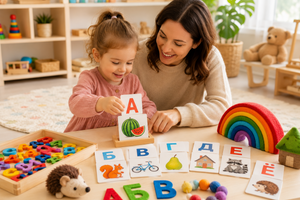
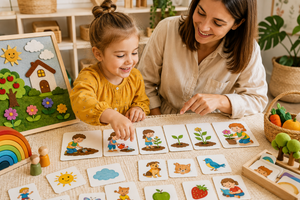
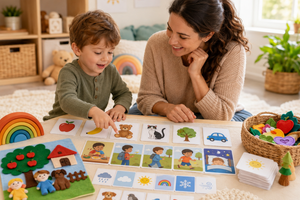
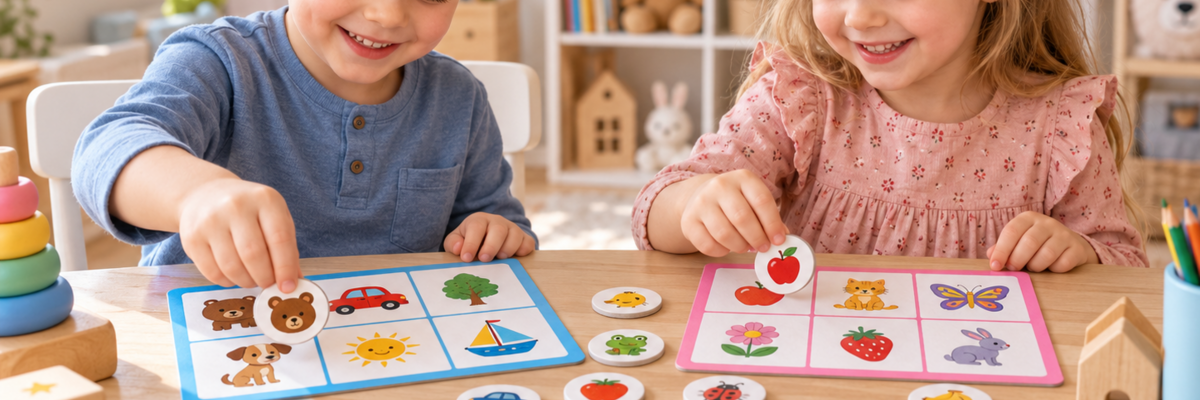
A typical picture lotto set includes several large boards and a collection of smaller cards. The pictures on the cards also appear on the boards. A caller displays one card, while players scan their own boards. A player who finds the match covers it with a counter, marker, or the matching card, depending on how the material is designed.
That apparently simple turn combines several actions. The child attends to the shared card, identifies useful visual features, searches their board, compares the images, decides whether they match, and marks the result. During a group round, the child must also wait while others check and remember the rule until the end. Presenting every demand at once can make even familiar pictures difficult, which is why an open, short version is the best introduction.
A lotto game for children is not a general test of intelligence or vocabulary. A child may match an unfamiliar object without naming it, or know every word yet lose track when the caller moves quickly. Adjust the difficult step rather than treating the whole game as mastered or failed.
Open and closed lotto formats
Both formats use the same basic materials, but they place different demands on the player. Open lotto isolates the principle of correspondence. Closed lotto adds uncertainty, waiting, and the need to redirect attention whenever a new card appears.
|
Format |
Position of the small cards |
Child's main task |
Sign that the next step is suitable |
|
Open lotto |
Face up in a short row or small grid |
Select a card, compare it with the board, and cover the match |
The child completes most matches without an adult pointing to the location |
|
Partly open lotto |
Some cards are visible and the rest form a pile |
Choose among visible options, then respond to an occasional random reveal |
The rule remains clear when the presentation changes |
|
Closed lotto |
Face down in a pile, box, or bag |
Wait for a reveal, scan the board, and mark a match if present |
The child manages a short round, follows turns, and accepts cards that do not match |
For an open activity, display the cards found on one board, perhaps with one extra choice. The child places each card on its match. Once the action is understood, reverse roles and let the child check the adult's decision.
In a closed round, reveal each card where everyone can see it and allow time to inspect it. Put unmatched cards in a visible discard row so the sequence remains clear and no draw is repeated.
Basic lotto rules, step by step
Agree on the finishing condition before play. A short game may end when someone covers one complete row; a full game may require the whole board. Do not change the goal halfway through a round simply to make the result closer.
- Give each player one board. In a teaching round, the adult may keep their board visible and model how to scan it.
- Mix the small cards and choose a caller. An adult can call the first round; once the routine is clear, the child can take the role.
- Reveal one card and show it to everyone. Name it or offer one concise clue if language is part of the activity.
- Each player checks their own board. A player who sees the matching image says so and covers it.
- After the match has been checked, reveal the next card. Keep used cards separate from the remaining pile.
- End as soon as the agreed row or board is complete. Review the covered pictures and collect every piece together.
If the same image appears on two players' boards, both should cover it. When a child chooses incorrectly, do not silently move the counter. Put the sample beside the chosen picture and invite comparison of one feature: outline, colour, direction, or number. A neutral opportunity to check preserves more learning than an adult correcting the placement immediately.
What the game can support
Lotto coordinates several modest skills. Visual discrimination supports matching, selective attention filters unrelated detail, and working memory keeps the rule active. Shared play adds waiting, making a claim, and coping with chance. Language is involved only when the child speaks: invite the player to name a match, finish a phrase, or give a clue, but do not demand a sentence every turn. Picking up and positioning pieces also uses hand-eye coordination. One game is not a developmental test; its value is repeatable practice in a predictable structure.
Increasing difficulty by age and experience
Age bands are starting points, not standards. A child may match familiar animals easily but still find waiting difficult, or play closed lotto with everyday objects yet need an open version for a new theme. Adjust the rule to current experience.
|
Approximate stage |
Starting board and presentation |
Suitable rule |
One manageable next challenge |
|
Ages 2–3 |
3–4 clearly different, familiar pictures; all cards face up |
Place identical on identical after one demonstration |
Add one picture or offer two somewhat similar choices |
|
Ages 3–4 |
4–6 images; several cards in an open row |
Find, name, and wait through a brief turn |
Draw cards from a bag or add one descriptive clue |
|
Ages 4–5 |
6–9 images; face-down pile |
Play until one row is covered and check matches independently |
Add similar pictures, the caller role, or a clue based on an attribute |
|
Ages 5–6 |
8–12 images across several themed boards |
Follow a shared rule and explain selected matches |
Use riddles, categories, numbers, or a cooperative goal |
|
Ages 6+ |
More symbols or mixed themes |
Work from indirect clues and monitor the round |
Design a board, write or dictate clues, and call a game for others |
Move on when the player understands the goal, completes most turns without continual prompting, and remains interested. Deliberate comparison matters more than speed. Change one variable at a time: add a picture while cards remain open, or keep the small board and turn the cards over. If the child watches the adult for every answer, restore the previous level.
The practical guide to adapting one learning game for ages 2, 3, and 4 offers another way to vary the number of pieces, prompts, and independence.
Theme-based variations with familiar materials
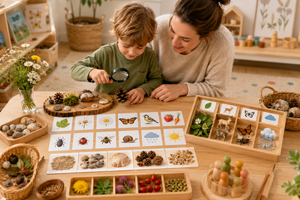
A theme determines which relationships can be explored. Familiar household objects reduce the language load; animals invite clues about habitat, movement, or sound; transport can be grouped by where it travels.
Begin with ordinary identical matching before introducing facts. Next, the caller may hide the card and say, “Find something that flies” or “Look for an object used in the rain.” When several pictures satisfy the clue, accept every defensible answer or refine the wording. The aim is to reason from the information given, not to guess an answer known only to the adult.
Useful variations include:
- sound lotto: imitate a familiar animal or everyday sound, then find its picture;
- attribute lotto: call a colour, shape, part, or function rather than an object's name;
- movement lotto: perform a relevant action after a match and then cover the image;
- story lotto: use three covered pictures as prompts for a short story after the round;
- cooperative lotto: work together to fill all boards within an agreed number of draws;
- child-made lotto: draw cards for a simple grid and ask the child to state the matching rule.
For related correspondence activities, see the guide to matching games and age-based difficulty. Lotto differs from face-down memory because each player searches a personal board in response to a shared card rather than looking for two hidden positions among identical backs.
A short home session that remains playful
Prepare the material before inviting the child: check that it is complete, select the boards, remove unused cards, and establish a place for completed draws. Five to ten minutes is enough for an introduction. Demonstrate one full turn instead of explaining every possible rule in advance.
A child might first place cat on cat, then respond to the word “cat”, and finally solve “a pet that purrs”. Difficulty with the clue does not cancel success in the earlier actions.
End before attention is exhausted. Finishing after a clear turn and returning another day is better than persuading a tired child to fill a large board. The collection of 25 games with educational cards provides other ways to change the action while keeping familiar pictures.
Lotto in a group or mixed-age family
Ensure that every player can see the caller's card. In a larger class, several short tables create more active turns than one long game. For mixed ages, adjust the demand: give a younger child fewer pictures and an older child a larger field, indirect clues, or the caller role. Avoid improvised bonus turns; predictable rules are easier to trust. If competition overwhelms the activity, use a shared goal of covering every board.
Common problems and specific adjustments
The child selects the first available card. Offer two clearly different images and return to open overlay matching. Ask for one shared feature.
The match is missed on the board. Orient the board correctly and teach a search path: top row from left to right, then the next row. Do not point out every location.
The child matches but does not name the item. Accept the placement, model the word, and invite rather than require repetition. Ask for names on only one or two familiar cards next time.
Losing causes distress. Play to one row, explain that draws are random, or cooperate. Model an ordinary loss calmly instead of deliberately handing over a win.
Interest disappears in the closed version. Use fewer boards, let the child draw, or leave half the pile face up. Waiting may be harder than matching.
Choosing and using lotto materials safely
Check the stated age range, piece size, condition, and manufacturer's instructions. Small counters are unsuitable for children who may put them in their mouths. Remove split, peeling, or sharp pieces; supervision does not make an age-inappropriate part suitable.
Images should be readable and corresponding pairs genuinely comparable. A beginner benefits more from a few distinct pictures than from a large, highly decorated board. The educational card materials catalogue can be browsed by theme, but confirm the current contents, language, material, and safety information on the individual product page before choosing anything.
Count the parts as you put the game away. Labelled envelopes or small inner boxes make the next setup quicker and give shared play a clear final step.
Frequently asked questions
At what age can a child begin playing picture lotto?
At around ages two to three, many children can try an open game with three or four large, familiar pictures. Readiness to copy one matching action after a brief demonstration matters more than a precise age. Add hidden cards, waiting, and a full board later, one demand at a time.
How many pictures should be used in a first round?
Start with three or four images on one board and the corresponding cards face up. Add one picture or a second small board after several confident attempts. If the child guesses or waits for constant help, temporarily reduce the visual field.
What is the difference between open and closed lotto?
In open lotto, every choice remains visible, so the child concentrates on comparison. In closed lotto, the caller draws randomly; the player must wait, redirect attention, and accept that a draw may not match their board. Closed play is a later challenge, not an inherently better version.
What should I do when a child knows the picture but cannot find it?
Use a smaller board, orient it correctly, and teach a consistent row-by-row search. Place the sample beside the field so the child can compare an outline or detail. Avoid naming the location or covering it yourself, because that transfers the visual search back to the adult.
How can we prevent arguments about winning?
State the finishing condition before the draw: one row or the entire board. Keep that rule until the round ends. If chance results are still too upsetting, choose a cooperative goal, play a shorter round, or take turns without recording winners. Competitive play can be introduced gradually.
From an identical match to a child-created rule
The most useful progression does not depend on ever-larger boards. It changes the thinking action: overlay an open card, respond to a random reveal, listen to a description, explain a feature, and eventually become the caller. At every stage, keep the rule understandable, allow a meaningful way to check, and finish before fatigue. Lotto then remains a genuine shared game rather than a disguised test.