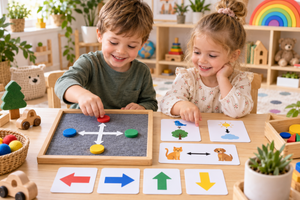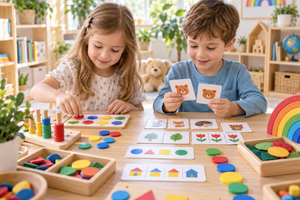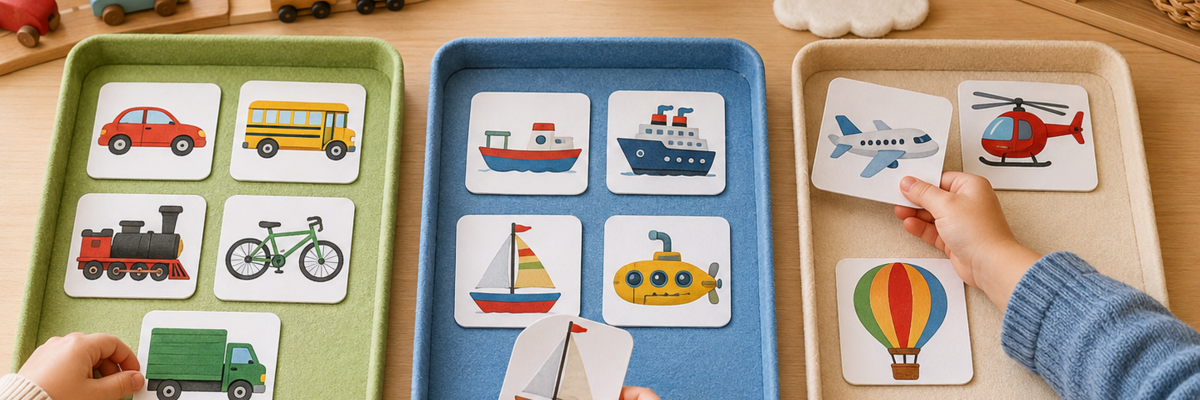
A bus travels on a road, a boat moves through water, and an airplane flies through the air. These examples make the first transport lesson feel effortless. Then a train appears, followed by a seaplane, hovercraft, or amphibious vehicle. The useful question is no longer “Does the child remember the right pile?” but “Which feature are we using, and can the choice be explained?”
Classification turns familiar vehicles into material for thinking. Children observe a feature, compare alternatives, make a decision, and test whether the same rule works again. A fire engine can belong with land vehicles in one activity, emergency vehicles in another, and community helpers in a third. The vehicle has not changed; the question has.
This guide develops the topic from a six-card sort to route planning and ambiguous examples. It is designed for a home, preschool, or small learning group. The activities do not require children to memorize technical definitions. They offer simple working language, real observations, and repeated opportunities to state the criterion before changing it.
Key takeaways
- Begin with the main environment in which a vehicle travels: land, water, or air.
- Use clearly different examples before adding vehicles that work in more than one environment.
- Ask for reasons on selected turns instead of treating every card as a test.
- Keep travel environment separate from purpose, power source, passenger capacity, and ownership.
- Connect pictures to vehicles and routes children can safely observe in real life.
Define the rule before placing the first card
For an introductory sort, ask where the vehicle completes the main part of its journey. Land transport travels on the ground, roads, or rails. Water transport moves on or below a body of water. Air transport leaves the ground and covers most of its route through the air. These are accessible working definitions, not an attempt to settle every engineering category.
Avoid switching silently from “Where does it move?” to “What does it do?” A city bus and a fire engine are both land transport, although their purposes differ. A passenger airplane and rescue helicopter are both air transport, although their routes and jobs are not the same. If the class changes its question, remove the old category labels and state the new rule.
Explain that categories are tools. They organize objects in relation to a particular question; they do not tell the whole story about each object. The same cards can later be grouped by carrying people or goods, following rails or travelling freely, serving one family or the public, and operating locally or over long distances. Naming the criterion is part of every new round.
Choose a starting point by experience and readiness
|
Starting point |
Work field |
Main action |
Possible next step |
|
About 2–3 years |
Two or three large cards with toy models |
Name and match identical vehicles |
Separate obvious “goes” and “flies” examples |
|
About 3–4 years |
Six contrasting cards, two per environment |
Sort onto land, water, and air scenes |
Give one observable reason |
|
About 4–5 years |
Nine to twelve cards, including related types |
Sort, then regroup by purpose |
Compare two possible rules |
|
About 5–6 years |
Routes, transfers, and mixed-use vehicles |
Defend a choice and notice ambiguity |
Design and label a new classification |
Age is only a planning clue. A child who rarely sees boats may need a book, model, or short factual video even when cars are easy to classify. Reduce the number of cards whenever unfamiliar vocabulary hides the actual reasoning task.
A clear classification lesson, step by step
1. Prepare three visible environments
Represent land with a road or brown strip, water with blue cloth, and air with a pale page and cloud. Say each environment rather than relying on color alone. Place one unmistakable reference beside each area: car, boat, and airplane.
2. Model comparison, not a finished display
Pick up a bus and make the relevant thought audible: “It travels along a road, so under today’s rule it belongs with land transport.” Invite the child to place the next vehicle. When the choice appears random, return to one question: “Where does most of its journey happen?”
3. Test the rule across categories
Alternate examples so the child cannot continue a visual row automatically. After several placements, ask for one reason. “The ship is in water” is enough. A complete sentence after every turn adds language pressure without necessarily improving classification.
4. Change only one condition
Once the first sort is restored, introduce a new contrast: people or goods, rails or no rails, fixed timetable or individual trip. Replace the headings. The same vehicle may now move elsewhere, which makes the relationship between rule and result visible.
5. Reconnect the groups through a route
Choose a starting point and destination. The child builds one or more stages: bus to a station, train to a coastal town, ferry across the water. Discuss where transfers occur and why one vehicle may not fit the entire route.
Eight classification games with transport
- Three stations. Create a land station, water dock, and airfield. A card or model can park only after its main travel environment is named.
- Route ticket. Give each vehicle a simple land, water, or air token. Younger children choose between two tokens; older children explain the evidence.
- Dispatcher’s mistake. Deliberately place a boat on the road scene. The child identifies what conflicts with the stated rule and repairs the arrangement.
- One does not belong. Display three land vehicles and one aircraft. Then search for a different valid criterion that changes which card is the outsider.
- Movement charades. Mime steering, rowing, flying, or train motion. After guessing, the group names an environment and one more member of that category.
- Transfer chain. Build a trip with two or three vehicles. Mark the transfer points and explain why the landscape makes a change necessary.
- Secret rule. Select vehicles that use rails, carry many people, work on water, or serve emergencies. The child proposes a rule and tests it with a new card.
- Category designer. An older preschooler invents two or three groups, creates their labels, and decides what to do with a difficult example.
For active games, clear the movement area and remove speed as the winning condition. The meaningful outcome is a decision supported by evidence, not the first card dropped near a category sign.
Move from pictures to safe real-world observation
Choose a protected observation point away from moving traffic. For five minutes, record which vehicles pass, where they move, and what they may be carrying. The adult manages safety and note-taking; the child watches. There is no reason to approach machinery or photograph individual passengers.
Back indoors, work only with the examples actually observed. Compare a residential street with a railway station, harbor, or airport shown in a reliable book or video. Ask why some categories dominate a location. Classification now helps explain an environment instead of merely arranging prepared pictures.
Extend the sort through language, number, and maps
Describe each completed group before introducing another criterion. A younger child can name one member; an older child can use a consistent frame: name, travel environment, typical load, and route requirement. “A ferry carries people across water” is more informative than an unrelated list of facts and is easy to compare with the next example.
Count the cards in each area and compare more, fewer, or equal. Make it explicit that the result describes the selection on the table, not the real world. Five car cards and one boat card do not prove that there are always five times as many land vehicles. Children can represent each count with blocks or tally marks to build a simple object graph.
Draw a house, river, island, station, and airport with gaps between them. The child selects a suitable vehicle for each segment and traces the route. Look for transfer points and necessary infrastructure. Airplanes require suitable places to take off and land, trains need rails and stations, and boats need access to water. These constraints turn pretend travel into reasoned planning.
Finish with one changed condition: a closed bridge, a package for an island, or a destination without rails. Several plans may work. Ask what assumptions each plan makes and distinguish a plausible route from a fantasy story without treating imagination as a mistake in its own setting.
Handle mixed and ambiguous examples carefully
An amphibious vehicle uses land and water, a seaplane flies but lands on water, and a cable car does not match the familiar image of a road vehicle. Save these examples until the basic three-way rule is stable. Then allow two labels or create a temporary “more than one environment” area.
Ask which part of the journey the child is describing. If a seaplane is placed with water transport because of its landing, acknowledge that observation and then compare it with the main period of travel. The lesson is about refining a criterion when evidence changes, not defending a single answer at any cost.
Learn&Dream materials that fit the sequence
Choose each material for one clear action: matching familiar vehicles, sorting by travel environment, or studying how parts support movement. Before use, check the current shop listing for language, contents, age marking, and care instructions. Present only the cards needed for today’s criterion.
|
Material |
First use |
Classification focus |
Follow-up prompt |
|
Transport — three-part cards |
Match a few familiar images |
Main travel environment |
What does this vehicle carry? |
|
Types of Transport: Air, Water, Land |
Build three visible groups |
Land, water, and air |
Which example needs an explanation? |
|
Parts of a Whole: Automobile |
Study one vehicle in detail |
Parts for motion, control, and carrying |
Which parts help it move? |
|
Parts of a Whole: Airplane |
Compare with an automobile |
Shared and distinctive parts |
Which parts relate to flight? |
|
Parts of a Whole: Sailboat |
Reconstruct the whole image |
Water vehicle and structure |
What helps it travel on water? |
After studying parts, return the vehicle to the broader category map. The child can now explain not only where it travels but which structures make that form of travel possible.
Adapt the activity for home and groups
At home, six to eight cards and one family route are sufficient. Map a trip to preschool, a shop, or a relative, including walking where it actually occurs. A pedestrian is part of traffic but is not a form of transport; this is a useful distinction in its own right.
In a group, rotate the roles of observer, sorter, and rule checker. When two children suggest different placements, ask for their criteria before deciding. Both answers may be reasonable responses to different questions, and making that difference explicit is often the richest part of the discussion.
Common mistakes in transport activities
- Too much new vocabulary. Classify mainly familiar objects and introduce names gradually.
- A silent rule change. Remove old labels and announce the new criterion.
- Treating picture size as evidence. A card does not show the vehicle’s real scale.
- Opening with exceptions. Amphibious vehicles are excellent discussion material after the basic groups are clear.
- Correcting without listening. Ask for the observed feature before moving a card with an adult hand.
- Unsafe observation. Watch transport only from a protected, permitted place under adult supervision.
Frequently asked questions
At what age can a child sort transport into three groups?
At around three, begin with a few contrasting cards whose names are familiar. A younger child may first work with two groups, such as vehicles that go on the ground and vehicles that fly.
Does a train belong with land transport or in its own group?
In a sort by travel environment, a train is land transport because it moves across the ground on rails. Rail transport can become a separate category in a later activity with a different rule.
What if the child cannot explain a placement?
Offer a sentence opening such as “I put it here because it travels…” or provide two observable features. Pointing to the environment or demonstrating motion is also a valid early response.
Should every ambiguous answer be corrected?
First restate the rule and listen to the evidence. If two criteria were mixed, name the difference; if the reasoning is coherent, show how the category changes with the question.
How often should we return to the transport theme?
Return briefly in a fresh context after a walk, trip, book, or new interest. Keep one known rule and add only one new challenge so repetition remains purposeful.
Conclusion: the rule matters more than the pile
Transport becomes a reasoning topic when children do more than remember three locations. They observe a feature, choose, and explain. Clear examples establish the pattern, everyday routes provide context, and mixed vehicles create a reason to refine the original rule.
Begin with land, water, air, six familiar cards, and one short journey. Once that sort is comfortable, regroup the same material by purpose or structure. A modest selection can support many different questions while showing that the same objects can be compared through several independent features.