Nature science for preschoolers begins with a careful look, not a list of names. What changed after the rain? How are two leaves alike? Where did the puddle go? Why does one object float while another settles at the bottom? Questions rooted in direct experience give a child a reason to seek words, compare evidence, and test an idea.
Animals, plants, weather, water, land, and space can each support rich projects, yet a connected curriculum is not simply a collection of topics. Its thread is a recurring way of working: notice, describe, compare, group, name the rule, try the rule on a new example, and record what happened. That pathway travels from one subject to another.
The programme below works at home, in preschool, or with a small group. It does not require laboratory equipment and is not designed to push school content earlier. The adult prepares a safe situation for inquiry; the child gradually moves from “I see” to “I put these together because…”
Key takeaways
- Begin with something a child can observe, then introduce a precise word after the relevant feature has been noticed.
- Description answers “What can I detect?”, comparison asks “What is alike or different?”, and classification asks “What rule makes this group?”
- Sort the same collection in more than one way so a group is understood as a response to a question, not a permanent location for a picture.
- A quick drawing, symbol, photograph, or arrangement helps children revisit evidence without turning the activity into a memory test.
- Safety and care for living things belong inside every nature-science activity, not in an afterthought.
Why preschool nature science needs a pathway
If the adult supplies the name and the correct group immediately, the child's remaining task is recall. If the child first examines an object, names two features, and finds a related example, the concept is built through action. The technical word then becomes a concise label for a relationship already noticed.
A pathway also prevents disconnected fact collecting. A stone, tree, cloud, fish, and human-made object may appear in different sessions, but the intellectual moves recur. Children observe form, location, change, needs, or origin; compare cases; and check the edge of a group. They are learning how to question the world, not memorising an encyclopaedia page.
The route from observation to classification
|
Stage |
What the child does |
A useful adult prompt |
When to move on |
|
1. Observe |
Looks, listens, touches only when safe, notices a change |
“What did you notice first?” |
Points to or names at least one real feature |
|
2. Describe |
Uses words for colour, shape, surface, movement, or position |
“How could you explain it to someone who cannot see it?” |
The description distinguishes it from a nearby example |
|
3. Compare |
Finds a similarity and a difference between two examples |
“What is the same? What is different?” |
Names a feature rather than only a preference |
|
4. Group |
Places several objects together by one visible feature |
“Which things could belong together?” |
Uses the chosen rule consistently |
|
5. Classify |
Names the group's rule and tests a new case |
“Where would this go, and why?” |
Can explain inclusion, exclusion, or uncertainty |
|
6. Connect |
Links an object with a habitat, condition, source, or change |
“What might this depend on?” |
Offers a simple relationship open to checking |
|
7. Test and record |
Makes a prediction, watches the result, draws or marks it |
“What did we expect? What happened?” |
Distinguishes the prediction from the observed result |
What each stage looks like in play
1. Allow looking time before explaining
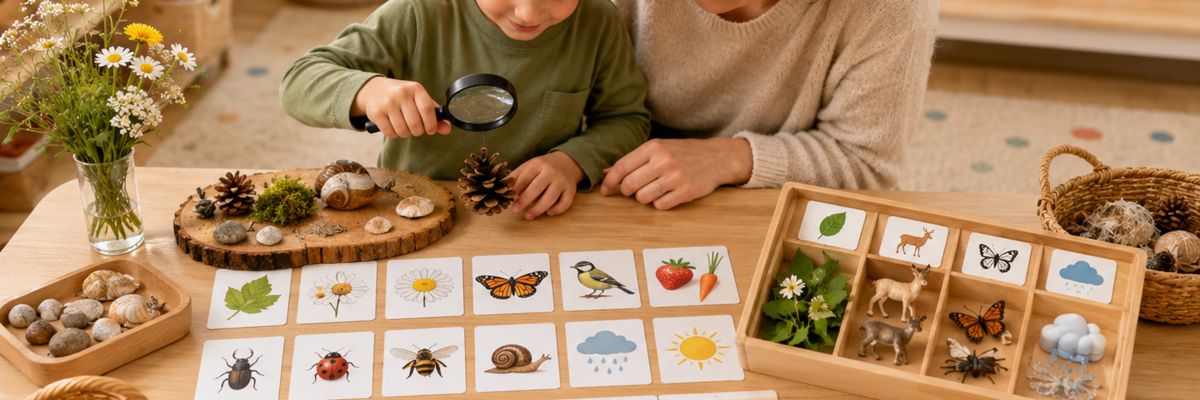
Place two or three safe natural objects or realistic cards on a plain surface. Do not announce the whole lesson in the first minute. Invite the child to select the most interesting example and point out a detail. This quiet interval reveals what they genuinely notice rather than what they repeat after an adult.
2. Build vocabulary around detected features
If the child says “nice” or “strange,” accept the idea and ask what creates that impression: colour, edge, pattern, surface, or movement. Supply one precise word and use it in the next comparison. Five new terms are unnecessary when one is enough to make progress.
3. Compare in pairs
Two cases are easier to examine than six. Offer two leaves with different outlines, a smooth and a rough stone, or pictures of a river fish and an aquarium fish. Find one similarity first, then one difference. The child can choose a third case that is closer to either member and say why.
4. Change the grouping rule
The same collection can be divided by colour, habitat, living and non-living, or natural and human-made. After the first sort, mix the pieces and announce a new criterion. Children discover that the grouping depends on the investigator's question and that one card holds many features.
5. Explore the boundary of a concept
Add a case that requires thought. A wooden spoon comes from a natural material but is a human-made cultural object. A fallen leaf no longer grows, yet it came from a living plant. The goal is not an advanced philosophical definition; it is an honest statement of the rule being used today.
6. Look for relationships, not one universal cause
Ask what a plant needs, where a fish might live, or what changes after rainfall. Separate what was directly observed from an interpretation. “That is possible; how could we check?” supports inquiry better than approving every answer as fact.
7. Keep the record simple and useful
A preschooler does not need a formal report. Draw two states, place a symbol on a weather record, photograph an arrangement, or write down one dictated sentence. Revisit it the next day and ask what stayed the same and what changed.
An eight-session preschool inquiry project
Each meeting can last fifteen to twenty-five minutes and include observation, movement or handling, conversation, and a brief record. The meetings need not be consecutive. Time between them allows children to recognise the same idea in daily life.
Sessions 1–2: “I can see and describe”
For the first session, create a collection of three safe objects or cards. The child picks one and gives clues without saying its name. For the second, take a short walk with a single focus: find three different edges, surfaces, colours, or ways of moving. Record one example of each rather than collecting everything.
Sessions 3–4: “I compare and group”
Compare two pairs using the sentence frame, “Both…, but…”. Then mix six cards and divide them by a clear feature. At the next meeting, use the same cards under a different rule. Ask why the arrangement changed even though the pictures did not.
Sessions 5–6: “I state a rule and inspect an uncertain case”
Work with two meaningful categories, such as living and non-living nature or nature and culture. The adult supplies one clear example for each, then the child continues. At the sixth session, introduce a more complicated case and permit a temporary “need more information” area. Uncertainty can be an organised response.
Sessions 7–8: “I predict, test, and explain”
Choose a safe mini-observation: how ice changes in two locations, which familiar objects float in a bowl, or how a shadow shifts over a short interval. The adult controls the environment and safety. Finish with a “museum of rules”: the child arranges a small collection, explains the criterion, and answers one visitor's question.
Adapting the route by age and experience
A younger preschooler may work with two or three contrasting examples, choose between two descriptive words, and sort by a prominent feature. A gesture can be a valid response while the adult supplies language. Every object must be large enough and safe for the particular child and setting.
A child with more experience can compare four to six cards under two features and then switch the rule. An older preschooler may propose a criterion, locate a counterexample, predict an outcome, or say what evidence would help. Avoid increasing the number of cards, vocabulary load, and activity length all at once.
If a child knows many names but cannot explain a grouping, return to paired comparison. If observation is precise but speaking is unwelcome, allow arranging, drawing, pointing, or photographing. The pathway does not require the same response mode at every stage.
How to connect nature topics without blending them into a blur
Choose one relationship as the bridge. A weather observation can lead to what plants receive after rain; a plant project can lead to the small animals found nearby; a fish collection can lead to comparing bodies suited to different water environments. The bridge should answer a real question, not merely place several themes on one table.
Keep the operation visible. Say, “Yesterday we compared leaves by their edges. Today we will compare fish by body shape.” The content changes while the method remains recognizable. At the end of the week, ask which action appeared more than once: looking closely, describing, sorting, predicting, or checking.
Safety and respectful investigation
Set boundaries before beginning. Unknown plants, mushrooms, berries, and natural substances are not tasted. Hands are washed after handling soil or outdoor objects. Near roads, water, slopes, unfamiliar animals, or other hazards, the child remains close to a responsible adult. Use only familiar, suitable materials and stable containers for mini-investigations.
Observation should not damage living things. Watch an insect where it is, leave nests and shelters intact, and do not pick rare or unidentified plants. A photograph, drawing, or already fallen object may replace a large collection when local rules permit. Choosing not to disturb something is itself an important scientific and ethical decision.
Before an outdoor session, define the available area, the return signal, and what may be touched. The adult checks the site and conditions, brings water, and chooses an easily reversible route. Clear boundaries make genuine child-led noticing possible within a safe frame.
Learn&Dream materials for the connected pathway
Select a set for the intellectual action it can support: separating two broad categories, discussing origin, comparing environments, or moving from a broad group to individual examples. Always check the current product description, contents, and age guidance before preparing the session.
|
Material |
Place in the pathway |
First activity |
Next step |
|
“Living and Non-living Nature” didactic material |
Building and explaining a broad classification |
Provide one clear example of each group and continue together |
Add a case that requires the child to state today's rule |
|
“Nature and Culture” didactic set |
Distinguishing natural items and human-made objects |
Sort a small selection and name the visible clue |
Discuss an object made by people from a natural material |
|
“Types of Forest” didactic set |
Comparing environments through a system of features |
Find one similarity and one difference in two images |
Say what extra evidence would help decide a group |
|
“Aquarium Fish” three-part didactic cards |
Moving from a broad category to close comparison of members |
Observe a few cards and describe one feature of each |
Invent a grouping criterion and apply it to all selected cards |
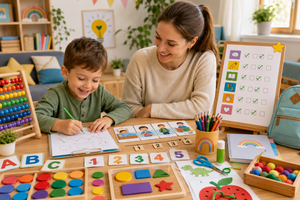
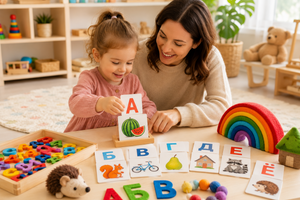
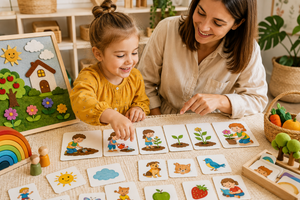
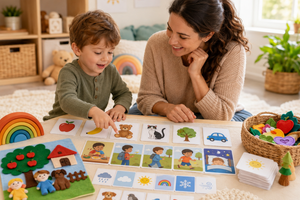
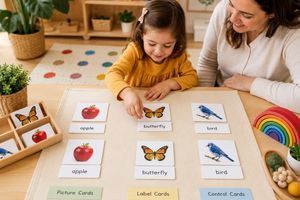
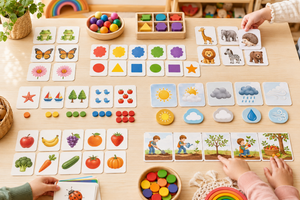
Cards work best as one stage of inquiry rather than a substitute for experience. Pair them with a walk, a safe physical object, a model, or a short observation. The same cards can support naming, matching, comparison, grouping, rule changing, or explanation. Decide which operation matters today and keep the other demands modest.
Common mistakes in preschool nature science
Beginning with a long adult lecture
When all information arrives first, there is little left to discover. Keep explanations short and connected to a feature the child has noticed. Turn a new fact into an immediate action: find, compare, arrange, or test.
Placing a card without naming the criterion
One placement may be reasonable under several rules. Ask “Why here?” and allow a revision after explanation. The goal is consistent use of a feature, not rapid distribution into adult-approved piles.
Correcting every imprecise word in the middle of an idea
Listen for the connection first, then model a more accurate phrase: “Yes, it feels prickly; we might also call that surface rough.” Scientific language grows through use, not only through repeating definitions.
Drawing a general conclusion from one case
One object sinking does not establish a rule for all similar objects. Test another and state that the conclusion applies to the conditions actually observed. “So far, we have seen…” is honest language a preschooler can understand.
Frequently asked questions
At what age can nature science through play begin?
Begin whenever a child shows interest in nearby objects and changes. Share attention to a colour, movement, sound, or texture. For younger children, use two contrasting safe examples and one short action, then add vocabulary gradually.
What is the difference between sorting and classification?
In simple sorting, a child places objects by a noticeable feature. Classification adds an explicit rule, a meaningful group name, and a test with a new example. Both actions can develop in sequence during the preschool years.
Should preschoolers be required to use scientific terms?
A precise word is useful when it helps reveal a difference or explain a rule. Introduce one term in context and reuse it in another action. Memorising an isolated list is not the central goal.
What if the child classifies differently from the adult?
Ask for the rule and see whether it is used consistently. A different division may be logical under another criterion. If rules have become mixed, find the card that reveals the conflict and refine the criterion together.
How often should preschool nature-science activities happen?
A few short meetings each week are enough when observation continues naturally during walks and routines. Repeated use of the same thinking move matters more than one long, information-heavy session.
Conclusion: nature science as a way of thinking
A connected nature-science pathway does not try to contain every preschool topic. It gives children reusable tools: look carefully, describe accurately, find similarities and differences, create a group, state its rule, make a prediction, and compare it with a result.
Begin with one accessible object and one honest question. Cards, a walk, a mini-observation, and a drawing can become successive parts of the same inquiry. When a child says not only “It goes here,” but “I placed it here because…,” nature science is already working as a living practice of reasoning.