How to Teach Geometric Shapes to a Child Through Play
Short answer: start with the circle, square, and triangle, and connect every name to an action: trace the outline, count sides and corners, find a similar object, or place the shape over a model. When your child recognizes these shapes in different colors, sizes, and orientations, add the oval, rectangle, and rhombus. The next step is to combine several pieces into houses, vehicles, animals, and original patterns instead of only rehearsing names.
Geometric shapes for kids become meaningful through short encounters in different settings. A circle on a card, a round lid, a drawn wheel, and a construction piece look different, yet share a form. Recognizing that shared property matters more than repeating a word on demand.
You do not need a long home “lesson.” Five to ten minutes of play or a shape hunt during a walk is enough. When choosing educational toys with geometric shapes, consider whether they invite your child to compare, rotate, overlap, build, and explain.
What does it mean to know a shape?
Naming a picture is only the first level. A child is forming a real concept when they can:
- recognize the same shape in different colors and sizes;
- identify it after it has been rotated;
- distinguish it from a similar shape and mention one visible property;
- relate a flat model to the outline or surface of a real object;
- use the piece in a composition and describe the result.
Alternate “What is this?” with “How did you know?”, “What stayed the same when we turned it?”, or “Which piece will fit here?” These prompts explore understanding rather than memory for a label.
A preschooler does not need formal definitions. Introduce accurate words gradually—side, corner, straight, curved, equal, longer, and shorter—and connect them to touch and movement. “Move your finger along every side” gives the child more useful information than repeating “This is a square” several times.
First step: circle, square, and triangle
These three shapes provide strong visual contrast. A circle has no straight sides or corners; its boundary curves continuously. A square has four sides of equal length and four corners. A triangle has three sides and three corners. For a first presentation, offer one large example of each without patterns, so decoration does not distract from the outline.
Name a shape yourself before asking the child: “This is a circle. Let’s move a finger around its curved edge.” Then offer an action without turning it into a quiz: place a circle over a circular outline, hide a triangle under a cloth and feel its corners, or build the sides of a square with craft sticks. After several experiences, ask the child to find the named shape from a choice of two, and later three.
Show varied triangles: wide, narrow, uneven, and turned upside down. Otherwise, a child may decide that a triangle is only a symmetrical “roof” pointing upward. Rotate squares too. A square remains a square after a turn, even when its new orientation initially looks like a “diamond.”
Moving on to the oval, rectangle, and rhombus
Introduce a new shape beside a familiar one. Compare a circle and an oval: both have a closed, curved boundary and no corners, but the oval is elongated. Next, put a square beside a rectangle. Both have four corners; in the rectangle usually shown to young children, two sides are longer and two are shorter, whereas a square has four equal sides.
In formal geometry, a square is both a special rectangle and a special rhombus. Preschool materials usually present a square, a non-square rectangle, and a slanted non-square rhombus as separate visual categories. Later you can say, “Shapes can belong to more than one family,” without a formal lecture.
Explore a rhombus through its sides: it has four equal sides, and each pair of opposite sides runs in the same direction. Avoid defining it only as a “tilted square.” Place a square beside a non-square rhombus, trace both outlines, and compare the corners. Your child can then notice a shared property as well as a difference.
|
Stage |
Shapes in focus |
What the child does |
Adult prompt |
Sign that the child is ready to continue |
|
1. Contrast |
circle, square, triangle |
touches outlines and matches to models |
“Which edge curves? Which one has three corners?” |
finds a named shape among two or three |
|
2. Variation |
the same shapes in different colors, sizes, and orientations |
groups by shape |
“The color changed. Did the shape change?” |
recognizes a rotated example |
|
3. Similar pairs |
circle and oval; square and rectangle |
compares boundaries and sides |
“What is the same? What is different?” |
describes at least one property |
|
4. Four-sided shapes |
square, rectangle, rhombus |
counts, traces, and rotates |
“Are all the sides equal, or are some longer?” |
no longer relies only on orientation |
|
5. Compositions |
all familiar shapes |
builds a whole from several pieces |
“Which shapes made the rocket?” |
plans a choice of pieces and explains it |
This is not an age chart. A child may build pictures while mixing up labels, or speak precisely but struggle to align pieces. Choose the next activity from observation, not the calendar.
Finding shapes in everyday life—with honest comparisons
A home or outdoor shape hunt helps transfer learning beyond cards. A plate resembles a circle, a cupboard door resembles a rectangle, and a traffic sign may have a triangular outline. However, the object is three-dimensional while a geometric shape on paper is flat. It is more accurate to say “the face looks like a circle” or “the window’s outline resembles a rectangle” than to call an entire ball a circle. A ball is a sphere; a typical box is a rectangular prism.
Hunt for one shape at a time: circles today and rectangles tomorrow. Photograph or sketch the finds, then group them. Discuss ambiguous examples: a clock may have a circular face while its other parts introduce different lines and shapes.
You can also search by properties rather than names: “Find something with four corners,” “What has a curved edge?”, or “Where can you see two long and two short sides?” The child then applies a feature instead of guessing from a memorized picture.
Games that connect a name with an action
Alternate visual, movement, tactile, and construction play. If your child does not want to answer aloud, they can point, bring an object, cover a card, or stand on the requested shape. Each is a valid response.
|
Game |
What to prepare |
How to play |
How to make it harder |
|
“Find the twin” |
two examples of every shape |
match identical outlines |
change the partner’s color, size, or orientation |
|
“Mystery bag” |
sturdy shapes and an opaque bag |
identify a piece by touch, then check |
describe sides and corners before taking it out |
|
“Walk the outline” |
rope or painter’s tape |
make a large shape and walk around its edge |
turn a square into a non-square rectangle by moving two points |
|
“Shape detective” |
a room or walking route |
find objects with a chosen outline |
search from a property without naming the shape |
|
“Finish the picture” |
a geometric shapes set |
complete a house, fish, or vehicle |
provide only a silhouette or verbal direction |
|
“What changed?” |
a picture made from 4–6 pieces |
remember it, close eyes, and spot a substitution |
rotate a piece or change its size |
Finish while interest remains. One reasoned attempt is more valuable than twenty rapid answers. After a mistake, invite the child to trace, overlap, or count before supplying the answer.
Cards, a sorter, and a puzzle support different actions
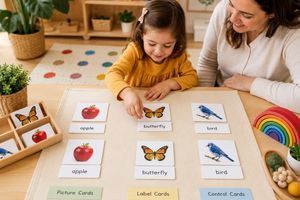
Choose material for the action you want. Shape demonstration cards can introduce a few forms, support matching with household objects, or provide a model. Three-part didactic shape cards add picture-and-label matching, but you do not need to introduce every component at once.
Some card materials carry English labels. The pictures can still be useful, but geometry does not have to become an English lesson. Discuss shapes in the child’s strongest language; cover the English label or explore it separately if the child is interested.
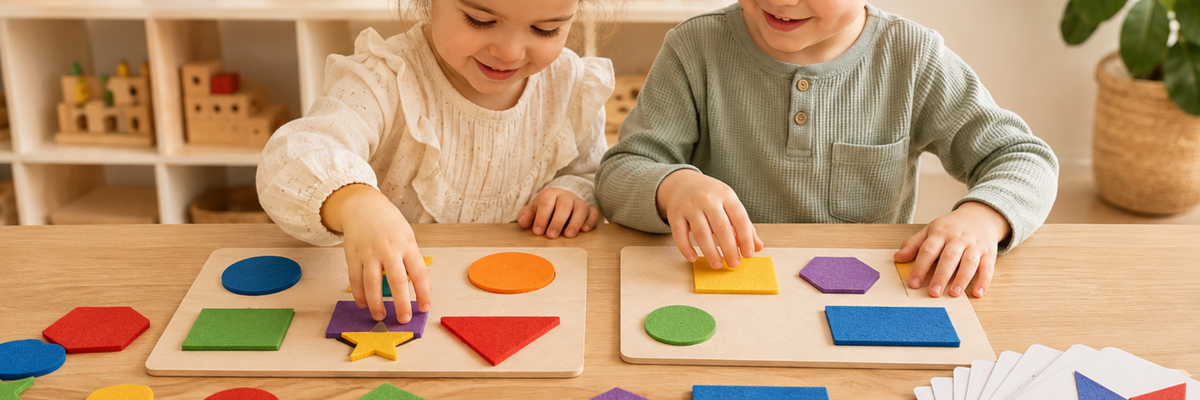
A geometric shape sorter makes the child rotate a piece and check whether boundaries align. Inserting it does not prove that the child knows its name, so ask them to find the same form elsewhere. The Shapes: Sorting activity supports grouping by form, while the Shapes puzzle supports the move from a piece to a whole.
If tracking color, shape, and size at once is difficult, keep only one feature variable at first. The related guide on teaching a child to sort objects by color, shape, and size develops classification more fully. The focus here is recognizing a shape’s structure when its appearance changes.
From one shape to a composite picture
Once the basic forms are familiar, build with two or three pieces: a house from a square and triangle or a car from a rectangle and two circles. Before a ten-piece silhouette, the child needs to see that a whole can be separated and recombined.
Move through three levels of support. First, place the pieces directly on a full-color model. Next, put the model beside the work area. Finally, provide only an outline or a verbal instruction: “Make a rocket with a rectangle, a triangle, and two circles.” This gradual shift exercises shape analysis, spatial planning, and visual memory.
After copying, ask, “Which pieces did you use?”, “Could two triangles replace the square?”, or “What needs to turn so the roof fits?” Welcome original solutions even when they differ from the model. The guide to pattern-building for spatial thinking and visual memory offers more ideas for increasing the challenge step by step.
Language that draws attention to properties
Instead of simply correcting, model a short line of reasoning: “You chose the square. Let’s check: it has four equal sides. This space has two long sides and two short ones, so let’s try the rectangle.” The child receives a checking strategy rather than a verdict that the attempt failed.
Useful sentence frames include:
- “I notice…, so I think this is…”;
- “They are alike because…, but different because…”;
- “Turn the shape. Which properties stayed the same?”;
- “Check by overlapping / tracing / counting”;
- “Is there another solution?”
Expand a gesture or one-word answer: “Yes, you are pointing to the corners. A triangle has three.” This keeps play moving while providing precise language.
Common mistakes when introducing shapes
Tying each shape to one color
If every circle is red and every triangle yellow, a child may be sorting by color. Vary the colors and sometimes show different shapes in the same color.
Showing only a “perfect” example
Different triangles, rectangles, and rotated examples reveal essential properties. At the same time, avoid distorted drawings whose intended outline is genuinely unclear.
Treating a household object as an exact flat shape
Talk about an object’s outline or face, and gradually distinguish flat and solid forms. This is useful accuracy in simple language, not unnecessary complexity.
Introducing too many labels at once
Six new shapes, several colors and sizes, plus English print in one task create needless load. Keep two or three forms and one clear action.
Turning every game into a test
Children need time to explore without questions. Describe what they are doing, notice their strategy, and ask for an explanation only sometimes.
Frequently asked questions
At what age can a child start learning geometric shapes?
You can name circular, square, and triangular outlines once a toddler begins matching identical objects. That may be around age two for one child and later for another. Follow interest and the ability to complete one simple action rather than a precise age.
Which geometric shapes should a child learn first?
Start with the circle, square, and triangle because their outlines contrast clearly. Once your child recognizes them in different colors, sizes, and orientations, add the oval, rectangle, and rhombus.
How can I explain the difference between a square and a rectangle?
Place them side by side, trace four sides, and count four corners. A square has four equal sides; the typical non-square rectangle has two longer and two shorter sides. You can tell an older child that, in mathematics, a square is a special rectangle.
Do I need to buy a sorter or geometric shapes set?
No. You can begin with paper templates, lids, painter’s tape, and outline hunts at home. A set provides accurate repeatable pieces, and a sorter allows alignment-based self-checking, but no material replaces shared play and conversation.
What should I do if my child confuses similar shapes?
Do not ask them simply to memorize again. Keep one contrasting pair, such as circle and oval or square and rectangle, and compare outlines, sides, and corners through touch, overlapping, and tracing. Then vary color, size, and orientation to check that the idea transfers.
The guiding principle
To learn geometric shapes, a child needs more meaningful actions with a few forms, not more pictures. Naming, touching, comparing, finding, rotating, fitting, and using a shape in a new composition create one coherent learning path.
Begin with three contrasting shapes, introduce similar pairs after recognition becomes stable, and preserve room for the child’s own constructions. Geometry then becomes a way of seeing how things are built within everyday play, rather than a list of words to recite.