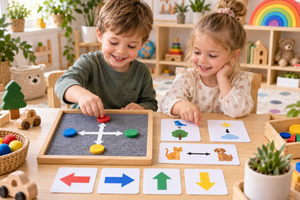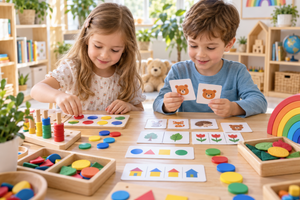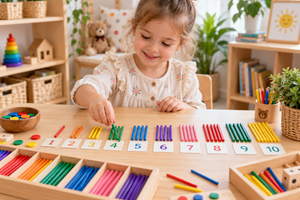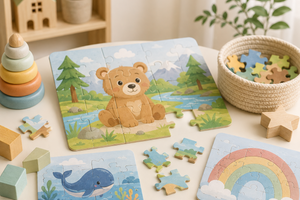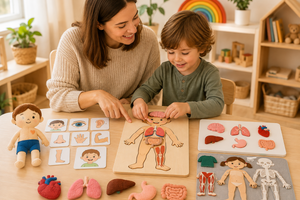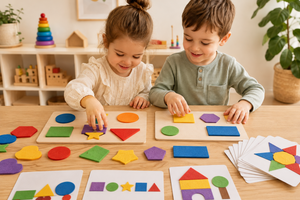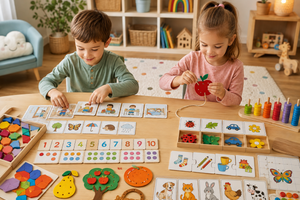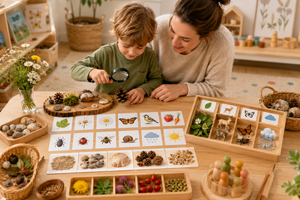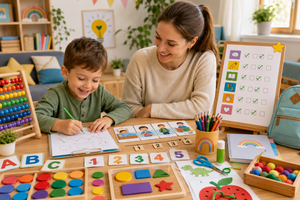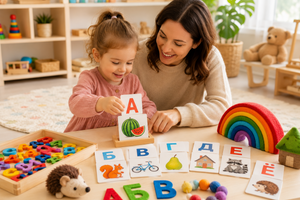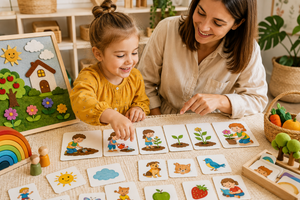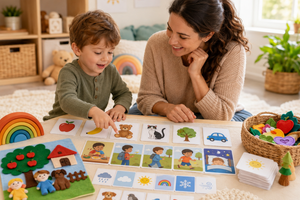
Sorting does not begin with a correct answer. It begins with a simple observation: these two objects are alike, while this one is different. When a child groups pieces by color, matches identical shapes, or separates large objects from small ones, they learn to notice attributes, compare what they see, and follow a clear rule.
You do not need lengthy explanations or a large collection of materials to teach sorting. At first, two groups, a few contrasting objects, and one short demonstration are enough. The key is to introduce one attribute at a time, let the child act independently, and make the activity more challenging only after the previous rule has become clear.
Key takeaways
- Begin with one attribute only: color, shape, or size.
- For the first activity, use four to six objects and offer just two groups.
- Demonstrate one example, then give the child time to work out the rest.
- Do not expect speed or correct every mistake on the child’s behalf.
- Move on to sorting by two attributes only when the child can confidently handle simpler tasks.
Why sorting is an important early learning skill
To sort objects, a child has to identify the relevant attribute, compare several items, and decide which group each item belongs to. The activity looks simple, but it involves meaningful thinking. It lays the foundation for later work with classification, patterns, sequences, and comparisons of quantity.
Sorting games also give children an opportunity to practice several useful skills at once:
- attention — noticing the attribute that connects the objects in a group;
- logical thinking — understanding a rule and applying it to a new item;
- language — naming a color, shape, or size and explaining a choice;
- fine motor skills — picking up, turning, moving, and placing a piece accurately;
- independence — checking a decision and trying a different solution when necessary.
It is important not to turn the activity into a test. A child may match colors correctly before they can name them, or may need more than one attempt to recognize a shape after it has been rotated. These are different skills and should be observed separately. First notice whether the child sees a similarity, then whether they can follow the sorting rule, and only after that whether they can name the attribute.
When is a child ready for sorting activities?
Readiness depends on more than age. To get started, a child needs to be able to pick up and move an object, stay with a brief activity, and copy one simple action demonstrated by an adult. If the task repeatedly causes frustration or the child keeps losing track of the rule, simplify it.
|
Approximate age |
Where to begin |
Example activity |
What to add next |
|
18–24 months |
Two clearly contrasting groups |
Put red pieces in one bowl and blue pieces in another |
A third color or a new set of familiar objects |
|
2–3 years |
Color, a simple shape, or big and small |
Find matching pairs or separate circles from squares |
Three groups and a short spoken rule |
|
3–4 years |
Size, purpose, or theme |
Group objects by material, location, or function |
Use the same pieces but change the sorting rule |
|
4–5 years |
Two attributes and an explanation of the choice |
Find all the small red shapes or explain which item does not belong |
Invite the child to invent a sorting rule |
This chart is a guide, not a developmental standard. One child may find colors easier to work with, while another may be more interested in grouping animals, vehicles, or household objects. A familiar theme often makes a new rule easier to understand.
How to teach a child to sort: a step-by-step method
Step 1. Choose one clear attribute
Do not combine color, shape, and size in the first task. If you are sorting by color, use objects that are identical or very similar in shape and size. This helps the child focus on the exact difference that matters.
Step 2. Limit the number of objects
Set out four to six pieces and place two boxes, baskets, bowls, or marked spaces on the table. A large pile creates unnecessary demands: the child has to search for a piece, remember the rule, and choose a destination at the same time. Once the principle is clear, gradually increase the number of items.
Step 3. Demonstrate one action
Pick up an object and briefly describe your decision: “This one is red. I’ll put it with the red one.” Then invite the child to place the next object. There is no need to explain every part of the task in advance. One visible example is often more useful than a long instruction.
Step 4. Allow time to think
If the child pauses, do not immediately move the piece for them. Ask a prompt such as, “Which one does it look like?”, “Where can you see the same color?”, or “Which home does it belong in?” A useful prompt redirects attention to the relevant attribute instead of simply revealing the answer.
Step 5. Finish before interest fades
Six thoughtful choices are more valuable than mechanically placing 30 cards. A few minutes may be enough for a first attempt. If the child wants to continue, add a few pieces or change the story around the activity, but there is no need to introduce a more difficult rule immediately.
Color sorting activities for toddlers and preschoolers
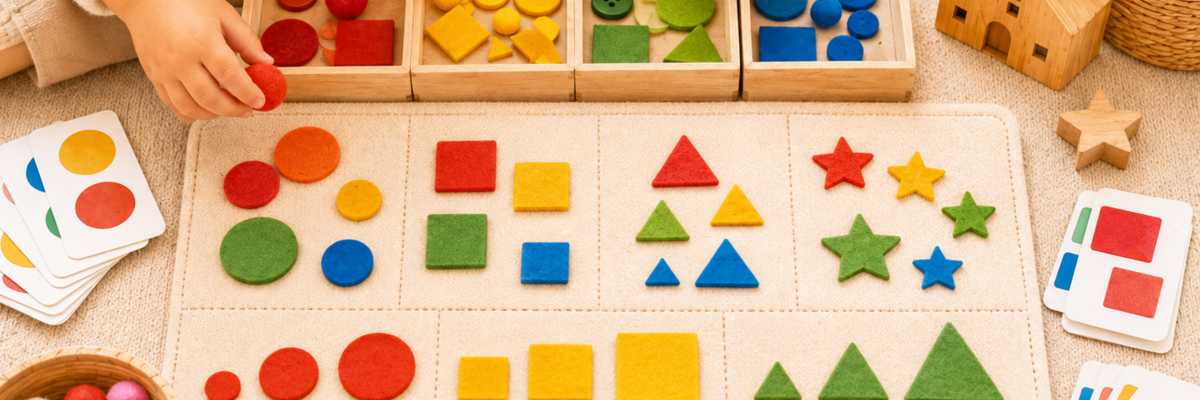
Color is easiest to introduce with objects that share the same shape, such as large bottle caps, pom-poms, blocks, or felt pieces. Begin with two contrasting colors, such as red and blue. Save similar shades for a later stage.
Color homes
Set out two sheets of paper or two bowls in different colors and ask each piece to “go home.” When the child can sort the objects confidently, switch the homes from one side to the other. This helps you see whether the child is following the color rather than remembering that a piece always goes on the right or left.
Color hunt
Choose one color and look around the room for several safe objects in that color. Then compare what you found: which are big or small, soft or hard? The sorting concept now moves from a teaching material into the child’s everyday environment.
Laundry day for toys
Turn boxes into pretend washing machines and sort felt clothes, socks, or other pieces by color. The story gives the task a purpose, while words such as “light,” “dark,” “same,” and “different” expand the child’s vocabulary naturally.
How to teach a child to sort by shape
Circles, squares, and triangles are useful first shapes. Begin with two of them and choose pieces in one color so that color does not distract from the rule. Trace the outline with a finger, name the shape, and then find its matching place.
Find the same shape
Place two examples in front of the child, such as a circle and a square, along with several matching pieces. Ask the child to make two groups. Afterward, rotate one piece. Over time, the child discovers that a square remains a square even when it is turned and may look like a “diamond.”
Shapes in everyday objects
After working with geometric pieces, look for familiar shapes at home: a round plate, a rectangular book, or a square napkin. Do not demand perfect geometric accuracy. The goal is to help the child recognize an attribute in new objects.
Match a piece to its outline
Invite the child to match a piece to a silhouette or an opening with the same shape. If this is difficult, offer only two choices and let the child place, rotate, and try the piece independently. Discovering whether it fits teaches more about shape than receiving the answer from an adult.
How to explain “big” and “small” to a child
Size is relative. A cup can be large next to a smaller cup and still be smaller than a pitcher. Begin by comparing two objects of the same kind: two balls, two leaves, or two shapes with the same outline. The difference in size should be easy to see.
Two boxes
Place a large box and a small box side by side. Put large pieces in the large box and small pieces in the small one. Once the rule is clear, swap the boxes from one side to the other or remove any color cues.
From smallest to largest
For the next stage, use three objects of the same kind in different sizes. Find the smallest and largest first, then decide where the medium-sized item belongs. Move to longer sequences only after the child is comfortable with this three-item comparison.
Who lives where?
Draw a large house and a small house, then match characters or objects to the appropriate home. Ask the child to explain the choice: “This bear is bigger, so it needs the big house.” Explaining the decision shows whether the rule is understood and supports language development at the same time.
How to make sorting activities gradually more challenging
Increasing the challenge does not simply mean adding more pieces. It is often more useful to change how the child has to think: add another group, switch to a new rule, or ask the child to consider two attributes at once.
- Add another group. Once two colors are easy, introduce a third.
- Change the rule. Sort the same pieces by color first and then by shape.
- Combine two attributes. Find only the large blue shapes or the small red circles.
- Introduce category sorting. Separate clothes from dishes, vehicles from animals, or natural objects from human-made ones.
- Find the odd one out. Add one item that does not follow the shared rule and ask the child to explain why.
- Let the child lead. Invite the child to invent a sorting rule and let the adult try to follow it.
Understanding, rather than error-free speed, shows that a child is ready for the next level. If the child can restate the rule in their own words, correct some mistakes after a prompt, and apply the principle to unfamiliar objects, you can make the activity slightly more complex.
Learn&Dream materials for practicing sorting
When choosing a material, focus less on the number of pieces and more on the action the child will perform. The Learn&Dream collection of sorting toys and logic games includes activities for several stages, from matching one visible attribute to working with more complex combinations.
|
Material |
Main activity |
When to offer it |
How to vary the activity |
|
Select geometric pieces and reproduce a combination shown on a sample card |
From age 3, for exploring shape, color, position, and sequence |
Copy a sample first, then create a new combination and describe its rule |
|
|
Match removable autumn pieces to the color combination on a sample card |
From age 2, once the child can match identical colors |
Name the objects, look for different shades, and create short autumn stories |
|
|
Match interchangeable hats to characters by color |
From age 2, for short activities based on one clear attribute |
Add simple spoken directions or ask the child to name the needed color |
|
|
Join pieces by shape and symbol to make complete hearts |
From age 3, once the idea of finding a matching piece is familiar |
Assemble the hearts first, then describe the attributes used to identify each pair |
To add more hands-on practice, combine sorting with simple fine motor activities. When the child needs a fresh setting rather than a harder rule, use the same familiar pieces in a new story.
How to organize sorting at home or in preschool
During everyday routines
Sorting fits naturally into daily tasks: matching socks into pairs, separating spoons from forks, putting toys into different boxes, or collecting large and small leaves after a walk. In these situations, the child sees why the rule is useful instead of completing an exercise only to produce a correct answer.
During a group activity
At preschool or an early learning center, give each child one piece and invite them, in turn, to find its group. Change the rule after the first round. For example, children can sort the same objects by color first and by purpose afterward. Ask a few children to explain their choices, without turning the discussion into a test for every participant.
For shared play, make sure every child can see and reach the groups and that waiting for a turn does not take longer than the action itself. With a large class, set up several identical stations with a small number of materials at each one.
Common mistakes when teaching a child to sort
- Introducing several rules at once. Asking a child to sort by both color and shape may be too advanced. Practice each attribute separately first.
- Using too many pieces. A larger set does not automatically make an activity more valuable. Begin with the minimum number needed to understand the rule.
- Correcting every mistake with the adult’s hands. Redirect the child’s attention with a prompt and let them move the object independently.
- Expecting the child to name an attribute before acting. A child may recognize a match before they can say the word. Continue naming colors, shapes, and sizes calmly during play.
- Turning it into a race too soon. Rushing interferes with comparison. Use a timer only when the rule is already familiar and the child wants that kind of challenge.
- Repeating exactly the same activity every day. Change the objects or the story, but not every condition at once. This allows the skill to transfer to a new situation without making the rule unclear.
Always check that the pieces are safe for the child’s age, intact, and securely made. Activities involving small parts require adult supervision.
Frequently asked questions
At what age can a child start sorting objects?
Simple activities with two contrasting groups can often be introduced at around 18–24 months, provided the child can pick up and move objects confidently and copy a short demonstration. The safe size of the pieces and an achievable level of difficulty matter more than an exact age.
What if a child sorts correctly but cannot name the colors?
Keep naming the colors during play, but do not require the child to repeat each word before every action. Matching identical colors and naming them can develop at different times. Check understanding through an action, such as: “Put it with the one that is the same.”
How long should a sorting activity last?
For a first attempt, a few minutes and four to six pieces are enough. Follow the child’s interest rather than a timer. It is better to finish a short activity after a successful attempt than to insist on completing the entire set after the child’s attention has faded.
What should I do if a child keeps making mistakes?
Simplify the activity: leave two contrasting groups, reduce the number of pieces, and demonstrate one action again. Instead of saying “That’s wrong,” ask where the same color or shape can be found. If the rule is still unclear, return to it another day.
Can children learn sorting without special toys?
Yes. Safe household objects such as large bottle caps, socks, spoons, blocks, leaves, or cardboard shapes work well. A ready-made set offers consistent pieces and a planned level of difficulty, but the same sorting principle should also be practiced in everyday life.
From simple matching to creating a rule
Sorting becomes an effective learning experience when it progresses in small steps: one attribute, two groups, a short demonstration, and enough time for an independent attempt. First, a child finds what is the same. Next, they group by color, shape, or size, switch rules, and eventually explain or invent a rule of their own.
Choose each activity to match the child’s current ability instead of rushing to a more difficult level. Sorting can then remain an engaging form of play in which the child compares, checks a decision, and discovers patterns in familiar objects.