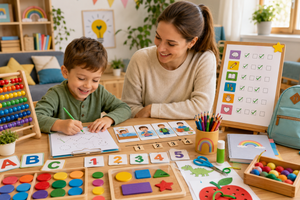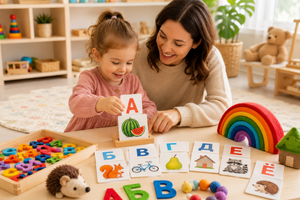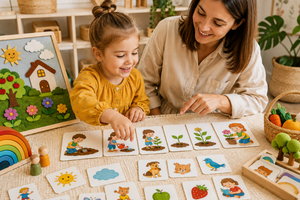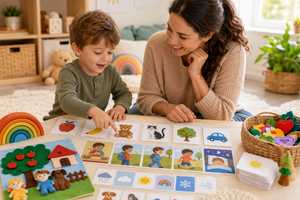
A long journey asks a lot of a preschooler. The child must stay in one place, wait through transitions, cope with unfamiliar sounds, and accept that the destination is still far away. A screen can fill time, but it is not the only workable tool. A small collection of predictable games can offer conversation, gentle problem-solving, and something purposeful for busy hands.
The most useful travel kit is rarely the largest one. It contains one activity the child already understands, a few games that require no equipment, and one fresh option saved for a difficult stretch. The ideas below are designed for children travelling as passengers in a car, train, or plane. They can be shortened, simplified, or paused whenever the travel conditions change.
Key takeaways
- Object-based games in a vehicle are for the child passenger only; the driver must not lead, check, or watch the activity.
- In a car, choose light, soft, age-appropriate pieces that stay on one contained surface.
- Offer three or four activities one at a time instead of opening the entire bag at once.
- Alternate looking outside, talking, quiet hand play, snacks, audio, and genuine downtime.
- Count pieces, inspect wear, and follow both the product age guidance and the carrier's instructions.
Safety comes before finishing the game
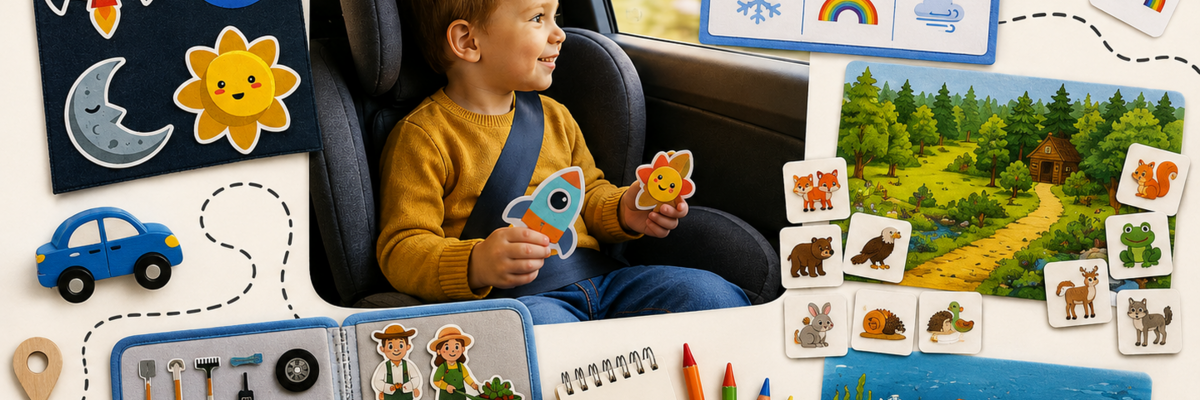
In a moving car, the child remains correctly secured in an appropriate restraint. An activity should never encourage reaching into the footwell, leaning between seats, twisting out of position, or loosening a belt. A felt board on the lap is generally easier to contain than a hard box, a pile of counters, or pencils with sharp points. If a piece falls, leave it there until the vehicle is safely stopped.
The driver is not a game host. Questions such as “Is this right?” or “Look at my picture” can sound harmless, yet they pull attention from the road. Another passenger may run a game, or the child can use a familiar self-directed activity. When one adult is driving alone with a child, spoken observation prompts that do not require a reply from the driver, a preloaded audio story, or a well-known lap activity are more realistic choices.
Trains and planes provide different possibilities, but they still require boundaries. Keep materials off aisles, pack them away during boarding and landing, and follow crew instructions during turbulence or other changes. Small components are unsuitable for a child who may mouth them. Product guidance, direct adult supervision, and the rules of the transport provider always take priority over an appealing play idea.
Choose a travel activity by age and situation
Age labels offer a useful starting point, but familiarity matters just as much. A four-year-old may happily complete a known matching task while finding a new three-step rule frustrating. Travel itself uses attention, so begin one level below what the child manages comfortably at home. Success in a short round is more helpful than carrying on until everyone is tired.
|
Age or setting |
Useful length |
Good starting formats |
Skip for now |
|
2–3 years |
3–7 minutes |
Place one large piece, find one colour, copy a sound, name a familiar object |
Many choices, long rules, tiny counters |
|
3–4 years |
5–10 minutes |
Open matching pairs, simple sorting, silhouettes, “I spy,” a story from two pictures |
Speed challenges and lengthy explanations |
|
4–5 years |
7–15 minutes |
Noughts and crosses, a small memory field, patterns, logical clues, a simple travel journal |
Long competitive rounds or loose collections |
|
Station or gate |
Up to 10 minutes |
Visual scavenger hunt, cards, drawing on a stable surface |
A layout that cannot be packed in seconds |
|
Moving car |
Short cycles |
Conversation, distant viewing, soft pieces on a lap board, audio |
Small print, hard heavy toys, prolonged looking down |
How to build a compact travel activity kit
Give every piece a defined home
Use a light zipped folder or organiser that can rest flat on a lap. Divide components into small transparent pouches, one activity per pouch. A child can see what belongs together, while an adult can check the set without emptying the bag. Avoid improvised hard boards or magnetic cases in a moving car unless the item was designed and approved for that use.
Pack familiar, verbal, and new
Start the journey with a familiar activity. Understanding the action—match, place, count, or complete—reduces the demand of an already unfamiliar situation. Follow it with an equipment-free word or observation game. Save one new activity for the middle of the trip rather than revealing every surprise before departure. A single well-timed novelty has more value than a crowded bag competing for attention.
Keep a low-effort reserve
Add a small picture book, reusable stickers, a few large cards, and an audio story downloaded in advance. Audio should be played at a comfortable level and does not have to run continuously. Looking through the window or doing nothing for a few minutes is also allowed. Boredom is not an emergency, and a child does not need an adult-directed task for every part of the route.
Ten practical screen-free travel games
1. Find the colour outside
Name one colour and invite the child to spot a matching object: a blue vehicle, a yellow suitcase, or a green sign. A younger child can simply point and name it. An older preschooler can add a second feature such as shape, size, or purpose. In a car, encourage looking forward and into the distance instead of switching repeatedly between the window and a lap activity.
2. What disappeared?
Place three large felt shapes on a contained board. The child closes their eyes while another passenger removes one, then identifies the missing item. Begin with two strongly contrasting objects for a two-year-old. For an experienced five-year-old, use five pieces and ask where each had been positioned before one disappeared.
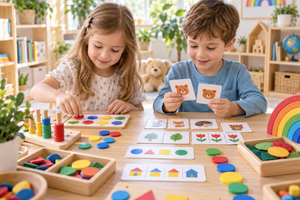
3. Open matching pairs
Classic memory is not the only matching format. Set out three picture samples and hand the child the three partners. They place each pair together and describe one feature. Because every card remains visible, the game is less vulnerable to vehicle movement and requires less working memory. When the setting is stable, turn over just two or three pairs.
4. A three-picture story
Choose a character, a place, and an object—for example, an octopus, a station, and a biscuit. The child begins with one sentence and the adult passenger adds another. With older preschoolers, introduce a small problem and solution: the character loses something, asks for help, and decides what to do. The story can end naturally whenever attention is needed elsewhere.
5. Yes-or-no detective
Think of something visible nearby and answer only yes or no. Give a younger player a category clue such as “It is a kind of transport.” An older child can ask about colour, material, function, and location. Reverse roles after one round. Creating useful clues builds more flexible language than simply guessing a word from a long list.
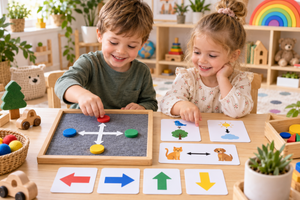
6. A short noughts-and-crosses puzzle
Use large, soft pieces on a stable train or plane table. Keep unused markers in their pouch and agree where completed pieces go. A three-year-old can finish a row that already contains two matching symbols. A five-year-old can name two possible moves, predict what the other player might do, and then choose. One or two rounds are enough.
7. Pack it or leave it
Name an item and ask whether it belongs in a particular trip: swimming clothes for the beach, mittens for a summer picnic, a ticket for a train. No materials are required. Children aged four or five can explain their decision in one sentence, then replace an unsuitable object with something more useful. Change the destination to keep the rule fresh.
8. Sound chain
One passenger names a travel-related word and the next adds another from the same category. With a two-year-old, imitate vehicle sounds instead: beep, whoosh, click-clack. Older children can link words by their first or final sound if they enjoy that rule. A noisy cabin is not the place to correct every pronunciation; connection and participation matter more than perfect performance.
9. Seated travel detective
Look for three circular things, two objects with numbers, or something moving more slowly than your vehicle. At a station, choose targets visible from the family's current place. The child should not explore an aisle, platform, or doorway alone. This is an observation game, not a physical scavenger hunt.
10. Quiet hands minute
Invite the child to place felt pieces by a simple sample, join two halves, or make a repeating colour pattern. For this round, the adult does not ask questions or test vocabulary. Repetition can be soothing after an energetic conversation game. Stop while the child is still settled rather than extending the task until frustration appears.
Learn&Dream materials that can be adapted for travel
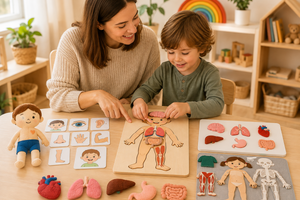
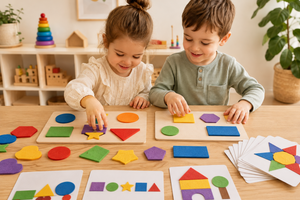
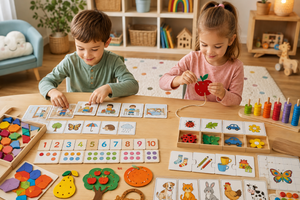
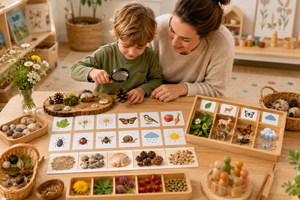
Learn&Dream's logic-and-sorting range includes felt activities with repeatable, hands-on actions. Check the exact product dimensions, parts, and age recommendation before packing. When the rules and product design allow it, a supervised passenger may use a small selection of the largest components rather than opening every piece at once.
|
Material |
Travel idea |
Best setting |
Easier version |
|
Place apples, count one to three, or find a named colour |
At a stop, at a table, or on a passenger's contained lap board |
Offer only a few large pieces |
|
|
Felt Game “Noughts and Crosses” |
Complete a row or play one short round |
A stable train or plane table |
Begin from a nearly finished layout |
|
Felt Game “Find a Pair: Sea Creatures” |
Open pairs, “what disappeared?”, or a sea story |
A quiet section of the journey |
Use two or three pairs |
|
Felt Game “Match by Shape and Symbol: Hearts” |
Join halves, find a partner, or describe a symbol |
On a stable surface with passenger supervision |
Work with two hearts at a time |
When choosing among these materials, compare the number and size of pieces with the child's age and the type of transport. A game that works well at a train table may still be unsuitable for a moving car. Practise the selected mini-version at home, pack each set separately, and use only the amount that an adult passenger can supervise and collect safely.
Common travel-play mistakes
- Revealing the whole bag immediately. Choice becomes harder and novelty disappears. Offer one activity at a time.
- Packing only unfamiliar games. A known rule is valuable when the environment already feels new.
- Scheduling constant entertainment. Children also need the view, conversation, food, quiet, and rest.
- Ignoring the setting. A tabletop success may scatter, feel uncomfortable, or encourage too much downward looking in a car.
- Asking the driver to participate. The driver does not check answers or look at play.
- Forgetting loose parts. Count pieces and remove damaged or age-inappropriate components.
- Pushing through refusal. Pause or simplify when the child is tired.
Frequently asked questions
How many activities should I pack for a long trip?
Three or four contrasting formats are usually enough: one familiar hands-on game, one verbal game, a book or audio option, and one new activity. Timing and rotation matter more than volume.
What works best in a moving car?
Conversation, looking outside, and familiar activities with large lightweight pieces on a contained soft surface. Every game is for the passenger; the driver does not participate.
What if looking down makes my child feel unwell?
Put away lap activities and encourage looking into the distance or resting. Follow the child's comfort, and discuss recurring or concerning symptoms with a qualified health professional.
Can we play memory while travelling?
Yes. Open matching pairs are easier in a car. A small face-down memory grid is better reserved for a stable table on a train or plane, when conditions allow.
How can I avoid losing pieces?
Store each activity in a separate zipped pouch, open only one set, and count the pieces before changing games. Never reach into a car footwell while the vehicle is moving.
A calmer journey starts with a simple rhythm
A familiar task creates an easy beginning, word games take no luggage space, one new option can revive interest, and unstructured pauses prevent the trip from becoming a performance schedule. The right sequence usually matters more than the perfect toy.
Adjust the challenge to the travel conditions as well as the child's age. Most importantly, let safety end any round immediately: the child plays as a passenger, the driver watches the road, and physical materials appear only when they can be used without unsafe reaching or distraction.