Space is rarely a hard topic to make exciting. Rockets, planets, stars, and astronauts already feel like an invitation to adventure. The harder task is protecting that curiosity from a flood of names, enormous numbers, and explanations that are either too technical or so simplified that they become inaccurate.
A useful preschool introduction grows around a few anchors: the sky a child can observe, the Sun as a star, Earth as our planet, and the Moon as Earth’s natural satellite. Once these relationships are familiar, other planets, space objects, and exploration missions have somewhere to connect. The activities below move from observation to models, sorting, memory, questions, and child-designed missions without expecting children to memorize an encyclopedia.
Key takeaways
- Begin with observations of the sky rather than a list of all eight planets.
- Build the first model around three objects: the Sun, Earth, and Moon.
- A lamp-and-ball model shows light and motion, but it does not represent true sizes or distances.
- Alternate conversation, cards, movement, drawing, memory games, and short investigations.
- Never look directly at the Sun without properly certified solar-viewing equipment.
A child-friendly sequence for introducing space
1. The observable sky
Start with what the child can notice: daylight is bright, stars become easier to see after dark, the Moon appears to change shape, and a few bright planets may sometimes be visible. Explain that we are not seeing an edge where space begins. We are looking at distant objects through Earth’s atmosphere. Clouds and aircraft are in the atmosphere; the Moon and planets are far beyond it.
2. The Sun, Earth, and Moon
The Sun is a star and the main source of light for Earth. Earth spins on its axis and travels around the Sun. The Moon is Earth’s natural satellite and travels around Earth. These statements are enough for a first framework. A child does not need numerical distances or orbital periods before the relationships themselves are clear.
3. Other planets in the Solar System
When the child understands that Earth is a planet, add two or three contrasting planets. Compare visible features and simple properties rather than testing the entire order immediately. The important general idea is that eight planets travel around the Sun and differ in size, appearance, conditions, and the time they take to complete an orbit.
4. Other objects and human exploration
Introduce stars, comets, asteroids, nebulae, rockets, probes, and satellites in small groups. Sort natural objects separately from human-made machines. Compare a star that produces light with a planet that is visible because it reflects a star’s light. Ask what a telescope or spacecraft helps people learn instead of presenting a vehicle only as a dramatic toy.
Space activities by age
Age is only a starting point. Interest and previous experience matter. A good level lets the child complete several actions independently, ask a question, and still want to return later.
|
Approximate age |
Main anchors |
Useful format |
What can wait |
|
2–3 years |
Day, night, Sun, Moon, and Earth |
Two to four large cards, movement, a short picture book, and drawing |
The full planet order and facts involving very large numbers |
|
3–4 years |
Sun as a star, Earth as a planet, Moon as a satellite |
A simple model, sorting, and memory with three or four pairs |
A detailed explanation of gravity |
|
4–5 years |
Earth’s rotation, day and night, and several planets |
A lamp and ball, card comparisons, and child questions |
Exact scale in a tabletop model |
|
5–6 years |
The Solar System, space objects, and exploration tools |
Classification, a simple mission, a model, or a small project |
Memorizing numbers without a meaningful context |
Practical activities for the first space lessons
1. Sky, atmosphere, or space?
Mix pictures of a cloud, bird, airplane, Moon, planet, star, and rocket. Younger children can first separate familiar daytime-sky images from distant space objects. Older preschoolers can create three groups: things in the atmosphere, natural objects in space, and machines that can travel beyond the atmosphere. A rocket can prompt discussion because it begins on Earth and passes through more than one region.
2. Three connected objects
Use a lamp as the Sun and two balls as Earth and Moon. Demonstrate which object travels around which. Say explicitly that the balls and the gaps between them are not to scale. The model is a diagram that makes movement visible, not a miniature copy of the Solar System. Let the child hold one ball and repeat a single motion before combining the motions.
3. Where is it daytime now?
Darken the room, shine a stationary lamp on one side of a ball, and attach a small “we live here” marker. Slowly rotate the ball. When the marker faces the light, it is daytime there; when it turns into shadow, it is night. The activity counters the tempting idea that the Sun switches off or travels around Earth every day.
4. Sort the space families
Offer six cards from three types: stars, planets, and human-made spacecraft. The child sorts them and states a rule. Later add moons, comets, or asteroids. If a new term is unfamiliar, compare just two examples and return it to the larger set after the distinction becomes clear.
5. Space memory
Match identical cards face up before turning them into a memory game. Begin with three or four pairs. After finding a pair, a child may name one visible feature or ask one question. Keep the fact prompt occasional; requiring an answer after every turn changes a memory game into an oral test.
6. Design a mission
Choose a destination and provide cards showing a camera, communication antenna, wheels, solar panels, food, clothing, and distracting household objects. The child selects equipment and states what the mission should observe. The resulting pretend play has a research purpose: collect images, examine a surface, or send information back to Earth.
7. Rebuild a pattern
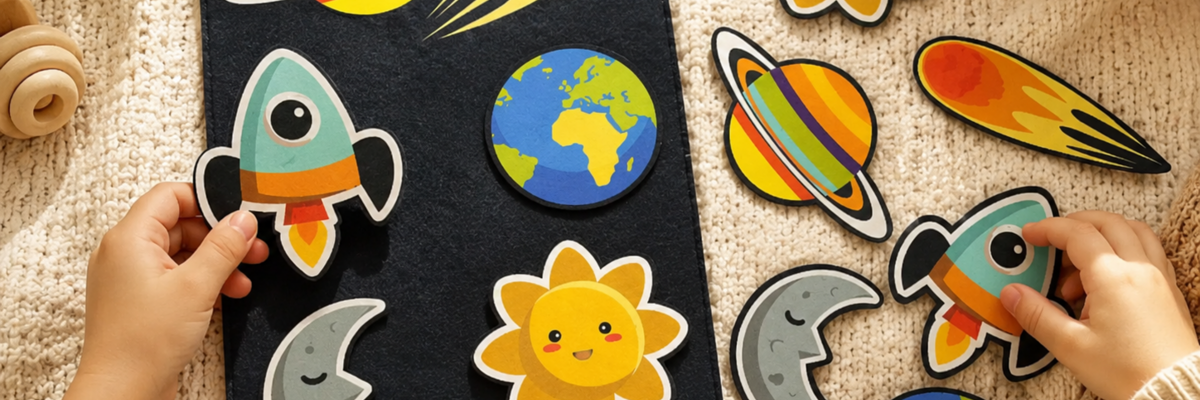
Show a simple arrangement of a rocket, planet, star, and satellite, then invite the child to reproduce it. Use spatial words: above, below, between, near, and farther away. Make the task harder by showing the model briefly or asking the child to create a pattern for an adult. Clarify again that the artistic arrangement is not an accurate map of distance.
8. Keep a question notebook
Give each page one question, a child’s prediction, a drawing or card, and a short note after checking a reliable source. Questions can include “Does every planet have a moon?” or “Why does the Moon look different across the month?” The adult does not need an instant answer. Saying “I am not sure; let’s check” models careful inquiry.
How to answer big space questions simply and accurately
Answer only the question that was actually asked, at a level the child can understand. If a child asks why the Moon does not fall, a useful first reply is: “Earth pulls the Moon, but the Moon is moving sideways so fast that it keeps traveling around Earth.” You can demonstrate a circular path with a ball without adding equations. Ask whether the child wants a picture or a more detailed explanation.
Separate observation, model, and conclusion. “We see one half of the ball lit” is an observation. “This ball represents Earth” identifies the model. “The lit side is experiencing daytime” is the conclusion the model supports. This language is not too advanced for children; it protects them from treating every classroom object as a literal copy.
Avoid replacing a difficult cause with a charming fiction. The Sun does not sleep at night, stars are not tiny because they look tiny, and astronauts do not float because gravity is absent. Short but accurate wording creates a foundation that can be expanded later. If you are unsure, write the question down and consult a reliable astronomy source together.
Learn&Dream materials for a first space unit
The collection of educational cards about space includes resources for demonstration, visual matching, vocabulary, sequence, and memory. Select a set by the action a child is ready to perform rather than by the total number of cards in the package.
|
Material |
Best starting action |
Teaching point |
Next level |
|
Recreate a small composition and name positions |
A pattern is a visual plan, not an accurate scale model |
Show the pattern briefly or let the child design one |
|
|
Observe, name, and describe objects; sort them by visible features |
Natural objects differ from human-made spacecraft |
Describe a card without naming it for the child to find |
|
|
Match pictures with labels and compare planets |
Earth is one of eight planets that travel around the Sun |
Arrange the planets in order after learning a few individually |
|
|
Match identical pictures and remember locations |
Names and one clear identifying feature |
Move from face-up matching to additional face-down pairs |
The same cards can support different levels. Use two or three for naming, six for sorting, a smaller selection for memory, and a mixed group for riddles. Reusing a familiar material lowers the visual demand when you introduce a new rule.
Space at home and in preschool
At home, try a “space week” made of short episodes. Observe the evening sky one day, model day and night the next, play memory later, and finish with a drawn mission. Ten to fifteen minutes focused on one clear action is enough. Return to an unanswered question rather than trying to finish the whole topic.
In preschool, arrange small-group stations: a day-and-night model, object cards, pattern matching, and a mission workshop. Children rotate, so everyone gets to move a ball, handle a card, and explain one choice. End with three group notes on a board: one answer children discovered, one idea they revised, and one question to investigate next.
Common mistakes in a first space unit
- Opening with an encyclopedia. Begin with observation, three connected objects, and one visible action.
- Testing the planet order too soon. First establish that Earth is a planet and that planets orbit the Sun.
- Presenting a craft model as an accurate scale model. State what the model demonstrates and what it does not.
- Using an invented cause to sound simple. Simplify the language while keeping the underlying explanation accurate.
- Answering every question immediately. Recording and checking a question is a valuable research habit.
- Unsafe solar viewing. Ordinary sunglasses, film, glass, binoculars, and unfiltered telescopes do not provide safe protection.
Frequently asked questions
At what age can children begin learning about space?
At two or three, children can talk about day and night, the Sun, Moon, and Earth through observation, large pictures, and movement. Planet names, comparisons, and more complex models can be added gradually when the first relationships are stable.
Should children learn all the planets immediately?
No. Start with the idea that Earth is a planet, the Sun is a star, and planets in our Solar System travel around the Sun. Add two or three contrasting planets before asking for the full sequence of eight names.
How can I explain day and night?
Shine a lamp on one side of a ball and slowly rotate it. The side facing the lamp experiences daytime; the side turned away experiences night. A marker on the ball helps the child track one place as it moves between light and shadow.
Why do astronauts appear to float in orbit?
The astronauts and their spacecraft are moving around Earth together in continuous free fall. Everything inside falls at the same rate, creating the experience of weightlessness. Gravity is still acting; it has not disappeared.
How can children observe the Sun safely?
Do not look directly at the Sun without properly certified solar-viewing equipment used according to its instructions. Ordinary sunglasses, colored film, glass, binoculars, or an unfiltered telescope are unsafe. Preschool activities can use shadows, models, and verified images instead.
Relationships first, names and facts second
A first space unit can begin with the evening sky, one lamp, two balls, and three cards. The Sun, Earth, and Moon provide a framework to which planets, other objects, spacecraft, and missions can be attached gradually.
If the child can demonstrate a motion, compare two cards, revise an idea, and ask the next question, meaningful learning is already happening. Leave room for “I do not know yet” and a shared search for evidence. That is how excitement about space becomes an early habit of inquiry.