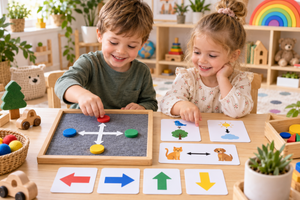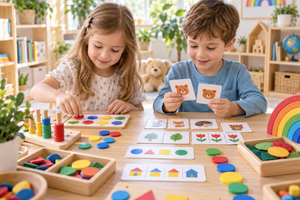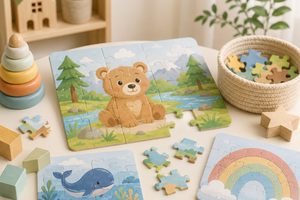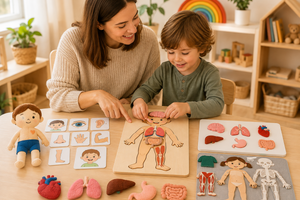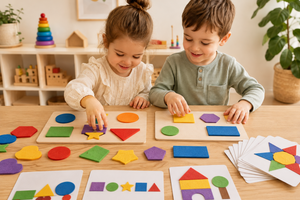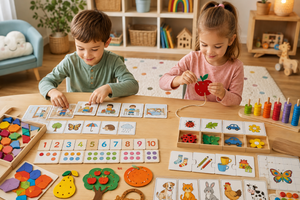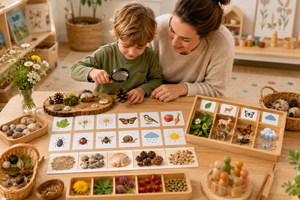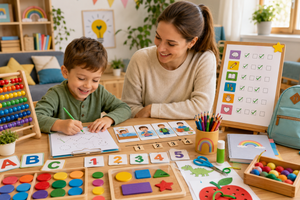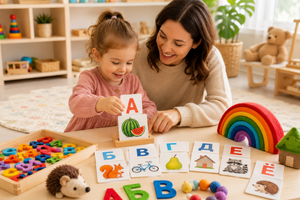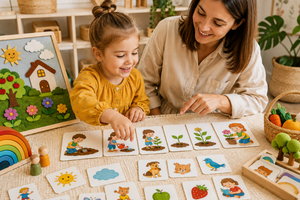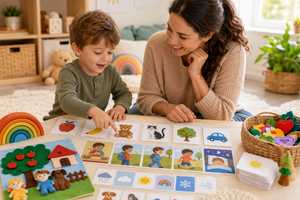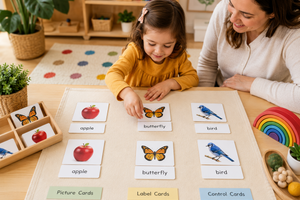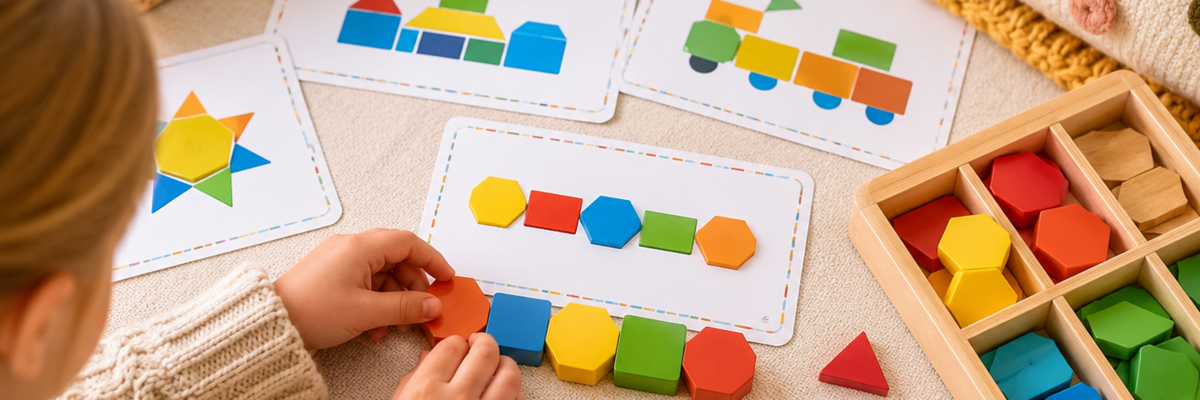
A “copy the pattern” activity looks simple: a child studies a card and places the pieces in the same arrangement. Between looking at the finished model and recreating it, however, the child completes a series of connected steps. They need to notice the parts, compare color and shape, identify positions, choose a starting point, hold some information in mind, and check the finished work.
These activities are useful not because they promise to “boost memory fast,” but because they offer clear, hands-on practice. A child repeatedly sees the relationship between a model, their own actions, and the result. The same task can be simplified to two large pieces or extended into a sequence, a memory challenge, a rotated model, or an error-detection game.
This guide gives parents and educators a practical sequence: when to begin, how to present the activity without overprompting, which spatial words to use, and how to turn one familiar set into activities at several levels.
Key takeaways
- Begin with two to four contrasting pieces and keep the model next to the child’s work area.
- First teach the child to compare one item at a time instead of memorizing an entire arrangement.
- Use spatial language in context: “above,” “below,” “between,” “left,” “right,” and “in the corner.”
- Change only one variable at a time: number of pieces, similarity of items, distance from the model, or viewing time.
- Treat an error as part of the activity. Invite the child to compare the two arrangements and locate the difference.
What does it mean to copy a pattern?
A model is a visible example of the intended result: a row of colored pieces, an ornament, cars positioned on a board, geometric shapes in a composition, or a completed picture. The child is not merely matching identical objects. They are recreating the relationships among them. A yellow star belongs above the rocket, not anywhere on the mat; the blue car belongs in the second space from the right, not simply somewhere in the parking lot.
Several skills work together during the task. Visual perception helps the child distinguish pieces. Spatial reasoning helps them understand where objects sit in relation to one another. Working memory is involved when they shift their gaze from the card to the mat and hold a short instruction in mind. Planning helps them choose an order, while fine-motor control helps them rotate and place each piece accurately.
This does not mean one game develops every skill equally or guarantees a particular academic result. The quality of the experience depends on the difficulty, repetition, adult support, and the child’s understanding of the task. A brief, manageable activity that allows independent checking is more valuable than a complicated picture assembled mostly by an adult.
When are children ready for pattern-copying activities?
Look at current abilities rather than age alone. For a first attempt, a child needs to distinguish a few contrasting pieces, imitate one visible action, and handle the materials safely. If the child loses the rule, clears away all the pieces, or turns the materials into pretend play, that is not a refusal to learn. The pattern may be too complex, or the activity may have been offered at the wrong moment.
|
Approximate age |
Activity format |
Example |
Adult’s role |
|
2–3 years |
Two or three large, contrasting pieces with the model nearby |
Place a red circle above a blue square |
Demonstrate the first move and name the color and position |
|
3–4 years |
A three- to five-piece picture or short repeating row |
Repeat two alternating colors or copy a simple scene |
Ask guiding questions and leave the model visible |
|
4–5 years |
Five to eight pieces, rotations, and similar-looking options |
Position vehicles on a board or reproduce an ornament |
Teach the child to compare the work one section at a time |
|
5–7 years |
Memory copying, error detection, and sequences |
Study a card for 10 seconds, cover it, and rebuild the arrangement |
Adjust time and complexity and ask about the child’s strategy |
These ranges are flexible. A child may copy a color sequence easily while still confusing left and right, or work enthusiastically with vehicles while showing little interest in decorative designs. A familiar theme and pieces that feel comfortable to handle may matter more than a formal age band.
How to prepare the materials and work area
Felt pieces, blocks, mosaics, cardboard shapes, large lids, or safe household objects can all work. The child should be able to distinguish and pick up each item independently. For younger children, avoid small pieces that could be swallowed, inspect materials for damage, and follow the manufacturer’s age and supervision guidance.
Place only the pieces needed for the current model on the table, plus one extra option when choosing is part of the challenge. Position the task card above or beside the work area, not on top of it. A small tray keeps pieces from scattering and makes all available choices easier to scan.
How to present a copy-the-pattern activity step by step
1. Study the model before touching the pieces
Ask, “What do you notice? How many pieces are there? Which colors do you see? What is at the top?” Two or three observations are enough. The goal is to establish a useful habit: gather information before beginning to act.
2. Find a clear anchor
Choose a noticeable item, such as the largest shape, an object at the edge, or the center piece. Say, “I’ll start with the blue car in the left corner.” An anchor gives the child a stable starting point instead of encouraging random placement.
3. Demonstrate one complete move
Find the corresponding piece, compare it with the model, and place it on the board. Then give the next move to the child. If an adult completes half the arrangement, the experience becomes a demonstration rather than independent practice.
4. Compare one section at a time
After two or three pieces, pause: “Let’s check the top row. Does it look the same?” Section-by-section checking reduces the amount of information the child must manage and shows that checking is a normal part of the process, not a final test.
5. Finish with a self-check
Place the model and the completed work side by side. Invite the child to scan from left to right or top to bottom. If something differs, do not identify it immediately. Narrow the search instead: “Let’s check only the bottom row,” or “Are all the pieces facing the same way?”
Five ways to use the same model
Copy it beside the model
Place the card beside the mat so the child can look back after every piece. This version introduces spatial vocabulary and a self-checking routine. Keep the model available and do not impose a time limit.
Build it from memory
Let the child study the arrangement for 5–15 seconds, then cover or turn over the card. Begin with three clearly different pieces. Reveal the model afterward and compare. If the task is too hard, do not keep extending the viewing time indefinitely; use fewer pieces or offer one additional quick look.
Rotate the model
Turn the card a quarter turn while leaving the work mat in place. The child has to determine how every position changes. Begin with an asymmetrical three-piece arrangement so the rotation is easy to notice. This is harder than direct copying, so do not combine it immediately with a memory challenge.
Find and fix the mistake
Build the arrangement ahead of time, but switch two pieces or turn one in the wrong direction. The child compares it with the model, names the difference, and corrects it. Encourage a consistent scan rather than guessing: look from left to right, row by row, or from the center outward.
Continue the sequence
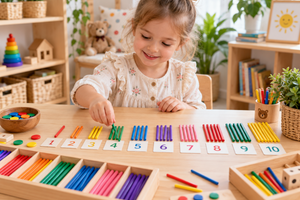
Use a model that shows a rule, such as red–blue–red–blue or circle–circle–square. The child first copies the visible part, then adds two to four pieces without a finished answer. Ask what repeats. Later, use a three-item unit or a sequence in which both color and shape change.
Spatial words that support the activity
Spatial language makes an invisible action plan easier to understand. Use each word in a concrete sentence: “The star is above the planet,” “The yellow sock is between two blue socks,” or “The car is in the lower-right corner.” Children generally understand these relationships more readily through movement and objects than through isolated vocabulary drills.
- position: top, bottom, middle, corner;
- direction: left, right, forward, backward;
- relationship: above, below, between, next to, across from;
- orientation: facing up, sideways, upside down;
- order: first, next, before, after, last.
There is no need to correct every imprecise phrase. If the child points to the correct place, restate the idea accurately: “Yes, the car is to the right of the bus.” Over time, ask the child to describe one move for the adult. This reveals whether they can turn visual information into a verbal direction.
How to increase the challenge gradually
Change one variable while keeping the rest familiar. If you add small similar pieces, rotate the card, and allow only five seconds to study it, you will not know which feature caused the difficulty.
- Direct copying. Use two to four contrasting pieces and keep the card nearby. When the child compares each item without repeated prompting, add one piece.
- More precise placement. Introduce corners, rows, and piece orientation. When the child notices position as well as identity, add similar-looking choices.
- Short-term recall. Move the card a short distance away or allow one brief look. When the child remembers three to five pieces or uses a reliable checking strategy, shorten viewing time slightly.
- Transformation. Add rotation, rule extension, or error detection. When the child can explain what changed and why, invite them to design a model for an adult to copy.
Learn&Dream materials for pattern-copying practice
The Sorting Toys for Kids collection includes several themes for the same core action. Choose a topic that already interests the child. To learn the process itself, it is usually better to reuse one familiar set in several ways than to introduce new materials and new rules each time.
|
Material |
Core action |
Extension idea |
|
Recreate decorative designs by comparing color, shape, and position |
Change one part of a design and ask the child to locate the difference |
|
|
Build themed compositions with space objects |
Describe positions aloud or recreate a few pieces from memory |
|
|
Select pieces and reproduce visible sequences |
Continue the rule or design a new repeating sequence |
|
|
Position vehicles on the board according to a task card |
Give verbal directions to a parking space or rotate the model |
Common mistakes adults make
- Offering too many pieces at the start. The child spends energy searching instead of understanding position. Set out only what is needed.
- Prompting with an adult’s hand. Moving the piece for the child removes the reasoning step. Narrow the search with a question instead.
- Training everything at once. Memory copying, rotation, and a timer are separate challenges. Introduce them one by one.
- Judging only the final picture. Notice the strategy: Does the child compare, begin with an anchor, and check errors?
- Requiring complete stillness. A preschooler may stand, walk closer to the card, or talk through a step. The goal is the targeted thinking process, not silent seat time.
- Rejecting creative variations. Agree to copy the model first, then make time for an original composition. The two formats serve different purposes.
How to use pattern activities at home and in the classroom
At home
Choose a 5- to 15-minute period when the child is not rushed or tired. One session can include three brief parts: copy an easy model, try one new variation, and create an original design. Stop before interest is gone. If every piece is age-appropriate and safe, the set can remain accessible for independent return.
In a classroom or preschool group
Prepare several identical stations or work in pairs. One child creates a model and the other copies it; then they switch roles. For a whole-group check, use a model large enough for everyone to see. Avoid making the activity a race. Speed can conceal children’s strategies and introduce unnecessary competition.
A useful group variation is a spoken layout. The educator says, “Place the rocket in the middle and the star above it.” After two or three directions, children compare their arrangements. If the results differ, the group discusses which part of the instruction could have been clearer.
How to notice progress without turning the game into a test
Record changes in the child’s process rather than counting “correct cards.” Do they study the model before beginning? Can they find an error after a neutral question? Do they use spatial words? Can they explain where they started? These observations point to the next useful challenge more clearly than completion speed.
Progress may also look like fewer prompts, holding the rule in mind for longer, correcting an error calmly, or transferring the same strategy to unfamiliar materials. If difficulty persists, return to the previous level and change just one condition. If you have significant concerns about vision, motor skills, or development, discuss them with an appropriate professional rather than using a game for self-diagnosis.
Frequently asked questions
At what age can a child begin copying patterns?
Simple arrangements with two or three large, contrasting pieces may be introduced around ages 2–3. More important than the exact age is whether the child can handle the pieces safely, imitate one visible action, and attend briefly. Begin with the model nearby and no time limit.
What if my child matches the pieces but puts them in the wrong positions?
Use fewer pieces and choose one anchor: the top row, center, or corner. Name relationships such as “above,” “below,” and “between.” Compare one small section after every two pieces. Wait to add a memory challenge until direct copying is understood.
How can a model be used for visual-memory practice?
Show a simple arrangement for 5–15 seconds, cover it, and invite the child to rebuild it. Always reveal the model afterward for self-checking. Change only one variable—the number of pieces or viewing time. If it is too difficult, offer another look instead of giving the answer.
Should I correct every mistake?
Not immediately. Put the work beside the model and scan from left to right or top to bottom. If the child cannot find the difference, narrow the search area. Correcting the piece independently provides more practice than having an adult move it.
How long should a pattern-copying activity last?
Five to 15 minutes is often enough for preschoolers, but engagement matters more than a timer. One short pattern completed thoughtfully is better than finishing an entire set after interest is gone. Regular, manageable practice matters more than one long session.
From copying a model to making a plan
Pattern copying begins with simple comparison, but it gradually teaches a child to follow a plan: inspect the arrangement, find an anchor, complete a sequence of steps, and check the result. Once direct copying is comfortable, the same materials can support memory work, rotation, error detection, and repeating rules.
Keep a balance between a defined task and creativity. First agree to recreate the card, then invite the child to become the designer of a new model. The example becomes a starting point for independent ideas rather than the limit of the game.