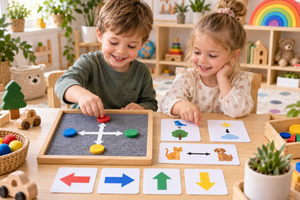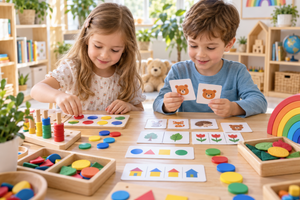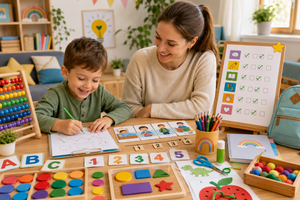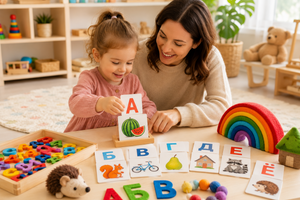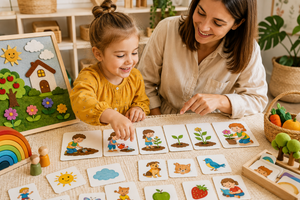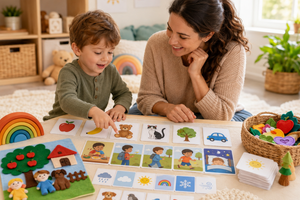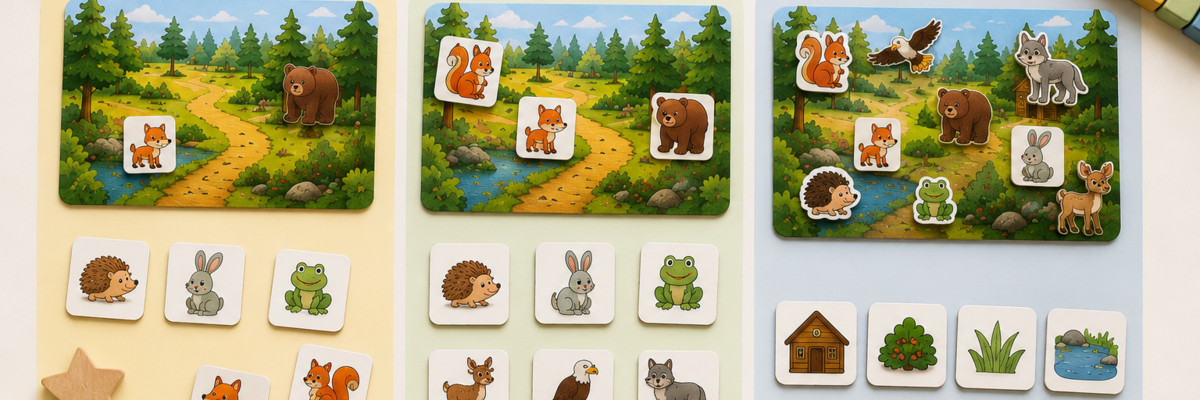
A learning game does not suddenly become too young after a birthday. The same set can offer a concrete placing action to a two-year-old, a comparison task to a three-year-old, and a small planning challenge to a four-year-old. The material stays the same. The adult changes how much is visible, whether a sample remains available, what language is expected, and how the child checks the result.
Adaptation can extend the useful life of a favourite activity, but it is not about extracting a lesson from every minute. The task should remain manageable and interesting. The framework below includes age-based starting points, ready-to-use variations, and examples with current Learn&Dream materials. Ages are approximate: begin with the child's present experience with that particular action.
Key takeaways
- Change one variable at a time: number of pieces, choices, sample, language, rule, or checking method.
- At two, emphasise a clear physical action; at three, comparison and selection; at four, sequence, explanation, and simple planning.
- When introducing a new rule, temporarily reduce the amount of material.
- A prompt is part of teaching: demonstrate, ask about a feature, narrow the choice, then move toward self-checking.
- Increase difficulty after stable understanding, not simply because of speed or chronological age.
Five levers that change difficulty
1. Number of pieces
Two components create much less visual demand than ten, even when the rule is identical. Begin with the smallest complete task and add one or two pieces. The full set does not need to appear in every session. Store unused parts out of sight so the visible selection feels intentionally complete.
2. Number and similarity of choices
Placing a red apple in the only empty spot is easier than selecting it from four colours. Give a beginner two strongly contrasting choices. Add a third option once the action is understood. A more experienced child can compare similar shapes, reject a distracting piece, or notice that more than one answer could work.
3. Availability of the sample
With a completed model beside the child, each move can be compared directly. Show the model briefly and remove it, and memory becomes part of the task. Ask for an original pattern, and planning enters. These are three distinct challenges made from the same set of shapes.
4. Language demand
A child may first act without naming. Next, add one word such as the colour or object. Later, invite a short phrase—“large yellow apple”—or a reason: “These halves match because the symbols are the same.” Do not require colour, shape, number, and justification in every turn.
5. Method of checking
At the first level, an adult shows the location. Later, ask a neutral question: “Do the edges meet?” The child can then overlay a part, compare with a control card, or locate an intentional error. Self-checking raises the thinking demand without making the field larger.
One game at ages 2, 3, and 4: a starting framework
Use age to select the first attempt, not to assign a permanent level. A child who has never used silhouettes may need the two-year-old style demonstration at four. A child who understands the action immediately may try one next step. Product age restrictions still apply and cannot be changed by simplifying the rule.
|
Variable |
Age 2 |
Age 3 |
Age 4 |
|
Amount |
2–4 large pieces |
4–8 pieces |
8–12 pieces or one complete small set |
|
Main action |
Take, attach, find the same |
Compare, match, sort by one feature |
Follow a sequence, explain, invent a rule |
|
Prompt |
Demonstration and a shared first move |
A question about one visible clue |
A control sample or time to check independently |
|
Language |
One word or an imitation sound |
Feature plus object, a short sentence |
Reason for choice, sequence description, mini-story |
|
Typical session |
3–7 minutes |
5–10 minutes |
10–15 minutes |
|
Clear finish |
All prepared parts are placed |
One series or three to four pairs are complete |
The rule is completed and the result checked |
Worked example: changing an apple-tree game
At two: action and a single word
Set out the tree and three apples. Attach the first while saying, “Apple on the tree,” then invite the child to repeat the action. Ask for a red apple from two options or count together, “one, two.” Finish when the prepared pieces are used. Do not open the rest of the collection halfway through.
At three: sorting with one condition
Offer more apples and agree on one feature. Red apples go on the left and yellow apples on the right. In another round, reduce the amount again and change the rule: large apples high, small apples low. Ask for one feature rather than a complete description of every piece.
At four: sequence and a child-made rule
Show a short colour order for a few seconds and ask the child to reproduce it. Another challenge is to place five apples so that red ones do not touch, then explain the solution. Finally, the child can design a rule for the adult and decide whether it was followed accurately.
These versions use the same object but place different demands on the learner. If the sequence is difficult, return the visible sample. If three placements are easy at two, add one apple rather than a new sorting rule. By changing only one variable, the adult can see what made the difference.
Adapt five common task types
Matching pairs
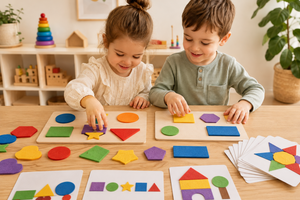
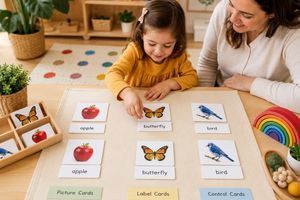
Age 2: two open pairs with very different images. Age 3: four open pairs or object-to-silhouette matching. Age 4: four to six face-down pairs, simple logical partners, or an explanation of the connection. When introducing face-down memory, make the field smaller again.
Sorting
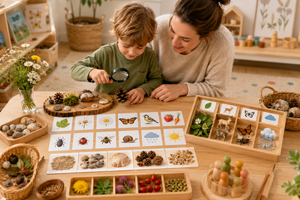
Age 2: two groups by one obvious colour. Age 3: one feature across three groups, or alternating attention between colour and shape in separate rounds. Age 4: a collection that can be classified in more than one valid way. Accept an alternative if the child can state a coherent rule.
Copying a sample
Age 2: place one part directly over its location. Age 3: build a neighbouring copy with three or four pieces. Age 4: look, partly cover the model, rebuild, and compare. Avoid adding a timer while the rule and accuracy still require frequent support.
Part and whole
Age 2: join the two prepared halves of one image. Age 3: choose among the halves of two or three pictures. Age 4: find a missing part from edge clues, work without the finished sample, or build a playful mixed whole and name it.
Early counting
Age 2: say “one, two” together during a placing action. Age 3: place the amount shown by fingers or a small number card. Age 4: change a group by one, compare two amounts, or explain how to make them equal. Keep the hands-on game from turning into a long worksheet spoken aloud.
Know when to increase—and when to step back
Look for stable understanding. The child remembers the short rule, completes most actions without continuous help, can review some choices after a neutral prompt, and remains interested. Fast performance is not the main measure. A slow, reasoned selection may show more understanding than an instant guess.
Add one challenge: two more pieces, a less obvious partner, one sentence of explanation, or a hidden sample. Watch several moves. If the rule disappears, restore the previous condition without saying it is “for babies.” The level is an adult planning tool, not a label for the child.
Temporary simplification is also appropriate after a break, on a tired day, or in a new environment. A skill is not lost because one session is easier. A manageable start helps the child recall the action and return to the more complex form without unnecessary conflict.
Use three short trials instead of guessing
In the first session, demonstrate with the minimum amount. In the second, repeat without the full demonstration. In the third, change one feature and note exactly where support is needed. Record the type of help, not a score. If colour sorting is easy but combining colour and size causes confusion, practise those features separately before joining them.
Share one set between different ages
A two-year-old can attach a prepared piece, a three-year-old can select it from a clue, and a four-year-old can formulate or check the next rule. Rotate roles so the older child does not become a permanent teacher. Give each child turns and work toward one shared picture rather than comparing speed.
Learn&Dream materials that support several levels
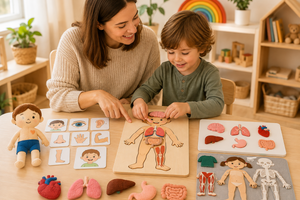
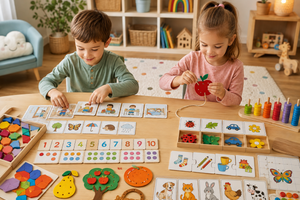
Learn&Dream logic-and-sorting materials use separate felt pieces and repeatable actions that can be presented in small portions. Check the exact age guidance, contents, and supervision requirements for each product. The suggestions below change the presentation, not the manufacturer's safety instructions.
|
Material |
Age 2 version |
Age 3 version |
Age 4 version |
|
Attach two or three apples and name colour |
Sort by one feature |
Copy an order or create a rule |
|
|
Felt Board “Find the Shadow” |
Overlay two contrasting objects |
Match three or four objects without direct pointing |
Explain contour clues and self-check |
|
Felt Game “Match: Shapes” |
Find one requested shape |
Copy a simple picture |
Remember a composition or design one |
|
Felt Game “Match by Shape and Symbol: Hearts” |
Join one prepared heart |
Find halves for two or three hearts |
Explain symbols, work without a sample, invent a pair |
Choose the set whose basic action the child can already perform safely, then change one variable from the table. Keep unused pieces in the container and confirm the full count at the end. If a product has an older age label, wait for that age rather than treating a simpler rule as permission to use the components early.
Common adaptation mistakes
- Changing everything together. Do not add pieces, hide the sample, and introduce a new rule in the same round.
- Using age as the only measure. Experience with the specific action matters more.
- Increasing only quantity. Prompts, language, and checking can change without a huge field.
- Turning a prompt into the adult's answer. Narrow the choice, then leave the final action to the child.
- Calling an easier level babyish. It is a useful step that anyone may revisit.
- Scoring only correctness. Notice whether the rule is understood and the result can be checked.
- Continuing after interest ends. A short complete series is better than resistance through the full set.
Frequently asked questions
Can I give a two-year-old a game marked 3+ if I simplify it?
Follow the manufacturer's age label and safety guidance. A simpler rule does not change component size, material risks, or supervision requirements. Do not use a 3+ set earlier against its instructions.
How many pieces should I add at once?
Usually one or two. Keep the other conditions familiar and observe whether the rule remains stable. A large jump hides which change created the difficulty.
What if an older child chooses the easiest version?
Let the child begin there. Offer one additional step after a successful series, but do not remove the simple version. A familiar action may be how the child enters the game.
How do I prompt without doing the task?
Use a sequence: pause, ask about one feature, narrow to two choices, or demonstrate only the first part. Stop as soon as the child can continue and let them complete the physical action.
How often should the level change?
After several stable attempts rather than on a schedule. When the rule is understood, help is minimal, and interest remains, add one new requirement and observe.
One game, several manageable steps
You do not need a new toy for every age. Adjust five variables: pieces, choices, sample, language, and checking. Each small change creates a genuinely different task while the material remains familiar.
Begin where the child can understand and finish. Add one challenge, keep a route back, and never frame the easier scenario as failure. A well-adapted game grows with the child through steady practice rather than pressure or comparison.