Recognizing a firefighter, teacher, baker, or builder in a picture is a useful beginning, but it does not yet explain what work means. A preschooler needs connections: What problem does this person solve? Where do they work? Which tools support the task? What changes when the work is complete? Sorting makes those relationships visible, while role-play gives the child a chance to use them.
A strong activity therefore moves beyond a parade of uniforms. Children group tools, consider more than one possible match, plan a small job, and tell what happened. This focused approach develops vocabulary, reasoning, sequencing, and social understanding. It also makes space for a realistic message: jobs belong to people with the relevant skills, not to one gender, appearance, or costume.
Key takeaways
- Describe every job through four anchors: task, workplace, tools, and result.
- Begin with workers the child has encountered in everyday life rather than a long encyclopedic list.
- Sort clear examples first, then add objects that several workers may use.
- Give role-play a specific problem: “The library received new books” is more useful than “Play librarian.”
- Ask for reasons and accept more than one answer when the relationship makes sense.
- Show people of different genders and backgrounds performing every kind of work.
- Present a community as a network of ordinary contributions, not a ranking of “important” and “unimportant” jobs.
What should a child understand about jobs?
The word “job” becomes concrete through action. A baker prepares bread, a driver moves people or goods, a teacher organizes learning, and a designer plans how something will look and work. The sentence frame “This person…” naturally invites a verb and a purpose. It is far more informative than asking a child to repeat an occupation label with no context.
The next idea is cooperation. A shop depends on people who make, deliver, receive, display, sell, clean, plan, and repair. A theatre, hospital, construction site, school, or park also involves several roles. When children build a team for one result, they begin to understand that visible front-stage work and quieter supporting work both matter.
Tools are another opportunity for flexible thinking. A computer may be used by an architect, cashier, photographer, researcher, and teacher. Scissors appear in the work of a hairdresser, tailor, florist, and artist, though not for the same action. If a child creates an unexpected match, ask how the worker would use the object. A sound explanation is more valuable than copying one printed answer key.
How job activities can grow with age
Use the ages below as starting points. Familiarity changes the level: a child who visits a family restaurant may plan a detailed café story while still learning the tools used in a workshop. Introduce a new game rule with two familiar jobs, and introduce unfamiliar job names through a matching or story format the child already understands.
|
Approximate age |
Helpful focus |
Activity format |
Next step |
|
2–3 years |
Three to five familiar workers and one characteristic action |
Name, imitate, and match one obvious object |
Add a workplace or a one-step doll scenario |
|
3–4 years |
Job, action, several tools, and a visible result |
Sorting, logical pairs, and a short role-play scene |
Add an object shared by two jobs and ask for a reason |
|
4–5 years |
Workplaces, task order, and cooperation |
A town layout, role cards, a problem, and team play |
Let the child assign roles and plan three or four actions |
|
5–6 years |
Less visible jobs, shared tools, and benefits to the community |
Interviews, multiple sorting rules, and child-created games |
Compare two occupations and defend several possible answers |
The “picture—sort—story” sequence
First, observe the work
Show one picture of a person doing something and wait before naming the job. Ask, “What is happening? What clues can you see?” The child may notice an object, a place, clothing, or the result. After the description, provide the occupation name and one brief purpose statement. The new word is now attached to evidence the child found.
Next, sort evidence
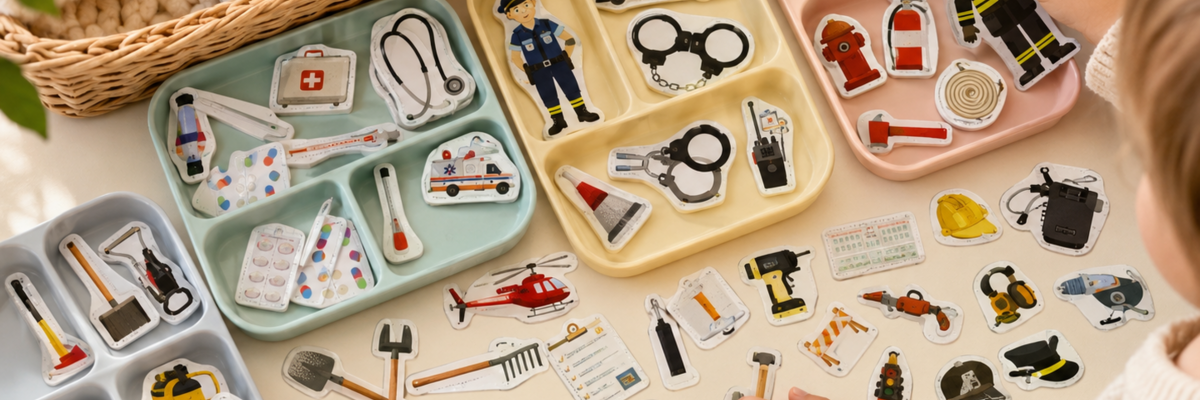
Place two job cards with four to six tools, products, or workplace items. The child assigns each item and explains one or two decisions. On another day, add a shared object such as a phone, ruler, gloves, or notebook. Create a middle area labelled “both could use this” instead of forcing an artificial single answer.
Finally, create an event
Turn the matches into a specific situation. A café is preparing to open, the theatre needs a poster, a road sign in the play town has fallen, or a library has received a delivery. The child chooses a role, useful objects, and a few actions. Cards can remain visible as prompts, but the child decides how the scene develops.
Questions that invite reasoning instead of quizzing
“Who is this?” checks only a label. Use one deeper question at a time: “What problem does this worker solve? What should happen first? Which object would help? Who else might join? What will be different at the end?” Give the child time to answer through speech, gesture, or moving a piece. A pause is productive thinking time, not a signal that the adult should answer.
Questions about missing information are especially useful: “What does the team still need?” or “Who has not arrived yet?” They require the child to analyse a whole situation rather than reproduce a fixed pair. An original response may reveal a real connection: a photographer can work at a theatre, and a driver may deliver parcels rather than transport passengers.
Seven practical activities about jobs
1. Who could help?
Describe an ordinary need: hair needs cutting, a parcel must be delivered, a playground requires a plan, someone wants to learn an instrument, or a tap needs repair. The child chooses a worker and explains the action. With older preschoolers, choose a multi-step situation and look for several contributors instead of one “correct helper.”
2. Tool bags
Give each job card a “bag” made from a hoop or sheet of paper. Children sort object pictures into the bags, find one item that does not fit, and identify one that could belong in both. Replace “Is that right?” with “What would this person do with it?” The explanation keeps the task about function rather than visual guessing.
3. A route through town
Arrange buildings or draw a simple map with a post office, school, bakery, workshop, clinic, theatre, and park. A toy character has several errands. The child plans a route, names the people the character may meet, and tells what happens in order. This connects jobs with places, transport, spatial vocabulary, and planning.
4. Build the team
Present a result—a book, house, performance, celebration cake, or planted courtyard—and ask who might contribute. The child selects roles and places them in a plausible sequence. The process does not need industry-level accuracy. The learning point is that a complex result usually comes from cooperation and includes planning, making, checking, and caring for the space.
5. Worker interview
One player draws a card and answers in character: “What do you do? Where do you work? What do you need? Who works with you?” Let the child invent a day while gently clarifying important facts. Switch interviewer and worker. The format supports question formation, complete sentences, perspective-taking, and connected storytelling.
6. Sort by contribution
Use categories that are not job titles: make objects, teach, move things, care for places, work with information, or organize events. Many jobs can sit in more than one group. Ask the child to explain the overlap, then invent a different sorting rule. A useful rule should be clear enough that another person can follow it.
7. Change the stereotype
Use the same set of tools with different characters, or let the child choose each worker’s name, appearance, and role. Talk about how any person can become a chef, engineer, driver, scientist, educator, or builder after learning the necessary skills. Describe what people do rather than relying on costume color, gender, or a single dramatic attribute.
Learn&Dream materials for a jobs unit
A useful combination includes one material with a clear classification task and one open setting for stories. The child can discover relationships first and then transfer them into a route, team, or role-play problem. Three materials from the Learn&Dream catalogue support different parts of this progression.
|
Material |
Main learning action |
Easy start |
Story extension |
|
Felt Game “Sorting: Signs of a Profession” |
Match jobs with characteristic objects and clues |
Choose two occupations and a few clearly different pieces |
Add a shared tool, an explanation, and one workplace problem |
|
Felt Puzzle “Little Town” |
Create workplaces, locations, and routes |
Build the town and decide where three or four workers may be found |
Give a resident several errands and plan the order of visits |
|
“Types of Art” three-part cards |
Broaden the unit to creative fields and the people working in them |
Compare several art forms, actions, and materials |
Build a team for a concert, exhibition, or performance |
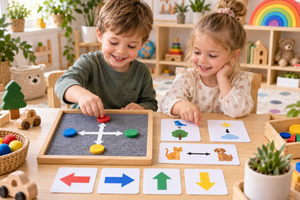
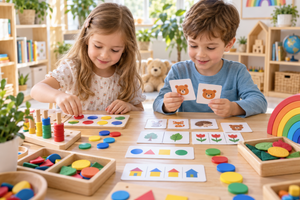
Felt pieces add a useful hands-on stage: children separate, move, compare, and accurately place visual clues. Three-part cards can begin as picture material and later introduce printed labels. Select only the pieces needed for today’s relationship so that managing the set does not become harder than thinking about the work.
A focused 15-minute activity
- Select two jobs. Make one familiar and the other new or similar in its tools.
- Name the actions. Build one “This person…” sentence for each picture.
- Sort four to six clues. Ask for reasons on two choices rather than every turn.
- Add a problem. The worker needs to make, organize, deliver, repair, or help with something.
- Finish with the result. The child explains what changed because the work was completed.
At the next session, change only one element. Keep the workers but replace the objects, or leave the town assembled and add a new request. A familiar setting frees attention for the new logical step. When the child understands the structure, hand over authorship and complete the challenge they invent for you.
Common mistakes in jobs activities
- Teaching only names and uniforms. Add an action, purpose, workplace, or result every time.
- Using the entire set immediately. Two jobs and a small group of clues make the rule visible.
- Assuming every tool has one owner. Make room for shared objects and well-reasoned alternatives.
- Writing the whole story for the child. Offer a problem and materials, then leave the solution open.
- Reinforcing gender stereotypes. Vary the characters and discuss knowledge, training, and skills.
- Showing work only as heroic or comic. Include planning, routine tasks, teamwork, and care.
- Treating play as an early career decision. Preschoolers are exploring society and can enjoy a different role every day.
Frequently asked questions
When can children start learning about jobs?
At around age two, connect familiar workers with one visible action. Sorting a few objects and acting out short roles often become clearer at three to four. Multi-person stories, less visible occupations, and several possible answers fit later preschool years, depending on experience.
How many jobs should we explore in one session?
Two are enough for a new rule. When the child already understands the format, use three or four without automatically emptying the whole box. It is more valuable to explore two roles through actions, tools, and a result than to identify ten cards quickly.
What if an object belongs with several occupations?
Invite the child to explain each use and create a shared area. Phones, computers, gloves, notebooks, vehicles, and measuring tools appear in many workplaces. Ambiguous examples are valuable because they build flexible classification and reasoning.
Should I correct an imaginary role-play story?
Allow the story to develop unless it involves an unsafe action. Clarify an important factual point with a question such as, “How does that happen in real life?” or look it up together. Role-play applies broad knowledge; it does not need to reproduce a professional workflow in exact detail.
How should we discuss risky or demanding jobs?
Focus on the purpose of the work, training, teamwork, protective equipment, and rules. Avoid frightening detail and claims that a worker can always solve every problem. A preschooler mainly needs to understand that people prepare, cooperate, and follow safety procedures.
From a job picture to an understanding of shared work
Job knowledge becomes meaningful when a child can follow the chain: a need appears, a person performs actions, selects tools, works with others, and produces a result. Sorting exposes the relationships. A story turns those relationships into language, planning, negotiation, and a child’s own decision.
Begin with a few familiar roles, welcome several defensible matches, and represent a wide variety of people in every occupation. The topic then builds more than recall: it supports respect for work, flexible thinking, and an early understanding of how a community functions.