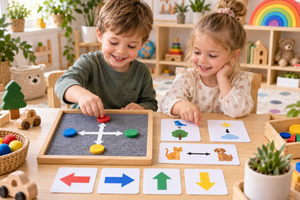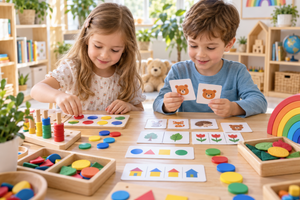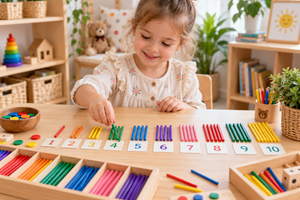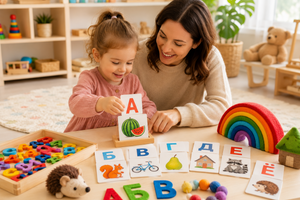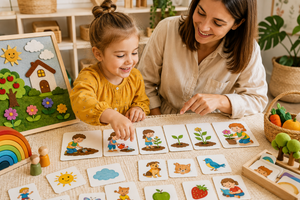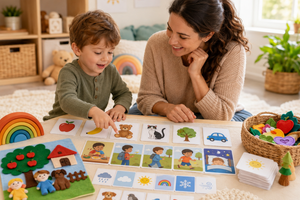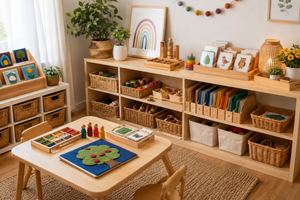
School preparation is often reduced to letters, numbers, and pencil worksheets. A child entering a classroom will use a much wider set of abilities: listening to a brief direction, asking for clarification, waiting for a turn, organizing materials, trying again after an error, and explaining an idea. Families can practise these actions without recreating a classroom at the kitchen table.
Play gives each skill a meaningful job. A child counts because toy guests need plates, describes a picture because a partner must identify it, and follows a sequence because a shared mission depends on it. Early literacy and mathematics then develop alongside language, movement, planning, and cooperation instead of becoming isolated drills.
The checklist below is not a test, a diagnosis, or a deadline. Use it as a planning map: notice what the child can do independently, what becomes possible after a demonstration, and where a smaller step would help. Choose a few current priorities and revisit them in varied games rather than comparing one child with another.
Key takeaways
- School readiness includes communication, early literacy and maths, attention, movement, practical routines, and participation with others.
- A checklist should guide the next playful opportunity, not produce a score or label.
- Three short sessions with familiar repetition are usually more useful than one long lesson.
- Adjust one variable at a time: the number of pieces, length of the direction, visibility of the model, or need to explain a choice.
- End with reflection: what worked, what felt difficult, and what the child would like to try again.
What school readiness looks like in everyday play
Being ready for school does not mean reading fluently or completing next year's arithmetic in advance. More useful questions are whether a child can join a shared task, understand its immediate purpose, use an appropriate prompt, complete a manageable step, and move on. Letters and numbers belong in this picture, but they should not replace curiosity, conversation, imaginative play, and physical activity.
The areas are interconnected. Recreating a card pattern can involve visual discrimination, spatial vocabulary, planning, and an explanation of strategy. Sharing counters equally involves one-to-one counting, monitoring an action, and applying a fair rule. Integrated experiences resemble the demands of a real school day more closely than pages of identical exercises.
A practical readiness checklist for ages four to six
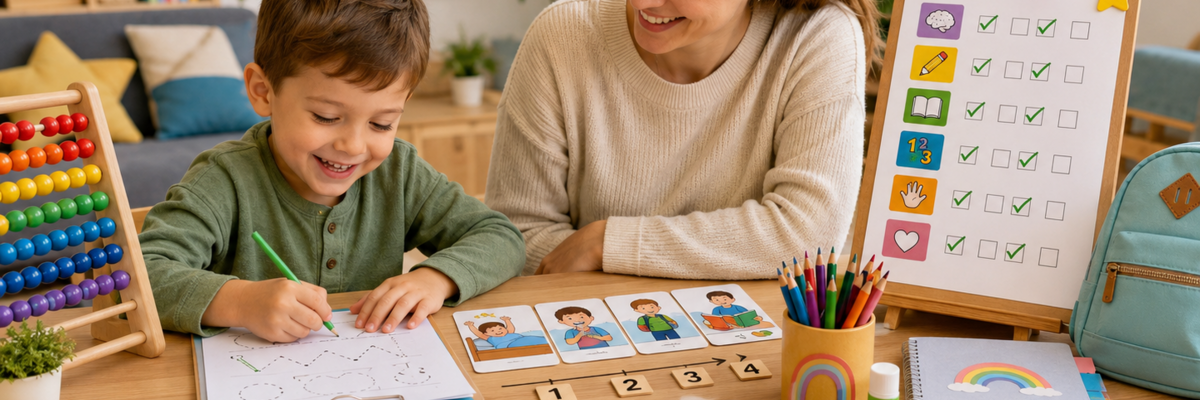
Observe familiar play over two or three weeks rather than arranging a special performance. Record the conditions as well as the action: independently, after a model, with one verbal cue, or together with an adult. That detail is far more useful for planning than a simple yes or no.
|
Area |
What you might notice |
A gentle next step |
Where to observe it |
|
Speaking and listening |
Listens to a short explanation, answers on topic, describes a familiar object |
Add a two-part direction or invite one clarifying question |
Guessing games, building, preparing a snack with an adult |
|
Early literacy |
Notices first sounds, recognizes their name, shows interest in books and print |
Find the sound in familiar words or tell a story from three pictures |
Shared reading, picture cards, labels used in the home |
|
Early mathematical thinking |
Counts a small group, connects quantity and numeral, compares shape or size |
Count after rearranging, sort a second way, explain more and less |
Sharing counters, setting the table, shape play |
|
Attention and planning |
Holds a simple rule, returns after a pause, notices an incorrect step |
Offer two strategies or use a brief first-then plan |
Matching, puzzles, copying a model |
|
Hand control and coordination |
Manipulates pieces, draws purposeful lines, uses suitable tools with safety rules |
Reduce the physical support or copy a simple repeating design |
Modelling, mosaics, drawing, fastening clothing |
|
Cooperation and routines |
Waits briefly, asks for help in words, helps restore the activity space |
Assign one role and introduce a predictable finishing routine |
Board games, pretend shops, setting out materials |
How to use the checklist without pressure
Describe an action instead of a trait
Replace “easily distracted” with an observation such as, “After the first turn, the rule was forgotten; seeing my example helped the child return.” The second note identifies a useful support. Repeat a related game later and compare the level of help, not the child with a peer.
Choose one main skill and one supporting skill
The primary goal might be matching a numeral to a quantity, while the supporting goal is explaining the choice in a sentence. If correct counting, speed, handwriting, neatness, and sustained eye contact are all demanded at once, it becomes impossible to see which part caused difficulty.
Protect time to think, pause, and repeat
A child may decline because the timing is poor, the directions are unclear, or the activity has too many elements. Offer a shorter version, the role of leader, or a return tomorrow. A willing second attempt shows more than a result obtained through insistence.
A six-week learning-through-play plan
The plan uses three sessions each week. Fifteen to twenty-five minutes is a practical home range, but engagement matters more than the clock. Each week has a focus, while speaking, counting, movement, and cooperation continue to overlap.
Week 1: Listen, clarify, and act
Play “the robot.” Give one action, then two connected actions, and explicitly allow the child to request a repeat. Swap roles so the child must create a precise direction. At another meeting, build a small structure from a spoken description. Finish by agreeing on three steps for returning the materials.
Week 2: Tell stories and notice sounds
Choose three images and make a story with a beginning, event, and ending. Hunt for objects beginning with a target sound without requiring the written word. Add “ask the character”: the child invents a relevant question for someone in the story, practising meaning rather than a rehearsed response.
Week 3: Quantity, numerals, and comparison
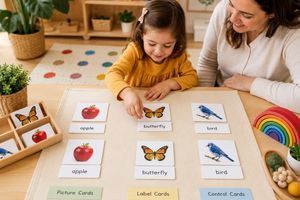
Give pretend visitors one cup or counter each and check whether everyone received one. Rearrange the same group and count it again. Sort shapes by form, then by colour; invite a more experienced player to announce a new rule and explain how an item fits.
Week 4: Attention, memory, and sequence
Create a short pattern, show it briefly, and reconstruct it. Use a small memory game and model a strategy aloud: “I remember that picture was near the edge.” Arrange three picture steps for a simple project, follow them in order, and turn each finished card over.
Week 5: Precise and comfortable hand work
Alternate modelling material, age-suitable loose pieces, broad drawing paths, and copying simple forms. Do not force a particular grip. Provide a stable surface, a comfortably short drawing tool, and breaks before fatigue. Include one practical action such as folding a cloth, operating a familiar fastener, or sorting stationery.
Week 6: A shared mission and independent choices
Plan a pretend shop, journey, exhibition, or town. The child chooses materials, names two or three roles, counts what is needed, and tells the plan. In the final meeting, repeat favourite tasks from Week 1 and notice which prompt is no longer necessary. The purpose is to see changing strategies, not to stage a final exam.
A simple structure for one short session
Connect for two or three minutes. State a goal as an action: “Today we will give clues that a partner can follow,” rather than “We are developing attention.” Let the child choose between two suitable materials while keeping the shared rule clear.
Play for ten to fifteen minutes. Demonstrate one example, complete one turn together, and hand over responsibility. If it is difficult, remove some pieces, leave the model visible, or split the action into steps. If it is easy, ask for an explanation, a second solution, or a challenge designed for the adult.
Change position for two minutes. Carry the same concept into movement: jump the number on a card, follow two route directions, or find an object of a chosen shape. Movement is not a prize after the “real work.” It is another way to represent and remember an idea.
Close for two or three minutes. The child restores a manageable portion of the materials and answers one question: “What helped?” or “What shall we change next time?” Make any checklist note after the session so every turn is not accompanied by visible evaluation.
Using Learn&Dream materials along the pathway
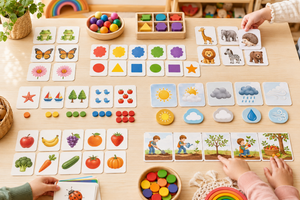
Select a material for the action it makes possible, not simply for the number of components. Check the current product description and age marking before use. Begin with a manageable selection, then add pieces or rules when the child understands the basic action and remains interested.
|
Material |
Readiness focus |
First invitation |
Possible extension |
|
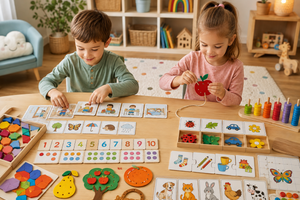
Felt game “Number and Quantity 1–10” |
Connecting numerals and sets, one-to-one counting |
Use three numerals and find the corresponding groups |
Mix more pairs and explain how each match was checked |
|
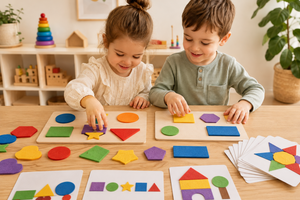
Felt game “Matching: Shapes” |
Visual discrimination, shape language, spatial planning |
Place one shape after watching a brief demonstration |
Describe a shape without pointing or invent a sorting rule |
|
Felt board “Find the Shadow” |
Careful comparison and testing a prediction |
Compare one picture with a small choice of silhouettes |
Justify the match using two visible features |
|
Felt game “Hearts with Numbers” |
Numeral recognition, matching, controlled hand movements |
Work with a small selected group of numerals |
Add a movement response or a spoken number story |
The resource does not determine the lesson by itself. With the same pieces, a child can match quietly, name a feature, direct a partner, remember a layout, or make a new sequence. Decide which action matters today and keep the other demands light. This makes progress visible without turning a versatile game into a fixed worksheet.
Adapting the pathway for ages four, five, and six
For many four-year-olds, keep the model visible, offer one short condition, and use components that are comfortable to handle. Counting and sound play work best inside a story. The adult can think aloud: “I am looking for corners, so this shape might fit.” The language demonstrates a strategy without taking over the child's turn.
At five, try two-step directions, sorting under a rule that changes, and a brief plan spoken before action. At six, offer more responsibility for choosing materials, explaining an incorrect attempt, or teaching the rule to another player. Speed does not need to become the main measure at any age.
Age remains a guide, not a verdict. Interest, familiarity with the format, energy, and previous experience all influence a single performance. Start one step easier than your first instinct and increase the challenge after two confident attempts. The child then has room to investigate instead of guessing what answer the adult wants.
Common mistakes when preparing for school
Turning the checklist into a daily examination
When every game ends in judgment, children may avoid risk and choose only familiar answers. Observe discreetly and comment on a specific process: “You checked both features,” or “You asked for the direction again.”
Prioritizing worksheets over varied hand use
Long rows of pencil marks cannot replace modelling, drawing on a broad surface, working with fasteners, building, and cutting with suitable tools under clear safety rules. Change the action before fatigue and value an understandable intention over decorative perfection.
Prompting before the child has time to think
Allow a real pause after a question. If help is needed, narrow the choice, demonstrate the first step, or remove one competing item rather than announcing the answer. Then return control to the child.
Comparing pace with other children
The useful comparison is with the child's earlier attempt: fewer cues, a clearer explanation, longer participation, or a new strategy. No single activity gives a complete picture of readiness.
Frequently asked questions
Does a child need to read before starting school?
There is no single home-readiness milestone that suits every child and every school. Support interest in books, sounds, names, and meaning. Check the expectations of the chosen school without turning reading into a race.
How long should a session be for a four- to six-year-old?
Fifteen to twenty-five minutes is a practical starting range, with permission to finish sooner. Watch whether the child understands the rule, participates, and can return after a brief pause. Several short meetings are often easier to sustain than one long block.
What if the child refuses an activity?
Review timing, difficulty, and presentation. Reduce the number of elements, offer the leader's role, change the material, or return another day. One refusal says little about ability and does not require pressure.
Are pencil worksheets necessary for hand preparation?
They can be one option when comfortable and interesting, but they are not the only one. Modelling, mosaics, drawing, fastening, folding, and arranging pieces provide varied practice in precise movement.
How can I tell when to make a game harder?
The child completes the action calmly more than once, explains the rule, or begins inventing variations. Add only one change: more pieces, a new criterion, a short memory delay, or a request to explain the choice.
Conclusion: readiness grows through meaningful routines
Learning through play before school is a pathway, not a race through a list. Notice which supports already help the child listen, reason, count, tell, coordinate their hands, and cooperate. Choose one next step and allow it to appear in several familiar situations.
The six-week plan can be repeated with new stories and materials. The most valuable outcome is not flawless performance in advance, but a working belief: I can understand the task, request help, test an idea, correct a step, and explain what I did. That stance gives a child a useful foundation for entering a learning community.