What to Give a Child for St Nicholas Day: Educational Ideas by Age
Short answer: choose a St Nicholas gift that matches the child's current way of playing, not merely the age printed on the front of a box. Toddlers need large, safe pieces and one clear action. Preschoolers can sort, match, build stories, and follow short rules. Early school-age children often enjoy planning, creating, investigating, and explaining a strategy. Check the manufacturer's age guidance and the full contents, then offer one easy way to begin. A small personal note can make a simple, well-chosen gift feel more special than a pile of fashionable toys.
Searching for St Nicholas gifts for children can quickly produce long lists divided by gender, price, or this year's characters. Those lists rarely tell you whether a child can start independently, whether the activity offers more than one use, or whether its many pieces will fit into everyday family life. A more durable method begins with observation: what does this child repeatedly choose to build, draw, sort, act out, count, read, or share with another person?
This is an annual guide rather than a catalogue of short-lived trends. Revisit it before each St Nicholas season and reassess interests, abilities, available space, and safety. If you want to compare types of play before choosing an individual item, educational toys by Learn & Dream are a useful starting point. Browse by activity first and treat every product description as information to verify, not as a promise of a particular developmental result.
Four checks before buying
First ask, “What will the child actually do?” An item that produces an effect after one button press may be delightful, but it can offer limited control. Open-ended pieces can become a sorting challenge, a pattern, a story prop, or a counting tool. Educational gifts for kids do not have to teach letters or numbers. Pretend play, art, movement, construction, and warm shared time all have genuine value.
Second, check the first step. After one brief demonstration, the child should have a reasonable chance of trying it. A small stretch can sustain interest; constant adult assembly, reading, or correction usually signals that the activity is too early. “They will grow into it” is sensible only when the gift can be stored safely and there is something enjoyable to do with it now.
Third, inspect safety rather than relying on appearance. Follow the stated age range and warnings. Consider loose small parts, magnets, batteries, long cords, sharp edges, brittle finishes, and pieces that could detach. A child who still mouths objects should not use choking-size pieces, even with an adult nearby. Store an older sibling's set separately and out of the younger child's reach.
Fourth, picture where and with whom it will be used. A large set without a storage place can become frustrating. A morning surprise works well when it can be opened and sampled in ten minutes; a complex family game is better saved for unhurried time. Include any essential paper or ordinary supplies, but confirm what comes in the package before purchasing extras.
A quick age-by-age guide
Age bands are starting points, not tests of ability. Simplify an activity if the child avoids it, and add a rule only after the basic action feels comfortable. The safety range and instructions for the actual item always take priority over a general table.
|
Age |
Commonly engaging actions |
Gift directions |
A good first invitation |
|
1–2 |
putting in and taking out, rolling, finding a familiar image |
large inset pieces, a simple sorter, sturdy picture cards, soft sensory objects |
demonstrate one action, then allow quiet repetition |
|
2–3 |
naming, matching, copying daily routines |
large puzzles, pairs, simple pretend-play props, basic sorting |
offer three or four pieces and add the rest later |
|
4–5 |
inventing stories, noticing attributes, following a short sequence |
lotto, picture themes, mosaics, story cards, art materials |
play a short practice round without scoring |
|
6–7 |
completing missions, counting, reading clues, cooperating |
a board game with a short playing time, logic tasks, construction, a simple investigation |
let the child choose a level or mission |
|
8–9 |
planning, creating something of their own, discussing strategy |
a more challenging puzzle, creative project, thematic game, research activity |
offer help when requested without taking over |
St Nicholas gift ideas for ages 1–2
At this stage, repetition is not a lack of imagination; it is how the child explores cause, space, and control. Large shapes to insert and remove, realistic pictures of familiar objects, a simple sorter, or sturdy pieces for stacking can support shared language and hand-eye coordination during play. The learning-toy collection for ages 1–2 offers examples to compare for size and complexity.
A St Nicholas gift for a 2-year-old does not need a gender code. One child may enjoy feeding a doll and naming household objects, another may line up vehicles, and another may transfer large shapes between containers. The useful distinction is the action, not the colour of the packaging. The learning-toy collection for ages 2–3 helps compare play mechanisms without assuming that every two-year-old is at the same point.
Do not spread twenty pieces across the floor on the first morning. Begin with a tiny, solvable set and describe rather than quiz: “The round piece goes into this opening.” Wait after the invitation. If a component appears loose, chipped, or different from the description, remove the set until an adult has checked it fully.
What works around ages 3–4
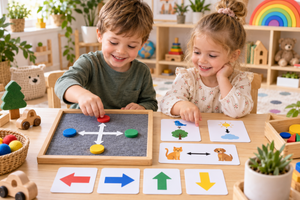
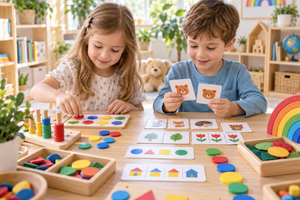
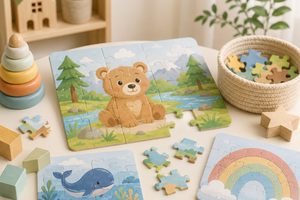
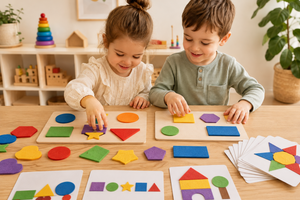
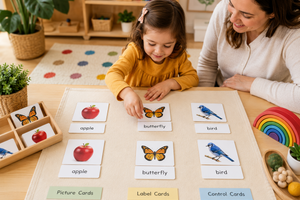
Many three-year-olds can match by a visible attribute, repeat a two-step sequence, and make a character perform familiar routines. Large puzzles, clear picture lotto, simple mosaics, animal-home pairs, and pretend-shop materials can all fit. Completing the whole activity is unnecessary. Finding four pairs and then inventing a story with them may be a successful session.
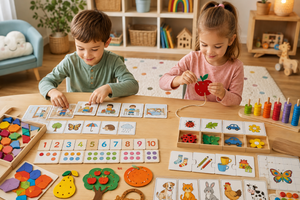
When choosing a gift for a 4-year-old child, look for more than one play route. The same picture cards might be named, sorted, turned into a memory game, or used to create a silly tale. A material that can be simplified and extended is less dependent on one narrow developmental window. The learning-toy collection for ages 4–5 offers further examples to compare for manageable challenge.
Keep the first rule short and finish while play still feels good. If waiting for turns is difficult, work together toward a shared goal: find all the pairs, make a path for a character, or build a five-picture story. Cooperative play is not a permanent shortcut; it can provide the experience needed for more formal game rules later.
Ages 5–6: stories, rules, and first strategies
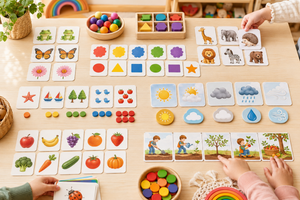
At five, children often enjoy spotting a pattern, taking a role, and producing something they can show. Memory games, lotto, tangrams, story prompts, accessible craft supplies, and construction pieces with a manageable joining method offer different entry points. Browse thematic learning sets by a real interest such as space, animals, cities, or nature rather than by a “boys” or “girls” shelf.
A gift for a 6-year-old boy should follow the same principle. An interest in vehicles could lead to a route-building challenge, classification cards, or a bridge to construct—not only another model car. An interest in fairy tales could lead to a small theatre, story cards, or materials for making a book. Gender does not determine difficulty, attention span, or preferred play mechanism.
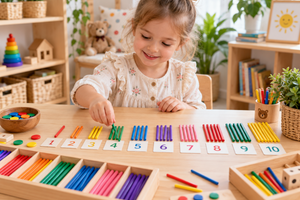
Six-year-olds often value a little independence. Add one optional mission: “Make three patterns that use the same pieces,” or “Choose a secret rule and let me work it out.” If the material uses letters or numbers, resist turning the first session into an assessment. Join the game as a curious partner and let the child explain what they notice.
Choosing for ages 7–9
A gift for a 7-year-old can contain a plan of several steps: a modest design challenge, a levelled logic game, a home investigation, or a cooperative tabletop mission. For a child who dislikes direct competition, choose a shared goal. For an enthusiastic competitor, consider the length of a round and whether an early piece of bad luck leaves meaningful choices.
At eight, advertising often splits suggestions sharply by gender. The better questions are consistent: what topic matters to this child, how independently do they want to work, and what kind of result would feel satisfying? An eight-year-old might appreciate a comic-making kit, a puzzle, a themed investigation, a strategy game, or materials for making a gift for someone else. None of these experiences belongs to one gender.
When seeking a gift for an 8-year-old child, avoid selecting an activity simply because it resembles extra homework. A child who loves words or numbers may enjoy an authentic game with choices and surprises. The Language & Mathematics collection shows several possible mechanisms, but the details and stated level of each item still need to be checked.
A gift for a 9-year-old child can reflect their preferences without revealing the surprise. Ask about a type of experience: would they rather make, solve, investigate, collect, or play with the family? You can then choose the particular item. Another thoughtful option is a “gift of time”: a handwritten invitation to one shared project evening paired with a modest supply kit.
Match the idea to interest and budget
Price does not predict how often an item will be used. A small deck with five game variations may remain relevant longer than a large, single-purpose set. Decide on a limit before browsing. Account for storage, replacement paper, or batteries only where they are genuinely required, and make sure the essential pieces are included.
|
The child likes… |
Modest direction |
A larger option |
A common mismatch |
|
creating stories |
character cards, notebook, home theatre props |
a themed set with several story routes |
a toy that only plays one recorded script |
|
sorting and finding |
pairs, lotto, inset pieces, logic cards |
a levelled puzzle or classification set |
too many tiny, nearly identical parts at once |
|
building |
large blocks, card shapes, simple design prompts |
a compatible construction set with open challenges |
a display model requiring constant adult assembly |
|
drawing and making |
good paper, pencils, age-suitable glue |
a project kit with spare consumables |
attractive decorations but awkward tools |
|
playing together |
a short card or cooperative game |
a board game with adjustable levels |
long elimination rounds and no practice mode |
Gifts for children on St Nicholas Day can feel abundant without being numerous: one central gift, a small treat according to family custom, and a personal note. If relatives have contributed several presents, opening everything simultaneously is optional. Saving one for another weekend gives each object time to become part of play.
Present it without turning play into a lesson
Avoid writing the St Nicholas note as a performance report. Mention a specific act of kindness, curiosity, persistence, or growth, and offer encouragement. The gift should not function as payment for perfect behaviour or as a threat that celebration will disappear after an ordinary mistake.
On the first morning, show only one possible move and ask, “Would you like to explore it yourself or begin together?” Excitement, tiredness, or another present may mean the child sets it aside. That reaction does not prove the choice was wrong. Return on a quiet day with a five-minute invitation.
Store the pieces in a clear container and add a picture of the complete set or a simple label. Independent access and tidy-up become easier. Weeks later, rotate the material, combine it with figures or drawing, or introduce a new rule. Freshness can come from a different use of familiar pieces, not only from buying something new.
Frequently asked questions
What is a versatile St Nicholas gift for a preschooler?
There is no completely universal gift. Flexible options have a simple first action and several uses: large themed cards, lotto, mosaics, blocks, or an accessible art set. Confirm the age guidance, the child's actual interest, and whether they can play for a few minutes without continuous adult direction.
Does the gift have to be educational?
No. Free pretend play, movement, art, and shared family time all support valuable experience. If you select an educational material, keep it playful: offer choice, an achievable challenge, and permission to stop rather than testing knowledge during a celebration.
How can I judge the right difficulty?
Look for a first action the child can attempt after one demonstration and a next level requiring modest effort. Examine sample tasks and piece counts. An open-ended material that begins simply is usually easier to extend with homemade rules than an advanced, tightly scripted set is to simplify.
Should gifts be divided into options for girls and boys?
Not unless the label reflects the individual child's own interest. Package colours do not determine ability. More useful categories are construction, stories, creativity, movement, logic, language, investigation, and social play; any child may prefer any combination.
When should I shop, and how can I reuse this guide next year?
Begin early enough to check the contents, delivery, and return information without pressure. Each year, note three current interests, one skill the child is personally keen to practise, and any formats they avoid. Those observations keep the decision relevant without chasing annual trends.
Conclusion
The most promising St Nicholas gift begins with attention to the child rather than a viral list. Balance age-appropriate safety, a manageable first step, favourite ways of playing, household space, and a realistic budget. Choose something with room for more than one scenario and let the child set the pace. The result is more likely to become part of everyday play instead of remaining an impressive box after the holiday.