Weather turns an ordinary window into a small laboratory. A child can notice how much of the sky is covered, whether a ribbon moves, whether drops remain on the railing, and which clothes make sense for the next outing. No elaborate station is needed to begin.
In this guide, a calendar is not a lesson about weekdays, months, or the order of seasons. It is a compact data sheet: each observation receives a consistent mark, and several marks can later be compared. The goal is to distinguish what is visible now from a forecast, record change, and use evidence for a practical decision.
This approach also keeps the conversation honest. “Clouds cover most of the sky” is an observation; “it may rain after lunch” is a prediction. Both are valuable, but they belong in separate boxes. Once children see that distinction, an inaccurate prediction becomes something to investigate rather than a wrong answer to hide.
Key takeaways
- Observe from one safe place at roughly the same time whenever possible.
- Begin with four features: sky, precipitation, wind, and warmth or coolness.
- Record what the child can observe, not what an app says should happen.
- Keep the same symbols and measurement method so entries remain comparable.
- Choose clothing from the combined conditions, outing length, and activity level.
What can a young weather observer record?
The sky
Start with three useful options: mostly clear, partly cloudy, and overcast. Ask how much of the visible sky the clouds cover and whether gaps remain. Shape, color, and movement can be added later. Accurate description matters more than rushing a preschooler to name a cloud genus.
Precipitation and its traces
“No precipitation” deserves its own mark. When rain or snow occurs, a beginner can choose light or heavy rather than estimate a number. Help the child separate a current event from a trace: the pavement may be wet even though the rain has stopped. Never go outside merely to complete a record during a thunderstorm, hail, a squall, or another hazardous event.
Wind
Air itself is invisible, but its effects are easy to find. Watch leaves, branches, a fixed flag, or a lightweight wind ribbon. Two choices—almost still and moving—are enough for a toddler; later add an intermediate or stronger category. Compare direction only from the same observation point, because nearby buildings and trees redirect airflow.
Temperature and personal sensation
A thermometer provides a number; a person reports how the conditions feel. Keep those entries separate. Twelve degrees Celsius is a reading, while “I feel cool in this wind” is an experience affected by clothing and activity. Together they can guide the next decision without pretending that every child will feel identical.
A short routine: notice, describe, mark
Use the same three-step routine. First, the child looks through a safe window or accompanies an adult to a suitable observation spot. Next, they say one visible fact without explaining it: “the ribbon is hanging,” “clouds are moving,” or “drops are on the bench.” Only then do they select a symbol and make a short verbal note. If an adult supplies every label immediately, the sheet records repetition rather than the child’s own attention.
Questions have different jobs. “What can you see?” invites evidence. “What changed since our previous entry?” prompts comparison. “What do you think may happen later?” opens a prediction. If two symbols seem possible, ask the child to point to the clue behind each choice. It is fine to mark uncertainty or look again after ten minutes.
A photograph from the same angle can support later comparison, but it need not replace close looking. A picture of the sky, tree, or ribbon is usually sufficient; avoid capturing faces, house numbers, and other unnecessary identifying details.
A weather calendar by age
|
Approximate age |
Features to track |
Recording method |
A sensible next step |
|
2–3 years |
One or two: sky and rain |
Choose one large picture from two or three |
Pick between a jacket and a rain layer |
|
3–4 years |
Sky, precipitation, and wind |
Sticker or symbol plus one spoken sentence |
Compare two entries and name one difference |
|
4–5 years |
Four or five, including temperature |
Symbols, a thermometer number, and a brief note |
Predict one change over a few hours, then check |
|
5–6 years |
Five or six, with one simple measurement |
A consistent grid and a short observation phrase |
Count symbols and describe only the pattern in the sample |
Age is a guide, not a deadline. Add a column when the child can observe that feature and record it consistently. A small grid used independently is more informative than a sophisticated sheet completed by an adult.
How to make an observation sheet that works
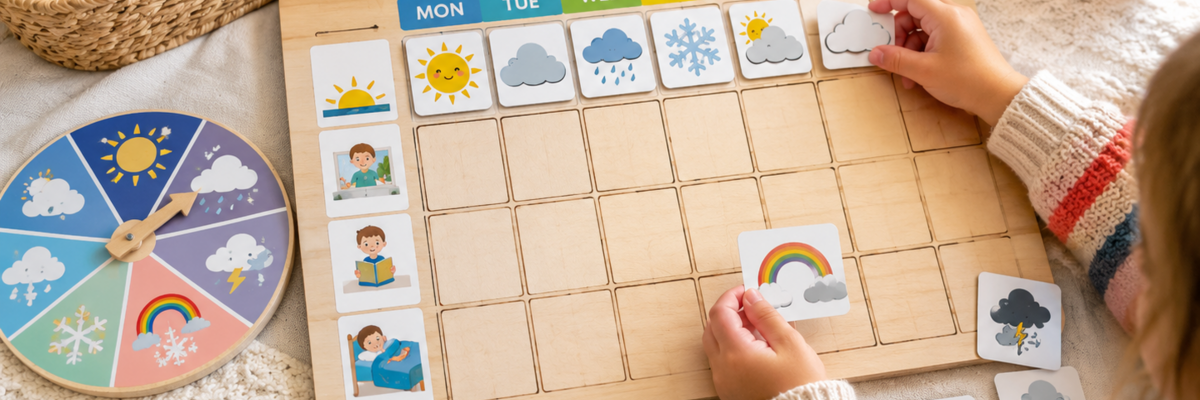
Create separate columns for sky, precipitation, wind, temperature, and clothing. Use only the first two for the youngest observer. Give each symbol one meaning: a sun behind a cloud means partial cloud cover, not “warm, dry weather.” A tiny legend beside the grid lets everyone interpret the marks in the same way.
Write the observation time or keep every entry within the same part of the day. A morning record and an evening record can legitimately differ. If a session is missed, leave the box empty instead of reconstructing it from memory or copying the forecast. Missing data are more truthful than invented continuity.
Seven to ten entries make a manageable first set. Look for two similar records, two contrasting records, and one surprising change. Avoid broad claims about an entire month or season from such a small sample. The useful statement is narrower: “In our eight morning observations, five had no precipitation.”
How to discuss the collected records
Lay the cards or rows side by side before counting anything. Invite the child to find two entries with similar skies but different wind, or similar thermometer readings with different clothing choices. They begin to see weather as a combination of conditions rather than a single icon.
Next, count a category and phrase the result precisely. Which rain-gauge reading showed the most water? How many observations showed a moving ribbon? A conclusion should stay within the actual sample. This language models careful reasoning without turning a playful routine into a formal statistics lesson.
Simple measurements without a complex weather station
Thermometer
Install an outdoor thermometer according to its instructions, away from direct sun and nearby heat sources. Compare readings from the same location after allowing a similar amount of time for the thermometer to stabilize. A younger child can mark warmer or cooler while an adult reads the instrument; an older preschooler can copy the number. This home setup supports comparison but should not be presented as an official meteorological station.
Ribbon or windsock
An adult can secure lightweight ribbons where fasteners and cords remain out of reach. Record a state rather than an invented wind speed: hanging, moving, or nearly horizontal. Keep the position unchanged. Indoors, test how a fan at a safe distance changes the ribbon, but do not treat that result as an outdoor measurement.
Rain gauge
A clear plastic container with straight sides can collect rain for simple comparisons. An adult places it upright in an open, stable location away from a walkway and empties it after recording. Begin with none, a little, and more; add marked levels only when the child understands what is being compared. Snow, wind, splashing, and container shape can affect the result, so call it a classroom observation rather than a precise official total.
Do not set up or check equipment during lightning, strong wind, hail, extreme heat, or another dangerous condition. Stay in a safe place and follow official local warnings. A gap in the data is normal and can itself prompt a conversation about responsible observing.
From a weather record to a clothing choice
Place the observation beside two realistic outfits. Identify a comfortable base, then check whether insulation or protection from rain and wind is needed. The child should explain the function of an item rather than call it “winter” or “summer” clothing. Change one variable—add wind, extend the outing, or switch from quiet walking to active play—and reconsider the layers.
After the outing, review the choice briefly: Was it comfortable at the start and after running? Was an extra protective layer useful? Different children may need different options under the same measured conditions. The adult sets safe boundaries, carries necessary spares, and responds to official alerts.
Six weather games that use real observations
1. Window report
In one minute, choose marks for sky, rain, and wind, then deliver a one-sentence report. If only a trace remains, say so: “It is not raining now, but the path is wet.”
2. Predict and check
Before lunch, predict one feature a few hours ahead. Record the prediction separately and compare it with the later observation. Ask which clues supported the idea and what changed unexpectedly.
3. Dress the character
Combine a weather card with an activity card. Select base, insulating, and protective layers as needed. Change one condition and invite the child to revise one item rather than replace everything.
4. Cloud detective
Find a card that most closely resembles the current clouds and give two pieces of visual evidence. Compare a photo from the same viewpoint later. Shape, coverage, shade, and movement matter more than a rushed scientific label.
5. What did the air move?
Place a cotton ball, pom-pom, and crumpled paper on a tray. An adult blows gently through a personal straw directed away from others. Compare how far the objects move. This demonstrates moving air; it does not measure outdoor wind speed.
6. Match the purpose
Match a condition to an object or action: rain to a water-resistant outer layer, strong sun to shade, and wind to a secured jacket. Accept more than one justified match because the complete situation matters.
Learn&Dream materials for a weather observation project
The Weather & Seasons learning materials offer images for describing current conditions, comparing clouds, and making practical clothing choices. Here, they support a record of observable evidence rather than memorization of calendar sequences.
|
Material |
First action |
Observation focus |
Extension |
|
Choose the closest image for the current conditions |
Separate the current condition, a trace, and a forecast |
Compare the card with a real photo and name one difference |
|
|
Match by shape and sky coverage |
Notice form, shade, motion, and visible gaps |
Photograph one viewpoint and compare it later |
|
|
Choose clothing for the observed conditions and planned activity |
Explain the purpose of the base, insulating, and protective layers |
Change wind, rain, or outing length and revise the choice |
At home and in a preschool group
At home, keep the routine to two or three minutes before an outing. The child looks, checks a ribbon, and helps choose clothing while the adult reads the thermometer. On a busy day, record one feature only; consistency matters more than a perfect page.
In a group, rotate roles such as sky observer, wind checker, thermometer reader assisted by an adult, and symbol recorder. Small teams can later select two records, name one change, and explain which mark provides the evidence.
Common weather-calendar mistakes
- Copying the forecast. Keep the forecast separate from the observed result.
- Adding too many columns. A few consistent features create better comparisons.
- Changing place and time constantly. Similar conditions make entries more comparable.
- Mixing temperature with sensation. Record the instrument and personal report separately.
- Dressing from one icon. Consider temperature, wind, rain, duration, and movement.
- Taking risks for an unbroken series. Safety and official warnings always come first.
Frequently asked questions
At what age can a child start a weather calendar?
At about two, many children can choose between two or three large pictures for sky or rain. Keep the routine brief and increase the number of features as the child shows genuine interest and consistency.
How often should we make an entry?
One short entry per day for seven to ten observations creates a useful first sample. Aim for a similar time, but leave a missed box blank instead of guessing.
Does a toddler need an exact temperature?
No. A toddler can compare warmer and cooler while an adult reads the thermometer. Add numbers when the child understands that the instrument provides a measurement and personal comfort also depends on wind, clothing, and activity.
What if the child’s prediction is inaccurate?
Keep it and record the actual conditions beside it. Discuss which clues were visible and which feature changed. A mismatch supplies evidence for the next prediction; it is not a reason to correct the sheet afterward.
How can a child learn to choose weather-appropriate clothing?
Offer two safe options and evaluate their functions in relation to temperature, wind, precipitation, outing length, and planned movement. Layers make the decision visible because protection or insulation can be added and removed as conditions change.
Conclusion: from an icon to an evidence-based choice
A child’s weather calendar is a repeated cycle: notice, mark, compare, and decide. It does not need to teach calendar vocabulary or produce a flawless sequence of entries.
Begin with two symbols and a few minutes. Add a thermometer, wind ribbon, rain gauge, and prediction only when earlier records are comparable. The child then moves beyond naming rain or wind and learns to check a claim, explain a choice, and observe safely.