Sensory Games for Children: What They Support and How to Organize Them at Home
Short answer: sensory play gives children a safe opportunity to notice, compare, and combine information from touch, movement, body position, sound, sight, smell, or taste. A large sensory room is not required. One clear action, a few age-appropriate materials, a calm adult, and the genuine option to pause or refuse can create a useful home activity.
Sensory games are often reduced to a tub of rice, foam, or other filler. Sensory experience is much broader. Children receive information through the skin, muscles and joints, vestibular system, eyes, ears, nose, and mouth. The brain combines these signals so a child can orient, plan a movement, locate an object, and understand what is happening.
The aim is not to provide as many bright impressions as possible. Too much noise, light, motion, and unfamiliar texture can be exhausting. A good activity has a predictable start, one main action, and an accessible exit. A child may watch, use a tool instead of a hand, take a break, or decide not to participate.
What sensory development means
Sensory development is the gradual improvement of a child’s ability to notice properties of objects and signals from the body, tell them apart, and respond with an appropriate action. A toddler compares smooth and rough, light and heavy, quieter and louder, or fast and slow movement. Later, the child holds more than one feature in mind, identifies an object by touch, controls pressure, and follows a movement direction.
Sensory information is present during dressing, meals, handwashing, drawing, walking, and tidying. Fastening hook-and-loop material combines touch, finger strength, and hand-eye coordination. Pouring water requires judging the weight of a cup, the direction of movement, and the point at which to stop. Sensory play does not sit apart from daily life; it makes these experiences more visible and manageable.
Avoid promising a guaranteed result from a single exercise. One box cannot “start speech,” and one texture does not treat developmental difficulties. Play may support attention, vocabulary, motor planning, and independence when it is part of regular, attentive interaction and suits the individual child.
Sensory systems involved in play
The tactile system provides information about touch, temperature, pressure, pain, and surface qualities. Suitable experiences may include clean fabrics, sponges, smooth cards, felt, water, or age-appropriate dough.
The proprioceptive system receives input from muscles and joints. It helps children sense body position and grade force. Carrying a manageable basket, pushing a cushion, modelling dough, using pegs, and carefully stretching a suitable resistance band under supervision provide this type of information.
The vestibular system responds to head movement, acceleration, and balance. Walking along a line, slow bends, safe stepping, and age-appropriate swinging involve it. Fast spinning is unnecessary and may cause dizziness.
Vision and hearing help children locate pieces, track movement, distinguish colors and rhythms, and identify the source of a sound. Intensity matters: a quiet voice and a small field of objects often support attention better than flashing lights or loud music.
Smell and taste are also sensory channels, but they require careful attention to allergies, food restrictions, and hygiene. Never invite children to taste non-food materials. Introduce smells gently and do not require a child to hold anything close to the face.
Adjusting play by age and experience
The table is a starting guide, not a developmental test. Manufacturer age limits, piece size, and the child’s actual behavior take priority. If a child explores with the mouth, use only items approved for that age and maintain direct supervision.
|
Approximate age |
Main action |
Helpful format |
One increase in challenge |
|
1–2 years |
Touch, squeeze, move a large item, copy a motion |
2–3 contrasting safe objects or water with a cup under supervision |
Add one word or one large item |
|
2–3 years |
Match textures, sort two colors, imitate a movement |
Large felt pieces, fabrics, and a simple movement path |
Add a third option or short sequence |
|
3–4 years |
Describe one feature, use tongs, identify a familiar object |
Touch bag, pouring, or sound pairs |
Remove a visual clue or request one reason |
|
4–5 years |
Combine two features, plan movement, copy a model |
Sorting, felt compositions, or a three-step route |
Add one rule, memory delay, or leader role |
|
5–6+ years |
Create a classification, describe sensation, design a game |
Comparison experiment, movement map, or original scenario |
Record an observation or change one condition |
Sensory games for children should remain an invitation, not a test of courage. If a four-year-old dislikes touching foam, there is no need to prove that they are “old enough.” Offer a spoon, glove, different texture, or the option to observe. Readiness is shown by calm curiosity and the ability to stop, not by age alone.
Preparing sensory games at home
Choose one purpose: compare two textures, transfer items with tongs, locate a sound, or complete a slow movement route. Mark the working area with a tray, mat, low container, or clear floor space. Remove materials that do not belong to the current task.
Inspect every item. Check age suitability, sharp edges, damage, loose fasteners, strong odors, and possible allergens. Small objects, magnets, batteries, water beads, and other high-risk fillers do not belong in unrestricted play. Safety cannot be established by saying “Do not put it in your mouth.”
Demonstrate one action and name the boundary: “We pour above the tray,” “We stop after the bell,” or “You may touch it with the spoon.” Keep a cloth or used-material container nearby. Restoring the pieces, wiping spills, and washing hands are part of the complete activity.
Ten simple sensory play activities
1. Mystery touch bag
Place two or three large familiar items in an opaque bag. The child touches one and matches it to a visible example. An older child can describe shape and surface before naming it.
2. Texture pairs
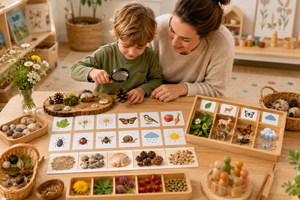
Prepare pairs of cotton, felt, smooth fabric, and sponge. Leave them visible at first, then hide one item from each pair. Materials must be clean and free of loose threads or detachable parts.
3. Transfer with tongs
Move large soft pieces between two bowls. Begin with hands, then offer child-sized kitchen tongs. The task supports grip and accuracy but should not cause pain or prolonged strain.
4. Slow movement route
Arrange a mat, cushion, and tape line on the floor. The child steps on, over, and along them at a comfortable pace. Use non-slip surfaces, a clear area, and no unnecessary height.
5. Sound pairs
Use opaque containers that are securely sealed so the child cannot reach the contents. Shake and match two that make a similar sound. Keep volume gentle and never shake a container next to the ear.
6. Find the color in the room
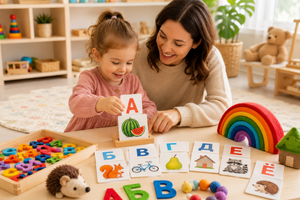
Show a color card and locate one matching object. Later compare a light and dark shade or make a small collection. Do not insist on a perfect color name while a child is still learning to distinguish the shades.
7. Water: full and empty
Put two small vessels and a minimal amount of water on a stable tray. The child pours, squeezes a sponge, and notices weight and level changes. An adult stays next to the activity, and all water is emptied afterward.
8. Copy a felt pattern
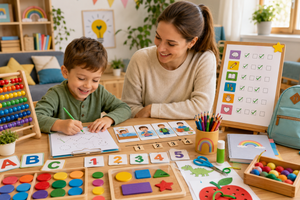
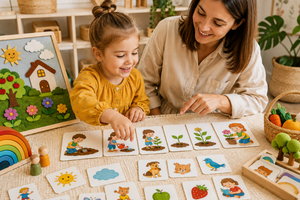
Show a composition made from three large felt shapes. The child recreates it on another base. Later show the model briefly and hide it, while temporarily reducing the number of pieces.
9. Strong movements without rushing
Invite the child to carry a manageable basket of soft items, push a large cushion toward a wall, or crumple paper for an art project. Resistance must suit the child. Do not add weights without professional guidance.
10. A sensory bin with large items
A sensory bin does not require a loose filler. Place large fabric pieces, balls with different firmness, and felt shapes in a container. Match pairs, sort by texture, or retrieve a named item. This version is easier to supervise and restore.
Connecting sensation with language and thinking
Name the action and sensation, not only the object: “You are squeezing the sponge; it feels soft and springy,” or “This container sounds quieter.” Offer choices: “Would you rather use your hand or the spoon?” Children gain useful words for their own experience instead of rehearsing a prepared answer.
Compare one feature at a time—smooth and rough, then soft and firm. When each concept is familiar, ask for an object that is both soft and large. An older child can create a category and explain why each item belongs.
After movement, ask a concrete question: “Which surface made balancing easier?” or “Which step came before the cushion?” This connects body experience with sequence and cause-and-effect thinking without turning play into an examination.
Carry one familiar contrast into daily life. After comparing soft and firm, find one example while dressing; after heavier and lighter, put away an empty and a filled box and name the difference. One brief comment is enough—there is no need for a second test. This helps words and actions transfer beyond the activity tray.
Choosing materials and related resources
You do not need to buy everything for sensory play. Choose a format in which the main action is visible, the pieces suit the age, and the set is easy to check. Always confirm the current description of a particular product.
|
Need |
Format |
First action |
Relevant collection |
|
Touch and precise finger movement |
Large pieces, hook-and-loop parts, grasping |
Attach or transfer 3–4 items |
|
|
Texture, shape, and assembly |
Soft felt parts |
Match a pair or copy a simple model |
|
|
Visual comparison and logic |
Color, shape, and sequence cards |
Sort by one feature |
When browsing educational toys for sensory experiences, focus on the action, piece size, and ability to control how much input is present. The guide to organizing a learning environment at home helps create an accessible work area. To change quantity, prompts, and independence, use the framework for adapting one learning game for ages 2, 3, and 4.
Recognizing comfort and overload
Signs of comfort include calm curiosity, repetition, the ability to stop and return, communication with the adult, and steady breathing. A child may be focused and quiet; this does not mean the activity needs more sound or questions.
Possible overload signals include turning away, covering the ears, pulling a hand back, suddenly speeding up, agitation, crying, freezing, or persistently trying to leave. Stop the input, remove the material, and offer a familiar calm place. Do not insist on “one more turn” merely to finish the planned round.
If sounds, touch, movement, dressing, eating, or other routines regularly cause intense distress and interfere with daily participation, discuss specific observations with a pediatrician or another qualified professional. Sensory games at home do not replace an individual assessment.
Common mistakes
- Combining too much input. Music, flashing light, scent, water, and movement together make responses harder to understand.
- Forcing touch. A tool, glove, observation, or refusal are valid options.
- Choosing filler for a photograph. Choking risk, allergies, hygiene, and cleanup matter more than appearance.
- Adding speed too early. Comfort and a stable action come first.
- Treating every reaction as a diagnosis. Fatigue, hunger, novelty, and context all affect behavior.
- Forgetting the finish. Cleanup, handwashing, and a calm transition belong in the plan.
Frequently asked questions
At what age can sensory play begin?
Sensory exploration begins from birth, but each material must match age and behavior. Babies and toddlers need large safe objects, short interaction, and direct supervision. Loose or small fillers are not necessary.
How long should a home sensory activity last?
Continue while the child remains calmly engaged. Five to ten minutes of a complete activity may be enough. Do not extend the session to meet a schedule when the child is tired, turns away, or asks to stop.
What can fill a sensory box without loose materials?
Use large fabric pieces, clean sponges, felt shapes, balls with different firmness, or large rings approved for the child’s age. Check every item and choose one action: match, sort, retrieve, or describe.
What if a child refuses to touch a new texture?
Do not force contact. Allow observation, use of a tool, selection of another texture, or ending the activity. Next time, place the new material beside something familiar while leaving the decision to the child.
Can sensory play replace work with a professional?
No. It supports play and daily experience but is not diagnosis or individualized therapy. When reactions interfere with everyday life, seek professional assessment and use home activities in line with qualified guidance.
Conclusion: less input, more attention
Sensory play works best when a child understands the action, feels safe, and can regulate participation. There is no need to collect dozens of textures or build a complicated room. One tray, two contrasting materials, a short demonstration, and time for exploration can already create a meaningful experience.
Begin with a channel the child willingly uses—movement, touch, sight, or sound. Add one new feature, observe comfort, and finish together. In this way, sensory play becomes a calm means of understanding objects, the body, and the words that describe experience rather than a race for stronger stimulation.