What to Give a 7-Year-Old: Useful Ideas for Learning, Creativity and Play
At seven, children usually have clear preferences and can explain why one present is exciting while another is forgotten after a day. That is why deciding what to give a 7-year-old child should begin with observation, not a list of this season’s bestsellers. Notice what the child reads, builds and draws, which questions return in conversation, and which activities are chosen without an adult’s prompting.
A good present supports a genuine interest and offers one manageable next step. A space enthusiast might enjoy more than pictures of planets: they may want to classify objects, read their names and make a small reference book. A child who invents stories needs material that can become characters, settings or clues. The goal is to give the seven-year-old an active role rather than turn a birthday into an extra lesson.
What changes around the age of seven
Seven often coincides with the first school years, but children do not reach the same skills at the same time. One reads short chapter books, another is gaining confidence with simple words, and a third currently prefers movement, construction or art. A gift should not test whether the child fits an imaginary standard.
Many children at this age can hold several rules in mind, plan a short sequence and explain how they reached an answer. They may stay with a project longer than they did as preschoolers. Yet, after a structured school day, they still need free play with no scores or corrections. A useful gift therefore has more than one mode: an easy starting activity, a challenge for later and an open-ended option in which the child decides what to make.
Five questions that prevent a random purchase
You do not need to interview the child directly. Listen to recent stories and ask a parent a few concrete questions.
- Which subject is genuinely interesting now? Space, animals, machines, drawing, music, experiments, sport and reading can all be strong starting points.
- What does the child like doing? Building, collecting, solving, imagining, competing, making things or explaining facts are more useful clues than colour preferences.
- Will the present be used alone or with others? Not every board game works without a partner, and some learning sets are awkward for a group.
- What level is comfortable? The label “7+” matters less than whether the child can understand the first action after a short explanation and experience an early success.
- What is already at home? It is usually better to add a new action to a favourite activity than buy a duplicate simply because the theme is familiar.
A quick choice by interest
|
The child enjoys |
A format worth considering |
What the child can do |
Check before buying |
|
Reading and words |
Word-picture cards, a language game or an accessible book series |
Read, match, explain and create new examples |
Product language, type size and word length |
|
Space and nature |
Themed cards, an atlas or a simple observation kit |
Classify, ask questions and build a mini reference book |
Accurate images, clear labels and room to explore further |
|
Art and making |
A focused craft kit with reusable techniques |
Plan, choose colours and finish a personal project |
Safe materials, realistic difficulty and refill availability |
|
Logic and rules |
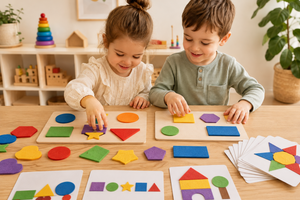
A puzzle, strategy game or cooperative challenge |
Test ideas, plan and take turns |
Playing time, player count and clarity of instructions |
|
Construction |
A modular set with models and free-building options |
Follow a plan and design independently |
Part compatibility, durability and storage space |
|
Movement and adventure |
Sports equipment, a treasure hunt or a family experience |
Practise a physical skill and share an experience |
Correct size, protection, supervision and place of use |
Gifts that support reading and language
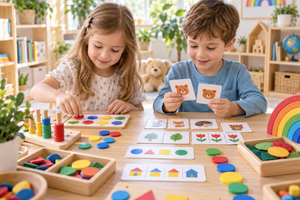
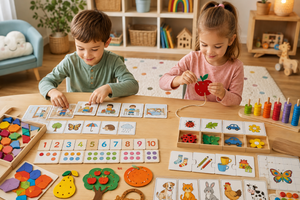
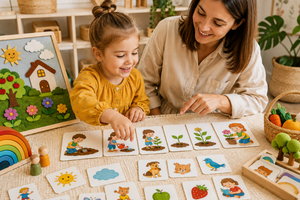
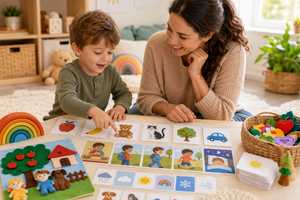
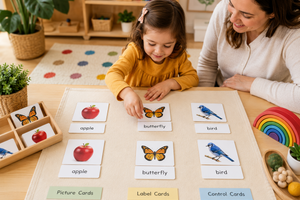
For a child interested in signs, comics or independent reading, choose material in which written words have a purpose. Matching a label to a picture, following a written clue, assembling a caption or making a new card feels like play because reading leads to an action. Repeating a list of isolated words can quickly feel like homework.
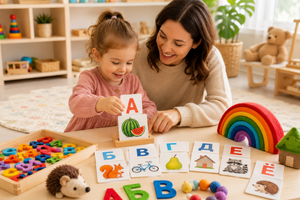
The Blue Series: Match the Picture to the Word, Set 1 uses word-picture matching and is marked for ages four to seven. It can suit a child who reads short Ukrainian words and enjoys finding correspondences. The linked product itself is in Ukrainian, even though the product page is available in English, so always check the material language, contents and type size before ordering.
The Blue Series: Matching, Set 1 combines reading with logical relationships and sound-letter analysis. Again, the linked set uses Ukrainian. To extend either material, invite the child to invent one new pair, write a clue for an adult or explain how an answer was checked. That small change turns a fixed task into a reusable game.
A book should reflect reading experience, not just the age on its cover. One child prefers short encyclopedia entries, another comics or a story read alternately with an adult. Length adds little when the format does not match how the child enjoys text.
Discovery gifts for a curious child
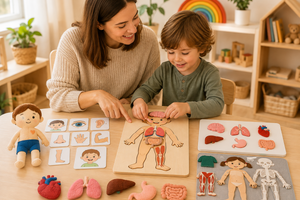
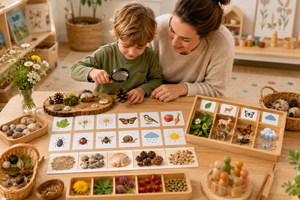
Around seven, broad curiosity often becomes wonderfully specific: black holes, volcanoes, the human body, insects, aircraft or prehistoric animals. Instead of a box of disconnected facts, offer a way to do something with information—sort it, compare it, label it, model it or record observations.
The three-part Space Objects learning cards introduce objects such as the Sun, a comet, an asteroid, a satellite, a rocket, a galaxy and the Solar System. The listed age is four plus and the linked cards are in Ukrainian. For a seven-year-old, move beyond basic matching: separate natural and human-made objects, write a question for each card, look up one additional fact or give a short family presentation.
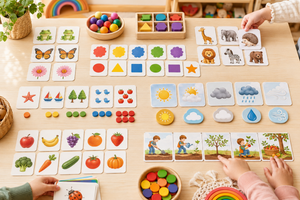
More themes are available among learning card materials. Do not choose the set that appears to teach the greatest number of facts. A focused theme the child already discusses is more likely to inspire repeated use. A thoughtful package might pair cards with an inexpensive field notebook and a promise to visit a museum, planetarium or nature centre together.
Creative projects and construction
The best creative sets provide enough structure to begin but do not dictate every detail. A reusable technique—simple sewing, model building, paper engineering or comic design—usually outlasts a box that produces only one object. Check the essential tools, the availability of refills and, for construction sets, reliable connections plus enough versatile parts for free building.
A child who enjoys long projects may appreciate a “project in a box”: a notebook, selected materials and one brief opening challenge. They might design an imaginary town, build a tabletop space museum or create a board game with original rules. An adult prepares a safe workspace and helps with difficult tools but leaves design decisions with the child.
These are strong creative gifts for 7-year-olds because the value is not a perfect finished object. The child makes choices, revises an idea and can return later with a new plan.
Gifts for girls and boys: use interests, not labels
Searches for a gift for a 7-year-old girl or a gift for a 7-year-old boy often produce two stereotyped shelves. Gender does not tell you whether a child enjoys engineering, animals, dance, astronomy, storytelling or crafts. Actions and interests are much better predictors.
If you wonder what to give a 7-year-old girl, the answer could be a microscope, a construction set, a strategy game or space cards when those match her curiosity. If you ask what to give a 7-year-old boy, art supplies, a music activity, cooking tools designed for children or a story-making set may be exactly right. There is no need to disguise an interest with a supposedly correct colour or character.
When relatives request a recommendation, answer with a verb: this child likes to build, read, run, draw, investigate or play with a group. It immediately narrows the useful formats. A birthday gift for a 7-year-old should recognise the individual, not reward the buyer for following an aisle sign.
Educational value without turning the gift into homework
Many families look for educational gifts for 7-year-olds, but “educational” should describe what the child can do, not a promise printed on a box. A simple card set that invites conversation may offer more than an electronic toy that merely repeats a recorded response.
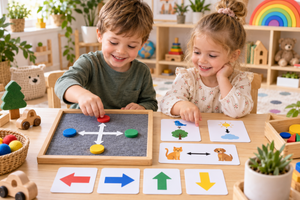
Look for agency. Can the child choose a strategy, compare two answers, explain an idea, create a variant or teach someone else? Also look for feedback that is visible without an adult grading each move: a construction stands, two cards match under a clear rule, or a puzzle piece fits. Immediate self-correction preserves independence.
Avoid giving practice material with the message that a weak school skill needs fixing. If reading is difficult, connect it to a beloved subject through a comic, a treasure hunt or short meaningful labels. The present should say, “I noticed what interests you,” not “Here is more work.”
Budget and personal meaning
Price does not determine whether a present will be used. A modest thematic set can become a favourite when it fits a current fascination and offers a clear first activity. A costly item can disappoint when it requires too much space, constant adult help or additional purchases.
|
Situation |
A sensible option |
How to make it personal |
Check in advance |
|
Small token |
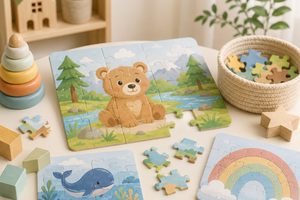
A book, compact puzzle or one themed card set |
Add a bookmark, note or first shared challenge |
Language, completeness and fit with the interest |
|
Medium budget |
Quality craft set, board game or modular construction kit |
Arrange a first game or project during the next week |
Player count, refills and storage |
|
Joint family present |
Larger construction, sports gear or discovery equipment |
Divide useful additions among relatives |
Size, safety, warranty and possible duplicates |
|
Experience present |
Workshop, quest, museum or planetarium visit |
Include an invitation and a small related keepsake |
Date, supervision and sensitivity to crowds or noise |
How to introduce a new gift
Do not demonstrate every function or read the entire manual immediately. Let the child inspect the set, ask questions and decide when to begin. Prepare one short activity with a reachable finish: find five matches, play a trial round, build one model or make the first page of a notebook.
When the child makes a mistake, resist showing the answer straight away. Ask what has already been checked and what they might try next. The present should be associated with curiosity, not evaluation. Afterwards, put the pieces away together and agree where the set will live; even an excellent gift is rarely used if setting it up is difficult.
This matters for all gifts for children aged 7. A brief follow-up a week later—“What was your most surprising discovery?”—shows sincere attention without demanding an immediate performance of gratitude.
What to avoid
Be cautious with a large difficulty gap. “Something to grow into” is not helpful when the first step already requires continual adult direction. At the other extreme, a toy whose only action is pressing a button for one effect may become predictable very quickly.
Check the age marking, small-part warnings, magnets, fasteners and battery compartment. For art kits, read material and tool instructions. Never give a live animal without explicit agreement from the whole household; that is a long-term responsibility rather than a birthday surprise.
Related guidance before you choose
If the present is connected with school skills, the guide to school readiness through play helps separate reading and counting from equally important attention, language, movement, planning and independence. For playful literacy ideas, see how to explore letters and sounds with a child.
You can also browse educational toys by the action they invite. Choose one or two experiences the child is likely to repeat rather than the longest list of claimed developmental benefits.
Frequently asked questions
What is a safe all-round gift for a seven-year-old?
No choice is truly universal, but a book on a familiar subject, a puzzle with levels, an open-ended art material or a short family game are dependable directions. Confirm the child’s current interest, the product language, what is already at home and whether a partner is needed.
What can I give a child who already has many toys?
Consider refills for a favourite craft, a museum ticket, a workshop, an addition to a compatible construction set or a compact discovery kit. An experience and the chance to make something personally meaningful are often more valuable than another large box.
Is a learning resource appropriate as a birthday present?
Yes, when the child is curious about the subject and the resource supports play, investigation or choice. Do not present it as a way to fix grades. The first activity should be brief, achievable and free from speed tests.
How do I choose when I barely know the child?
Ask a parent for two current interests, favourite ways to play, the needed language and possible duplicates. For a classmate, a compact board game, book, craft set or flexible gift certificate can be easier to match than a highly specialised toy.
Should gifts differ for seven-year-old girls and boys?
No. Match the present to interests, experience and preferred style of play rather than gender. Technology, space, art, music, logic, movement and storytelling can engage any child.
The best gift gives the child a meaningful role
There is rarely one correct answer to what a seven-year-old should receive. Observe genuine interests, check difficulty and safety, and account for language and context of use. A strong present lets the child do more than obtain a finished result: it invites reading, investigating, making, explaining or adapting rules.
Make the first action possible today and let later challenges unfold gradually. Then the gift will not compete with school or free time; it will become a starting point for a new interest and shared conversation.