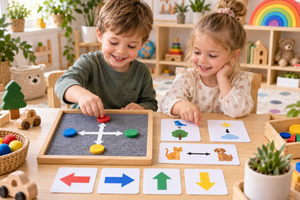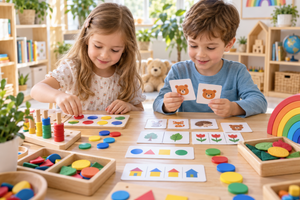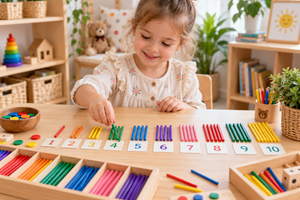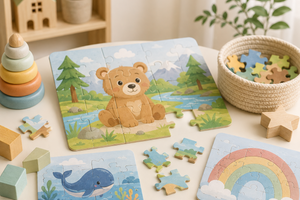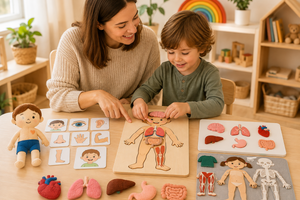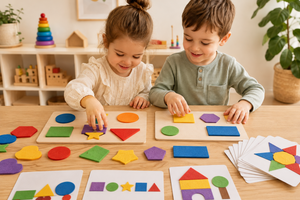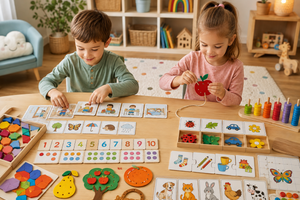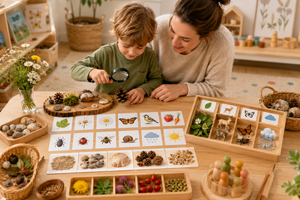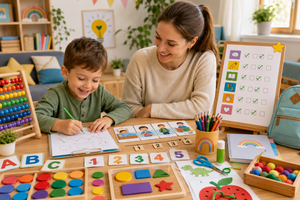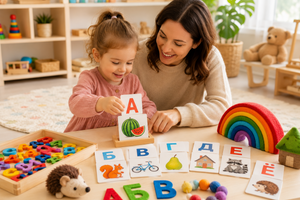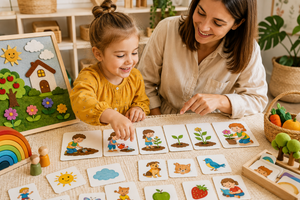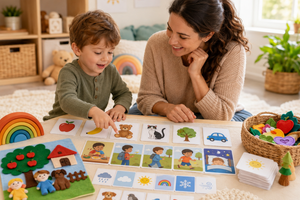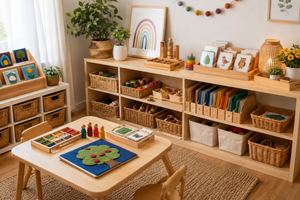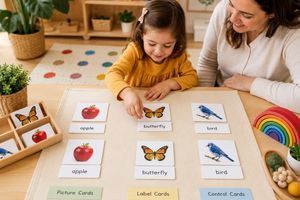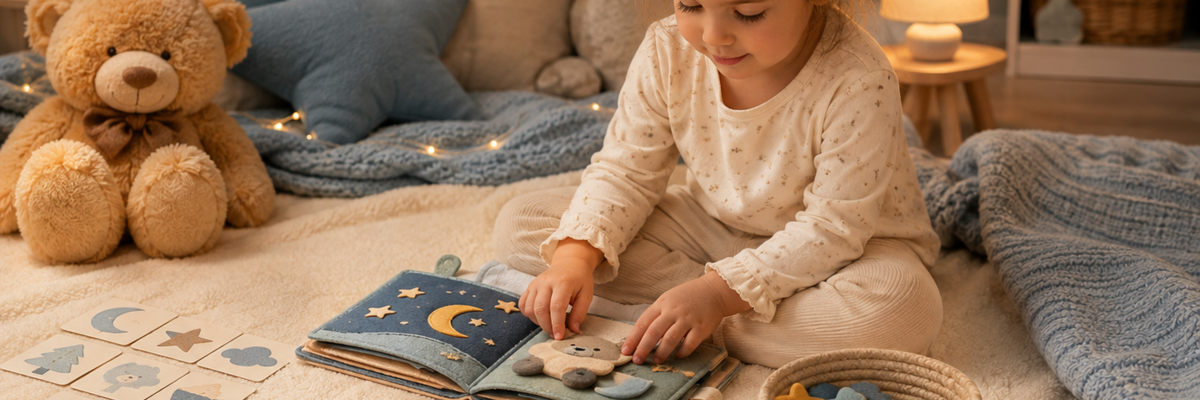
An evening game does not need a special bedtime theme. What matters is its rhythm: a familiar action, a small amount of material, and an ending the child can see coming. Placing a few felt pieces, finding open pairs, copying a short pattern, or telling a gentle picture story can create a clear bridge from the active part of the day to the family's next evening step.
Quiet play is not a treatment for sleep difficulties, and it cannot promise faster sleep. It is simply one optional part of a predictable home routine. This guide explains how to select and shorten activities for children ages two to five, how to end without opening “one more round,” and how several current Learn&Dream materials can be used in a calm, limited format.
Key takeaways
- Choose a familiar rule, a few pieces, and a visible finishing point.
- Use a regular quiet play place rather than scattering parts in the bed.
- Leave timers, loud celebration, electronic effects, and demanding new rules for daytime.
- Plan five to fifteen minutes according to age and energy, even when the full set offers much more.
- A calm routine may make the evening more predictable, but it is not medical care or a guarantee about sleep.
What makes an activity genuinely calm?
One clear action. The child already understands the verb: match, place, join, sort, or name. A short instruction reduces the amount of explaining and correction at the end of the day. If a game needs three demonstrations before the first move, introduce it at another time and bring it back once it is familiar.
A steady repeated movement. Moving soft pieces, joining halves, and matching colours can happen without speed. The goal is not to make every child silent; conversation and laughter still belong. However, an activity that reliably turns into running, shouting, or defending a score is better suited to an earlier part of the day.
A small field. Remove most of the set before inviting the child: three pairs, one short sample, five apples, or two silhouettes. The remaining amount should look complete in itself, not like an unfinished portion of a much larger challenge. Store the unused pieces out of sight.
An announced final step. Say what will happen: “We will finish these two hearts, put the pieces in the pouch, and choose a book.” A concrete sequence is easier to follow than a sudden “That's enough.” It also helps the adult avoid negotiating after each new move has begun.
Quiet evening games by age
The table is a flexible starting point. A stimulating day can make an easy task feel too large. Reduce the number of pieces or turn questions into a shared action: the adult locates a matching half and the child attaches it. A two-minute version still counts as a complete interaction.
|
Age or situation |
Approximate time |
Useful format |
A clear ending phrase |
|
2–3 years |
5–7 minutes |
Two or three large pieces, one colour, object and place, one short sequence |
“One last piece, then everything goes home in the pouch” |
|
3–4 years |
7–10 minutes |
Open pairs, silhouettes, a three-step sample, a gentle picture story |
“We will find one more pair and close the game” |
|
4–5 years |
10–15 minutes |
A pattern, logical pair, picture description, or simple plan for tomorrow |
“We finish this row, check the pieces, and move on” |
|
Very tired child |
Two to five minutes, or none |
Place a few pieces together or simply look at one image |
“That is enough for today; we can return another time” |
Prepare the space without making it theatrical
Keep one game and one parts container on the surface. Put other toys beyond the immediate field of view, so the child is not repeatedly switching sets. Lighting should be comfortable and bright enough to distinguish details safely; there is no need to create darkness for atmosphere. Choose a place where both players can sit without blocking a busy walkway.
Silence the adult's phone or place it elsewhere. The household does not need to become perfectly quiet, but notification sounds and simultaneous scrolling make shared attention fragile. A present adult can use fewer prompts. The game may contain stretches in which neither person is asking a question or trying to produce a learning outcome.
Mark the beginning as well: “We have ten quiet minutes.” If the child is already resisting any structured activity, do not force the ritual to preserve a schedule. A book, a short conversation about the day, or moving directly to the next household step may be the more appropriate choice.
Turn almost any daytime game into an evening version
Reduce the set to one mini-task
If the daytime activity uses twelve cards, keep four. If the child normally builds six pictures from samples, offer one. This is not “too easy.” The purpose is a completed shared action, not progression to the next level. Close the rest of the components in their box before the game starts, so they do not look like work that remains to be done.
Replace winning with a shared outcome
Points, records, and winning streaks can make a silent board game emotionally noisy. Change “who is fastest?” into “can we complete one row together?” One person selects a piece, the other places it, and the roles switch. Cooperation also makes it easier to stop because neither player is protecting a lead or demanding a rematch.
Lower the language demand
Do not ask for colour, shape, number, and reasoning after every move. Pick one language focus, or allow several minutes of quiet work. An adult might use only three neutral comments: “found it,” “let's check,” and “finished.” The activity retains its logic without becoming an end-of-day interview.
Make the route to the finish visible
Put a small group of unused pieces on the left and an empty return container on the right. Each move visibly reduces what remains. A card activity can begin with a stack of three; a pattern can have a clearly marked final space. “Only a little longer” is abstract, while the last available piece is concrete.
Connect the end to the next familiar step
After play, the material returns to the shelf and the child chooses a book, brushes teeth, or prepares clothes. Use the same short description across several evenings. This does not promise any sleep result. It simply makes the transition understandable and prevents the game from expanding into an undefined block of time.
Keep a two-minute alternative
Late returns, visitors, or an unusually busy day can make the regular version unnecessary. Agree on a tiny option: attach one piece, return it to the pouch, and choose the next activity. The child may also skip the game completely. There is no need to double the session the next evening or “catch up” on unused tasks.
Eight screen-free, sound-free play scenarios
1. Put each piece in its place
Select three large pieces and their positions on a base. The adult names an item quietly and the child attaches it. There is no extra level. When all three items have “gone home,” both players put the material away. The packing action belongs to the game instead of arriving as an interruption.
2. Two open pairs
Lay four cards or felt shapes face up. The child finds the partners without a memory demand. With an older preschooler, ask one question after the match: “What is the same?” Avoid turning the round into rapid-fire memory or adding extra pairs simply because the first two were easy.
3. A three-step pattern
Make a row such as red, yellow, red and invite the child to copy it below. On another evening, change the shape but keep the length. Do not introduce both a longer row and a new rule at once. A finished pattern provides a natural stopping point that the child can recognise.
4. Find the silhouette
Offer two objects and two strongly contrasting silhouettes. Let the child place an object on the outline to check. A hint does not spoil the activity; this is not a test. An older child can notice one contour clue—long ears, a round body, or a wide roof—without giving a full explanation.
5. A gentle story about one piece
The child chooses one felt figure. The adult begins: “In the evening, the little apple returned to its tree…” Add no more than three events and give the story a settled ending. Avoid suspenseful trouble and repeated demands for the child to invent what happens next. They may listen, add one sentence, or simply move the character.
6. One thing from today
Choose three pictures that might connect with the day: food, transport, or nature. The child selects one and shares a related moment. If they do not want to talk, the adult can offer one brief observation. Do not require a report, correct the event order, or turn the conversation into a review of behaviour.
7. Cooperative sorting
Take turns placing one element: large here and small there, or warm colours here and cool colours there. There are no points. If the rule becomes confusing, return to one obvious feature or stop after the next piece. A neutral “we finished our two groups” closes the activity.
8. Check and pack
Use the final two minutes to compare a completed picture with its sample, count the large components, and return them to their sections. This sequence means the material is not suddenly taken away. It also lets the child complete a real responsibility without needing a separate clean-up contest.
Learn&Dream materials for a quiet evening format
Learn&Dream offers felt fine-motor activities built around repeatable placement, matching, and pattern actions. For evening use, the important feature is not completing every educational possibility, but selecting a small self-contained portion. Always check the age guidance and supervise components appropriately.
|
Material |
Quiet scenario |
Evening amount |
Gentle finish |
|
Place apples by colour or count a few pieces |
Three to five apples |
All apples return to their pouch |
|
|
Felt Board “Find the Shadow” |
Match an object to an outline and notice one contour clue |
Two to four pairs |
One final overlay check |
|
Felt Game “Coloured Hats” |
Match colours or repeat one simple row |
One short pattern |
Finish the row and return the pieces |
|
Felt Game “Match: Shapes” |
Select the correct shape or copy one sample |
Two or three tasks |
Compare the last picture with its sample |
Select the material by action rather than by how many learning possibilities appear in the full set. For an evening version, the child should be able to see the complete small task and return every piece without opening a second round. Check the age label, supervise the components, and introduce an unfamiliar product during the day before using it in a quiet routine.
Common mistakes
- Introducing the hardest new game. Several new rules are usually better learned earlier in the day.
- Opening the whole set. A small portion is easier to finish without conflict.
- Adding timers and competition. Speed and scorekeeping change the emotional tone.
- Starting without a boundary. Announce the last move before another series begins.
- Testing after every action. Parts of the activity may happen without questions.
- Forcing the ritual. If the child declines, move to another familiar evening step.
- Promising the game will make the child sleep. It can structure a transition, but it is not a guarantee or treatment.
Frequently asked questions
How long before bed should a quiet game begin?
Use the family's existing sequence rather than a universal number of minutes. Leave enough time to finish a five-to-fifteen-minute activity without rushing into the next household step.
Should we play directly in bed?
A separate regular place is usually more practical. Pieces do not disappear into bedding, and putting the game on its shelf creates a clear transition to what comes next.
What if my child asks for another round?
Refer to the boundary announced at the start, complete the final move, and offer to photograph or preserve the sample for tomorrow. Do not open a new sequence after the finish.
Does evening play have to be educational?
No. It may simply be a pleasant shared action. If sorting, counting, or vocabulary naturally appears, keep it light and avoid assessment.
Will a quiet game solve sleep problems?
This article does not provide guidance about sleep disorders. A quiet game may belong to a predictable home routine, but it is not treatment; ongoing or concerning questions should be discussed with a qualified professional.
The aim is a calm ending, not making sleep happen
A suitable evening game has a simple rule, a small amount, and a finish the child can see. The child knows the action, completes the final step, and helps return the material. Predictability—not difficulty—makes the activity fit this part of the day.
Choose according to the child in front of you: sometimes ten minutes of sorting works, sometimes one piece is enough, and sometimes no game is the right choice. Quiet play remains a flexible family practice, never a compulsory condition or a promise of a particular sleep outcome.