Sports for children: names, classification and learning games
Is swimming an individual sport, a summer sport or a water sport? All three answers can be useful. Change the question and the same picture may move into a different group. That simple discovery makes sport vocabulary especially valuable for children: naming an activity is only the beginning, while comparing it from several viewpoints builds richer language and more flexible thinking.
The purpose is not to decide which sport is best or to choose a club. It is to notice what a sport is called, who takes part, where it happens and when people commonly associate it with a season. Pictures, counters and educational toys can turn these ideas into conversations rather than a list to memorise.
For adults looking for sports for preschoolers, the activities below are language and classification games. They do not teach technique, prescribe exercise or promise a particular developmental result. Actual participation in a sport involves separate questions about interest, suitable instruction, equipment, supervision and local safety requirements.
One sport can belong to several groups
A category answers a particular question. “Team or individual?” asks about participation. “Summer or winter?” asks about a common season or competition context. “Land, water or air?” asks about the main setting. These groupings cross one another instead of forming a single ladder.
Football is a team sport, is played on land and is often associated with outdoor warm-season play, although organised football also takes place throughout the year. Swimming is performed by each swimmer, yet relays have teams; it is a water sport and appears in the Summer Olympic programme, while indoor pools make year-round participation possible. Neither example needs one permanent label.
Children may first expect every card to have one correct “home”. Let them sort by one question, look at the result and then return all cards to the middle. Announce a new question and sort again. When a card changes groups, the first answer has not become wrong. The viewpoint has changed.
|
Sport |
Participation view |
Seasonal view |
Setting view |
A useful point to discuss |
|
Football |
Team |
Often linked with warmer outdoor seasons; also year-round |
Land |
Indoor and outdoor versions change the context, not the name |
|
Swimming |
Individual and relay team events |
Summer competition; possible indoors all year |
Water |
One swimmer acts individually while a relay score belongs to a team |
|
Ice hockey |
Team |
Winter |
Ice surface |
Frozen water is present, but the playing surface is treated differently from open-water sports |
|
Skiing |
Mainly individual, with some team events |
Winter |
Land covered by snow |
The season and surface are closely connected |
|
Rowing |
Individual or crew |
Commonly associated with warmer seasons |
Water |
Boat size changes whether one person or a crew participates |
|
Sailing |
Individual or crew |
Commonly associated with warmer seasons |
Water and moving air |
Water supports the boat while wind helps move it |
|
Skydiving |
Individual jumps or group formations |
Weather-dependent, often warmer-season |
Air |
A picture may be classified for vocabulary even when the activity is not for children |
|
Beach volleyball |
Team |
Summer |
Land, specifically sand |
The playing surface helps distinguish it from indoor volleyball |
Ask three questions, not one
The easiest way to keep the groupings clear is to attach each one to a short question.
- Who takes part in the event? One competitor, partners or a team?
- When is it commonly played or shown? Is it strongly linked with summer, winter or neither?
- Where does the main action happen? On land, in or on water, or in the air?
The answers need room for “both”, “it depends” and “not enough information”. Those phrases are not evasions; they show that the child is considering the version of the sport shown. A rowing single and an eight are both rowing, but one is individual and the other requires a crew. A parachute picture clearly suggests air, yet it says little about season without more context.
The wider social world learning materials can help connect sport names with people, places, clothing and equipment. The adult’s role is to keep the current question visible instead of accepting or rejecting a label without explaining why.
Summer and winter sports are seasonal associations
Pictures of snow, ice, a beach or bright sunshine offer strong clues, so summer and winter sports are often an accessible first comparison. Skiing, snowboarding, biathlon, figure skating and ice hockey are closely associated with winter conditions or ice. Sailing, beach volleyball and many athletics events are commonly linked with summer competition.
Season does not always describe every real occasion. Swimming can happen indoors in January. Football leagues follow different calendars in different countries. Tennis is played across much of the year. An indoor ice rink can operate in warm weather. It is therefore more accurate to say “commonly associated with winter” than “only possible in winter”.
The seasonal sports didactic cards can be sorted first by visible clues and then reconsidered through discussion. Ask whether the clue belongs to the sport itself, the venue, the clothing or the background. This separates evidence in the picture from assumptions added by the viewer.
Land, water and air describe the setting
Setting groups begin with the place or medium most important to the activity. Running, football, basketball, gymnastics and fencing take place on a solid surface. Swimming, diving, rowing, canoeing, surfing and sailing depend on water. Parachuting, hang gliding and paragliding place the participant in the air for the central part of the activity.
Dedicated visual sets can make the vocabulary manageable: water sports cards focus attention on water, air sports cards highlight activities above the ground, and land sports cards provide contrasting examples on solid surfaces.
Some borders remain interesting. Sailing uses both water and wind. Kitesurfing combines a board on water with a kite in the air. Ice hockey happens on frozen water, but is normally discussed as an ice or winter sport rather than placed beside swimming. Instead of hiding these examples, use them to ask which part of the activity the current group is meant to describe.
Team and individual depend on the event
The visible number of players is a useful starting clue. Football, basketball and ice hockey require teams in their standard forms. Singles tennis, many gymnastics events and an individual swimming race focus on one competitor’s result.
However, the sport name alone may not settle the answer. Tennis includes singles and doubles. Swimming and athletics include individual races and relays. Rowing includes single sculls and multi-person boats. Even when competitors perform one at a time, their results may contribute to a team competition.
Try naming the most specific version shown: “singles tennis”, “a swimming relay” or “a rowing eight”. Specific language resolves many disagreements. It also teaches children that categories describe an event or format, not the personality of the athlete. “Individual sport” does not mean that a person trains without teachers or other people nearby.
Learning games that change the sorting rule
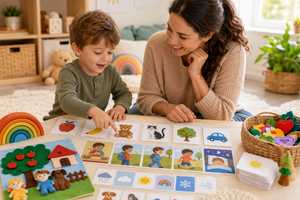
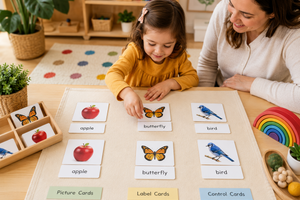
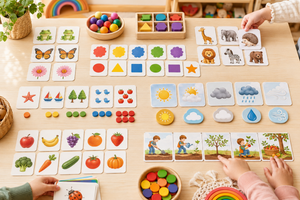
Good classification play makes the question more important than speed. Begin with a small, clearly visible card set and one rule. Once the child can explain that rule with a word, gesture or short sentence, change only the question. The same cards then produce new relationships without requiring a completely new vocabulary set.
|
Game |
Simple setup |
Prompt to use |
What children can notice |
|
Sort, then re-sort |
Place 6–10 sport pictures in the middle |
“First sort by season; now sort by setting” |
A card can move while both groupings remain valid |
|
One card, three answers |
Reveal one picture at a time |
“Who, when and where?” |
One sport can collect several labels |
|
Mystery sport |
Describe without showing the card |
“It is a team sport on ice” |
Several features narrow the possibilities |
|
Find the exception |
Show four cards, with one differing by the chosen rule |
“Which one does not match this question?” |
The answer can change when the rule changes |
|
Overlap circles |
Use two loops labelled, for example, “team” and “water” |
“Can any card belong in the overlap?” |
Groups can intersect rather than remain separate |
|
Evidence detective |
Study clothing, equipment and background |
“What in the picture supports your answer?” |
A claim can be linked to a visible clue |
|
Child as host |
The child chooses and states the next sorting rule |
“Tell us the question before we sort” |
Clear instructions matter as much as the result |
Make explanations part of the game
A correct pile gives only part of the learning opportunity. Invite a short reason: “I put rowing with water sports because the boat is on a river.” A preschooler may answer with one word and a point to the picture; an adult can model the complete sentence without demanding repetition.
When children disagree, return to the question. If one puts sailing under water and another under air, both have noticed meaningful information. For a setting sort, decide whether the group is based on where the craft travels or what makes it move. Then name the choice: “Today we are sorting by where the activity happens, so sailing goes with water.” On another round, “uses wind” could form a different group.
Avoid correcting from the label alone. Ask what version the child imagines. “Tennis is a team sport” may refer to doubles; “swimming is a team sport” may refer to a relay. The explanation reveals whether the child misunderstood the rule or supplied a context that the picture left open.
Adapt the language without changing the idea
For younger learners, use a choice between two clear groups and a small number of distinct pictures. The response can be placing, pointing or naming. Keep labels concrete: “water or land?” is easier to process than a long definition.
For children ready for more language, add qualifiers such as “usually”, “sometimes”, “both” and “in this event”. They can compare two cards, invent a clue or defend an overlap. Mixed-age groups can share the same materials while taking different roles: one child places a card, another names the sport and a third explains a second possible group.
Sports for children also provide a natural bridge to other classification themes. After sorting by land, water and air, compare the logic with children’s transport classification games. A boat and rowing both connect with water, but one card names transport and the other names an activity. This comparison strengthens word meaning without pretending the two systems are identical.
Notice reasoning, not a perfect pile
Progress can appear in several forms: the child remembers a sport name, holds the current question in mind, changes a card’s position after the rule changes or gives evidence for an unusual answer. These observations are more informative than how quickly the child finishes.
If every card goes into one group, check the instruction together and demonstrate one contrast. If the child insists that a card has two homes, ask for both reasons. If attention fades, finish with one familiar mystery clue or let the child choose the final card. Classification should remain a shared investigation, not a test of sporting knowledge.
Frequently asked questions
Can one sport be both team and individual?
Yes. Tennis has singles and doubles; swimming has individual races and team relays; rowing has one-person and crew boats. Name the event shown and allow “both” when the sport includes more than one format.
Is every water sport a summer sport?
No. Water describes setting, while summer describes a seasonal association. Swimming and other water sports may take place indoors or in different seasons. A child should answer each question separately rather than treat “water” and “summer” as synonyms.
Where should sailing go: water or air?
For a sort based on where the craft travels, sailing belongs with water sports. Wind is also essential, so sailing can join a “uses moving air” group in another game. State the rule before deciding where the card belongs.
How many sport cards work well for preschoolers?
There is no fixed number. A small field of six to ten distinct pictures often keeps names and group labels visible, while some children may prefer fewer or more. Add complexity by changing the question before enlarging the set.
What should an adult do when a child gives an unexpected answer?
Ask, “What made you choose that group?” The child may have noticed a relay, indoor venue, frozen surface or piece of equipment. Compare that reason with the current question, acknowledge useful evidence and clarify the rule when needed.
A practical way to finish
Choose six varied sport pictures and make three labelled pairs: team or individual, summer or winter, and land or water or air. Sort the same cards three times. Before each round, say the new question aloud; after each round, invite one explanation and one card that could reasonably belong elsewhere.
The important result is not a final arrangement that never changes. It is the ability to name the sport, identify the question, use a clue and reconsider a category when the viewpoint changes. That is what turns sports vocabulary into flexible classification play.