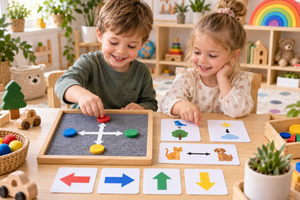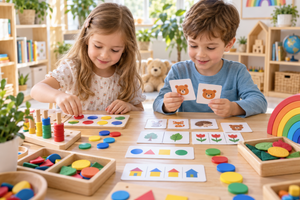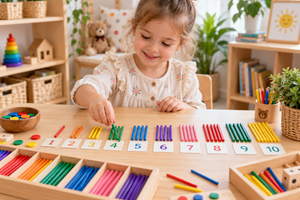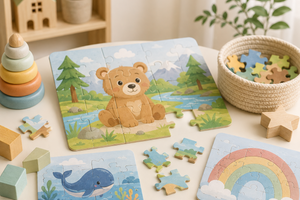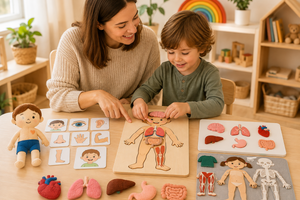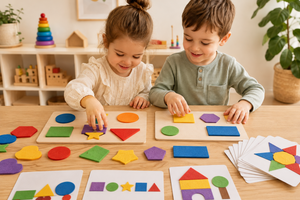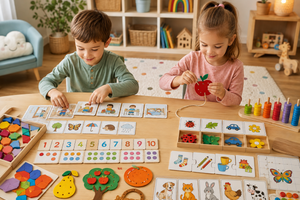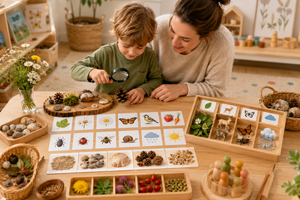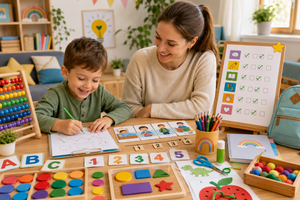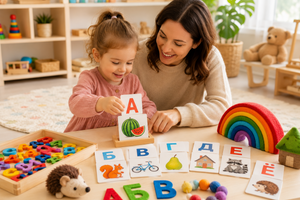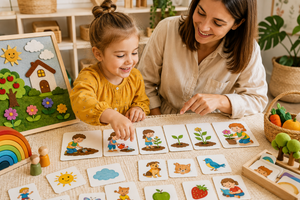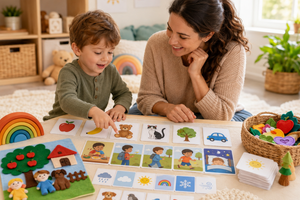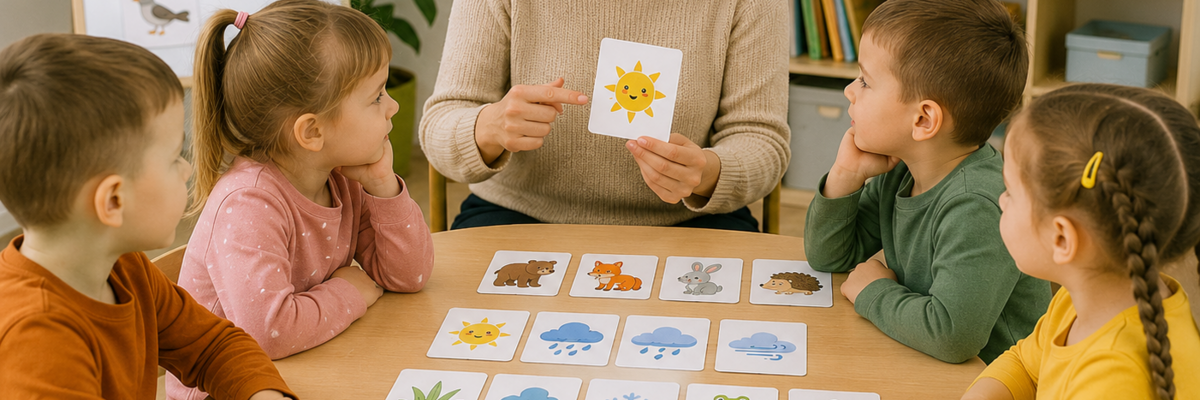
A card in the educator's hand can easily turn into a long whole-group quiz: the adult shows it, one child answers, and everyone else waits. The limitation is not the card. The same images can support sorting, partner matching, short explanations, station work, or a shared story in which every learner has a concrete action.
Small groups need frequent turns and changing roles. Large groups need visibility, parallel participation, and a transition rule that takes seconds to understand. The formats below are designed for preschools, primary classrooms, and learning centres, with practical examples from current Learn&Dream card sets.
Key takeaways
- Plan the child's action—find, group, explain, order, or check—not simply “show the cards.”
- In a small group of three to six, assign roles and rotate after one or two turns.
- In a large group, use duplicates, stations, partner talk, and simultaneous gestures instead of twenty serial answers.
- Give one session one main learning goal and one observation focus.
- Cards support educator observation in context; they are not a stand-alone diagnostic test.
Four decisions to make before the activity
1. Name an action, not just a topic
“Insects” is a theme, not a task. “Sort by how they move,” “match a label to an image,” or “state one shared feature” describes what learners will do. Once the action is clear, the educator can select only the needed part of a set and explain the rule in one sentence.
2. Choose one primary goal
Cards can engage vocabulary, reading, memory, and classification at the same time, but a short group episode works better with a main focus. Today children may sort by habitat while the educator models names without assessing every response. The same cards can support sentence building in a later session.
3. Prepare packs by role
Do not place the whole box in the middle. Separate cards for the facilitator, participants, and self-check. If there are four stations, each receives a labelled pouch and a place for completed cards. A duplicate image is often more valuable than a queue to the only copy.
4. Define a visible finish
The task ends when three categories are filled, every pair has made two descriptions, or each station has completed one series. “Until time runs out” is less informative. A visible amount helps learners pace their attention and makes clean-up and rotation much easier.
Choose a format by group size
|
Group |
Organisation |
Useful action |
Educator role |
Watch for |
|
2–3 learners |
One set on a shared surface |
Pairs, description, logical links |
Models language, then steps back |
One learner taking every turn |
|
4–6 learners |
Roles or two teams |
Sorting, clue cards, shared story |
Ensures roles rotate |
The same child always leading |
|
7–12 learners |
Pairs, trios, two or three stations |
One action on several mini-sets |
Observes and gives brief prompts |
A rotation explanation that is too long |
|
13–25 learners |
Four or five stations or simultaneous response |
Classification, gesture choice, solution gallery |
Controls pace and samples examples |
A serial queue to one small card |
Specific formats for small groups of 3–6
Role circle
Use four roles: select a card, name it, choose a category, and check. Move roles clockwise after every card or two. With younger learners, combine naming and sorting and check together. The structure prevents the quickest child from controlling the material while quieter children watch.
Question-and-answer partners
One learner draws an image and chooses a prepared question: “Where might we see it?”, “What is it used for?”, or “Which group fits?” The partner answers and roles switch. Keep a support card with two or three sentence starters on the table so producing the question is manageable.
Secret sorting rule
Place a few cards in two groups without naming the principle. Learners take turns positioning a new image and explaining a hypothesis. Begin with animals versus plants. Later try natural versus human-made or food versus non-food. Accept a different classification when the rule is coherent and consistently applied.
One-sentence shared story
Each learner receives a card. The first starts a story and the next adds exactly one sentence containing their image. The limit prevents one fluent narrator from using the whole time. Offer a frame—who, where, problem, ending—and allow a child to ask a partner for a word.
Expert and checker
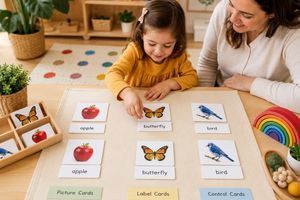
One learner assembles a three-part sequence: picture, label, and control card. The checker does not move pieces immediately. They ask one question or invite comparison with the control. Roles then swap. Checking becomes a learning action rather than peer judgement.
Specific formats for large groups of 13–25
Stations with the same rhythm
Prepare four or five tables with four to six learners each. Every station has one short action: name, sort, match a label, find the odd one out, or build a sentence. Groups work for the same brief period and rotate on a simple signal. Demonstrate the movement route and the finished-card location before explaining academic details.
Simultaneous gesture choice
Show a large image and let everyone answer with a gesture: hands up for living, hands on knees for non-living; one finger for spring, two for summer. Then ask two learners to explain contrasting examples. The educator sees the whole response without hearing the same word twenty times.
Category corners
Label four areas. Learners receive a card and walk calmly to the matching category on a signal. Within the corner, they compare choices and select one image to explain. If movement space is limited, label tables instead and let one representative carry the team's cards. Safety and classroom routines determine the version.
Solution gallery
Small teams sort a mini-set and leave the result on their table. Groups then visit two or three layouts and place a token beside one choice they want to ask about. The final discussion uses these actual differences rather than repeating every correct answer. An alternative solution becomes useful evidence for reasoning.
A chain with no elimination
The first learner places a card and states a feature. The next adds an image connected to it and explains the link. If no link is available, the learner takes a clue or consults a partner; nobody leaves the activity after an error. Stop after a predetermined number of cards, not when one winner remains.
Differentiate within one group
Different levels do not require three unrelated lessons. Keep a shared theme but vary the operation. Level one names or finds the same. Level two sorts by one feature. Level three explains a link, suggests another category, or builds a sentence. Learners can work side by side and contribute to one closing discussion.
Prompts also have levels: completed sample, choice of two, sentence starter, question about one feature, and self-check. Put them on a neutral “help card” available to everyone. A learner can take support without a public announcement that they have the easy task.
Prepare depth rather than volume for early finishers: invent a second sorting rule, find a card that belongs to two categories, or write a question for the next group. Automatically handing out twenty more cards rewards speed with repetition and can disrupt the station's shared finish.
Use focused educator observation, not an informal test
Select two or three observable behaviours before the lesson: understands after a demonstration, sorts by one feature, gives a short reason, waits for a role, or uses a control card. Trying to assess vocabulary, memory, logic, fine motor control, and collaboration for every learner in one ten-minute station will produce vague notes.
A compact record can use name plus code: I for independent, P for prompted, T for together. It describes one action in one context, not a diagnosis or permanent characteristic. Revisit the rule with a different topic later to see whether the learner can transfer the operation.
A practical 25-minute lesson flow
Use the first three minutes to show one complete example and rehearse the transition signal. Spend twelve to fifteen minutes in pairs or stations; two rotations are usually enough. Keep two to four minutes for a gallery look or two selected explanations. Use the final three minutes for a control-card check, counting sets, and returning each pack.
The educator does not need to visit every table for the same length. Start where the rule is least familiar, listen for one round, and move when learners can continue. Carry one small prompt card rather than repeating the full instruction. If several groups make the same error, pause everyone for a ten-second clarification and resume.
For a first station lesson, reduce content. Teach the movement and material routine with an easy familiar theme. A later lesson can add a more demanding classification. When the logistical and learning challenges are introduced separately, it becomes clearer whether difficulty comes from the concept or from not knowing where to go next.
Learn&Dream materials for group formats
Learn&Dream's current card catalogue includes themed sets, three-part cards, classification materials, and logical relationships. Select only the portion needed for the goal, check age guidance, and ensure the image size or number of duplicates suits the group.
|
Material |
Small-group use |
Large-group use |
Main action |
|
“Children's Room” three-part cards |
Assemble image, label, and control |
Furniture, toys, and other-item stations |
Vocabulary, classification, self-check |
|
“Insects” three-part cards |
Expert and checker, feature description |
Category corners or solution gallery |
Science vocabulary, reading, classification |
|
“Fruit Ice Cream” didactic set |
Connect fruit, flavour, and finished item |
Logical-matching stations |
Relationships, speech, sequence |
|
Sort and build “jam made from…” sentences |
Simultaneous category choice or link chain |
Classifying fruit and prepared foods |
Choose the set by the operation learners need to practise and by what the group can see. Three-part cards suit matching and self-checking; relationship sets suit sequences and explanations. Before the lesson, count each mini-pack, remove damaged cards, and make sure the print size and number of copies support simultaneous participation.
Common group-work mistakes
- One card and a long queue. Use duplicates, mini-sets, or a simultaneous response.
- Too many goals. Choose one primary action and one observation focus.
- Permanent roles. Facilitator, narrator, and checker must rotate.
- Complex rotation. Rehearse the movement route without an academic task first.
- Elimination after an error. Offer a clue or partner support so participation continues.
- Public “easy” and “hard” tables. Differentiate discreetly through operations and help cards.
- Using the full set for completeness. Select the amount that serves the goal and pace.
Frequently asked questions
How many cards do I need for a group of 20?
You do not need one per learner. For five stations, prepare four to eight cards per table or mini-sets for pairs. The action determines the amount: each active learner must hold or clearly see the relevant image.
How can a large group see small cards?
Do not make one small card the central tool. Demonstrate with an enlarged image or duplicate set, then let tables work with their own cards. Visibility is part of activity design.
How long should a station last?
Often five to ten minutes, depending on age and action. Include one complete series and a simple transition. Fewer rotations with genuine participation are better than rushing through every set.
What if one child answers for everyone?
Assign roles, distribute pieces by turn, or require partner discussion before a response. Instead of “Who knows?”, call the role: “The checker explains this one.”
Can card performance be used to assess a child?
Cards offer material for educator observation in a specific situation, but one game is not a diagnostic assessment. Record the action and support needed, and use several contexts before drawing educational conclusions.
Cards work in groups when learners do the work
An effective session is defined less by how many images the adult presents and more by how often learners make meaningful moves. Small groups achieve that through rotating roles and short turns. Large groups need stations, pairs, simultaneous responses, and visible transitions.
Begin with one goal, prepare mini-sets, name the finish, and observe only a few specific behaviours. Learning cards then become tools for comparing, speaking, checking, and collaborating—not decoration around the educator's explanation.