Letters and sounds are connected, but they are not the same thing. A speech sound is heard and produced; a letter is a visual symbol that can be seen, touched, written, and arranged. A child may know that the symbol M is called “em” without yet noticing the /m/ at the beginning of “map.” Another child may sort several /m/ words by ear before recognizing the printed letter.
A calm introduction therefore does not need to begin with reciting the entire alphabet. Begin with the sound pattern of familiar spoken words. Listen, compare, clap syllables, identify a shared beginning, and then connect a well-heard sound with a symbol. The letter has a job: it helps record something the child already noticed.
This is an educational play guide, not a treatment program or a promise of early reading. Children enter print in different ways, and the stages below are format suggestions rather than deadlines. If you have continuing concerns about hearing, language understanding, distinguishing speech sounds, or communication more generally, seek individual advice from a pediatrician or qualified professional.
Key takeaways
- Play with spoken sounds before asking a child to remember their written symbols.
- During sound work, use the sound in the word rather than relying only on a letter's name.
- Introduce one or two symbols among familiar ones instead of displaying the whole alphabet as a test.
- Use words the child already understands and agree on the name of every pictured object.
- Alternate listening, movement, sorting, touch, and print hunts in the real environment.
- Do not claim that one game teaches reading; reading coordinates several skills and develops over time.
Sound and letter: a child-friendly distinction
Try: “A sound lives in a spoken word; we hear it. A letter is a sign we use when we write.” Show a familiar object, say “map” naturally, and then highlight the beginning once: “mmm-map.” Bring out M and explain that this shape is one way English represents the sound heard at the start.
Letter names matter when discussing the alphabet and spelling, but they can obscure a listening task. The spoken name “em” is not the beginning of “map.” Keep the jobs clear: “The letter is called M. In this word, it represents /m/.” There is no need to use technical vocabulary with a young child, but the adult model should remain accurate.
English spelling is not a one-letter, one-sound code. One letter may represent different sounds, as c does in “cat” and “city”; a sound may be written with more than one letter, as in “ship”; and the same sound may have several spellings. Begin with transparent examples, then say honestly, “English has more patterns. Today we are investigating this one.”
Choosing a format by interest and current skill
|
Current situation |
Main purpose |
A useful format |
What not to require yet |
|
Enjoys songs and imitates sounds |
Notice similarities and differences in sound |
Rhymes, environmental sounds, syllable claps, predictable pauses |
Alphabet recall or decoding printed syllables |
|
Names many familiar objects |
Hear the beginning of a spoken word |
Sound baskets, odd-one-out, initial-sound matching |
Written analysis of long words |
|
Asks about signs in books and surroundings |
Connect a few heard sounds with letters |
One or two movable letters, tactile shapes, symbol hunts |
Mastery of the alphabet before taking the next step |
|
Recognizes some letters and asks about words |
Flexibly relate sounds, symbols, and familiar words |
Sorting, changing an initial letter, short words with movable symbols |
Fast reading or error-free spelling |
A child may confidently name many letters while still learning to attend to sound order. This is not a contradiction. Returning to oral play is not moving backwards; it gives the visual symbol a clearer foundation.
Where to start: a sound heard in familiar words
Choose a sound that can be heard clearly at the beginning of several familiar words. Gather three or four objects or pictures and confirm their names. One drawing might be called “sofa” by one family and “couch” by another, producing a different initial sound. Name each item before the sorting rule begins.
Say the words normally first, then emphasize the beginning once. For sounds such as /m/, /s/, or /f/, a brief stretch can make the shared feature easier to hear. For a stop sound such as /t/ or /p/, avoid adding “uh” and turning it into an extra syllable. Clear, short production is enough.
After several listening comparisons, reveal the letter, trace its main form, and locate it among two other symbols. Then return it to real print: a book title, a label, a name, or a sign the child sees often. Ask both, “What sound begins this word?” and “Which symbol could help us write it?”
Ten unhurried games with sounds and letters
1. Catch a sound around you
Close your eyes for half a minute and identify what you hear: running water, a creaking door, a humming vehicle. Compare loud and quiet, short and long, near and far. Attentive listening comes before print and does not require a correct letter answer.
2. Words in your hands
Say familiar words and clap their beats or syllables: ta-ble, ba-na-na. Keep it playful rather than turning each word into a formal analysis. The purpose is to notice that speech can be attended to in smaller chunks.
3. A sound basket
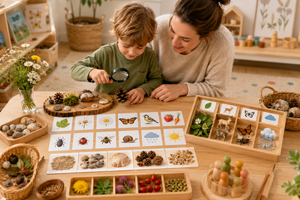
Place three objects with the same initial sound and one contrasting object in a basket. The child listens to the agreed names, groups the objects, and explains which word does not belong to the sound family.
4. Who may visit this sound?
Select a sound and a toy host. Only objects whose names begin with the target sound may visit. When a child suggests an unexpected picture, say its chosen name aloud. Judge the spoken word, not what the picture “should” be called.
5. The sound train
The train moves when an adult begins a familiar word with a stretchable sound and the child completes it: “sss…sun.” Switch roles. With short stop sounds, use clear comparisons rather than an artificial long production.
6. A letter through touch
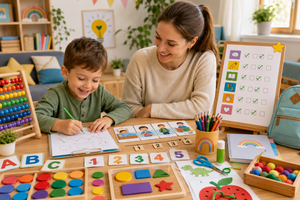
Build one letter from cord, craft sticks, or dough. The child traces the shape with a finger while producing the relevant sound. Next, find the same symbol among two or three visibly different forms.
7. Initial-sound detective
Search the room for objects beginning with a target sound. Place a movable letter or token beside each find. Agree on names in advance so that “sofa” and “couch” do not create a false dispute about the rule.
8. Find the letter inside a word
Show a short familiar word in large print and ask the child to locate one known letter, not read the whole word. Compare uppercase and lowercase after the first form is recognized reliably in several contexts.
9. Change the beginning, change the word
Use short familiar words in which changing the initial sound creates another real word, such as “map” and “cap.” Make the change orally first, then swap one movable letter. Select examples that work in the language being explored rather than forcing nonsense pairs.
10. Letter post boxes
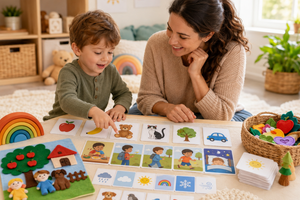
Make two or three boxes labeled with letters. Each object or picture receives an address according to its initial sound. After sorting, the child says every group aloud and corrects one deliberate adult mistake.
Introducing one new letter without overloading memory
- Hear the sound. Compare two or three familiar words and identify a shared beginning.
- See the symbol. Present one letter without a busy decorative background.
- Re-create the form. Trace it, build it from material, or draw it with a large movement.
- Find it in meaningful print. Locate the symbol in a short familiar sign or name.
- Use it in a game. Sort three pictures or deliver “mail” to the matching letter.
- Return later. On another day, mix the known letter with one new choice rather than beginning a large test.
Alphabetical order is not required for first encounters. The child's name, favorite objects, and easily compared sounds can make a purposeful start. A complete alphabet can remain visible as a reference map rather than a list for daily recitation.
When to move from individual letters toward short words
Readiness involves more than knowing names. The child can identify an initial sound, match it with a letter, hold two or three sounds in order, and shows curiosity about combining them. Begin with short familiar words whose spellings fit the pattern currently being explored.
Do not describe a guess based on the illustration as reading. Sometimes cover the picture, let the child work from the print, and reveal the image as a check. In a different activity, the picture may intentionally supply meaning. Be clear about which process the game is practicing.
If blending does not yet work, return to oral play. Say two or three sounds slowly with decreasing gaps and ask the child to choose the corresponding object. There is no need to rush. Letter knowledge is a resource, not an automatic guarantee that decoding has developed.
Uppercase and lowercase forms also deserve a deliberate comparison. Establish one form in several examples, then locate its partner. Do not introduce every printed, handwritten, and decorative version at once. Font variation becomes useful after the central shape is stable.
During shared book reading, keep the story alive. An adult may track one short word and point out a known letter, but does not need to stretch every sound throughout the page. Focused sound play and fluent, expressive reading support different parts of literacy and should not turn every book into a test.
Learn&Dream materials for sound–letter play
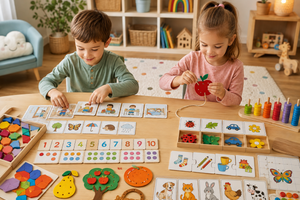
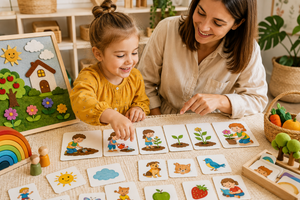
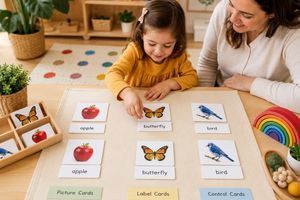
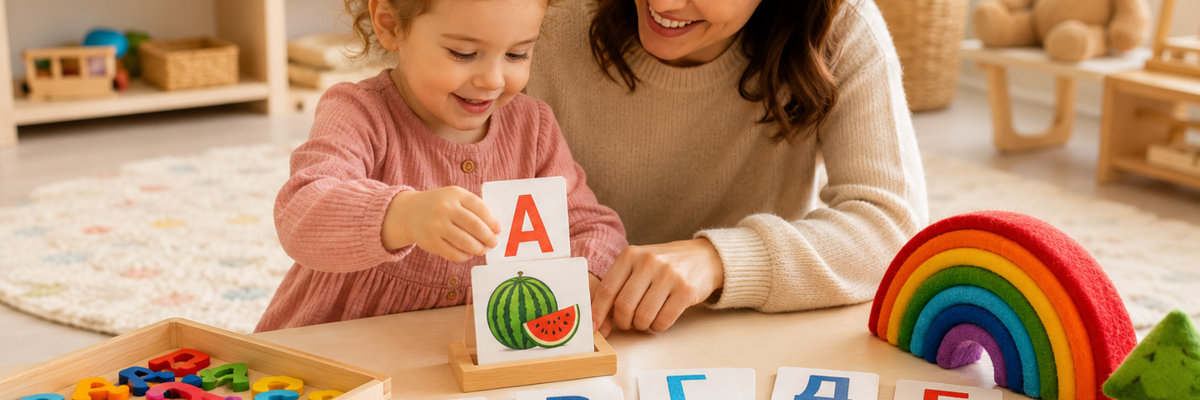
Sets involving letters, words, and pictures work best when the adult names one learning action: hear a sound, locate a symbol, complete a word, or check a choice. One card activity should not demand all of these processes at once.
|
Material |
What it makes visible |
A simple start |
An important boundary |
|
Pink Series “Word–Letter,” No. 1 |
A relationship between a familiar word and a selected letter |
Name the picture and find its initial sound before using print |
Do not treat a picture-based choice as independent reading |
|
Pink Series “Insert the Vowels,” No. 1 |
The position of a vowel in a printed word pattern |
Say the word and compare possible sounds first |
Use only after the relevant symbols are familiar |
|
Pink Series “Insert the Consonants,” No. 1 |
A missing consonant in a word |
Identify the sound orally, then choose the symbol |
Limit the number of choices while the principle is new |
|
Pink Series “Which Vowel Is in the Word?”, No. 1 |
Auditory vowel comparison linked with print |
Agree on and clearly pronounce the picture name |
Check that the child knows every word used in the task |
Check the current product language, contents, and age guidance before selecting a set. Printed-word tasks must match the language the child is exploring. When they do not, use other visual materials for oral sound games rather than improvising inaccurate spellings.
Common mistakes when exploring letters and sounds
- Beginning with mechanical alphabet recall. Add listening and meaningful words so order is not the only skill.
- Confusing a letter name with its sound. State whether you are naming M or listening for /m/.
- Adding an extra vowel to a consonant. Produce /m/ without an added vowel rather than saying “muh.”
- Using ambiguous or unfamiliar pictures. Agree on the spoken name before sorting.
- Introducing too many symbols. One new letter among known choices makes the rule clearer.
- Calling every picture-supported guess reading. Distinguish picture recognition, memorized words, and sound-by-sound decoding.
- Promising rapid results. Play supports component skills, while the pace of reading development varies.
Frequently asked questions
Should children learn letter names or sounds first?
It is useful to hear a sound in familiar words and then connect it with the symbol and letter name. Both kinds of knowledge matter, but they perform different jobs. A child need not recite the full alphabet before playing with sounds.
Must letters be introduced in alphabetical order?
No. Letters from a child's name, favorite words, or easy-to-compare sounds can provide a meaningful start. Alphabetical order becomes useful for locating information, but it is not the only sequence for first encounters.
How many letters should appear in one activity?
When the principle is new, one new letter among one or two familiar choices is often enough. Increase the number of letters after the child hears the target sound and understands the action rather than guessing from position.
What if the child confuses similar-looking letters?
Compare two shapes with large movements, name one specific difference, and connect each form with a familiar sound and word. Delay a third similar symbol until the comparison rule is clear.
Does knowing letters mean a child is ready to read?
Not necessarily. Reading also involves noticing sound order, connecting sounds with graphemes, blending, and understanding the resulting word. Letter-name knowledge is valuable, but it does not create the whole process automatically.
Conclusion: hear the pattern, then see the connection
Letter learning becomes meaningful when a child first notices a sound inside a real word and then discovers a symbol used to represent it. Listening baskets, movement, tactile forms, and print hunts provide several routes to the same clear relationship.
There is no need to display the full alphabet or move quickly to long words. One accurate sound–letter connection that a child can hear, find, and explain is stronger than many mechanically named symbols. Play protects curiosity; time and connected practice allow that curiosity to support later reading.