A child may recite all seven days and still wonder why Monday returns after Sunday. They may identify winter in a picture yet be surprised by snow in March. This is normal: calendar time is invisible, and “yesterday,” “next week,” and “in a month” describe very different periods.
Days, months, and seasons become clearer through repeated experiences rather than one long list. Children first notice familiar sequences, connect them to a day or season, and eventually use a calendar to anticipate events.
This guide separates time, routines, calendar models, and seasonal observation. It offers an age-based path, practical games, a short daily ritual, and ways to check understanding without a school-style quiz.
Key takeaways
- Begin with “first—next,” parts of the day, and events happening today, rather than asking a young child to memorize twelve month names.
- Treat time, routines, calendars, and seasons as related but distinct concepts.
- Briefly mark yesterday, today, tomorrow, the weekday, the date, and one real weather observation each day.
- Check practical understanding: can the child find tomorrow, identify the day after Wednesday, or count the spaces until an event?
- Use age ranges as flexible guidance. Language, experience, interest, and the amount of visual support all affect progress.
Why is calendar time difficult for children?
A chair remains visible; yesterday has disappeared, and next Thursday does not exist yet. A child must imagine an event, place it in relation to now, and choose the right unit. “After lunch,” “tomorrow,” and “in summer” describe different scales.
A calendar combines several systems: parts of a day, a seven-day week, unequal months, and a repeating year. Weekday names return weekly, date numbers roughly monthly, and birthdays yearly. Children connect these overlapping cycles gradually.
A rhyme can teach order, but recitation alone does not prove calendar awareness. Understanding appears when a child answers “What comes after Friday?”, locates an outing, or explains why it is three boxes away.
Time, routines, calendars, and seasons are not the same thing
Time as an abstract idea
A sense of time includes sequence, duration, and relationships: earlier and later, fast and slow, past and future. It grows when children wait, compare familiar actions, remember events, and make simple plans. A weekday song supports but cannot replace those experiences.
Routines as repeated order
Dressing, breakfast, preschool, dinner, and bedtime create a predictable sequence. A routine answers “What happens next?” but does not teach dates by itself. Picture cards can clarify the day, yet they remain a schedule rather than a calendar.
A calendar as a visual model
A calendar turns invisible time into space: days become boxes, weeks rows, and months pages. Children learn the reading direction, weekly pattern, and meaning of numbers and symbols. Wall, linear, and circular calendars differ, so explain each new format briefly.
Seasons as natural cycles
Seasons reflect yearly patterns in daylight, temperature, plants, and animal activity, but one day may not match a textbook picture. Autumn (fall) can be warm, and spring can bring snow. Use the yearly cycle and several observations, not one weather sign.
Age guide: from daily sequences to planning a month
This progression is guidance, not a deadline. A child may understand seasons before every month or confuse yesterday and tomorrow while using a visual schedule well. If an adult must always supply the answer, return to a simpler level.
|
Approximate age |
Signs of readiness |
Learning focus |
Suitable format |
|
2–3 years |
Understands simple sequences and recognizes familiar routines |
First—next; morning, afternoon, evening, night |
Two to four routine cards and conversation about one day |
|
3–4 years |
Recalls a recent event and anticipates something familiar tomorrow |
Today, yesterday, tomorrow, and the current season |
Three-day strip, weather chart, and seasonal walk |
|
4–5 years |
Follows a weekly routine and compares several events |
Weekday order, weekdays and weekends, seasonal changes |
Weekly board, sequence song, and event cards |
|
5–6 years |
Counts objects, reads some numerals, and finds a matching box |
The date, month layout, month names, and their seasons |
Monthly calendar, birthdays, and a year wheel |
|
6–7 years |
Follows several conditions and navigates rows and columns |
Planning one to four weeks, counting days, comparing calendars |
Personal planner, calendar puzzles, and independent markers |
In what order should calendar concepts be introduced?
Move from direct experience to larger units: events within one day; yesterday, today, and tomorrow; the repeating week; a monthly date; seasons; twelve months; and finally the whole year and planning.
Use month names naturally—“Your birthday is in May”—without expecting all twelve before shorter cycles make sense. Attach new vocabulary to lived experience instead of a separate list.
Step 1. Events within one day
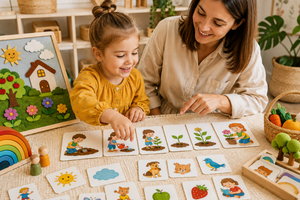
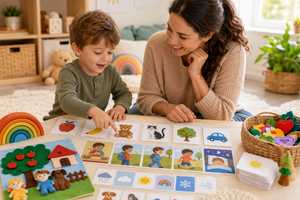
Order pictures of waking, breakfast, going out, coming home, and bedtime. Ask what happened and what comes next. Compare duration informally: a story is shorter than sleep, while a walk is longer than handwashing.
Step 2. Yesterday, today, and tomorrow
Create spaces for yesterday, today, and tomorrow. Move today’s event to yesterday, then tomorrow’s event to today. This physical shift shows that each word changes with the point of reference.
Step 3. The week
Display seven fixed positions from Monday through Sunday and add a few regular events. Move one marker each morning, naming the previous, current, and next day. Many US calendars start with Sunday; explain that a printed layout may do so even when your learning sequence runs Monday to Sunday.
Step 4. The month and date
Explain that a month is a larger period and a date identifies one day within it. Circle today, find the month’s ends, and count boxes to one event. Rules about month length can wait.
Step 5. Seasons and the year
A year wheel shows recurrence: January follows December, and spring follows winter. Sort months by season and add family events. A line clarifies before and after; a circle shows repetition. Use both.
How can children learn the days of the week without constant quizzing?
Establish three relationships first: today, the day before, and the day after. Let the child consult a weekly board. Finding an answer in the model matters before confident recall.
Connect weekdays with real events without turning events into definitions. Music class may happen on Wednesday, but vacation does not change Wednesday. Later ask, “If today is Monday, what day is it in two days?”
Use songs, rhymes, claps, or movement, then apply the sequence: cover a card, switch two, find the weekend, or place today’s marker. In English, capitalize weekday and month names.
How should the twelve months and their order be explained?
Twelve names need structure. Begin with the current, previous, and next month. Then group months in threes by calendar season and connect the four groups into a year.
Add personal reference points such as birthdays, school, or an annual trip. Clarify that a private event does not define a month: “beach month” is only one child’s cue.
Do not require immediate recall of 30- and 31-day months. Teach the child to find that information. Later, compare pages, identify the shorter month, and count full weeks plus extra days.
How can children learn the seasons through observation?
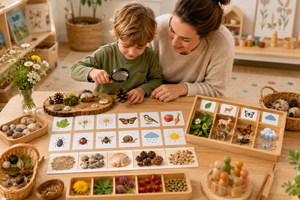
“Winter means snow; summer means sun” is too narrow. Observe the same place weekly, noticing daylight, temperature, precipitation, soil, plants, and familiar animals.
Compare photos of the same place across months. Ask what changed, what stayed the same, and whether one clue is enough. Weather changes daily; a season lasts several months.
Sort clothing, plants, and activities while allowing multiple answers. Rain boots extend beyond autumn, and bicycles beyond summer. Ask for reasons and keep a “more than one season” group. In English, spring, summer, autumn, and winter normally stay lowercase.
Practical calendar activities by age
Ages 2–3: “What happened first?”
Mix two or three pictures from a familiar task and rebuild the order. Say, “First socks, then shoes.” The goal is sequence, not month names.
Ages 3–4: “Three days”
Choose one event for yesterday, today, and tomorrow. The child moves each card and says a sentence. If terms are mixed up, point and model the word without scoring.
Ages 4–5: “The living week”
Place seven cards on the floor. The child stands on today, steps to yesterday or tomorrow, and jumps to the weekend or a class day. Movement makes positions tangible.
Ages 5–6: “Date detective”
Ask the child to find today, next Saturday, and a marked event, then explain the route. Begin within one month; add crossing a month boundary later.
Ages 6–7: “Project planner”
Plan a one-week project such as growing microgreens or tracking weather. Put three to five steps on dates and mark each one. The calendar becomes an organizing tool.
Which material fits each learning goal?
A visual tool needs one clear purpose. A board crowded with dates, weather, emotions, letters, numbers, and decoration can hide the task. Start small and add information after the earlier layer is understood.
|
Material or activity |
What it clarifies |
How to use it |
Common mistake |
|
Daily routine cards |
Sequence and predictability |
Select three to six real events and remove completed ones |
Calling the schedule a calendar and demanding dates |
|
Weekly strip |
The seven-day cycle; yesterday, today, tomorrow |
Move one marker daily and add a few regular events |
Using too many cards or changing weekday colors |
|
Monthly calendar |
Dates, weeks, and distance to an event |
Mark today and one to three important dates |
Turning every morning into a long quiz |
|
Year wheel |
Month order and repeating seasons |
Add months, family events, and seasonal observations |
Explaining a season through only one weather clue |
|
Nature calendar |
The difference between today’s weather and a season |
Record one or two observations at a consistent time |
Searching for “correct” weather instead of recording reality |
|
Personal planner |
Planning and counting days |
Schedule several achievable steps for one week |
Completing it for the child or judging neatness |
How to use Learn&Dream materials in calendar play
Choose materials that let the child move, match, order, or sort independently. The Weather & Seasons collection gathers hands-on resources for these topics. Check the suggested age, piece size, included elements, and the action the child will perform.
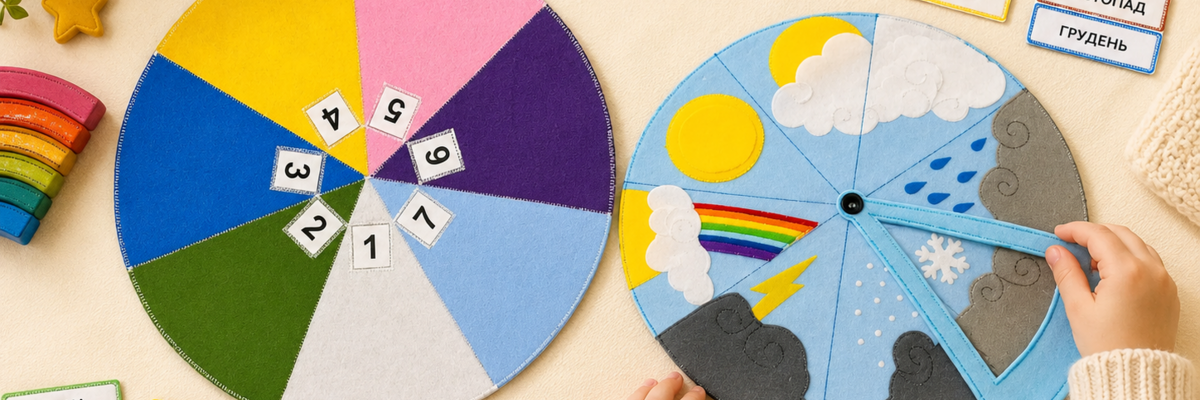
The Learning Set: Days of the Week builds the seven-day sequence. Find today, identify neighboring days, or hide one label. The Felt Circle “Days of the Week” emphasizes repetition and supports a short morning routine.
The Learning Set: Seasons and Months groups twelve months into four sections. Pair it with real observations through the Felt Game “Signs of the Seasons”. Compare several clues and discuss why some signs fit more than one season.
Do not introduce all four resources at once. Start with the week if today and tomorrow are the goal; add months and seasons later. A focused session keeps the material useful.
A 3–5 minute daily calendar ritual
- Find today. Let the child move a marker or circle the date.
- Name three days. Say, “Yesterday was Wednesday, today is Thursday, and tomorrow is Friday,” initially with the model visible.
- Check one event. See what is planned today or count the boxes to the next meaningful event.
- Record one observation. Choose one real sign of weather or nature instead of trying to describe everything.
- Ask a practical question. For example, “If the library visit is on Saturday, how many days are left?”
The ritual should not feel like a test. On a tiring morning, moving the marker and naming the day together is enough. Consistency connects the model to real life; it is not a reason to grade memory every day.
Common mistakes adults make
- Teaching everything at once. Weekdays, date numbers, months, seasons, and clock time are separate layers. Add one after the previous model is useful.
- Confusing recitation with understanding. After a rhyme, ask the child to find, compare, move, or plan something.
- Defining a day by one event. A lesson may be canceled, but the weekday does not change.
- Correcting unusual weather. Discuss the difference between one day and a longer seasonal pattern.
- Counting for the child. Invite them to trace the boxes and touch each day once.
- Promising a quick result. Calendar awareness grows through language, experience, repetition, and time.
How can you tell that a child understands the calendar?
Watch how the child transfers the idea to a new situation. They do more than say Monday after Sunday: they find Monday on a different layout. They do more than recognize an autumn picture: they describe several changes noticed outside. They do more than recite the months: they locate their birthday month on a year wheel.
Useful signs of progress include checking a calendar for an answer, correctly moving an event from tomorrow to today, counting boxes without skipping, noticing the transition between months, and using “before,” “after,” and “in” meaningfully. Occasional confusion between labels does not erase broader progress.
If a child has persistent difficulty following simple time-related directions in daily life and it interferes with routines, share your observations with an educator or appropriate professional. Educational play can provide practice, but it is not a diagnostic tool.
Frequently asked questions
At what age should children learn the days of the week?
At around ages 3–4, you can regularly name today, yesterday, and tomorrow and show them on a simple weekly strip. The full seven-day sequence often becomes easier later. Follow the child’s understanding of order and interest rather than requiring the whole list by a fixed age.
Why does my child know the weekday names but confuse yesterday and tomorrow?
Weekday names can be memorized like a poem, while “yesterday” and “tomorrow” change meaning every day. Use three labeled spaces and physically move event cards in the evening or morning. This makes the shifting point of reference visible instead of leaving it as a verbal explanation.
What is the fastest way to teach a child all twelve months?
Do not make speed the main goal. Start with the current, previous, and next months, then organize months into groups of three by season. Add personal events and a year wheel. Check whether the child can find and use a month’s position, not only recite the names.
How do I explain seasons when the weather is unusual?
Separate one day’s weather from a season’s place in the yearly cycle. Compare several signs over multiple weeks, including daylight, temperature, plants, and precipitation. Spring snow or a warm autumn day does not change the calendar season; it shows that daily weather varies.
How long should a calendar activity last?
A daily ritual of 3–5 minutes is often enough. A separate game may last 10–15 minutes while the child remains engaged. Regularly linking calendar marks to real events matters more than spending a long time testing the names of days, months, and seasons.
Conclusion: children understand calendars by using them
Learning the days of the week, months, and seasons requires more than hearing the names in the correct order. A child needs to experience the repetition of days and weeks, see time represented by a model, connect symbols to real events, and observe changes across the year.
Begin with what is close and concrete: what happened, what is happening, and what will happen next. Add a weekly strip, then a monthly calendar and year wheel. Short repeated actions, manageable questions, and opportunities to find answers independently build a stronger foundation than one intensive memorization session.