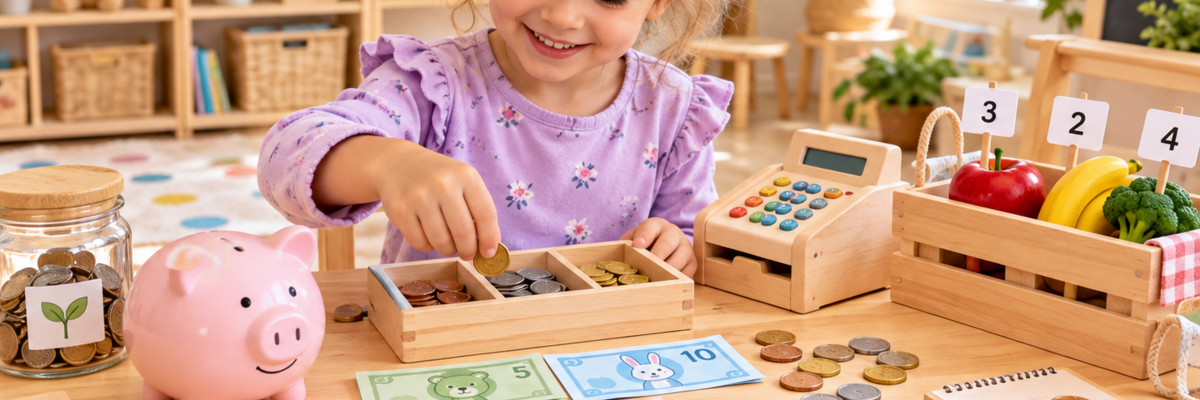
Financial Literacy for Preschoolers: First Games About Money and Shopping
A child watches adults tap a bank card, collect a parcel, compare prices, and sometimes postpone a purchase. It may seem that money simply comes out of a cash machine or that a card makes every desired item available. Brief conversations, household routines, and pretend play make the real connections visible long before school arithmetic.
Financial literacy for children of preschool age does not begin with banks, interest, or investments. It begins with needs and wants, goods and services, exchange, and choosing within a limited amount. Educational toys for open-ended role-play can help create a shop, café, or workshop without complicated equipment.
The aim is not to produce a “perfect shopper” or make a child worry about family expenses. Offer calm language: “We need this,” “You would like that,” “Today we are choosing one,” and “We can consider it later.”
What a preschooler can understand about money
When introducing money for children, begin with a visible exchange. A customer receives a product or service, and the seller receives payment. Materials, time, and work stand behind it. Prices differ, so the same handful of tokens cannot buy every item; unspent tokens remain for another round.
An older preschooler can explore these relationships when actions and results are visible. No budget definition is needed. A basket, five pretend coins, and “What can we choose so we have enough?” already introduce planning, comparison, and delayed choice.
|
Approximate age |
Accessible idea |
Play example |
Helpful adult wording |
|
3–4 years |
Exchange one token for one item and take turns in roles |
Buy one piece of fruit at a home stall |
“You give the token, and the seller gives you the apple” |
|
4–5 years |
Different prices, a choice between two options, simple counting |
Hold 5 coins and select an item priced at 3 or 5 |
“Both choices are possible, but today you are choosing one” |
|
5–6 years |
A list, a limited amount, change, and a short saving goal |
Fill an order and leave some coins in a savings jar |
“Let’s check the list, the total, and what remains” |
|
6–7 years |
Compare prices, find several ways to use an amount, plan across rounds |
Buy ingredients for a meal or save for a shared item |
“Which plan gets what we need without using everything?” |
The ages are guides rather than tests. If counting while playing the seller is too demanding, simplify the numbers or make every price the same. If play has become effortless, change one condition instead of replacing the entire rule.
Needs and wants without calling one good and the other bad
A need supports life, health, safety, or daily functioning: food, water, shelter, suitable clothing, and healthcare. Wants also matter because they bring pleasure and support creativity. A need is not “good” while a want is “wasteful”; they simply have different priority in a situation.
Offer pictures of water, a warm coat, medicine, cake, a second toy car, and a park ticket. Ask the child to pack for a winter outing instead of mechanically dividing them into two piles. The setting gives the choice meaning: a coat is needed in winter but not at the beach.
Ask, “Why did you choose it?”, “What might happen without it?”, or “Could we return to this idea later?” Reasoning matters more than a memorized label. Materials about the social world can supply images of jobs and community places for similar stories.
Where products come from and why people pay
“People earn money by working” is still abstract. Use something familiar: a baker prepares bread, a driver brings it to a shop, a worker arranges it, and a customer pays. A hairdresser provides a service using time and skill rather than handing over an object.
Create a workshop, shop, and home. The child “makes” paper cards, gives them to the shopkeeper, and a customer chooses and pays. Switch roles after several turns so work, cooperation, and exchange become visible.
Avoid tying a person’s worth to income or ranking occupations as important and unimportant. A sufficient message is that people make different goods, provide different services, and rely on one another.
How to set up a first pretend shop
Gather five familiar objects, price tags from 1 to 5, ten large tokens, a basket, and places for the shopkeeper and customer. Tokens must be intact and age-appropriate; real coins are unnecessary.
At first, every item can cost one token. The adult models one full transaction: greeting the seller, choosing an item, asking the price, handing over a token, receiving the item, and saying thank you. The child then becomes the customer. Once the sequence is familiar, add prices of 2 and 3 while keeping the display small.
Shopping play is not only about numbers. The seller listens, the customer waits, and both check the agreement. Daily living skills through play also shows how a visible sequence gives a child a manageable part of a shared task.
Eight games about money and shopping
Money games become easier to understand when the tokens stay familiar and only the story changes. The child can then notice the new idea without learning an entirely new system.
|
Game |
What to prepare |
The child’s action |
A small next challenge |
|
One token, one item |
4 objects with the same price |
Complete the exchange in order |
Add a cashier and a paper receipt |
|
Exact order |
A list with 2–3 pictures |
Find and count only the requested goods |
Add one attractive item that is not listed |
|
Two prices |
Items priced at 2 and 4 coins |
Match the price tag to a number of coins |
Ask what remains from 5 coins |
|
Café |
A menu, play dishes, and tokens |
Take an order, serve it, and accept payment |
Choose two menu items within an amount |
|
Barter |
Two small sets of objects |
Agree on an exchange acceptable to both players |
Discuss why an exchange might not happen |
|
Savings goal |
A goal picture and 5 tokens |
Save one token after each round |
Choose between a small goal now and a larger one later |
|
Advertising break |
Bright product cards |
Separate information from a prompt to buy |
Create an honest description without exaggeration |
|
Family picnic |
A basket, list, and 10 coins |
Select what is needed within the amount |
Find two different workable baskets |
There is no reason to play all eight at once. One ten- to fifteen-minute story offers more useful practice than a long series that ends with fatigue and random guessing.
Price, quantity, and change with small numbers
A price tells the customer how many agreed units to give for an item. It does not have to imitate a real price: an apple can cost 2 tokens and a toy car 3. What matters initially is matching the written numeral to the number of coins.
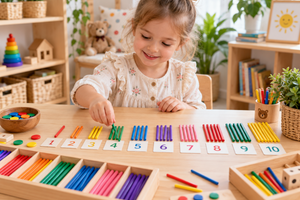
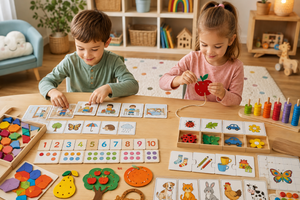
If numeral recognition is still developing, mark a price tag with dots. The child places one coin on every dot and then looks at the numeral beside them. The Counting with Objects felt game can support movement between pictured quantities and symbols, while the step-by-step guide to numbers and quantity from 1 to 10 explains why handling and counting objects should come before expecting quick work with written numerals.
Introduce change only after exact payment is comfortable. The customer has 5 coins and chooses an item priced at 3. They hand over all 5; the seller puts 3 in the till and returns 2. Both players can arrange the coins in a row. Spoken subtraction is not required. The visible action already shows that part of the original amount came back.
Saving as a choice moved into the future
A savings jar should not become a test of willpower. Choose a small, visible pretend goal: five tokens for a ticket for a toy bear or six for a large shared play set. Draw the required number of empty circles and cover one after each round.
Give the child a genuine choice: use a token for a small item now or keep it for the chosen goal. Either decision can be reasonable. If the adult always insists on saving, the activity becomes a disguised quiz with only one accepted answer.
When the child changes the goal, ask what has become more important. Do not call it inconsistency. Revising a plan after receiving new information is also part of thoughtful decision-making.
A real shop visit without turning it into a test
Before a short visit, create a list with two or three items. The child can find a product, check the quantity, and put it in the basket. The adult remains responsible for payment. Avoid a difficult task at a busy checkout or when the child is tired.
Compare two similar items, while explaining that cheaper does not always mean more suitable. Quantity, purpose, ingredients, and what is already at home also matter. Ask one concrete question: “Do we need the small pack or the large one?” Afterwards, recall what was bought and why.
A request for sweets or a toy should not lead to shame. Try: “You really want that. It is not in today’s plan. We can add it to a wish list.” Recognizing the feeling does not promise a purchase.
Calm language about the family budget
A young child does not need information about income, debts, or adult financial anxiety. Say simply: “First we pay for what the family needs,” “There is a set amount for shopping,” or “We are not buying that today.”
“We spent everything because of you” and “Good children do not ask for so much” create guilt without teaching planning. Nor do good habits guarantee wealth. A preschooler practises manageable choices; responsibility for the household budget stays with adults.
If adults in the family have different rules, agree privately on a few stable limits and phrases. Predictability supports learning better than an argument beside the shop shelf.
Does a preschooler need pocket money?
Pocket money can provide practice, but it is not required. A family may use pretend tokens or a small regular amount within clear limits. Explain what it can buy, where it is kept, and which purchases require a shared decision.
Avoid paying for dressing, putting away personal belongings, or showing kindness. These are parts of family life. A reward for an unusual extra task is possible when agreed beforehand and clearly separated from shared responsibility.
Allow a safe, small mistake. If the child spends the available amount and then wants something else, do not replace it or lecture. Say: “That amount has been used. The next comes at the agreed time.”
What makes learning to handle money harder
Real prices, large numbers, percentages, and long explanations make early play unnecessarily difficult. Return to tokens from 1 to 5 and one clear action. Language and Mathematics activities provide enough groundwork: match numeral and quantity, compare two groups, and check the result.
Do not rescue the child from every limit. If the coins buy only one of two items, choosing is the point. Offer two acceptable options and time to decide without manufacturing distress.
Labels such as “wasteful” or “greedy” block conversation. Describe the action: “You used all three coins,” “You kept two,” or “Your plan changed.” This makes the result visible without judging character.
Frequently asked questions
At what age can financial literacy for children begin?
At around three or four, a child can play a simple exchange with one large token for one item and switch between customer and seller. Different prices, choices within an amount, and short saving goals can be added gradually according to the child’s interest and current counting skills.
Can preschoolers use real coins?
Large tokens, paper circles, or sturdy cards are safer for pretend play and can be selected for the child’s age without a swallowing risk. The adult handles real payment and bank cards. An older preschooler may examine notes with an adult, but real currency is not necessary for understanding an exchange.
How to teach a child to handle money without constant prohibitions?
Offer a small choice inside a clear boundary: two acceptable items, five pretend coins, or a short list. State what follows from each option and let the child decide. The limit remains steady, but the child practises planning instead of hearing only “no.”
What if my child wants to spend everything immediately?
That can be a safe outcome in a pretend round. Show the empty purse and explain that another purchase can happen in the next round. Later, offer two boxes labelled “use” and “keep,” without making saving the mandatory answer every time.
Should children be paid for household tasks?
Ordinary participation in family life can remain a shared responsibility without payment. If adults reward a separate extra task, agree on it before the work begins and distinguish it clearly from daily routines. Money should not become a condition for helping or being considerate.
A practical way to begin
Set up a home shop with five items. Give the child five large tokens, use prices from 1 to 3, and model one complete purchase. The next day add a picture list, later a choice between two items, and eventually a savings jar for a small pretend goal. Let each new step change only one part of the familiar activity.
Good financial practice for a preschooler sounds ordinary: notice a need, name a want, count the coins available, choose, and experience the result. Without shame, promises of future wealth, or responsibility for adult problems, the child can learn not to fear money but to understand the simple decisions connected to it.