Logic Games for Children: Age-Based Activities for Preschoolers
Short answer: useful preschool logic activities ask a child to compare features, discover a rule, predict a consequence, reproduce a spatial arrangement, or explain a choice. Start with three to five clearly different items and one rule. Increase difficulty through the kind of thinking: introduce a second feature, hide information, allow another valid solution, or invite the child to create a problem.
Well-designed logic games for children should not feel like tests of cleverness. A child can move pieces, try an idea, notice a contradiction, and return to the condition. A mistake shows what needs checking.
Distinguish knowledge from reasoning. Finding the odd one out among a lion, whale, cat, and horse requires facts about animals; not knowing one does not prove weak logic. A good task uses familiar material and makes the thinking visible. Apply this principle when choosing educational toys for logical thinking.
What Does a Logic Game Actually Exercise?
Logical thinking is not one isolated skill. A child may compare, group, order, detect a pattern, or plan several moves. In practice, a logic game is useful when the action it requires is clear.
Key forms of preschool reasoning include:
- classification: group items by a shared feature and state the rule;
- seriation: order objects by size, shade, quantity, or time;
- pattern detection: identify a repeat and predict what follows;
- part and whole: assemble an image, find a missing piece, or imagine a combination;
- spatial reasoning: rotate, reflect, or position an item in relation to others;
- cause and effect: connect an event with a plausible result and explain the link;
- exclusion: find an item that does not fit, sometimes with more than one defensible answer;
- planning: choose a sequence while considering an obstacle or another player.
One activity may combine several operations, but beginners benefit from one focus. If the child must learn names, remember a new story, count, and infer a rule at once, the source of difficulty is unclear.
Choosing Activities by Age and Experience
Age suggests a starting point, but observation matters more. A frequent builder may handle spatial challenges easily yet need a simpler verbal condition. Another child may explain causes well but begin guessing when too many similar pieces appear.
Look for independence. A manageable task has a clear objective after one example, allows several steps without constant prompting, and provides a way to check the answer. If the adult names every next move, the adult is doing the reasoning.
|
Age as a guide |
A useful starting point |
A manageable amount of information |
How to increase the challenge |
|
2.5–3 years |
Identical pairs, sorting by color or shape, simple big/small comparisons |
3–5 items and one visible feature |
Add one contrasting odd item or ask the child to name the rule |
|
3–4 years |
Part and whole, simple AB sequences, grouping familiar objects |
4–8 pieces and one condition |
Use a new rule with the same pieces or add a third element to the pattern |
|
4–5 years |
Pattern copying, two possible sorting rules, story sequencing |
6–10 pieces and a short verbal condition |
Add a distractor, briefly remove the model, or request evidence |
|
5–6 years |
Two-feature classification, a 2×2 matrix, error finding, simple strategy |
8–12 pieces and two connected features |
Hide some data, allow several solutions, or plan two steps |
|
6–7 years |
More complex patterns, conditional rules, routes with restrictions |
A small field, 2–3 rules, and space for notes |
Add an alternative path, a limited resource, or strategy comparison |
These levels need not be completed in order. Familiar content may support a harder operation, while a new subject calls for simple matching again. Change the level in response to behavior, not a wish to move through a chart quickly.
Classification: One Object Can Belong to Different Groups
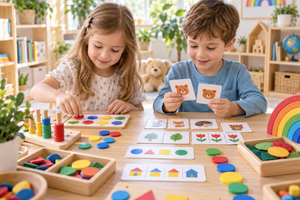
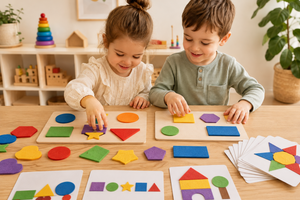
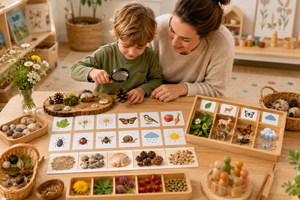
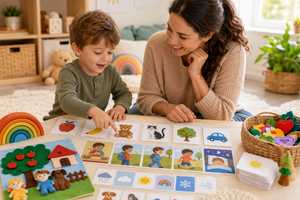
For first sorting, use items with obvious contrasts: large and small lids, red and blue pieces, circles and squares. State the rule once and demonstrate the first placement. When the child is confident, mix the same objects and introduce another principle.
The most interesting moment comes when one piece can belong to two groups. A red circle fits with red objects and with circles. Ask, “Where could it go? What does the answer depend on?” The child discovers that the group depends on the agreed rule, not an invisible “correct box.”
For a harder variation, let the child invent a feature. The adult closes their eyes while the child arranges the set, then tries to infer the system. Accept unexpected but consistent groups, such as “used in the kitchen,” “can roll,” or “contains wood.” The child moves from following a condition to designing one.
Patterns: More Than a Line of Colored Beads
Begin with an AB repeat: red, blue, red, blue. The child continues the row and names the repeating unit. Then try ABB, changes of shape, body movements, or sounds. The rule should be describable.
A longer row is not necessarily a more thoughtful task. Instead, ask the child to find an error, restore a missing unit, or propose two continuations when the information is incomplete. After “circle, square, circle,” there is not enough evidence to know whether the rule alternates or begins another pattern. This teaches the child to check whether the data support one answer rather than guessing the adult’s intention.
Movement patterns are helpful after sitting: clap, step, step; clap, step, step. The child now has to maintain order over time, not merely across a visible row.
Parts, Wholes, and Space
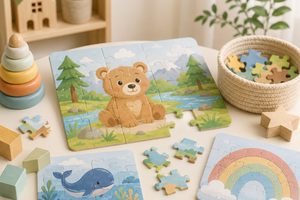
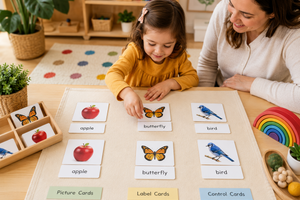
Puzzles and pattern copying become reasoning tasks when a child uses features instead of trying pieces at random. Before a move, ask, “Where might this piece belong? Which edge could help you check?” Spatial words such as above, below, between, left, and right are useful, but the adult should not dictate every placement.
Use three levels with one composition. First, keep the model visible. Next, show it for ten seconds and cover it. Finally, let the child create a design and explain how the adult should reproduce it. The last format requires the child to see a spatial structure and communicate it.
Rotating a piece, finding a mirror pair, or making a square from two triangles adds transformation. If the child keeps trying randomly, reduce the options and point out the boundary or corner that can be compared.
Cause, Effect, and Story Logic
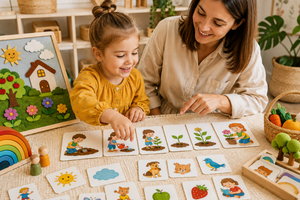
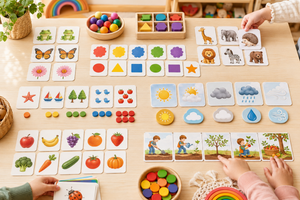
Event pictures invite reasoning about links rather than simple naming. Arrange three scenes: a child takes a watering can, waters a plant, and later notices a new leaf. Ask the learner to restore the order and explain it. Then remove the middle picture and discuss what could connect the beginning and end.
Separate a possible cause from the only cause. A puddle may come from rain, watering, or spilled water. When the prompt does not provide enough evidence, accept several answers that fit the facts. Logic does not mean guessing the picture author’s hidden intention.
With five- and six-year-olds, add “What would happen if…?” What changes if a character forgets an umbrella? Which action should come first? Story order then develops into planning.
Odd-One-Out Tasks With More Than One Answer
A set such as apple, pear, plum, and bus has an obvious answer and works for a beginner. Later, offer items that allow different classifications: a bus, bicycle, boat, and airplane. The bicycle differs because a person powers it; the boat differs by environment; the airplane differs by its normal relationship to the ground.
Ask the child to complete the sentence, “I choose … because …” Accept any consistent feature, then ask whether another answer is possible. This reveals the difference between an argument and a random choice.
Avoid tasks where an object is considered “odd” only because of an obscure or culturally dependent association. A child cannot infer an assumption that the prompt never provides. Accessible evidence is part of good task design.
First Strategy: Thinking About the Next Move
Simple strategy appears when one player’s action changes another player’s options. In tic-tac-toe, a beginner tries to build a line and later begins to notice the opponent’s threat. Instead of naming the winning square, ask, “What could happen if this space stays open?”
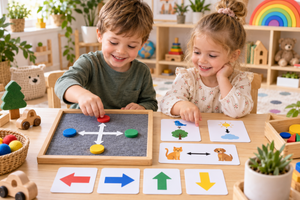
For route activities, add obstacles and a limited resource. A figure may need to reach a house using three direction cards. The child lays out a plan before moving and checks it step by step. If the route fails, allow one card to be changed after the attempt.
Strategic thinking does not require a long game. Predicting one consequence is enough for a preschooler. When that becomes familiar, add two possible routes, a different cost for each action, or a resource that must remain for the end.
A 10–20 Minute Logic Session
Build a short activity around one operation. There is no need to cover every form of reasoning each day.
|
Focus |
2–3 minute start |
8–12 minute main activity |
One extension |
A clear ending |
|
Classification |
Sort four pieces by color |
Regroup the same pieces by shape or function |
Child creates a rule for the adult |
Name the two features used |
|
Pattern |
Continue an AB rhythm |
Restore a gap and find an error |
Add movement or a third element |
Create one short row together |
|
Space |
Find a piece with a needed edge |
Copy a composition from a model |
Hide the model for one stage |
Check from the edges toward the center |
|
Cause and effect |
Order three familiar events |
Add a missing event to a story |
Suggest two possible causes |
Choose an answer and state the evidence |
|
Strategy |
Demonstrate one open move |
Play a short round or plan a route |
Predict one reply |
Name the move that changed the outcome |
If interest drops, do not add another card to rescue the session. Finish the current cycle and return another day. Frequent short attempts leave more room for independent reasoning than one long series sustained by prompts.
Learn&Dream Materials for Different Reasoning Actions
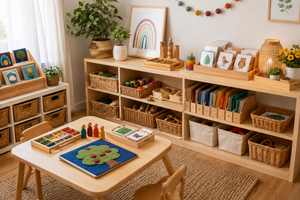
The Logic and Sorting collection lets families choose material by the action they want to offer.
- Felt “Sorting: What Is It Made Of? 2” supports classification by properties and conversation about the evidence for an answer.
- Felt “Pattern Matching: Parking” invites spatial comparison, position language, and checking against a model.
- Felt Tic-Tac-Toe creates a short setting for alternating turns and predicting the next move.
Before use, check the current contents, age guidance, and condition of the pieces. A material cannot guarantee development by itself. What matters is the child’s action, a genuine choice, and an achievable way to check the outcome.
Helping Without Solving the Problem
Useful help narrows attention without naming the answer. Instead of “Put it here,” ask, “Which edge could you compare?” Instead of explaining the odd item, ask, “What rule connects these three pictures?” Then allow a pause.
What Changes After Preschool?
After preschool, logic games for children aged 6–7 may include conditional rules, 2×2 tables, restricted routes, and written intermediate results. Introduce unfamiliar symbols separately so the child does not have to decode a complex key while also finding the pattern.
At the next stage, logic games for 8-year-olds often add several possible moves, longer sequences, or comparison between strategies. Later, logic games for children aged 9–10 may use combinatorial problems, richer deduction grids, and resource planning. The core remains the same: a clear condition, sufficient data, a way to verify, and gradual progression.
Do not judge an older child only by speed. Slow, systematic elimination may show more mature reasoning than a fast correct guess.
Related Guides
The first stages of classification are explained in the guide to teaching a child to sort by color, shape, and size. For spatial work, use Pattern Building: Developing Spatial Thinking and Visual Memory.
Frequently asked questions
At What Age Can Logic Activities Begin?
Simple matching and sorting may begin at about 2.5–3 years when all components meet the product’s current safety guidance. Start with three to five pieces and one visible feature. Understanding one demonstrated step matters more than the child’s exact age.
How Many Logic Problems Should We Do in One Session?
One main activity lasting 8–12 minutes is often enough. Add a brief start and a simple closing if useful, but there is no need to fill the time with worksheets. Stop while the child can still state the rule and would like to return another day.
What If the Child Keeps Guessing?
Reduce the options and ask the child to name the available data before choosing: color, shape, edge, order, or condition. Provide a physical or visual method of checking. If guessing continues, return to a simpler operation with familiar material.
May an Adult Show the Correct Answer?
A direct demonstration is appropriate when introducing a new rule. During an independent attempt, point to what can be checked rather than where to place the piece. A pause, fewer options, and one neutral question preserve more reasoning than repeated answers.
Do Digital Games Develop Logic in the Same Way?
A digital game can require planning or pattern detection, but its value depends on mechanics, feedback, and level—not the screen alone. Preschoolers still benefit from many hands-on tasks where they can move pieces, see an error, and discuss a strategy with another person.
Conclusion
Good logic games do not test whether a child can guess an adult’s hidden answer. They provide enough evidence, a clear action, and a way to check an idea. Begin with classification, simple patterns, part and whole, space, and familiar causal links.
Keep one focus, increase challenge gradually, and accept multiple answers with consistent reasoning. Play then supports comparing options and explaining a choice instead of guessing.