Tangram for Kids: What It Is, Rules, and Patterns from Easy to Challenging
Short answer: a tangram is a puzzle made of seven geometric pieces that can form silhouettes of people, animals, objects, and abstract designs. A beginner can first identify the pieces, rotate them, and place them directly over a full-size pattern. The pattern then moves beside the working area, colored boundaries disappear, and the final challenge is to build from a solid silhouette or an original idea.
The classic set is small, yet it supports a wide range of play. A child compares sides and angles, imagines a piece after rotation, notices how two parts make a new shape, and tests an idea with their hands. This is why a tangram game can suit both preschoolers and primary-school children: the level depends less on the number of pieces than on the kind of visual support provided.
The first session does not need to become a geometry lesson. Offer two or three pieces, demonstrate one brief action, and leave room for exploration. When choosing educational toys for spatial thinking, consider whether an activity can grow with the child rather than judging it only by bright pictures or the number of included cards.
What is a tangram, and what are its seven pieces?
A classic tangram puzzle comes from a square divided into seven pieces, traditionally called tans. The set contains two large isosceles right triangles, one medium and two small triangles, one square, and one parallelogram. Arranged in their starting positions, all seven pieces make the original square again.
Most traditional challenges follow three straightforward rules:
- use all seven tans unless the task says otherwise;
- rotate and flip pieces, but do not overlap them;
- let pieces meet along edges or at vertices to form the target silhouette.
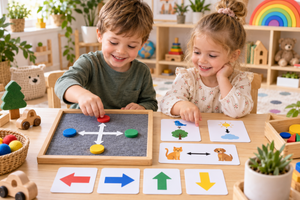
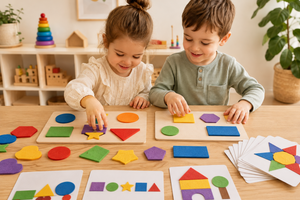
For a younger child, begin with two to four pieces and direct placement over a colored guide. The first goal is not a formal seven-piece challenge, but discovering that shapes can be turned, combined, and checked against a boundary.
The parallelogram deserves special attention. A rotation cannot always give it the required orientation; sometimes it must be flipped to its other face. That difference introduces reflection in a concrete way. If both faces look identical, place a small removable sticker on one side so the child can see when a flip, rather than another turn, has changed the piece.
What does tangram play actually develop?
A child does more than look for a “correct place.” They analyze the whole, imagine possible parts, change a piece’s orientation, and evaluate the result.
Spatial reasoning
The player anticipates a piece after a turn or move and attends to points, edges, symmetry, and the space between parts. This supports construction, reading diagrams, and later geometric reasoning.
Part–whole analysis
A cat appears to be one recognizable image, but building it requires seeing a possible combination of triangles, a square, and a parallelogram. The reverse process matters too: abstract shapes become a meaningful object. Moving between part and whole encourages flexible visual analysis.
Planning and self-correction
An unsuccessful attempt is visible: the last tan will not fit or the outer edge differs from the pattern. The arrangement itself provides feedback before an adult gives an answer. With practice, a child learns to locate one doubtful section and revise it instead of dismantling everything immediately.
Fine motor control, attention, and language
Aligning edges asks the eyes and fingers to work together. Discussion introduces useful spatial language: turn, flip, above, to the left, point downward, between, and along the edge. Words become tools for planning rather than a list of shape names to recite.
When should a child start, and at what level?
The age printed on a box is only a guide. More useful signs are whether the child can attend to a brief task, turn a flat piece, match it to an outline, and tolerate several attempts. For one child the material may be an open-ended shape set; for another it may be a full problem represented by an unsegmented silhouette.
|
Approximate stage |
Suitable format |
Number of pieces |
Adult support |
Sign that the next level may be useful |
|
Age 2.5–3.5 |
free combining and direct placement on a large colored pattern |
2–4 |
model one action and name directions |
turns a piece independently and searches for a matching outline |
|
Age 3.5–4.5 |
simple object on a guide with visible boundaries |
4–7 |
suggest beginning with the largest area |
positions most pieces without the adult moving their hand |
|
Age 4.5–6 |
copy a colored pattern placed beside the work |
7 |
ask about edges and points |
compares the result with the model and corrects one error |
|
Age 6–7 |
build a solid, single-color silhouette |
7 |
help identify one anchor piece |
plans several moves and explains a choice |
|
Age 7+ |
explore multiple solutions, create patterns, or use a timer by choice |
7 |
compare strategies without revealing an answer |
transfers a useful strategy to a new design |
This is not a developmental standard. Choose the next format by observing the child’s strategy, not by age alone.
How to run a first session without overload
Begin by rebuilding the square, separating the pieces, and finding the matching triangles, square, and “slanting” parallelogram. Exact vocabulary can develop gradually.
Select a simple two- or three-piece image such as a boat, house, or fish. Place the required pieces beside a full-size guide. Demonstrate only the first move: “I am looking for the longest edge, so I will turn this large triangle until it matches.” Invite the child to position the next piece.
If they pause, increase help in small steps:
- ask them to find the largest empty area in the pattern;
- narrow the choice to a large or a small piece;
- point out one relevant edge or vertex;
- allow direct placement to test the idea;
- show the orientation only as a last step, then mix two pieces for another independent attempt.
Stop after one or two satisfying figures. Photograph or name the result. Ending while interest remains encourages the child to return.
How to move from easy patterns to hard silhouettes
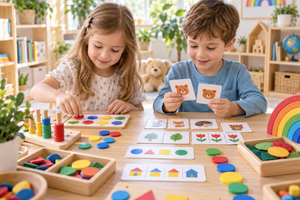
Each new level should remove one kind of support. Jumping straight from a segmented color picture to a black silhouette changes too many demands at once.
Level 1: direct placement on a full-size guide
Every boundary remains visible, so the child can verify alignment without a verbal answer.
Level 2: the same pattern beside the work
Keep the scale and colors unchanged while the child transfers the arrangement to an empty space. Ask which piece offers a good starting point.
Level 3: a smaller or colorless segmented pattern
Proportions and directions now matter, while internal boundaries remain visible. If random guessing increases, restore the previous support.
Level 4: a solid silhouette
The child must imagine where internal divisions could lie. Look for sharp points, long boundaries, and areas roughly the size of a large triangle. Reveal one anchor, not the solution.
Level 5: an original figure and pattern
Create an animal or vehicle, trace its outside boundary, mix the pieces, and offer the problem to someone else. Becoming the author clarifies how a clue is made.
Ten activities with one set
Vary the rule so that tangram work does not become a stack of answer cards.
- Finish the picture. Place three or four tans; the child completes or transforms the image.
- Find the mistake. One piece in a finished figure has the wrong orientation.
- Remember it. View a design briefly, cover it, and reconstruct its main part.
- Build from words. One player describes positions; the other cannot see the model.
- Tell a story. Change a boat into a fish and connect the pictures in a story.
- Move one piece. Relocate one tan and name the new composition.
- Investigate symmetry. Explore whether the pieces can make a mirror half.
- Hunt for angles. Find right, sharp, and wide angles by observation.
- Seek another solution. Make a simple form in two ways.
- Family round. Create silhouettes on one theme and explain each idea without ranking speed.
Use a timer only when an experienced child requests it. For a beginner, speed often replaces careful visual comparison with hurried guessing.
How to choose a set and related materials
Before you buy a tangram, examine how the material will work in real play. Pieces should lie flat, have clear smooth edges, contrast with the working surface, and resist excessive sliding. Larger pieces are usually easier for young hands; small pieces require age-appropriate handling and supervision.
A useful set includes patterns at several levels: full-size segmented guides, models placed beside the work, and solid silhouettes. Colored tans make first attempts clearer, while a single-color set places greater emphasis on shape. Wood feels stable, a magnetic surface travels well, and heavy card is light and accessible. The best material depends on where and how the child will use it.
Learn & Dream does not currently list a classic tangram, so related products should not be presented as the same object. The Logic and Sorting category contains activities that exercise neighboring skills. The Shapes puzzle asks a child to construct wholes from parts, while the Shapes sorting activity supports discrimination and classification of forms. These are useful complements, not substitutes.
If transferring positions from a model is the main difficulty, the guide to pattern-copying activities for spatial reasoning and visual memory provides a gentler progression. If the child relies only on color or confuses forms, first strengthen classification through sorting by color, shape, and size.
A one-week home plan
A session can last about 7–15 minutes, adjusted to the child’s age and interest.
|
Day |
Main action |
Example task |
Make it easier |
Add a challenge |
|
1 |
explore pieces |
rebuild the square and find matching triangles |
keep only 3–4 parts |
describe one similarity and difference |
|
2 |
place on a guide |
build a house or fish with visible boundaries |
provide only the required tans |
include one extra piece as a choice |
|
3 |
transfer a pattern |
copy a figure beside the model |
begin the first pair together |
reduce the model’s size |
|
4 |
use spatial words |
follow short spoken directions |
allow a view of the model |
put a screen between players |
|
5 |
correct an error |
find one incorrect rotation |
identify the doubtful area |
include two different errors |
|
6 |
solve a silhouette |
construct one single-color animal |
reveal the boundaries of two tans |
offer another silhouette without help |
|
7 |
design something |
create, trace, and give the problem to another person |
choose a theme together |
write a verbal building instruction |
Repeat favorite mechanics with new themes. Progress appears when the child guesses less, studies an edge before moving, and can say what they intend to change.
How to help without taking over
The best prompt directs attention while preserving the decision. Instead of saying, “Put the triangle here,” ask, “Which area has the longest edge?”, “What piece could fill that sharp point?”, or “Does the parallelogram need a turn or a flip?”
Allow a real pause: the child may be mentally testing an orientation. Moving their hand produces a finished picture but removes the strategy.
Praise a specific action: “You noticed that the long edges did not line up.” If irritation grows, reveal boundaries, remove pieces, or end with a shared design. Simplifying preserves thoughtful practice.
Frequently asked questions
At what age can a child use a tangram?
Around age three, many children can explore large pieces and place two to four of them on a simple guide. Full sets and side-by-side patterns are often more accessible from four to six, with solid silhouettes becoming suitable later. Follow the product label, piece size, and the individual child’s current skills.
Must every activity use all seven pieces?
Traditional challenges do, but early learning activities do not have to. Two- to five-piece designs teach rotation, edge alignment, and pattern reading. Add all seven when a shorter task no longer leads mainly to random guessing.
Is a colored pattern or a black silhouette better for beginners?
Start with a full-size colored guide that shows every internal boundary. Next move it beside the work, remove color, reduce its size, and only then offer a solid silhouette. Changing one condition at a time reveals what the child understands and where support is needed.
How is a tangram different from an ordinary jigsaw puzzle?
A jigsaw piece usually has one intended place in one picture. The same seven tans can make many silhouettes, and their straight edges do not reveal a single connection. Tangram play therefore places more emphasis on rotation, decomposition, and alternative constructions.
What should I do when a difficult pattern causes frustration?
Return to the previous level: reveal internal lines, enlarge the model, reduce the number of pieces, or locate only the first anchor together. End after one manageable success. Regular experience of productive effort is more valuable than a hard silhouette completed by the adult.
From following a guide to creating an idea
The value of tangram play is not the number of cards in the box. It lies in rebuilding the same seven pieces again and again. A child begins with visible boundaries, learns to transfer an arrangement, decomposes a solid shape, and eventually creates a new problem.
Support that path with short sessions, precise spatial language, and prompts that leave the final move open. An error then becomes useful information: which tan to turn, which edge to compare, and which alternative to test next.