Living and Non-Living Nature for Children: Simple Explanations, Examples, and Games
A stone stays still, a cat runs, a cloud drifts, and a seed may look unchanged for months. “Living things move” sounds simple until a child notices that a car moves too, water flows, and a tree never walks away. A sound explanation uses a set of features rather than one eye-catching action.
Children understand living and non-living nature most readily when they begin with clear pairs, explain their choices, and only then explore borderline-looking cases. Pair picture cards with a real plant, a walk, respectful animal observation, and safe home investigations. Among educational toys and materials for exploring nature, choose resources for comparing, sorting, and giving reasons.
What counts as living nature?
Living nature consists of organisms: animals, plants, fungi, and microorganisms. Humans are organisms too. Living things are cellular, obtain and use energy, exchange matter with their surroundings, grow or develop, respond to change, and regulate their own life processes. Species continue through reproduction, although an individual organism may never produce offspring.
A preschooler does not need a lecture on cells, metabolism, or heredity. A useful first model is: “A living thing has a life of its own. It needs resources, grows and changes according to its biological instructions, responds to its surroundings, and organisms of its kind can produce a new generation.” The important idea is all of these working together. One feature alone is not proof of life.
A cat obtains energy from food, while a plant uses light to make sugars from water and carbon dioxide. A bird may fly from danger; a shoot bends toward light slowly. A fungus is not a plant, yet it grows, takes in nutrients, and reproduces by spores. Very different organisms can therefore share the features of life.
Characteristics of living things without the “it moves” shortcut
Change over time makes life easier to see. A bean germinates, develops a root, and opens leaves. A kitten responds, grows, and matures. One brief observation cannot reveal every process, but a series can.
|
Characteristic |
Child-friendly wording |
Clear example |
Important limit |
|
Uses energy and matter |
Living things need resources to maintain life |
An animal eats; a plant uses light, water, and carbon dioxide |
Water and air support life but are not alive themselves |
|
Grows and develops |
An organism changes according to biological instructions |
A seed develops into a plant; a child matures |
A crystal can enlarge, but it does not grow as an organism does |
|
Responds to surroundings |
Living things detect change and respond |
A pupil narrows in bright light; a shoot bends toward a window |
A plant response may be too slow to see at once |
|
Carries out life processes |
Work is always happening within an organism |
Respiration, transport of water, and repair |
Many processes require instruments to observe |
|
Reproduces at species level |
Living things can form a new generation |
Many plants make seeds; birds lay eggs |
Not every individual must reproduce to be alive |
|
Has a life cycle |
An organism begins, develops, ages, and eventually dies |
A butterfly develops from egg to adult |
Rest, dormancy, or winter stillness is not the same as death |
Movement is one possible response, not the definition of life. Plants change their direction of growth without walking; viable seeds may remain dormant. Robots, river currents, and flames move without being organisms.
What belongs to non-living nature?
Non-living things in nature include water, air, rocks, minerals, soil particles, sunlight, clouds, rain, snow, and wind. They may move, change shape, heat up, cool down, or interact with organisms. They do not have cellular organization or the coordinated set of processes that maintains an organism’s life.
A useful explanation of non-living things for children stresses that changing or moving does not automatically mean having a life of one’s own.
Non-living does not mean unimportant. Organisms depend on water, gases, light, suitable temperatures, and minerals. Rocks provide shelter and water provides habitat. The groups describe whether something is alive, not whether it matters.
Natural is a separate idea from living. Glass is non-living and made by people from natural raw materials. A wooden chair is human-made from material that once formed part of a tree. A Nature and Culture learning set can support that second classification, but children should not be asked to apply “living or non-living” and “natural or human-made” in the same first game.
Three groups are more accurate than two
Begin with an obvious two-way sort: a growing plant and a stone, a bird and rain. Then add once living or made by living things. A dead leaf, dry branch, empty shell, feather, paper, and wooden board all come from organisms. The label includes former living tissue as well as non-living structures or materials produced by an organism. Dry wood and an empty shell do not have the same origin as a rock.
This also clarifies materials: wool came from an animal and cotton from plant fibers. Plastic was never an organism. For young children, an object’s direct origin is enough.
|
Example |
Best group |
Simple explanation |
Why it can be confusing |
|
Cat, growing flower, fungus |
Living |
It is an organism carrying out its own life processes |
A fungus is not a plant, but it is alive |
|
Viable seed |
Living but dormant |
It contains an embryo that can resume development in suitable conditions |
Appearance alone may not reveal whether one seed is viable |
|
Water, rock, air, cloud |
Never living |
They are natural substances, objects, or phenomena, not organisms |
They may move and be essential for life |
|
Flame |
Never living |
It is combustion that needs fuel and oxygen, not a cellular organism |
It becomes larger and spreads, which can resemble life |
|
Dead leaf, dry wood |
Once living |
They used to be parts of organisms, but their life processes have ended |
Fungi, insects, and microbes may now live on them |
|
Living tree |
Living organism |
Its active tissues grow, transport materials, and respond |
Much of the inner wood consists of dead cells |
|
Soil |
A mixture, not one organism |
It contains non-living minerals, water, air, and living organisms |
A single word names a complex system |
Tricky examples worth discussing
A seed does not have to germinate immediately
A viable seed contains a living embryo. During dormancy, its activity is greatly reduced and germination waits for the required conditions. Depending on the species, these may include water, oxygen, a suitable temperature, light, or a period of chilling. “It is not moving or growing right now” therefore does not mean “it is non-living.”
Not every seed is viable, and a photograph cannot settle the question. Say: “Seeds belong to the plant life cycle. Germination or a specialist test would tell us whether this embryo is alive.” Pair the Plants and Nature collection with a dated bean-germination diary.
A tree is alive although not every one of its cells is
A living tree is one organism. Active tissues near the outer part of the trunk produce new cells and transport water and sugars. In many mature trees, heartwood forms within the trunk; its cells are no longer alive, and it contributes to mechanical support. There is no contradiction: an organism may include structures whose cells are no longer alive, just as the visible part of human hair and the outer nail plate consist of non-living cells.
A detached dry branch is no longer alive, though fungi, bacteria, lichens, or insects may inhabit it. Ask both “Is the branch alive?” and “What lives on it?”
Water and clouds change but are not alive
Water evaporates, freezes, flows, and becomes part of organisms. A cloud forms, changes shape, travels with moving air, and disperses. Atmospheric conditions and physical processes cause these changes; there is no internal biological program. A cloud is made of tiny water droplets or ice crystals, so forming and dispersing are not the birth and death of an organism.
Instead of “water feeds the plant,” say: “The plant absorbs water and uses it in its life processes.” The Natural Science cards collection offers organisms, substances, and phenomena to compare.
Fire only resembles life in a few ways
A flame needs fuel and an oxidizer, releases heat, increases in size, and can spread. That resemblance makes it a valuable challenge once the basic sort is secure. Fire is combustion, not an organism: it has no cells, does not regulate a stable internal environment, and does not transmit inherited biological information. When one burning object ignites another, the reaction has spread; it has not reproduced.
Use a photograph or adult-controlled video, not a preschool experiment with open flame. Fire remains something an adult handles, never an independent play material.
How to lead the first sort
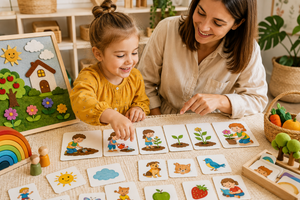
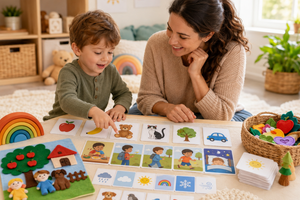
Prepare six pictures: dog, tree, flower, rock, water, and cloud. Model one item from each group, then offer one picture at a time. Ask, “Where would you put it?” and “What helped you decide?” Accept a brief answer and model a more exact sentence.
If a child says, “The tree is alive because it is green,” keep the useful observation but test the rule: “Leaves are often green, but green is not the main sign. A tree grows, uses water and light, and responds to seasons.” Then offer a green stone or an artificial plant. The guide to sorting by color, shape, and size shows how to introduce one grouping rule at a time and check whether it works across every item.
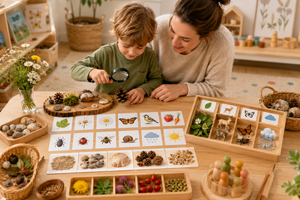
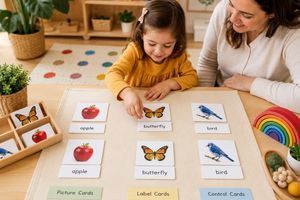
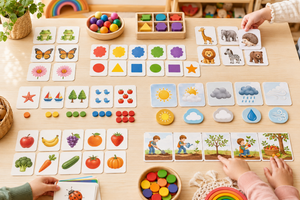
The Living and Non-Living Nature learning material provides a ready visual framework. Before play, review its contents, select a small number of cards, and decide whether the child will use two groups or is ready for a third, “once living.” There is no need to display an entire set in one session.
Seven games that build on the explanation
Living, once living, never living. Offer one card at a time and ask for one clue. Put uncertain cases in “need more information” instead of guessing.
Match a need. Connect a plant with water, an animal with air, and a shoot with light. The resource supports life but is not alive, and it may match several organisms.
Prove it without saying “moves.” Explain a drawn organism through development, energy use, response, or life cycle. Ask, “What did it look like before?” or “What does it need?”
Slow change. Photograph the same shoot every second day or mark its height. A sequence reveals growth that cannot be seen during a one-minute observation.
Researcher’s mistake. Deliberately place a car with living things because it moves, or a cloud there because it “grows.” The child checks the claim against the full rule. Swap roles so that mistakes become information, not punishment.
Who lives on the non-living? Look for organisms in a photograph of a rock, pond, or fallen log. Name the setting and inhabitant separately: the pond is not alive; the fish is alive.
Nature detective walk. Choose five safe examples without picking plants or touching animals. Photograph or sketch them, then sort them at home. The broader guide to nature science for preschoolers through play develops the same path from observation to comparison and explanation.
Adjusting the challenge by age
At three to four, use two clear groups and four to six pictures. The adult supplies most of the language. Leave fire, dormant seeds, and dead wood for later.
At four to five, add the third group, growth sequences, and “why?” Test weak rules: not everything green or moving is alive. At five to six, discuss systems such as soil, a pond, a decaying log, or an aquarium; a correct answer may have several parts.
Age labels guide use and safety; they do not guarantee readiness for every concept. When attention fades, reduce the field and add only one challenge at a time.
Frequently asked questions
Is a seed a living thing?
A viable seed contains a living embryo and belongs to the plant life cycle even while dormant. It may wait for suitable conditions before germinating. Appearance alone cannot always show whether one particular embryo is alive.
Why is fire not alive if it grows and needs “food”?
A flame enlarges through combustion and spreads when the reaction reaches more fuel. It has no cells, regulated internal environment, or inherited biological program. Resembling life in one or two respects does not make a process an organism.
Is a cloud living or non-living?
A cloud is non-living. It consists of tiny water droplets or ice crystals and forms, moves, changes shape, and disperses according to atmospheric conditions. These are physical changes, not an organism’s life cycle.
Are dead leaves and dry wood living or non-living?
They are no longer alive but came from organisms, so “once living” is the most informative group. Living fungi, bacteria, and animals may inhabit dead wood; those organisms should be distinguished from the wood itself.
How can a plant be alive if it cannot walk?
Observe it over several days: mark growth, note a shoot’s direction, watch a leaf emerge, and record its use of water and light. Plant responses and development are often slower than animal movement, so a sequence reveals more than one moment.
A practical conclusion
Begin with a dog, flower, stone, and water, but do not end with mechanical sorting. Ask for one clue, challenge weak shortcuts with a counterexample, and later introduce “once living.” The central idea is simple: an organism shows a coordinated set of life processes, not one dramatic feature.
Seeds, trees, clouds, flames, and fallen logs demonstrate that nature cannot always be classified by appearance alone. A child may say “we need to observe longer,” separate a system into parts, or revise an answer after learning a new fact. That is the moment a card sort becomes genuine scientific thinking.